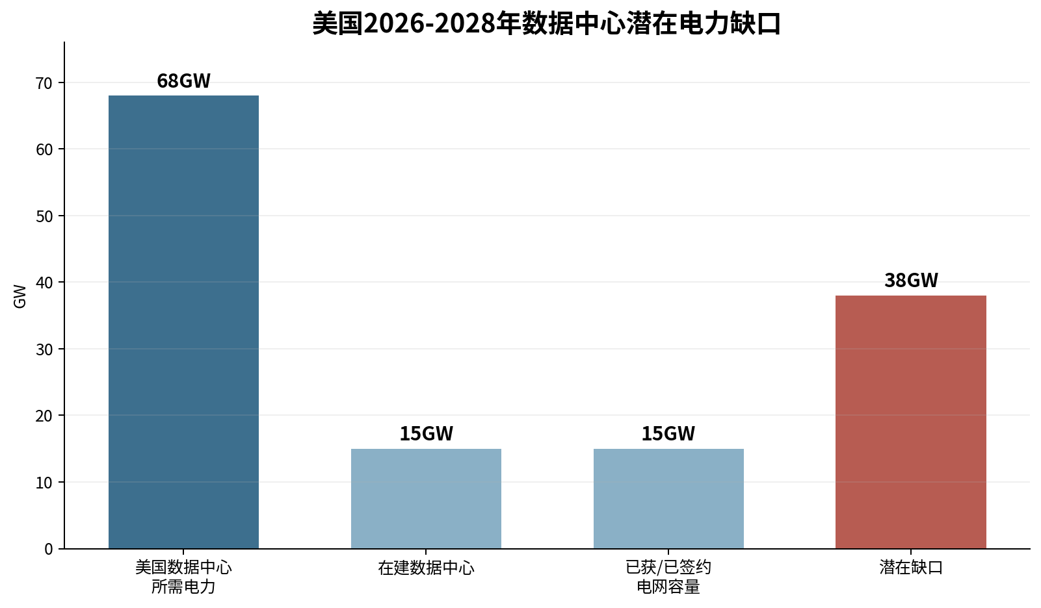
As competition among AI data centers shifts from "who can buy more GPUs" to "who can secure electricity sooner," a group of previously seen as highly volatile assets—Bitcoin mining facilities—are transforming into data centers for cloud providers, leveraging their ready-to-use grid connections, land, and power substations. Morgan Stanley estimates that U.S. data centers may face a power shortfall of approximately 38GW between 2026 and 2028, with the conversion of old mining facilities potentially contributing 10-19GW; driven by long-term leases, project financing, and valuation shifts, the value of electricity per watt could even be redefined. But is this a genuine revaluation of infrastructure assets, or merely another capital story amplified by the "AI narrative"?
I. What's Happening? – Miners Transitioning in Bulk to AIDC
1. From "Mining Coins" to "Selling Power Entry Points":
Over the past two years, a number of listed Bitcoin mining companies in North America have accelerated their transition towards AI and high-performance computing data centers. Companies like TeraWulf, Hut 8, Cipher Mining, Riot Platforms, Applied Digital, and Galaxy Digital are gradually moving the investor focus away from metrics like miner count, total network hashrate, and Bitcoin production cost per coin. Instead, they are directing attention towards a new set of metrics: available power capacity, contracted megawatts, data center construction costs, customer creditworthiness, and project commissioning timelines.
This transition is summarized as becoming a "Powered Shell Provider." They are not necessarily purchasing GPUs directly or operating cloud computing services themselves. Rather, they provide near-ready infrastructure—including land, grid interconnection, substations, building shells, and in some cases, power, cooling, and network systems—to cloud providers, AI compute operators, or other data center customers.
In other words, these companies are no longer just selling Bitcoin hashing power; they are selling a much scarcer capability—enabling their customers to secure hundreds of megawatts of deployable compute capacity years ahead of their competitors.
Morgan Stanley has identified "Bitcoin miners transitioning into Powered Shell Providers" as one of the most important "time to power" investment themes within AI infrastructure. Their core thesis is that there could be a gap of about 38GW between U.S. data center power demand and available supply from 2026 to 2028. Within this gap, converting existing Bitcoin mining sites into data centers could potentially supply 10-19GW of capacity, with a central estimate of around 14GW.
2. Why Old Mining Sites?
While AI data centers appear to be a computing business, their expansion is increasingly resembling an energy and engineering business.
GPU procurement cycles might be just a few months, but building a new large-scale data center often requires waiting several years. Land itself is usually not scarce; what's truly difficult to replicate is large-scale, stable, and already-approved grid access. Morgan Stanley points out that the wait time for new large-load users to get interconnected to the grid in some parts of the U.S. has reached 5-7 years. In this context, an old mining site with hundreds of megawatts of approved power capacity is far more valuable than a plot of ordinary land without any power permits.
......



















