Is Cardano Over? Charles Hoskinson Warns Of A “Wave Of Failures” — And His Own Community Is Furious

bitcoinistPublicado a 2026-06-04Actualizado a 2026-06-04

Resumen

Cardano co-founder Charles Hoskinson has issued a severe warning, predicting a "wave of failures," forced consolidation, and DeFi shutdowns across the Cardano ecosystem in the second half of 2026. His comments followed the sudden shutdown announcement of TapTools, a major analytics and infrastructure platform for Cardano, citing unsustainable costs. Hoskinson framed this not as an isolated incident but a sign of deeper ecosystem stress, acknowledging that a proposed treasury-funded index to support projects never materialized. He subsequently announced he was "taking a break." The crypto community reacted with strong criticism. Prominent figures accused Hoskinson of overselling Cardano's potential and failing to deliver on promises, leaving investors to suffer. The ecosystem faces significant challenges: Cardano's Total Value Locked (TVL) ranks only 28th, its 2026 summit was canceled, engineering funding was slashed, and ADA's price has fallen below $0.20 for the first time in over five years. Hoskinson's own bleak assessment raises fundamental questions about Cardano's ability to reverse its current trajectory.

Charles Hoskinson, co-founder of Cardano and Input Output Global, sparked one of the most uncomfortable public debates in the blockchain’s history this week — warning in a video posted on YouTube that the second half of 2026 will bring a wave of project failures, forced consolidation, and DeFi shutdowns across the ecosystem, as ADA fell below $0.20 for the first time in more than five years.

The catalyst was the June 2 announcement by TapTools — Cardano’s most widely used analytics and infrastructure platform, serving over one million users and powering backend data for hundreds of Cardano-native token protocols across four years — that it will wind down operations within two weeks.

The closure follows the departure of five senior team members including both co-founders, the COO, the CTO, and a backend developer who had stepped into technical leadership after the founders left, per TapTools’ official statement. Infrastructure costs, software development expenses, and support obligations had become impossible to sustain, the company said. TapTools added it remains open to acquisition discussions.
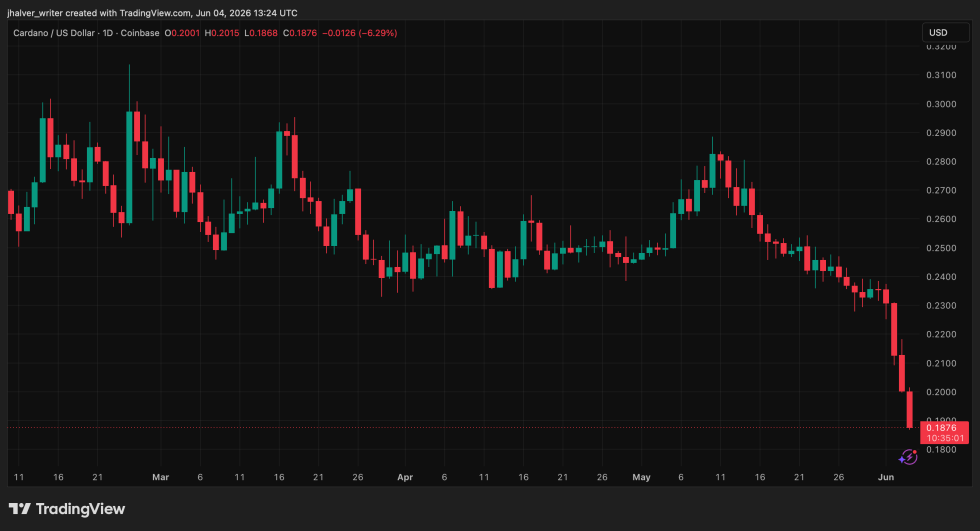
ADA's price trends to the downside on the daily chart. Source: ADAUSD on Tradingview

Hoskinson’s Warning — And The ADA Fallout

Responding in a video on the same day, Hoskinson framed TapTools’ exit not as an isolated event but as a leading indicator of deeper ecosystem stress. A substantial portion of older Cardano projects are no longer in an investable state, he said — and the H2 2026 environment will force many into the same position.

He pointed to JX Door’s earlier collapse as a warning sign that went unheeded, and acknowledged that a treasury-funded index he had proposed to backstop struggling ecosystem projects never materialized. “I came up with the plan of an index. It did not get executed,” he said in the video, per the YouTube posting, placing partial responsibility on Cardano’s governance community for failing to act when opportunities were available.

Hoskinson subsequently posted on X that he is “taking a break” — three words that landed heavily given the timing.

The Community Fires Back

The response from prominent voices in the crypto community was swift and pointed. Andreas Svanevik (@ASvanevik), CEO of Nansen, addressed Hoskinson’s implicit question about what he could do to help directly: “It’s not about what he can do NOW,” Svanevik wrote on X. “The problem is he sold Cardano as something it never was. And people believed him. Now they will all suffer the consequences together.”

The post drew significant engagement and amplified a sentiment that had been building in the community for months — that Hoskinson’s long-standing promises about Cardano’s institutional potential and developer adoption had set expectations the network could not match. @Pledditor’s post on X added further community context to the criticism, reflecting frustration that had been building across ADA holders as the ecosystem continued to lose ground.

The Structural Picture

The numbers behind the debate are difficult to argue with. Cardano’s total value locked stands at approximately $123.85 million — placing it 28th by chain TVL on DeFiLlama, behind Stellar, NEAR, Aptos, and Mantle, and roughly two orders of magnitude below Ethereum’s $39.9 billion.

The 2026 Cardano Summit was canceled after the community voted down treasury funding. Engineering proposals for 2026 were cut to $46.8 million from $97.5 million the prior year. The van Rossem hard fork was postponed to allow further testing. ADA is currently trading at approximately $0.20 — its lowest level in more than five years.

The question Hoskinson’s own comments raise — whether Cardano can reverse a trajectory that its own founder is now publicly describing in near-apocalyptic terms — is one the ecosystem has no clean answer to heading into what he himself calls the hardest half of the year.

Cover image from Grok, ADAUSD chart from Tradingview

Criptos en tendencia

Preguntas relacionadas

QWhat specific event did Charles Hoskinson cite as a catalyst for his warning about Cardano's ecosystem, and what was its impact?

AThe catalyst was the announcement by TapTools, Cardano's most widely used analytics and infrastructure platform, that it would wind down operations within two weeks. This event signaled deeper ecosystem stress to Hoskinson, contributing to his warning about a coming wave of project failures.

QHow did prominent voices in the crypto community, like Andreas Svanevik, respond to Hoskinson's warning and his role in Cardano's situation?

AAndreas Svanevik, CEO of Nansen, responded critically on X. He argued that the problem stemmed from Hoskinson selling Cardano as something it never was, setting unrealistic expectations about its institutional potential and developer adoption that the network failed to meet.

QWhat are some key metrics mentioned in the article that illustrate Cardano's current challenges in the broader blockchain landscape?

AKey metrics include Cardano's Total Value Locked (TVL) of approximately $123.85 million, ranking 28th among chains, and ADA's price falling below $0.20 for the first time in over five years. The article also notes the 2026 Cardano Summit was canceled and engineering proposals were significantly cut from $97.5 million to $46.8 million.

QWhat internal failure did Hoskinson acknowledge regarding a proposed plan to support struggling Cardano projects?

AHoskinson acknowledged that a treasury-funded index he had proposed to backstop struggling ecosystem projects never materialized. He stated, 'I came up with the plan of an index. It did not get executed,' placing partial responsibility on Cardano's governance community for failing to act.

QWhat major implication does Charles Hoskinson's warning raise for the future of the Cardano ecosystem according to the article's conclusion?

AHoskinson's warning raises the question of whether Cardano can reverse its current negative trajectory, which he himself describes in near-apocalyptic terms. The ecosystem faces this challenge heading into what he calls the hardest half of the year (H2 2026), with no clear answer provided.

Lecturas Relacionadas

human.tech Launches Clean SDK for Privacy-First Web3 Apps

human.tech has launched the Clean SDK, a toolkit enabling developers to build privacy-first Web3 applications with transparent accountability. Released alongside Aztec's version 5, the SDK provides components for integrating zero-knowledge identity verification, sanctions screening, and private transactions, without developers handling sensitive user data or building compliance infrastructure from scratch. It uses zero-knowledge proofs and programmable verification to allow apps to confirm user legitimacy and sanctions compliance while keeping identities confidential. The first application built on the SDK, Shield, a privacy bridge to Aztec, also launched. It allows users to transfer assets privately while proving a unique human is behind each transfer and that funds have passed sanctions checks, as verified by a May 2026 audit. The SDK offers three core verification techniques: Proof of Innocence (sanctions screening against 23 sources), Proof of Personhood (simpler verification via Human Passport), and Proof of Clean Hands (higher-assurance zero-knowledge government ID checks). This allows apps to authenticate users and transactions without exposing personal data. Designed for Aztec builders, the SDK lets developers add programmable privacy to decentralized apps, eliminating the need to create their own verification and ZK infrastructure. Shield demonstrates its practical use for private bridges, but the SDK aims to enable a wider ecosystem of private, accountable financial apps and services. The launch addresses growing demand for infrastructure that balances privacy and accountability. The SDK avoids traditional identity databases, storing encrypted data off-chain, screening at both entry and exit points, and including a gated disclosure mechanism for legal requests. human.tech's products, including the Clean SDK, focus on using zero-knowledge technology to enable verifiable personhood and privacy in digital systems.

TheNewsCryptoHace 35 min(s)

human.tech Launches Clean SDK for Privacy-First Web3 Apps

TheNewsCryptoHace 35 min(s)

Unlocking $100 Million in Liquidity? Pump.fun's New Policy Tests the 5-Minute Pump Technique

Pump.fun, a popular meme coin launchpad, has introduced a new standard mechanism called BOOST. It aims to address a significant capital efficiency issue: when a newly launched token graduates from its initial bonding curve to a liquidity pool (LP), roughly 20% of its liquidity becomes permanently locked as "dead liquidity," estimated to waste over $100 million annually. Instead of locking these funds permanently, BOOST repurposes them. Upon a token's migration, approximately 20% of the settlement funds (e.g., 17.6 SOL or ~$2516 USDC) are used to buy back the token on the open market over a 5-minute period via a Time-Weighted Average Price (TWAP) mechanism. All purchased tokens are immediately burned. This creates a brief, systematic buy pressure immediately after migration, potentially generating a short-term price surge ("pump") while permanently reducing the token's circulating supply. The goal is to enhance the immediate post-launch trading experience, potentially increasing trader retention and sustainable protocol revenue, which funds ongoing token buybacks. However, concerns exist that this artificial 5-minute boost could lower the barrier for launching low-quality tokens and lead to steeper price crashes once the buy pressure stops, if followed by large sell-offs. The feature automatically applies to tokens migrating after July 21, 2024, but not to previously migrated tokens or those launched via the Mayhem AI Agent lab.

marsbitHace 43 min(s)

Unlocking $100 Million in Liquidity? Pump.fun's New Policy Tests the 5-Minute Pump Technique

marsbitHace 43 min(s)

Podcast Notes | Conversation with GSR Asset Management Head: To Determine if This Crypto Rally is Real, Just Watch the Lending Rates on Aave

Podcast Summary: Dialogue with GSR's Head of Asset Management: To Determine if This Crypto Rally is Real, Just Check Lending Rates on Aave Andy Baehr, Managing Director of Asset Management at GSR, discusses the current crypto market, characterizing it as stuck in a state of "ambivalence" with short-lived, unsustainable rallies. He outlines a simple framework: the market moves between "ambivalence" and "conviction" (sustained upward momentum). Currently, every rally resembles a single-stage rocket booster that quickly fizzles out. Baehr identifies three key signals to watch: 1) DeFi lending rates, 2) the potential passage of the CLARITY Act, and 3) the market forming a consensus on the "Fed hawkish peak." He emphasizes that the most immediate indicator for the sustainability of the recent CPI-triggered rally is the USDC borrowing rate on Aave, currently around 3.75%—close to U.S. Treasury yields. The absence of a credit spread indicates low leverage demand and a lack of market energy. He explains that a healthy, sustained rally requires layered buying pressure. Last year's rally progressed from an ETH short squeeze to crypto-native trader influx and finally to ETF inflows. Currently, this structure is missing. Other potential structural buyers like Digital Asset Treasury (DAT) companies are absent, and ETF flows have proven transient. Baehr notes that while small-cap crypto tokens outperformed large caps in Q2—a potential sign of capitation in major assets—capital is also flowing to more exciting opportunities like AI stocks and tech IPOs, leaving crypto sidelined. Regarding DeFi, he highlights that platforms like Aave provide a clear, real-time signal of leverage demand through their supply/demand-driven interest rates. A significant, sustained rate increase would signal genuine market conviction. He also observes the quiet emergence of fixed-income-like products and vaults in DeFi. On regulation, the probability of the CLARITY Act passing before the August 7th deadline has dropped linearly from 75% to below 40% on Polymarket. Baehr suggests its passage would be treated as a bullish surprise, a potent driver for price movement. However, political hurdles, including ethical clause debates and disclosures about the First Family's crypto profits, remain significant obstacles. Ultimately, the market awaits clarity on the Fed's terminal rate under Chair Warsh. Until the "Fed Solstice"—the point where the market collectively understands the peak of hawkish policy—sustained conviction will be difficult to achieve.

marsbitHace 1 hora(s)

Podcast Notes | Conversation with GSR Asset Management Head: To Determine if This Crypto Rally is Real, Just Watch the Lending Rates on Aave

marsbitHace 1 hora(s)

Trading

Spot

Artículos destacados

Cómo comprar ADA

¡Bienvenido a HTX.com! Hemos hecho que comprar Cardano (ADA) sea simple y conveniente. Sigue nuestra guía paso a paso para iniciar tu viaje de criptos.Paso 1: crea tu cuenta HTXUtiliza tu correo electrónico o número de teléfono para registrarte y obtener una cuenta gratuita en HTX. Experimenta un proceso de registro sin complicaciones y desbloquea todas las funciones.Obtener mi cuentaPaso 2: ve a Comprar cripto y elige tu método de pagoTarjeta de crédito/débito: usa tu Visa o Mastercard para comprar Cardano (ADA) al instante.Saldo: utiliza fondos del saldo de tu cuenta HTX para tradear sin problemas.Terceros: hemos agregado métodos de pago populares como Google Pay y Apple Pay para mejorar la comodidad.P2P: tradear directamente con otros usuarios en HTX.Over-the-Counter (OTC): ofrecemos servicios personalizados y tipos de cambio competitivos para los traders.Paso 3: guarda tu Cardano (ADA)Después de comprar tu Cardano (ADA), guárdalo en tu cuenta HTX. Alternativamente, puedes enviarlo a otro lugar mediante transferencia blockchain o utilizarlo para tradear otras criptomonedas.Paso 4: tradear Cardano (ADA)Tradear fácilmente con Cardano (ADA) en HTX's mercado spot. Simplemente accede a tu cuenta, selecciona tu par de trading, ejecuta tus trades y monitorea en tiempo real. Ofrecemos una experiencia fácil de usar tanto para principiantes como para traders experimentados.

1.5k Vistas totalesPublicado en 2024.12.10Actualizado en 2026.06.02

Cómo comprar ADA

Discusiones

Bienvenido a la comunidad de HTX. Aquí puedes mantenerte informado sobre los últimos desarrollos de la plataforma y acceder a análisis profesionales del mercado. A continuación se presentan las opiniones de los usuarios sobre el precio de ADA (ADA).

活动图片













