IBIT Records $1.3 Billion Outflow in a Single Week, Bitcoin's Largest ETF Becomes a Wall of Selling Pressure That Bulls Must Break Through

marsbitPublicado a 2026-06-29Actualizado a 2026-06-29

Resumen

BlackRock's iShares Bitcoin Trust (IBIT), the largest U.S. spot bitcoin ETF, saw $1.3 billion in net outflows for the week ending June 26, accounting for roughly 73% of total ETF outflows ($1.79B). This significant, concentrated selling pressure from the primary vehicle that previously funneled institutional demand into bitcoin is now testing the market at a key support level near $60,000. The article notes a narrative shift: the same ETF that served as a major entry ramp for compliant investment is now operating in reverse as a potential exit lane. While ETF outflows represent a transmission risk rather than direct spot selling, they create a new structural headwind. Bitcoin's next move hinges on whether non-ETF buyers can absorb this pressure. Two scenarios are presented: if IBIT outflows slow and bitcoin reclaims the $59,000-$62,000 range, the event could be seen as a clearing of weak hands. However, if IBIT continues to lead significant redemptions while bitcoin struggles to hold $60k, the ETF complex itself may become a persistent source of selling pressure, challenging the long-held "institutional demand" thesis. The coming trading sessions will determine if this is a one-time purge or the start of sustained outflows.

Author: Liam 'Akiba' Wright

Compiled by: TechFlow

TechFlow Insights: BlackRock's IBIT accounted for nearly 73% of the net outflows from US spot Bitcoin ETFs last week, with a single-week redemption of $1.3 billion. When this major gateway, which once brought Wall Street buying power to Bitcoin, starts operating in reverse, the bulls at the $60,000 level are no longer facing retail selling pressure but structural ETF selling pressure. The fund flows over the next few trading days will determine whether this is a clearing event or the beginning of sustained bleeding.

BlackRock's iShares Bitcoin Trust (IBIT) is becoming a test that Bitcoin bulls least want to face. This ETF, which helped Bitcoin open compliant funding channels and turned 'institutional demand' into a simple narrative, is now where price-sensitive holders are making their presence felt.

Bitcoin ETF flow data from Farside Investors shows that during the trading week of June 22-26, US spot Bitcoin ETFs collectively saw a net outflow of approximately $1.789 billion. IBIT alone accounted for about $1.303 billion, close to 73% of the total weekly outflow.

The latest trading day's data makes the signal even clearer: Farside's data for June 26 shows a net outflow of $444.5 million from the ETF complex, with all negative values coming from IBIT.

This concentration changes the conditions for Bitcoin's rebound test. The ETF complex can still be a demand channel, but the largest spot Bitcoin ETF must now also be viewed as a redemption channel.

If this shell, which once helped Bitcoin gain acceptance from brokerage account investors, becomes the primary exit lane, then spot buyers outside the ETFs must absorb these exposures when ETF holders reduce their positions.

IBIT Leads ETF Fund Exodus

The reason Farside's data constitutes a market structure signal is that the pressure is concentrated on Bitcoin's most prominent ETF.
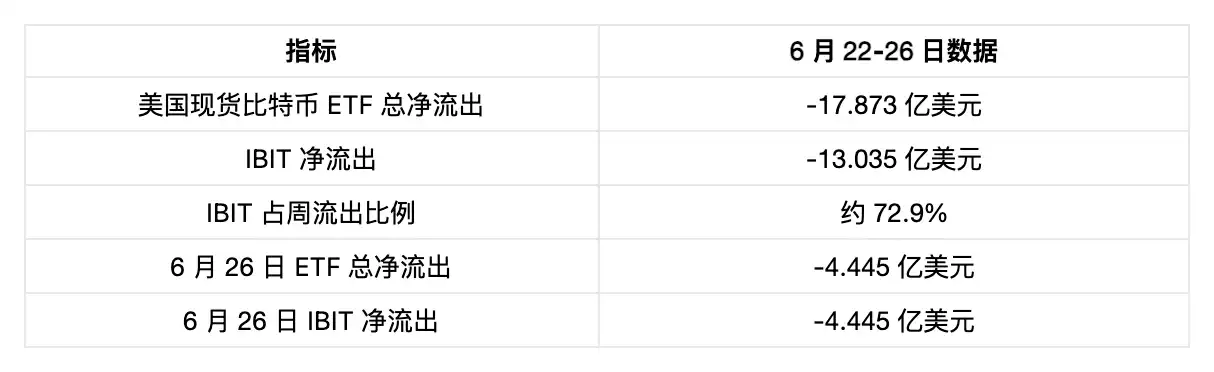
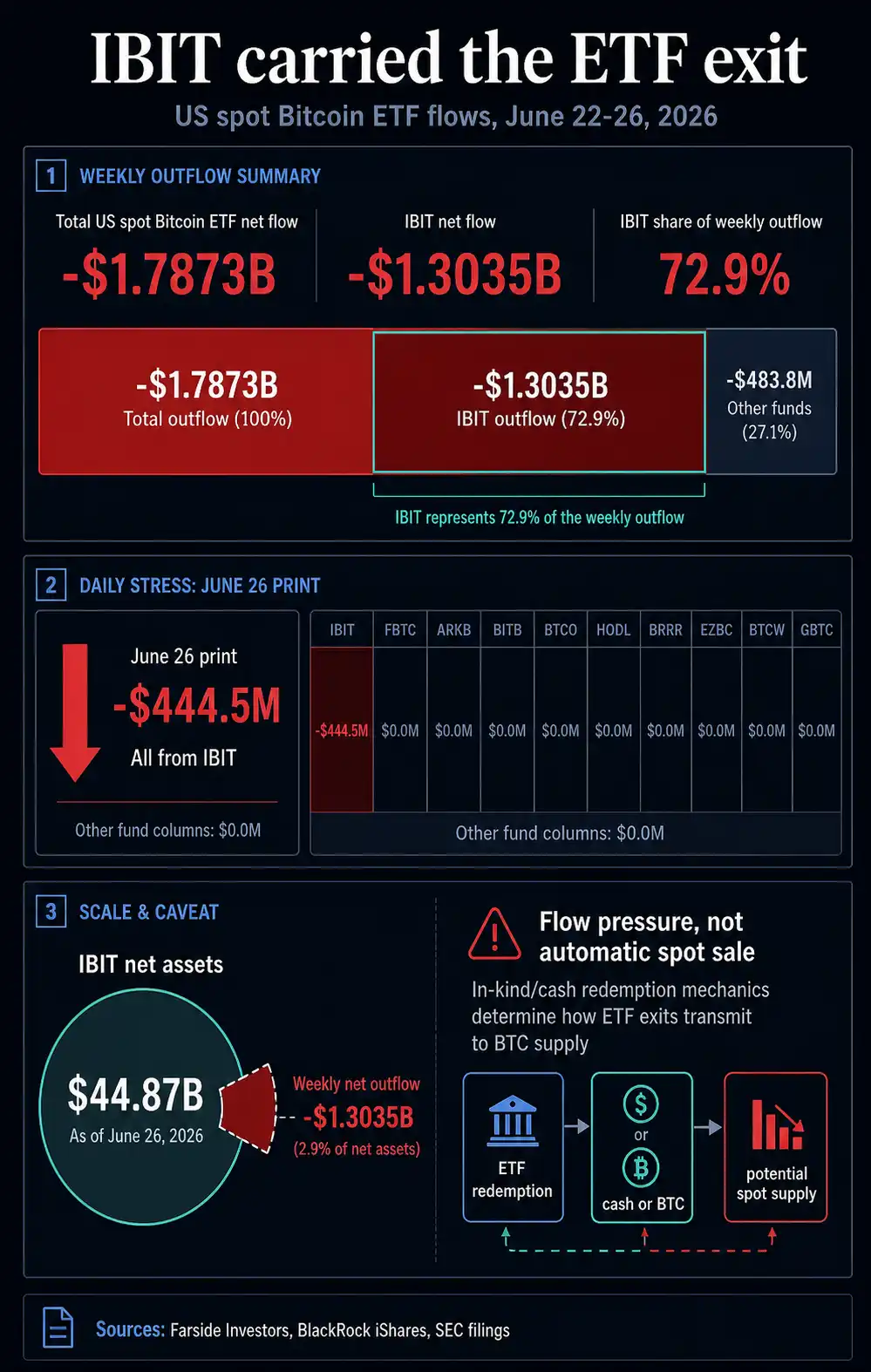
Caption: IBIT accounted for 72.9% of the total weekly outflows from US spot Bitcoin ETFs ($1.3035 billion / $1.7873 billion), data source Farside Investors.

IBIT is not just a ticker in the ETF complex. It is one of the clearest channels for Bitcoin to achieve compliant access through existing brokerage accounts. Its scale gives its fund flows more market weight than redemptions from smaller funds.

When this product contributes the majority of fund outflows in a week, the signal is no longer just 'the ETF market is cooling down.' It is a stress test on the strongest access channel Bitcoin has gained since the launch of spot ETFs.

These outflows occurred while Bitcoin itself was under pressure. CryptoSlate market data shows BTC was trading around $60,000 on June 28, with negative price changes over both 7-day and 30-day periods.

Previous CryptoSlate reports have tracked the broader context of collective ETF surrender and Bitcoin's struggle in the $58,000 to $60,000 range. The new added pressure now is that IBIT itself has become the marginal flow to watch.

Narrative Flip: The Same Channel, Operating in Both Directions

The early spot ETF story was simple: compliant channels broadened the buyer base, ETF demand reduced available supply, and Bitcoin gained a more familiar holding path for institutions and brokerage account investors.

The latest data preserves that history while revealing that the same entry point can operate in reverse when ETF holders decide to exit.

IBIT's scale is both why this week's outflow matters and provides a proportional reference. BlackRock iShares' official product page shows IBIT had net assets of $44.87 billion as of June 26, with a benchmark price around $59,813.

A $1.3 billion weekly outflow is enough to dominate the ETF complex but remains a small percentage relative to the fund's total assets. IBIT is still an important compliant Bitcoin wrapper. The market's question is what this scale means at the margin.

When IBIT was attracting capital, its scale reinforced the 'institutional demand' narrative. When IBIT is bleeding, its scale makes this outflow hard for the rest of the market to ignore.

Smaller funds can bleed continuously without altering the overall ETF narrative. IBIT cannot. Its redemptions indicate that ETF holdings may be becoming more price-sensitive near Bitcoin's support levels.

This distinction is crucial at the $60,000 level. The optimistic read: the largest redemptions have already worked through the system, outflows will slow from here, and Bitcoin reclaiming the $59,000-$62,000 range would mean the market has absorbed the selling pressure.

The cautious read: the next recovery rally must not only rebound from liquidation shocks but also withstand new ETF selling pressure.

This is the 'wall of selling pressure' version of the IBIT story. It doesn't require BlackRock to be bearish on Bitcoin or IBIT holders to exit all at once. It's a market structure argument: the largest access product can become where price-sensitive holdings surface first.

Precise Definition of the ETF Mechanism

ETF flow data is a pressure signal, not a record of direct on-chain selling.

In July 2025, the SEC approved a physical creation/redemption mechanism for crypto ETPs. IBIT's filings also show the redemption mechanism can involve cash proceeds from selling Bitcoin or Bitcoin in-kind, depending on the path used.

Therefore, ETF outflows should be seen as transmission risk, not direct evidence that for every dollar redeemed, a dollar is automatically dumped into the spot market.

The risk remains real. A large, liquid ETF can translate investors' de-risking moves into a recurring source of pressure on Bitcoin's supply side (or the expectation thereof), especially if redemptions are settled in cash or if the Bitcoin obtained from redemptions is subsequently sold.

The signal carries weight even without perfect mechanistic certainty. If IBIT continues to post large net outflow days, buyers must ask: who is absorbing these exposures when ETF holders exit?

If Bitcoin cannot reclaim $60,000 during this period, the old 'institutional demand' narrative weakens. If flows stabilize quickly, the same dataset may later be viewed as just a clearing of crowded trades.

The real test is: have ETF holdings matured into a two-way source of price pressure? Spot ETFs provided investors with a more convenient holding path. More convenient holding also means more convenient exiting.

IBIT's outflows last week placed this trade-off precisely at a fragile spot on Bitcoin's chart.

Two Scenarios

If IBIT outflows slow, Bitcoin holds the high $50,000s range, and reclaims the $59,000-$62,000 level, this week can be interpreted as a potential capitulation flush or flow reset.

In this version, the ETF holders who wanted to leave have done so, the market absorbed the transmission risk, and the largest compliant product remains a net positive for Bitcoin over a longer timeframe.

If IBIT continues to lead redemptions and Bitcoin persistently fails to re-establish a footing above $60,000, the interpretation changes. The ETF complex will define the conditions for the next recovery test: non-ETF spot buyers must hold the market on their own, without the help of the shell that once offered the simplest bullish narrative.

The IBIT-led capital withdrawal leaves Bitcoin with a live test, not a conclusion. One week of flow data cannot determine investor motives, and the redemption mechanism doesn't allow for simple 'one dollar out = one dollar spot sale' inference.

But the data does indicate that at a time when Bitcoin most needs demand from outside the ETF system, the market's most prominent Bitcoin ETF can become a primary source of outflow pressure.

For Bitcoin, the next few trading days carry unusual weight. If IBIT's bleeding slows, this week will be seen as a selling pressure exhaustion. Another round of large redemptions, and the 'wall of selling pressure' narrative becomes harder to ignore.


Criptos en tendencia

Preguntas relacionadas

QAccording to the article, which Bitcoin ETF was the main source of outflow for U.S. spot Bitcoin ETFs during the week of June 22-26, and how much did it contribute to the total outflow?

AAccording to the article, BlackRock's iShares Bitcoin Trust (IBIT) was the main source of outflow. It contributed approximately $1.3035 billion in outflows, representing about 72.9% of the total $1.7873 billion weekly outflow for U.S. spot Bitcoin ETFs during that period.

QWhat is the core change in the role of IBIT that the article highlights, and why is this significant for the Bitcoin market?

AThe article highlights that IBIT has transformed from being the primary compliant on-ramp bringing institutional demand into Bitcoin to now also becoming a significant off-ramp. This is significant because it means the largest and most visible Bitcoin ETF is now a source of structural selling pressure. When price-sensitive holders exit through IBIT, it creates a new challenge for the market, forcing non-ETF buyers to absorb that selling pressure, especially at a critical price point like $60,000.

QWhat are the two contrasting scenarios the article presents for Bitcoin's market depending on the future behavior of IBIT's flows?

AThe article presents two contrasting scenarios. Scenario 1 (Optimistic): IBIT outflows slow down, and Bitcoin holds the high $50,000s range and reclaims the $59,000-$62,000 area. This would be interpreted as a capitulation event or flow reset, where the selling pressure has been absorbed. Scenario 2 (Cautious): IBIT continues to dominate outflows, and Bitcoin fails to re-establish a footing above $60,000. This would confirm that the ETF complex, particularly IBIT, has become a structural headwind, forcing a market recovery without the support of its previously bullish narrative.

QDoes the article state that every dollar of ETF outflow directly results in a dollar of Bitcoin being sold in the spot market? If not, how should ETF outflows be interpreted?

ANo, the article clarifies that ETF outflow data is not a direct record of Bitcoin being sold on-chain. It explains that ETF redemptions can be settled in cash or in-kind (bitcoin), depending on the mechanism. Therefore, outflows should be interpreted as a transmission risk or a source of supply pressure, not as a 1:1 equivalent of spot market selling. The risk is that large, liquid ETFs can convert investor de-risking into recurring pressure on Bitcoin's supply side, especially if redemptions are cash-settled.

QWhat key price level is Bitcoin struggling with according to the article, and why is the timing of IBIT's significant outflows particularly problematic?

ABitcoin is struggling with the $60,000 price level. The timing of IBIT's significant outflows is problematic because it adds a new layer of selling pressure precisely when Bitcoin is trying to defend a crucial psychological and technical support area. Instead of facing just retail selling, the market must now contend with potential structural selling from the largest Bitcoin ETF, making a recovery at this level more difficult.

Lecturas Relacionadas

Margin Exhausted, "Brother Huang Li Cheng" Begins Selling Monkeys at a Loss

Taiwanese crypto whale "Machi Big Brother" Jeffrey Huang has been forced to sell his prized Bored Ape Yacht Club (BAYC) NFTs at significant losses to cover mounting losses from a highly leveraged ETH long position on Hyperliquid. Over the past month, Huang sold 34 BAYC NFTs for 326 ETH (approx. $514,000), realizing a loss of 399 ETH (approx. $631,000). The proceeds were transferred to Hyperliquid to replenish margin for his perpetual contract trades. One ape, BAYC #6057, bought for 76.84 ETH four years ago, was sold for just 7.65 ETH, a 90% loss in ETH terms. Huang began his high-leverage (25-40x) ETH long strategy in September 2025 when ETH was around $4,700. While his account once showed over $45 million in unrealized profit, the subsequent crash of ETH to the $1,600 range erased all gains. As of June 26, his cumulative losses on Hyperliquid reached $33.85 million, with over 335 liquidations earning him the community nickname "King of Liquidations." With conventional funds depleted, Huang's once-valuable NFT collection, which at its peak included around 200 BAYCs and was worth tens of millions, has become a lifeline. His remaining ~150 BAYCs, valued at roughly $1.6 million at current floor prices, provide only limited runway for his persistent high-stakes trading. Huang rose to prominence in crypto as a key figure in popularizing BAYC NFTs in Asia during the 2021 bull market. His pivot to perpetual contracts has now led to a cycle where his iconic "monkeys" are being sold to fund a failing trading strategy.

Foresight NewsHace 36 min(s)

Margin Exhausted, "Brother Huang Li Cheng" Begins Selling Monkeys at a Loss

Foresight NewsHace 36 min(s)

Quantum Computing Approaches "Q-Day": How Encryption Policy, Investment Logic, and Risk Management Are Reshaping the Landscape

Quantum Computing Nears 'Q-Day': Shaping Encryption Policy, Investment Logic, and Risk Management Quantum technology is increasingly intersecting with cryptocurrency policy and cybersecurity discussions as the potential 'Q-Day'—when quantum computers could break current encryption—approaches. While summer brings fast-paced crypto market dynamics, new U.S. legislation, and AI debates, the emerging dimension is how quantum advancements will reshape the digital asset landscape. The next phase of crypto investment is being shaped by two converging forces: clearer regulatory frameworks and cryptographic evolution driven by quantum computing. Investors stand to benefit from reduced uncertainty, but must also recognize that quantum readiness is becoming a core risk factor. Public blockchains rely on cryptography for security, and sufficiently advanced quantum machines could undermine these foundations. This does not mean imminent network collapse, but investors can no longer dismiss the timeline as irrelevant. Key questions now include whether projects have identified their cryptographic dependencies, formulated migration plans to post-quantum cryptography, and established governance for upgrades. For policymakers, the link is clear. Effective crypto policy must look beyond token classification and disclosure to address the underlying infrastructure. As stablecoins, tokenized assets, and blockchain payments integrate deeper into finance, cryptographic resilience becomes a systemic issue. Failure to prepare could lead to investor losses, operational failures, and legal disputes. Policy should encourage risk disclosure, require major intermediaries to maintain upgrade and response plans, and foster coordination across the ecosystem—rather than impose a single technical fix. The sustainability of cryptocurrencies will increasingly depend on their security infrastructure's ability to adapt to these accelerating technological pressures.

Foresight NewsHace 1 hora(s)

Quantum Computing Approaches "Q-Day": How Encryption Policy, Investment Logic, and Risk Management Are Reshaping the Landscape

Foresight NewsHace 1 hora(s)

Bitcoin's Five-Wave Adjustment Nears End, Opportunities Emerge in HYPE Support Zone | Invited Analysis

**Bitcoin's Five-Wave Adjustment Nears End, HYPE Support Zone Presents Opportunity | Guest Analysis** This week, Bitcoin (BTC) is in the final stage of a five-wave corrective structure. The formation of 'Endpoint 44' is key: a level above $58,110 suggests a high probability of a technical rebound, leading likely to wide-range consolidation. A break below $58,110 without bullish divergence warrants caution for further downside. Mid-term bearish positions are maintained at 20%, with 30% of capital reserved for short-term scalping opportunities based on predefined support/resistance levels and three scenario-based plans (A/B/C). Simultaneously, HYPE has entered the 55-56 segment of its own five-wave correction from its $76.94 high. If 'Endpoint 56' forms above the prior low (Endpoint 54), creating a double-bottom pattern, a rebound is significantly likely. A light long position (under 30% allocation) can be considered upon stabilization in the support zone. Last week's BTC short-term strategy, guided by proprietary quantitative models, successfully executed two short trades (1x leverage), yielding a total return of approximately 6.21%. The market move validated the prior weekly forecast of a retest towards the $59,100 support. **Core Trading Views Summary:** * **BTC:** Focus on the formation of 'Endpoint 44'. A scenario above $58,110 allows for tentative longs. Key resistances: $60,900-$62,300, ~$65,500, $67,300-$69,500. Key supports: ~$58,100, ~$55,000. * **HYPE:** Monitor the final position of 'Endpoint 56'. Key resistances: ~$65.5, ~$71.5. Key supports: ~$58.5, $52-$54 zone. Strategy favors buying on dips upon stabilization in support areas with confirmed model signals, with strict position control. **Risk Disclaimer:** Financial markets are volatile. All analysis, models, and strategies herein are based on personal technical analysis for journaling purposes only, not investment advice. Trade at your own risk.

Odaily星球日报Hace 1 hora(s)

Bitcoin's Five-Wave Adjustment Nears End, Opportunities Emerge in HYPE Support Zone | Invited Analysis

Odaily星球日报Hace 1 hora(s)

Trading

Spot

Artículos destacados

Qué es BITCOIN

Entendiendo HarryPotterObamaSonic10Inu (ERC-20) y Su Posición en el Espacio Cripto En los últimos años, el mercado de criptomonedas ha sido testigo de un aumento en la popularidad de las monedas meme, capturando el interés no solo de los comerciantes, sino también de aquellos que buscan compromiso comunitario y valor de entretenimiento. Entre estos tokens únicos se encuentra HarryPotterObamaSonic10Inu (ERC-20), un proyecto intrigante que mezcla referencias culturales en el tejido de las criptomonedas. Este artículo profundiza en los aspectos clave de HarryPotterObamaSonic10Inu, explorando sus mecanismos, ethos impulsado por la comunidad y su relación con el paisaje cripto más amplio. ¿Qué es HarryPotterObamaSonic10Inu (ERC-20)? Como su nombre sugiere, HarryPotterObamaSonic10Inu es una moneda meme construida sobre la blockchain de Ethereum, clasificada bajo el estándar ERC-20. A diferencia de las criptomonedas tradicionales que pueden enfatizar la utilidad práctica o el potencial de inversión, este token prospera en el valor de entretenimiento y la fuerza de su comunidad. El proyecto tiene como objetivo fomentar un entorno donde los usuarios comprometidos puedan reunirse, compartir ideas y participar en actividades inspiradas por diversos fenómenos culturales. Una característica notable de HarryPotterObamaSonic10Inu es su cero impuestos en las transacciones. Este atractivo elemento tiene como objetivo incentivar el comercio y la participación comunitaria, sin cargos adicionales que puedan disuadir a los comerciantes de pequeña escala. El suministro total de la moneda está establecido en mil millones de tokens, una cifra que marca su intención de mantener una circulación sustancial dentro de la comunidad. Creador de HarryPotterObamaSonic10Inu (ERC-20) Los orígenes de HarryPotterObamaSonic10Inu están algo envueltos en misterio; los detalles sobre el creador siguen siendo desconocidos. El desarrollo de este token carece de un equipo identificable o de un plan explícito, lo cual no es inusual dentro del sector de monedas meme. En cambio, el proyecto ha surgido de manera orgánica, con su progreso muy dependiente del entusiasmo y la participación de su comunidad. Inversores de HarryPotterObamaSonic10Inu (ERC-20) En cuanto a inversiones externas y respaldo, HarryPotterObamaSonic10Inu también sigue siendo ambiguo. El token no lista ninguna fundación de inversión conocida o apoyo organizacional significativo. En cambio, la savia del proyecto es su comunidad de base, que informa su crecimiento y sostenibilidad a través de la acción colectiva y el compromiso en el espacio cripto. ¿Cómo Funciona HarryPotterObamaSonic10Inu (ERC-20)? Como una moneda meme, HarryPotterObamaSonic10Inu opera principalmente fuera de los marcos tradicionales que a menudo rigen el valor de los activos. Hay varios aspectos distintivos que definen cómo funciona el proyecto: Transacciones Sin Impuestos: Sin tarifas impositivas en las transacciones, los usuarios pueden comprar y vender el token libremente sin preocuparse por costos ocultos. Compromiso Comunitario: El proyecto prospera en la interacción comunitaria, aprovechando plataformas de redes sociales para crear entusiasmo y facilitar la participación. Las discusiones, el intercambio de contenido y el compromiso son elementos cruciales que ayudan a expandir su alcance y fomentar la lealtad entre los seguidores. Sin Utilidad Práctica: Cabe señalar que HarryPotterObamaSonic10Inu no ofrece utilidad concreta dentro del ecosistema financiero. Más bien, se clasifica como un token principalmente para actividades de entretenimiento y comunitarias. Referencia Cultural: El token incorpora astutamente elementos de la cultura popular para atraer interés, conectando con entusiastas de los memes y seguidores de las criptomonedas por igual. HarryPotterObamaSonic10Inu ejemplifica cómo las monedas meme operan de manera diferente a los proyectos de criptomonedas más tradicionales, ingresando al mercado como construcciones sociales innovadoras en lugar de activos utilitarios. Cronología de HarryPotterObamaSonic10Inu (ERC-20) La historia de HarryPotterObamaSonic10Inu está marcada por varios hitos notables: Creación: El token surgió de un meme viral, capturando la imaginación de muchos entusiastas de las criptomonedas. Las fechas específicas de creación no están disponibles, subrayando su ascenso orgánico. Listado en Exchanges: HarryPotterObamaSonic10Inu ha llegado a varios exchanges, permitiendo un acceso y comercio más fácil por parte de la comunidad. Iniciativas de Compromiso Comunitario: Actividades continuas destinadas a mejorar la interacción comunitaria, incluyendo concursos, campañas en redes sociales y generación de contenido por parte de fanáticos y defensores. Planes de Expansión Futuros: La hoja de ruta del proyecto incluye el lanzamiento de una colección de NFT, mercancía y un sitio de comercio electrónico relacionado con sus temas culturales, involucrando aún más a la comunidad e intentando añadir más dimensiones a su ecosistema. Puntos Clave Sobre HarryPotterObamaSonic10Inu (ERC-20) Naturaleza Impulsada por la Comunidad: El proyecto prioriza la participación colectiva y la creatividad, asegurando que la involucración de los usuarios esté a la vanguardia de su desarrollo. Clasificación como Moneda Meme: Representa la epítome de las criptomonedas basadas en el entretenimiento, diferenciándose de los vehículos de inversión tradicionales. Sin Afiliación Directa con Bitcoin: A pesar de la similitud en el nombre del ticker, HarryPotterObamaSonic10Inu es distinto y no tiene relación con Bitcoin u otras criptomonedas establecidas. Enfoque en la Colaboración: HarryPotterObamaSonic10Inu está diseñado para crear un espacio para la colaboración y el intercambio de historias entre sus poseedores, proporcionando una vía para la creatividad y el vínculo comunitario. Perspectivas Futuras: La ambición de expandirse más allá de su premisa inicial hacia NFTs y mercancías describe un camino para que el proyecto potencialmente ingrese a avenidas más tradicionales dentro de la cultura digital. A medida que las monedas meme continúan capturando la imaginación de la comunidad de criptomonedas, HarryPotterObamaSonic10Inu (ERC-20) se destaca debido a sus lazos culturales y su enfoque centrado en la comunidad. Si bien puede no encajar en el molde típico de un token impulsado por la utilidad, su esencia radica en la alegría y la camaradería fomentadas entre sus seguidores, destacando la naturaleza en evolución de las criptomonedas en una era cada vez más digital. A medida que el proyecto continúa desarrollándose, será importante observar cómo las dinámicas comunitarias influyen en su trayectoria en el cambiante paisaje de la tecnología blockchain.

1.8k Vistas totalesPublicado en 2024.04.01Actualizado en 2024.12.03

Qué es BITCOIN

Cómo comprar BTC

¡Bienvenido a HTX.com! Hemos hecho que comprar Bitcoin (BTC) sea simple y conveniente. Sigue nuestra guía paso a paso para iniciar tu viaje de criptos.Paso 1: crea tu cuenta HTXUtiliza tu correo electrónico o número de teléfono para registrarte y obtener una cuenta gratuita en HTX. Experimenta un proceso de registro sin complicaciones y desbloquea todas las funciones.Obtener mi cuentaPaso 2: ve a Comprar cripto y elige tu método de pagoTarjeta de crédito/débito: usa tu Visa o Mastercard para comprar Bitcoin (BTC) al instante.Saldo: utiliza fondos del saldo de tu cuenta HTX para tradear sin problemas.Terceros: hemos agregado métodos de pago populares como Google Pay y Apple Pay para mejorar la comodidad.P2P: tradear directamente con otros usuarios en HTX.Over-the-Counter (OTC): ofrecemos servicios personalizados y tipos de cambio competitivos para los traders.Paso 3: guarda tu Bitcoin (BTC)Después de comprar tu Bitcoin (BTC), guárdalo en tu cuenta HTX. Alternativamente, puedes enviarlo a otro lugar mediante transferencia blockchain o utilizarlo para tradear otras criptomonedas.Paso 4: tradear Bitcoin (BTC)Tradear fácilmente con Bitcoin (BTC) en HTX's mercado spot. Simplemente accede a tu cuenta, selecciona tu par de trading, ejecuta tus trades y monitorea en tiempo real. Ofrecemos una experiencia fácil de usar tanto para principiantes como para traders experimentados.

5.2k Vistas totalesPublicado en 2024.12.12Actualizado en 2026.06.02

Cómo comprar BTC

Qué es $BITCOIN

ORO DIGITAL ($BITCOIN): Un Análisis Integral Introducción al ORO DIGITAL ($BITCOIN) ORO DIGITAL ($BITCOIN) es un proyecto basado en blockchain que opera en la red Solana, cuyo objetivo es combinar las características de los metales preciosos tradicionales con la innovación de las tecnologías descentralizadas. Aunque comparte un nombre con Bitcoin, a menudo referido como “oro digital” debido a su percepción como un refugio de valor, ORO DIGITAL es un token separado diseñado para crear un ecosistema único dentro del paisaje Web3. Su meta es posicionarse como un activo digital alternativo viable, aunque los detalles sobre sus aplicaciones y funcionalidades aún están en desarrollo. ¿Qué es ORO DIGITAL ($BITCOIN)? ORO DIGITAL ($BITCOIN) es un token de criptomoneda diseñado explícitamente para su uso en la blockchain de Solana. A diferencia de Bitcoin, que proporciona un papel de almacenamiento de valor ampliamente reconocido, este token parece centrarse en aplicaciones y características más amplias. Aspectos notables incluyen: Infraestructura Blockchain: El token está construido sobre la blockchain de Solana, conocida por su capacidad para manejar transacciones de alta velocidad y bajo costo. Dinámicas de Suministro: ORO DIGITAL tiene un suministro máximo limitado a 100 cuatrillones de tokens (100P $BITCOIN), aunque los detalles sobre su suministro circulante no se han divulgado actualmente. Utilidad: Si bien las funcionalidades precisas no están delineadas explícitamente, hay indicios de que el token podría ser utilizado para diversas aplicaciones, potencialmente involucrando aplicaciones descentralizadas (dApps) o estrategias de tokenización de activos. ¿Quién es el Creador de ORO DIGITAL ($BITCOIN)? En la actualidad, la identidad de los creadores y el equipo de desarrollo detrás de ORO DIGITAL ($BITCOIN) sigue siendo desconocida. Esta situación es típica entre muchos proyectos innovadores dentro del espacio blockchain, particularmente aquellos alineados con las finanzas descentralizadas y fenómenos de monedas meme. Si bien tal anonimato puede fomentar una cultura impulsada por la comunidad, intensifica las preocupaciones sobre la gobernanza y la responsabilidad. ¿Quiénes son los Inversores de ORO DIGITAL ($BITCOIN)? La información disponible indica que ORO DIGITAL ($BITCOIN) no tiene patrocinadores institucionales conocidos ni inversiones destacadas de capital de riesgo. El proyecto parece operar en un modelo de peer-to-peer centrado en el apoyo y la adopción de la comunidad en lugar de rutas de financiamiento tradicionales. Su actividad y liquidez se sitúan principalmente en intercambios descentralizados (DEX), como PumpSwap, en lugar de plataformas de trading centralizadas establecidas, lo que resalta aún más su enfoque de base. Cómo Funciona ORO DIGITAL ($BITCOIN) Los mecanismos operativos de ORO DIGITAL ($BITCOIN) pueden elaborarse en función de su diseño blockchain y atributos de red: Mecanismo de Consenso: Al aprovechar el único proof-of-history (PoH) de Solana combinado con un modelo de proof-of-stake (PoS), el proyecto asegura una validación de transacciones eficiente que contribuye al alto rendimiento de la red. Tokenómica: Si bien los mecanismos deflacionarios específicos no se han detallado extensamente, el vasto suministro máximo de tokens implica que podría atender microtransacciones o casos de uso nicho que aún están por definirse. Interoperabilidad: Existe el potencial de integración con el ecosistema más amplio de Solana, incluyendo varias plataformas de finanzas descentralizadas (DeFi). Sin embargo, los detalles sobre integraciones específicas permanecen no especificados. Cronología de Eventos Clave Aquí hay una cronología que destaca hitos significativos relacionados con ORO DIGITAL ($BITCOIN): 2023: El despliegue inicial del token ocurre en la blockchain de Solana, marcado por su dirección de contrato. 2024: ORO DIGITAL gana visibilidad al estar disponible para trading en intercambios descentralizados como PumpSwap, permitiendo a los usuarios comerciar contra SOL. 2025: El proyecto presencia actividad de trading esporádica y potencial interés en compromisos liderados por la comunidad, aunque no se han documentado asociaciones notables o avances técnicos hasta el momento. Análisis Crítico Fortalezas Escalabilidad: La infraestructura subyacente de Solana soporta altos volúmenes de transacciones, lo que podría mejorar la utilidad de $BITCOIN en varios escenarios de transacción. Accesibilidad: El potencial bajo precio de trading por token podría atraer a inversores minoristas, facilitando una participación más amplia debido a oportunidades de propiedad fraccionada. Riesgos Falta de Transparencia: La ausencia de patrocinadores, desarrolladores o un proceso de auditoría conocidos públicamente puede generar escepticismo sobre la sostenibilidad y confiabilidad del proyecto. Volatilidad del Mercado: La actividad de trading depende en gran medida del comportamiento especulativo, lo que puede resultar en una volatilidad de precios significativa y en incertidumbre para los inversores. Conclusión ORO DIGITAL ($BITCOIN) surge como un proyecto intrigante pero ambiguo dentro del ecosistema de Solana en rápida evolución. Si bien intenta aprovechar la narrativa del “oro digital”, su alejamiento del papel establecido de Bitcoin como refugio de valor subraya la necesidad de una diferenciación más clara de su utilidad y estructura de gobernanza previstas. La aceptación y adopción futura dependerán probablemente de abordar la actual opacidad y de definir sus estrategias operativas y económicas de manera más explícita. Nota: Este informe abarca información sintetizada disponible hasta octubre de 2023, y pueden haber ocurrido desarrollos más allá del período de investigación.

101 Vistas totalesPublicado en 2025.05.13Actualizado en 2025.05.13

Qué es $BITCOIN

Discusiones

Bienvenido a la comunidad de HTX. Aquí puedes mantenerte informado sobre los últimos desarrollos de la plataforma y acceder a análisis profesionales del mercado. A continuación se presentan las opiniones de los usuarios sobre el precio de BTC (BTC).

活动图片