Author: Ma He, Foresight News
Original Title: Prediction Platforms Are Becoming the Digital Battlefield of Postmodern Warfare
On February 28, the United States and Israel jointly launched an airstrike against Iran, resulting in the death of Iran's Supreme Leader Ali Khamenei. This attack shook Middle Eastern geopolitics. In the 21st century, the flames of war continue to spread everywhere, and its impact has also stirred up huge waves in the prediction markets of the crypto world.
Polymarket and Kalshi became another "battlefield" outside the actual war zone. Traders placed bets on the timing of the attack, regime change, and ceasefire dates, with trading volumes soaring to astronomical figures.
In war, some are always quietly making a fortune.
Polymarket became a "barometer" of the conflict. Since last December, they had set up a market for "When will the US strike Iran?" covering various date options.
The prediction market "Will Khamenei step down by February 28?" saw a daily trading volume of $95.93 million on February 28, becoming one of the platform's largest geopolitical markets ever. Its trading volume reached $54.15 million on March 31.
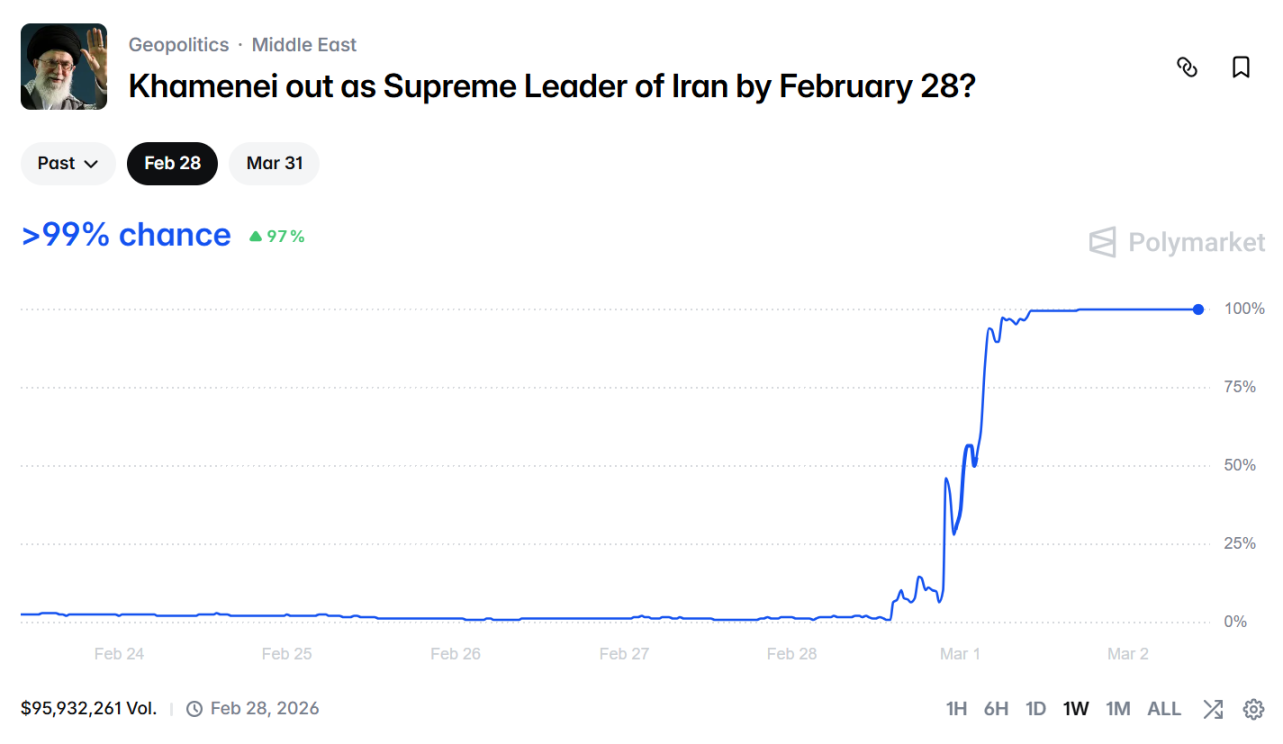
After the attack was confirmed, this market quickly settled to "Yes" (it is still in the final dispute period), as Khamenei's death directly led to him "stepping down."
Although Polymarket currently does not charge any transaction fees for the vast majority of its regular markets (including all political, geopolitical, pop culture, and long-term macro events), in early 2026, Polymarket introduced fees for specific high-frequency trading markets. The expansion of its brand influence has a significantly positive impact on its revenue growth.
Furthermore, the global version of Polymarket uses a profit-based fee model. Its core logic is: users do not need to pay fees when placing buy or sell orders daily, but when users close a position for profit, the platform charges a 2% fee on the net profit. This model only taxes the "winners."
Taking the example in the image, if the total net profit of the winners is $10 million, the income from this single prediction market alone would reach $200,000.
Traders flocked there not only for the thrill but also because these markets reflect news in real time—much faster than traditional media. As soon as news of the attack broke, contract prices instantly jumped, demonstrating the market's "efficiency."
There are always winners in war. In the past, those who profited from conflicts were often arms dealers, oil giants, or intelligence peddlers—think of Lockheed during World War II or the oil tycoons during the Cold War, who made fortunes through contracts and resource monopolies. Ordinary people? At best, they were bystanders; war meant loss and uncertainty for them. But now, crypto prediction markets have颠覆ed this landscape. Platforms like Polymarket allow retail investors to also bet on geopolitical events, from the date of US-Iran airstrikes to the probability of regime change, sharing a piece of the pie with just a few clicks.
However, participating in this game also blurs ethical boundaries. This shift is striking: the "dividends" of war have spread from the physical supply chain to the digital gambling table. Arms dealers are still making money, but prediction markets have turned ordinary users into new players. They don't produce missiles, but they can "predict" explosions on the blockchain and profit handsomely.
When conflicts escalate, platform trading volumes explode; the war economy has gone digital.
But this also raises many questions—does the thrill of making money dilute compassion for real suffering?
Kalshi, as another player, also got a share of the pie. Their "Will Khamenei step down?" market had a trading volume of tens of millions of dollars (slightly varying by source). On the day of the attack, trading volume in this market surged, reaching tens of millions of dollars in a single day.
But Kalshi's handling of the situation sparked controversy. A clause in the platform's rules states "no settlement on death," meaning that if stepping down is due to death, the "Yes" contract will not be paid in full.
After the attack, Kalshi suspended the market. CEO Tarek Mansour posted on X to explain: they oppose profiting from an individual's death, so they would settle at the last traded price before the death and refund all fees in full. Mansour emphasized that this was to uphold "moral bottom lines" and avoid the platform becoming a "death betting pool." Some users complained that this was like changing the rules mid-game, but Kalshi insisted this was a pre-set term, with details clarified just the day before the attack.
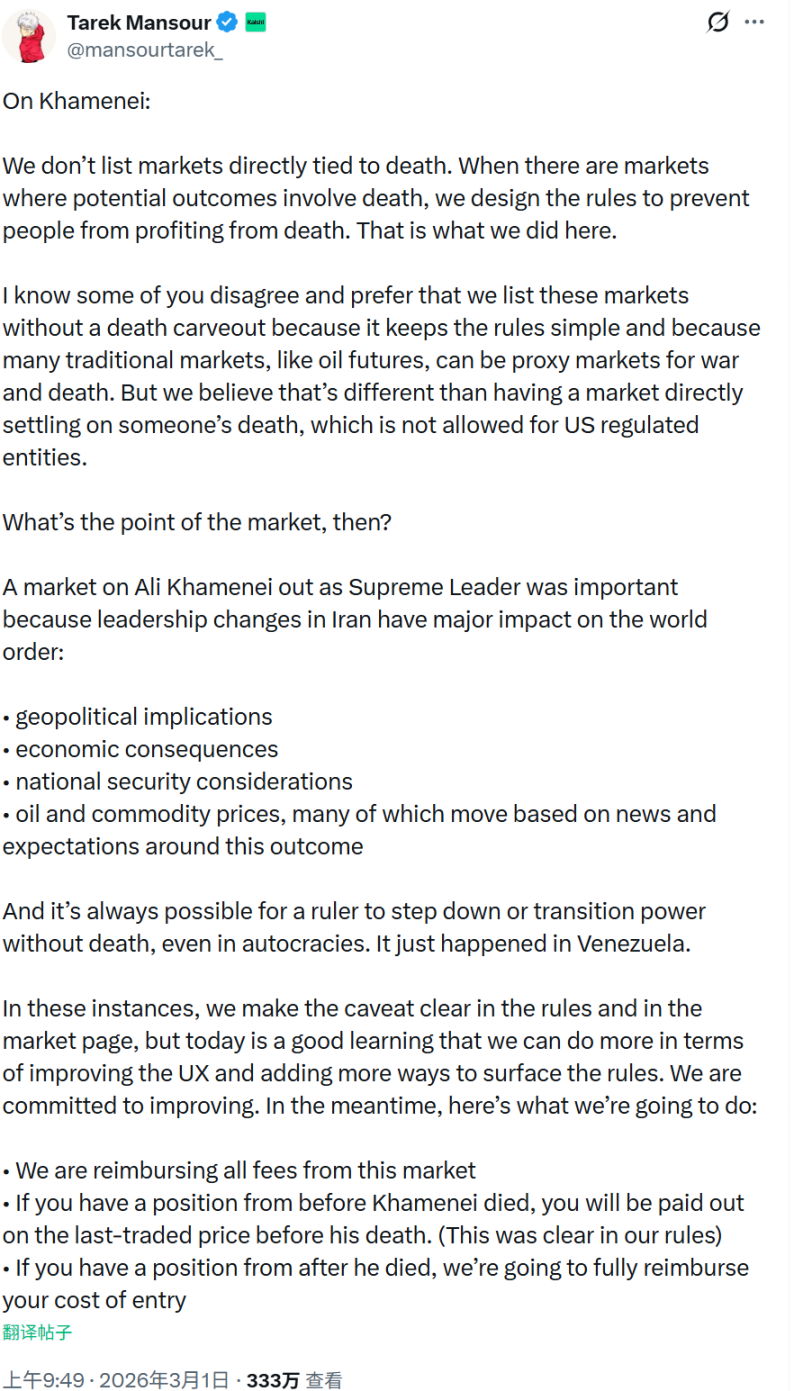
As a result, the platform lost money but gained a reputation for "not making money from the dead."
Polymarket has high user anonymity, attracting global funds; Kalshi is more compliant but restricts markets related to war and assassination.
However, while most players bet based on gut feeling, some insiders are also quietly making a fortune.
On Polymarket, the timing of some accounts' bets was so precise that it raised suspicions of insider trading. Blockchain analysis company Bubblemaps discovered that six newly created wallets placed bets on a US strike against Iran on February 28 just hours before the attack, collectively profiting about $1 million.
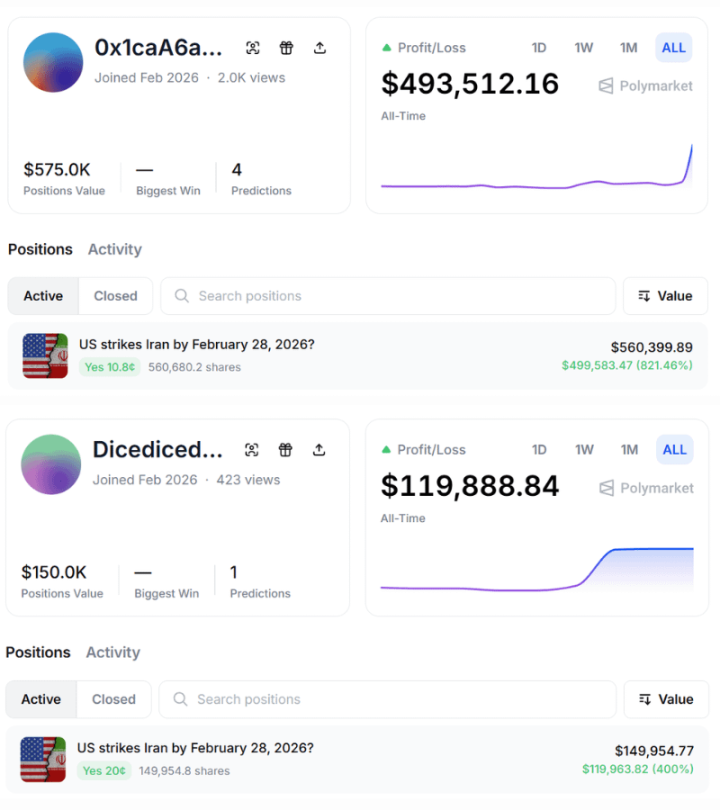
These 6 wallets were all created in February of this year. Almost all their trading was concentrated on contracts predicting the timing of the US military strike. Some positions were established hours before the first news of explosions emerged from Tehran, with contract purchase prices as low as around $0.10. Analysts stated that such concentrated betting behavior before major geopolitical events is characteristic of "suspected insider trading" previously seen in prediction markets.
However, the report also pointed out that the related accounts had incurred losses in other predictions before, and the US government had publicly warned weeks earlier that military action was possible. Therefore, the timing of the trades alone is not sufficient to directly prove illegal activity.
These are not isolated cases. Polymarket has faced similar质疑 in the past, such as during the 2024 Super Bowl or the Venezuela incident. But this time the scale is larger, involving national security. The CFTC has warned about insider trading in the past, and Kalshi recently penalized famous YouTube creator MrBeast's team editor, Artem Kaptur, for insider trading. Polymarket operates overseas with loose regulation, becoming a gray area.
US Representative Ritchie Torres is promoting legislation called the "2026 Public Integrity in Financial Prediction Markets Act," which aims to restrict government officials with access to non-public information from trading on related prediction markets. Meanwhile, Polymarket has faced regulatory restrictions or bans in multiple countries in recent years, including the Netherlands, France, Italy, and Singapore.
Of course, not everyone won. Many bet on the wrong date and suffered heavy losses. Currently, Polymarket has updated its website's top display, pinning all prediction markets related to the Iran situation to the top.
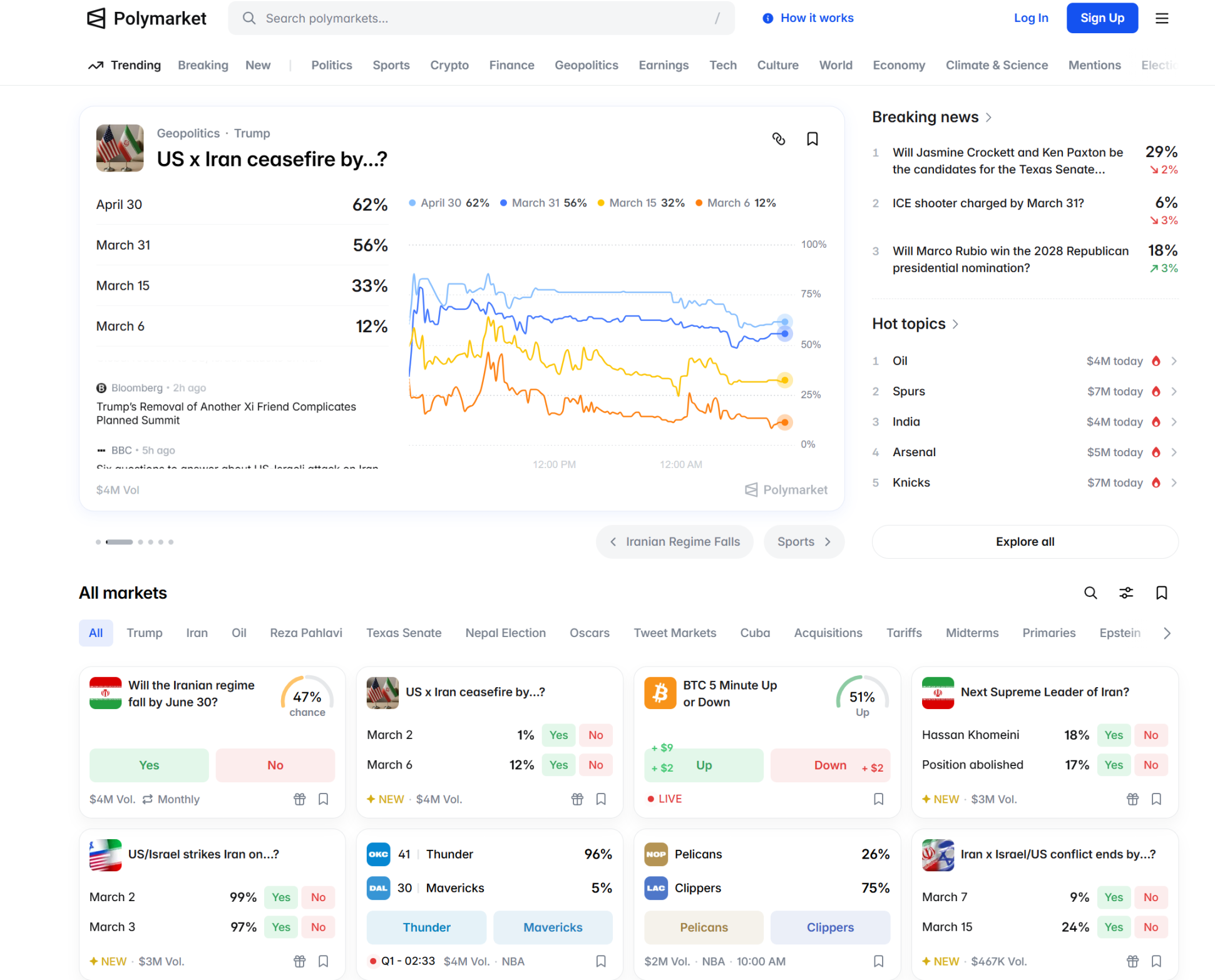
Overall, this "war profit" exposed the double-edged sword of prediction markets: on one hand, they provide real-time data intelligence and insights; on the other hand, they are easily manipulated or exploited with insider information.
Under the trend of "everything can be bet on," future betting in prediction markets may require stricter regulation and clearer rules. After all, the stakes are real money, but behind them are real lives.
Twitter:https://twitter.com/BitpushNewsCN
Bitpush TG Discussion Group:https://t.me/BitPushCommunity
Bitpush TG Subscription: https://t.me/bitpush