DeepSeek V4 Finally Released, Breaking the Strongest Closed-Source Monopoly, Explicitly Partnering with Huawei Chips

marsbitPublicado a 2026-04-24Actualizado a 2026-04-24

Resumen

DeepSeek AI has officially released DeepSeek-V4, available in two versions: the high-performance **DeepSeek-V4-Pro** (49B activated parameters, 1.6T total) and the more efficient **DeepSeek-V4-Flash** (13B activated parameters, 284B total). Both support a 1M context length, making long-context capability a baseline feature rather than a premium offering. The Pro version rivals top closed-source models in agent capabilities, world knowledge, and reasoning performance. It outperforms Claude Sonnet 4.5 in agentic coding and approaches Claude Opus 4.6 (non-thinking mode) in quality. The Flash version offers competitive performance at a lower cost, though it lags in highly complex tasks. A key technical innovation is a new attention mechanism that reduces computational and memory demands for long contexts. The models are optimized for agent frameworks like Claude Code and OpenClaw. API services are available with support for both OpenAI and Anthropic-style interfaces. DeepSeek also announced upcoming support for Huawei’s computing hardware in the second half of the year. The models are open-sourced on Hugging Face and ModelScope.

Just now, DeepSeek-V4 is here!

The preview version is officially launched and simultaneously open-sourced.

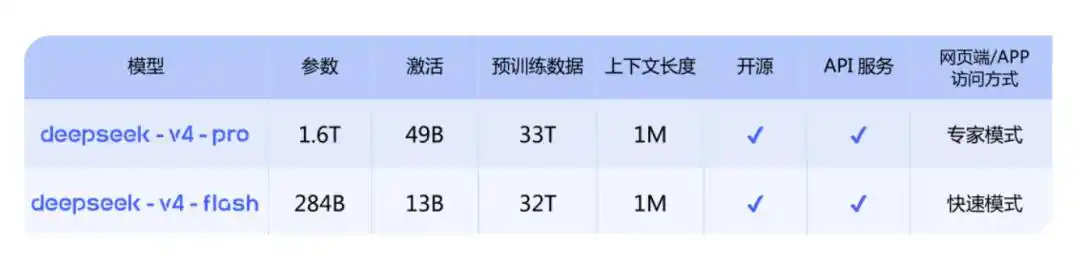
There are two versions in total:

DeepSeek-V4-Pro: Comparable to top closed-source models, 1.6T, 49B activated, 1M context length;

DeepSeek-V4-Flash: A smaller and faster economical version, 284B, 13B activated, 1M context length.
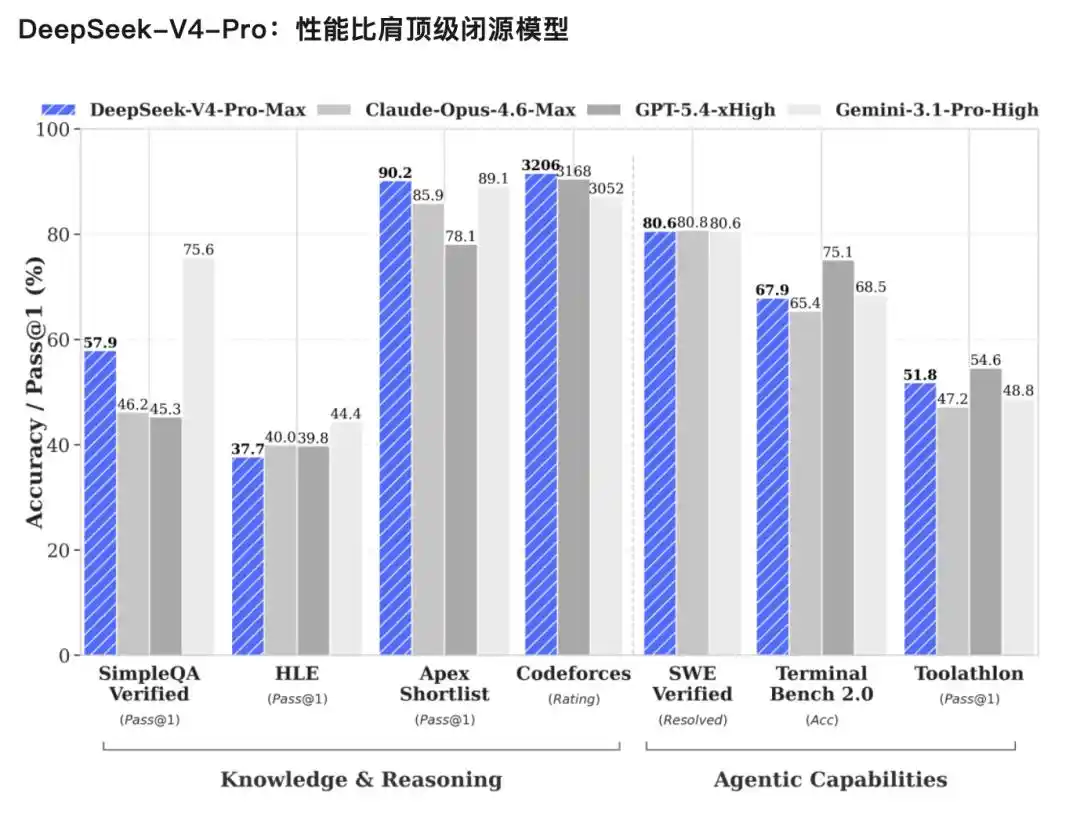
The official statement is: It leads domestically and in the open-source field in Agent capabilities, world knowledge, and reasoning performance.

And:

Currently, DeepSeek-V4 has become the Agentic Coding model used by company employees. According to evaluation feedback, the user experience is better than Sonnet 4.5, and the delivery quality is close to Opus 4.6 non-thinking mode. However, there is still a certain gap compared to the Opus 4.6 thinking model.
Currently, both the official website and the app have been updated, and the API service has also been synchronized.

Regarding the much-concerned domestic computing power, the key point is: Support for Huawei computing power in the second half of the year.

Top-Tier and Cost-Effective Choices, Two Versions Launched Together

This time, V4 releases two versions at once.

V4-Pro, performance comparable to top closed-source models.

The official judgment has three points:

Significantly improved Agent capabilities: In the Agentic Coding evaluation, V4-Pro has reached the best level among current open-source models and also performed excellently in other Agent-related evaluations. In internal evaluations, in Agent Coding mode, the V4 experience is better than Sonnet 4.5, and the delivery quality is close to Opus 4.6 non-thinking mode, but there is still a certain gap compared to the Opus 4.6 thinking mode.

Rich world knowledge: In world knowledge evaluations, DeepSeek-V4-Pro significantly leads other open-source models, only slightly inferior to the top closed-source model Gemini-Pro-3.1.

World-class reasoning performance: In evaluations of mathematics, STEM, and competitive code, DeepSeek-V4-Pro surpasses all currently publicly evaluated open-source models and achieves excellent results comparable to the world's top closed-source models.
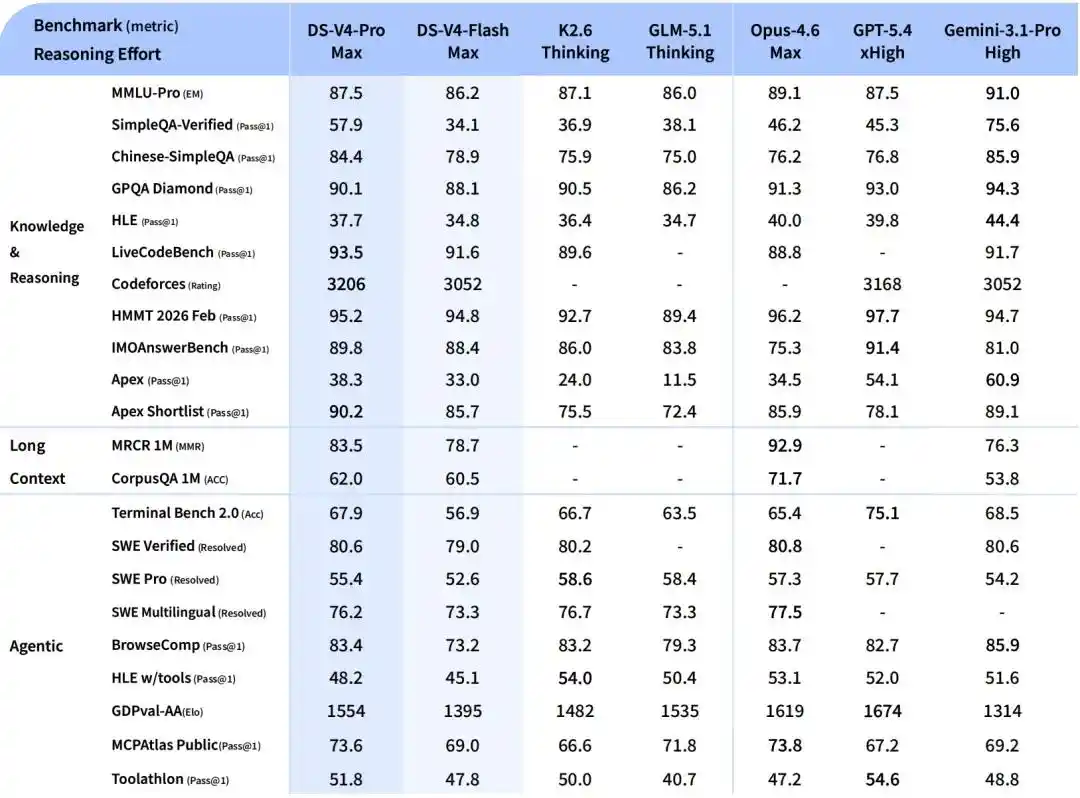
V4-Flash, a smaller and faster economical version. Reasoning ability is close to Pro, world knowledge reserve is slightly inferior, but with smaller parameters and activation, and cheaper API.

In Agent tasks, DeepSeek-V4-Flash is on par with DeepSeek-V4-Pro in simple tasks, but there is still a gap in high-difficulty tasks.

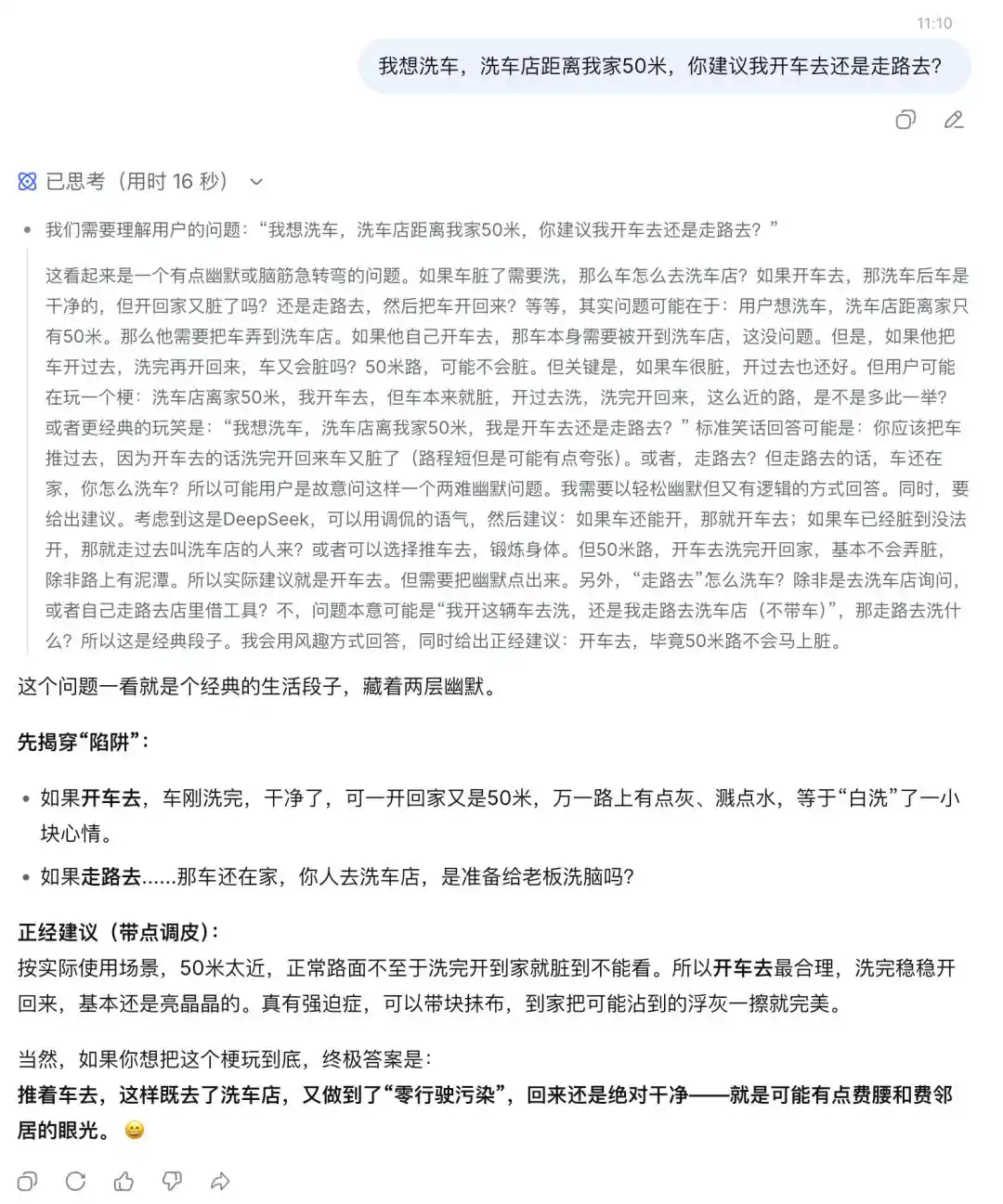
In the car wash test, V4 also passed quickly.
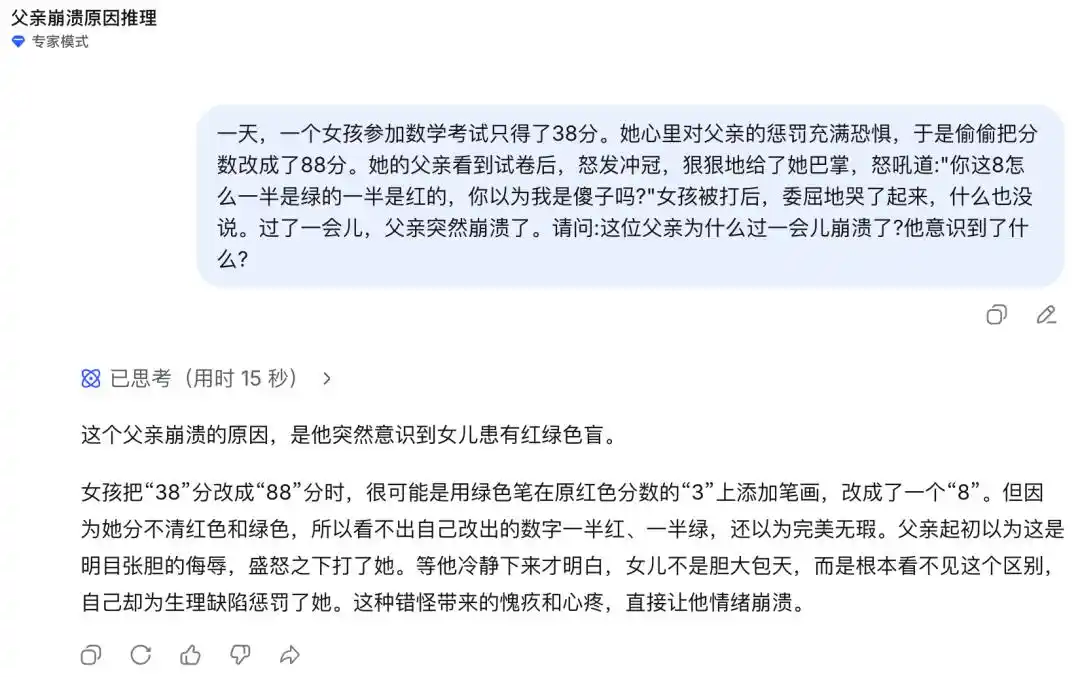
In the classic biological scenario "Desperate Father," DeepSeek-V4 did not immediately grasp the key point of red-green color blindness in one round (according to genetic rules, if a female is red-green color blind, her biological father must be as well).
Million Context Length Becomes Standard

It is worth mentioning that from today, 1M context length is standard for all DeepSeek official services.

A year ago, 1M context length was Gemini's exclusive trump card; all other closed-source models were either 128K or 200K; on the open-source side, almost no one could afford this level.

DeepSeek directly moved the million context length from a "high-end feature" to "basic infrastructure."

And it's open source. How did they do it? The release directly gave the answer—

V4 has created a new attention mechanism that compresses at the token dimension and is used in combination with DSA sparse attention. Compared to traditional methods, the demand for computation and memory is significantly reduced.
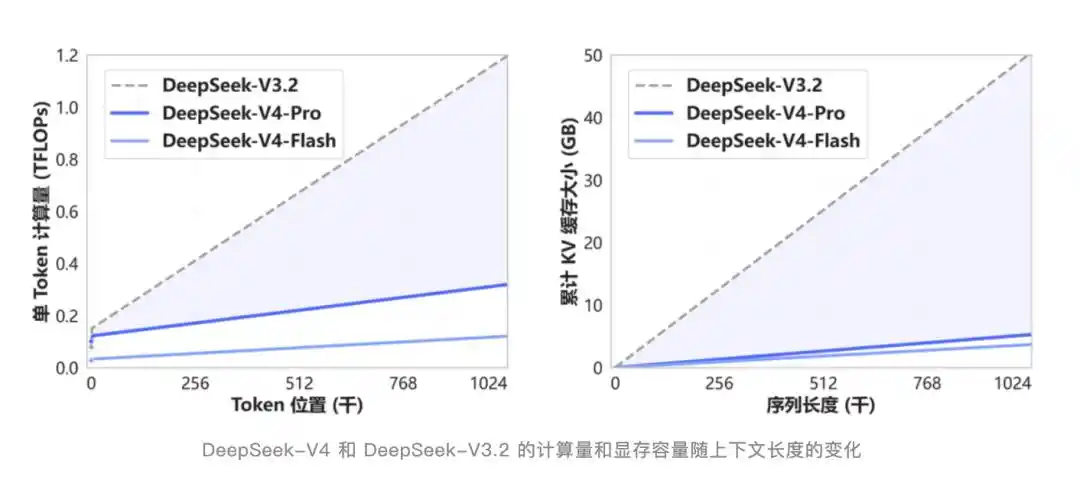
DSA is not a new term. It was first introduced in the V3.2-Exp update half a year ago. At that time, external attention was low because the benchmark scores were almost the same as V3.1-Terminus, making it seem like an insignificant intermediate version.

Looking back now, that was the foundation of V4.

Special Optimization for Agent Capabilities

On the Agent side, V4 has been adapted and optimized for mainstream Agent products such as Claude Code, OpenClaw, OpenCode, CodeBuddy, etc., with improvements in code tasks and document generation tasks.

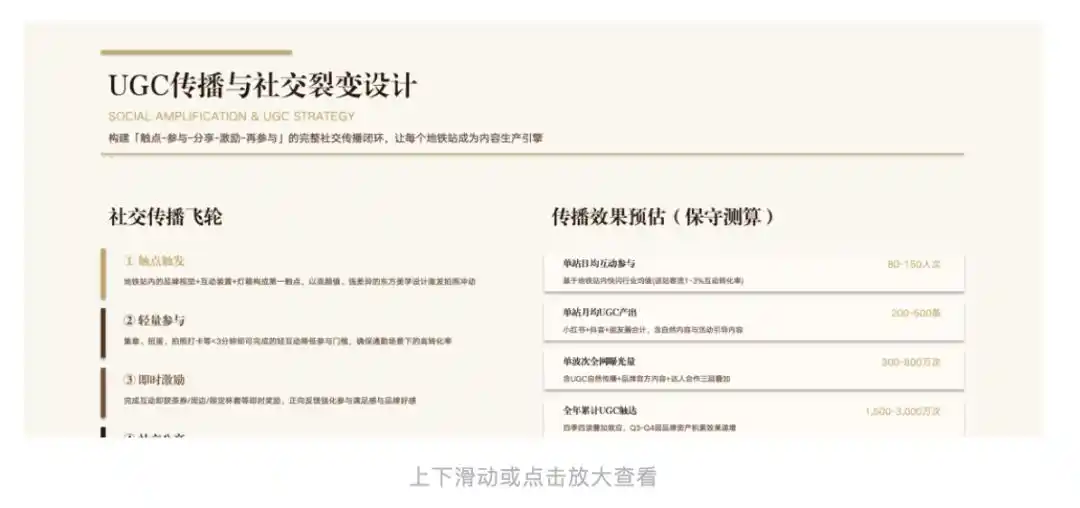
The release also included an example of a PPT inner page generated by V4-Pro under a certain Agent framework.
API Pricing

On the API side, V4-Pro and V4-Flash are simultaneously launched, supporting both OpenAI ChatCompletions interface and Anthropic interface.

The base_url remains unchanged, just change the model parameter to deepseek-v4-pro or deepseek-v4-flash to call.

Both versions have a maximum context length of 1M and support both non-thinking mode and thinking mode. In thinking mode, the intensity can be adjusted through the reasoning_effort parameter, with two levels: high and max. The official recommendation is to directly use max for complex Agent scenarios.
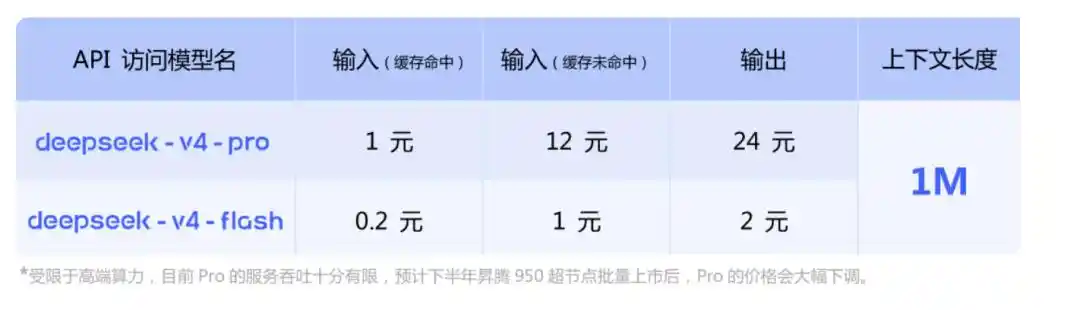
Here is a key point—Support for Huawei computing power in the second half of the year.

In addition, old model names will be discontinued.

deepseek-chat and deepseek-reasoner will be discontinued three months later (July 24, 2026). During the current phase, these two names point to the non-thinking and thinking modes of V4-Flash, respectively.

It has little impact on individual developers; just change one model parameter. Companies with production environments need to migrate during these three months.

One more thing

At the end of the release, DeepSeek quoted a sentence.

"Not tempted by praise, not frightened by slander, follow the path and act,端正自己端正自己 (correct oneself)."

This is a sentence from Xunzi's "Non-Twelve Masters." The literal meaning is: not tempted by praise, not frightened by slander, move forward according to the path one believes in, and correct oneself.

In today's context, it's somewhat interesting.

Over the past six months, rumors about when V4 would be released, whether it was delayed, whether it had been surpassed by others, whether it had been compromised by Claude's distilled data, etc., have circulated back and forth in both Chinese and English AI circles. At the beginning of the year, some even confidently said that V4 would be released before the Spring Festival, but it wasn't until the end of April.

They never responded once.

Then, on a Friday afternoon, they released V4, simultaneously open-sourced it, simultaneously launched it on the official website and app, simultaneously updated the API, and even wrote into the release that internal employees have already abandoned Claude.

No roadmap, no live stream, no interviews.

The four words "率道而行" (follow the path and act) sound like a slogan. But if you look at the path over the past six months: the V3.2 "unremarkable" Exp version, the DSA sparse attention that paved the way for V4 for half a year, and the path of making 1M context length from a trump card to a standard feature.

DeepSeek has already done it.

DeepSeek-V4 model open-source links:

[1]https://huggingface.co/collections/deepseek-ai/deepseek-v4

[2]https://modelscope.cn/collections/deepseek-ai/DeepSeek-V4

DeepSeek-V4 Technical Report: https://huggingface.co/deepseek-ai/DeepSeek-V4-Pro/blob/main/DeepSeek_V4.pdf

This article is from the WeChat public account "QbitAI", author: QbitAI

Preguntas relacionadas

QWhat are the two versions of DeepSeek-V4 that were released, and what are their key specifications?

ADeepSeek-V4 was released in two versions: DeepSeek-V4-Pro and DeepSeek-V4-Flash. The Pro version has 1.6T parameters with 49B activated and a 1M context length. The Flash version is a smaller, faster, and more economical model with 284B parameters, 13B activated, and also a 1M context length.

QAccording to the article, how does DeepSeek-V4-Pro's performance compare to top closed-source models like Anthropic's Opus 4.6?

AAccording to internal evaluations, DeepSeek-V4-Pro's performance in Agent Coding mode is better than Sonnet 4.5 and its delivery quality is close to Opus 4.6 in non-thinking mode, but it still has a gap compared to Opus 4.6 in thinking mode.

QWhat major technical achievement is highlighted for the DeepSeek-V4 models regarding context length?

AA major technical achievement is that a 1M context length has become the standard for all DeepSeek official services. This was achieved through a novel attention mechanism that compresses at the token dimension and is combined with DSA sparse attention, significantly reducing computational and memory requirements.

QWhat significant partnership or hardware support is announced for the future of DeepSeek's models?

AThe article announces that DeepSeek will support Huawei's computing power in the second half of the year.

QWhere can users find the open-source models and the technical report for DeepSeek-V4?

AThe open-source models can be found on Hugging Face and ModelScope collections under 'deepseek-ai/deepseek-v4'. The technical report is available at: https://huggingface.co/deepseek-ai/DeepSeek-V4-Pro/blob/main/DeepSeek_V4.pdf

Lecturas Relacionadas

When Doing Cryptocurrency Payment, the First Thing is Licenses, What is the Second?

When launching a crypto payment business, obtaining the necessary licenses is the crucial first step. However, the second, and arguably more critical, step is designing a comprehensive operational framework that forms a coherent business loop. This loop must be clearly understood and executable by all stakeholders: banks, payment partners, exchanges, on-chain analytics providers, regulators, and your internal team. Many projects mistakenly believe a single license permits all operations. Licenses merely grant entry; they don't define how the specific business functions. The real challenge lies in detailing every aspect of the workflow. This involves clarifying the customer base, the flow of fiat and crypto assets, the settlement process, and establishing clear lines of responsibility for risks like AML compliance, sanctions screening, chargebacks, and regulatory inquiries. A robust framework must answer seven core questions: Who are the clients and merchants? Who collects fiat and crypto? Who handles conversion and custody? And who is ultimately accountable for compliance and risk management? Projects often fail not from a lack of licensing, but during due diligence when they cannot convincingly explain these operational details. Therefore, beyond securing licenses, the priority must be constructing a closed-loop system. This system ensures the business model is transparent, risks are managed, responsibilities are delineated, contracts are aligned, and the entire process is comprehensible to partners and regulators. The true competitive edge in crypto payments lies not in acquiring a license quickly, but in integrating licensing, banking, compliance, and operations into a sustainable and executable whole.

marsbitHace 47 min(s)

When Doing Cryptocurrency Payment, the First Thing is Licenses, What is the Second?

marsbitHace 47 min(s)

Arthur Hayes Analysis: AI Bubble Nears Burst, Crypto Market Faces Short-Term Pressure

Arthur Hayes argues that the current AI market is a bubble poised to burst, which will exert downward pressure on the crypto market in the near term. The core trigger is rising oil prices due to the US-Iran conflict and a blockade of the Strait of Hormuz. Higher energy costs directly increase the operational expenses of AI data centers, squeezing profit margins for companies like Google, Anthropic, and OpenAI. Hayes predicts that persistent inflation from high oil prices will force Trump, in a bid to win the November election, to turn public sentiment against the AI industry. He may propose regulations and taxes on data centers and AI companies to appeal to voters concerned about costs and job displacement. Such political rhetoric could shatter market confidence. Furthermore, the market is unlikely to healthily absorb the massive concurrent IPOs of SpaceX, Anthropic, and OpenAI, which together seek valuations in the trillions. The combination of soaring energy costs, overwhelming equity supply, and negative political pressure will puncture the AI bubble. Hayes notes that nearly all new USD liquidity since 2022 has flowed into AI, leaving crypto like Bitcoin behind. When the AI bubble bursts, liquidity will contract sharply, pulling down all risk assets, including cryptocurrencies. In response, Hayes's fund, Maelstrom, has sold all AI-related stocks and non-core cryptocurrencies. It maintains core positions in Bitcoin and Ethereum while increasing exposure to energy sector equities, betting on rising oil and gas prices. He expects Bitcoin to bottom after the AI-led market decline, before rallying again with future monetary easing.

Foresight NewsHace 1 hora(s)

Arthur Hayes Analysis: AI Bubble Nears Burst, Crypto Market Faces Short-Term Pressure

Foresight NewsHace 1 hora(s)

To C, To B, and the Next Big Thing Called To A

After To C and To B, the Next Wave is To A: Serving AI Agents In a recent quarterly earnings call, Meituan's Wang Xing introduced a new concept: To A (To Agent), signifying that future business services will increasingly target AI Agents as primary clients, not just consumers or merchants. This shift implies that internet giants must now consider how to make their services more appealing for AI Agents to recommend, fundamentally altering traditional distribution logic. This "To A era" is prompting an unusual trend of alliances among major tech companies. Unlike previous competitive battles, firms like Meituan, Tencent, JD.com, Huawei, OPPO, and OpenAI are rapidly forming partnerships. The reason is strategic: as AI Agents become the primary user interface, handling tasks from a single command (e.g., "Book a Japanese restaurant for tomorrow"), the risk for platforms is being bypassed entirely. Companies are positioning themselves within this new value chain. Three primary strategies are emerging: 1. **Super-Entry Points + Service Providers:** Platforms like Tencent's Yuanbao, WeChat, and ChatGPT aim to be the first-stop Agent, integrating various services (food delivery, shopping, travel) from partners like Meituan and JD.com. 2. **Apps as Callable Services:** Companies like Meituan, JD.com, and Uber are ensuring their core services remain accessible and callable by external Agents, shifting from front-end apps to back-end capabilities. 3. **System-Level Agent Entry Points:** Smartphone makers (Huawei, Honor, OPPO) are leveraging their OS-level AI assistants to control the initial user command, redistributing it to relevant service apps. While alliances offer mutual benefit—entry points gain service capabilities, and service providers gain traffic—inherent conflicts of interest exist. A dominant Agent platform could eventually attempt to connect directly with suppliers (restaurants, hotels), bypassing current aggregators like Meituan or Ctrip. Other unresolved challenges include the potential for Agent recommendations to become a new form of paid ranking and unclear accountability for faulty recommendations. The current rush to form alliances is a defensive move by service providers to secure their position before the landscape solidifies. In this To A-driven restructuring, the greatest risk is not losing the race but failing to hear the starting gun.

marsbitHace 1 hora(s)

To C, To B, and the Next Big Thing Called To A

marsbitHace 1 hora(s)

Trading

Spot
Futuros
活动图片