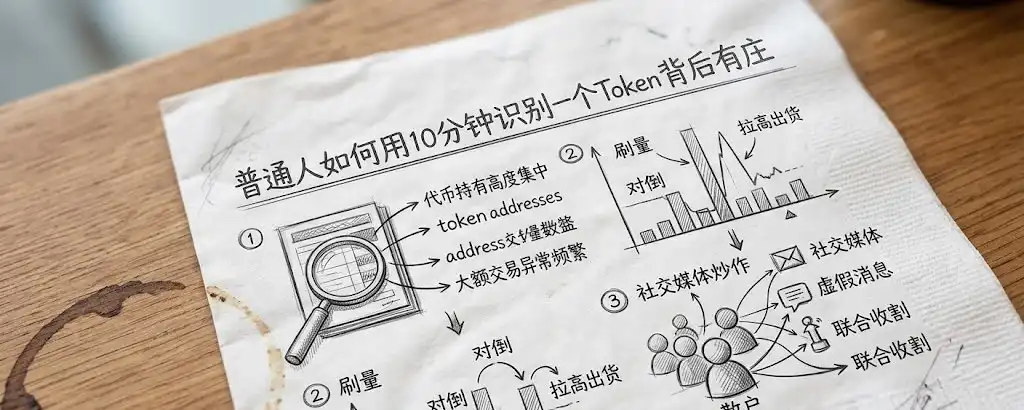
How Can an Average Person Identify if a Token Has a Whale Behind It in 10 Minutes?

marsbitPublicado a 2026-04-09Actualizado a 2026-04-09

Resumen

This article argues that identifying whether a token has a "whale" (a large, controlling holder) is the wrong question, as all successful tokens have them. The key is determining the whale's current phase: accumulation, markup (pumping), distribution (dumping), or having already exited. It provides a framework using on-chain and off-chain signals to identify these phases. Key on-chain metrics include: analyzing linked wallets to find true concentration, not just top holders; checking if trading volume is real or fake based on volume/holder ratio; monitoring DEX liquidity pool changes; analyzing trade volume concentration and net buy volume; and comparing price action to holder growth rates to pinpoint the whale's phase. The core thesis is that whales are not a bug but a fundamental feature of the market; concentrated筹码 (chips/tokens) and capital are prerequisites for a pump. The structural disadvantage for retail is being "long-only"—entering at high prices with no safety net, making them vulnerable. The article proposes that decentralized shorting mechanisms could be a solution, allowing retail to profit from correctly identifying distribution phases and breaking the whale's monopoly on price control. However, shorting carries extreme risks like unlimited losses and being squeezed. It is framed not as a guarantee of profits but as a necessary tool for "symmetrical armament," allowing retail to participate in two-way betting and transition from being "prey" to a "hunter" o...

Author: danny

Many people study on-chain data to find out "if this coin has a whale behind it," and then try to avoid, embrace, or follow it. But the truth is—coins without whales won't rise at all. So the truly useful question isn't "is there a whale?" but "what stage is the whale in?"—accumulation, markup, distribution, or has it already left?

Let's get straight to the point: you will definitely find whales, because whales are everywhere.

This article provides you with a framework of on-chain + off-chain signals. It's not about playing detective to catch the manipulators, but about quickly determining: at this moment, is this market in a stage that is friendly to retail investors?

I. On-Chain Signals: What Chips and Capital Are Saying

Remember: This cycle isn't short on capital or data; it's short on capital willing to enter the market. Like all games, everything revolves around getting you to "pay to play." As long as you keep paying attention, there's a thousand memes with a thousand faces, and there's always one tailored for you.

1: Token Concentration — Consolidate related wallets. Concentration itself isn't important; the degree of concentration is. Don't just look at the "Top 10 Holders %". Anyone can see that number, and it's easily disguised—a whale can split holdings into 50 wallets, each holding only 1%, making the Top 10 look "healthy." The right approach is to open a professional tracker and look at the bubble chart, consolidating addresses with connections (direct transfer relationships). Three wallets each holding 2% that have transferred to each other mean one entity holds 6%. Then look at the buy-in time of these related addresses—if they were all accumulated on the same day or even within the same hour, do you believe in coincidences?
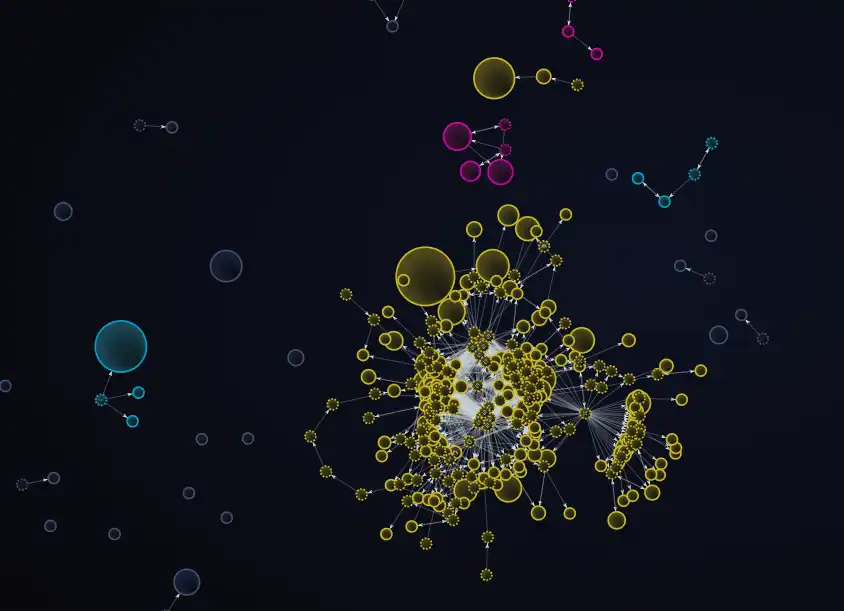
Funding Source Tracing (Funding Wallet Analysis) — Where did the initial ETH/BNB for these wallets come from? If the gas fees for 50 wallets all came from the same CEX withdrawal address or the same funding wallet, even if there are no direct transfers between them, they are likely the same person. If someone is spending money to accumulate, what do you think they want to do?

2: Trading Volume Authenticity — Vol / Holder (OI) Ratio 24h Trading Volume ÷ Total Number of Holders = Average trading volume contributed per holder. If a coin with only 800 holders has a 24h volume of $2 million, that's $2500 per person on average—this is most likely a few addresses wash trading疯狂对倒刷量, or bots running. Why would someone spend money to inflate the volume?

3: DEX Liquidity Pool Monitoring Observe the addition/removal of LP (Liquidity Pool) — A whale removing LP / adding thick LP is a signal of preparing to exit / stir things up. If the LP is not locked (unlocked), or the lock is about to expire, the risk is extremely high. Also observe changes in LP depth. If the price is rising but the LP depth is thinning, it indicates the whale might be quietly withdrawing liquidity to minimize their losses when they exit, and vice versa.

4: Turnover Rationality — 24h Vol / Market Cap Measures "what percentage of the market cap is traded in a day." Break it down by hour. If the volume spikes significantly in a few specific hours far exceeding other periods, it indicates concentrated wash trading. Normal retail trading time distribution is relatively smooth; sudden spikes are likely the prelude to manipulation. Furthermore, net buy volume is more valuable than total volume.

5: Number of Trades vs. Trading Volume — Large Order Percentage Look at the average value per transaction within 24 hours. If the top 10% of large transactions account for over 60% of the total volume, this market is driven by a minority of addresses, and the price action depends entirely on these few addresses. (A better method is to quantify the concentration of trading volume using the Gini coefficient, between 0 and 1; the closer to 1, the more concentrated). When these addresses stop moving is more important than when they move.

6: Address/Account/OI Growth Rate vs. Price Change Rate — Determining the Whale's Stage Combine the calculations from the previous 5 indicators (must be processed, screened, and calculated), then use the data analysis to determine which stage the asset is currently in:

  • Accumulation Stage: Price consolidates at low levels or even dips slightly, on-chain large addresses buy slowly, wallet/account count changes little. The whale is quietly accumulating chips. (The number of linked addresses doesn't count here).

  • Markup Stage (Pump): For example: price rises 30%, but wallet/account count only increases 5% → Chips haven't been distributed; a minority is pumping it themselves.

  • Distribution Stage (Most Dangerous): Price consolidates or even dips slightly, but wallet/account count increases (sometimes also in long/short ratio) by 20% → The whale is slowly distributing at high to retail; it looks like "the community is growing," but actually the whale is retreating.

  • Exited Stage: Price falls, wallet/account count doesn't decrease → Retail is bag-holding, the whale has finished exiting.

II. After Reading This, Then What?

Okay, you spent time confirming there's a whale, and it's in the xxx stage. Then what? Switch to another one? The next one will also have a whale. Because—

III. Whales Aren't a Bug; They Are the Underlying Structure of This Game

What makes a Token rise? Pumping requires two things: Chips + Capital. Combined, these are called Pricing Power. If chips aren't concentrated enough, and there isn't sufficient stake, no one has the incentive to pump the price.

Chip concentration isn't a conspiracy; it's a prerequisite for a pump. No whale, no rally.

IV. How Do Whales Win Against You?

Pricing power is just the entry ticket. What really makes whales win steadily is that their way of trading is completely different from yours. You operate on feeling; they operate with a system.

  • Whale's Cost Awareness: Calculate the profit of pumping and distributing, act if Expected Value (EV) is positive. Retail FOMOs in based on screenshots.

  • Whale's Probabilistic Thinking: Continuously adjust probabilities and position sizing. Retail repeatedly gambles.

  • Whale's Exploitation of Psychology: Create FOMO, exploit sunk cost fallacy to make you hold bags.

  • Whale's Tool Advantage: Ability to hedge, possess cost/information advantages, operational dimensions and error tolerance crush retail.

V. Then How Can Retail Win?

On the whale's home turf, using the whale's rules, retail cannot win. The asymmetry in information, tools, and psychology is comprehensive. But there is one asymmetry that can be broken.

VI. Retail's Biggest Structural Flaw: Can Only Go Long

In the era before perpetual contracts (perp), whales indeed could only go long, but they didn't need to short. The reason lies in cost.

The whale's chip cost is close to zero (gas fees or extremely low early prices). Even if it drops 90%, they are still profitable, just "less profitable." Ultra-low cost gives them enormous error tolerance.

But retail buys in during the FOMO phase, with a cost potentially 50 times higher than the whale's. Your cost structure determines that you cannot withstand drawdowns. Retail lacks both shorting tools and a low-cost safety net. The only profitable scenario is: buy, then it rises, and sell before it falls.

One direction, one window, almost zero error tolerance. This is structural unfairness.

VII. What If Retail Could Also Short?

When signals point to the distribution stage, false prosperity—you aren't just "running away," you can open a short, turning the whale's distribution into your profit. When truth reverts, you can be on the winning side. Your analytical skills are finally not wasted.

VIII. Mechanism Perspective: With Shorting Rights, Can Retail Master Pricing Power?

Straight to the conclusion: No.

The formula for pricing power is always: Chips + Capital. The essence of retail is a dispersed, uncoordinated group of capital. No matter how clever the mechanism, it cannot turn a pile of sand into a cannon. However, introducing decentralized spot leverage and lending protocols isn't about making retail "become the whale," but about breaking the whale's "absolute monopoly" on pricing power.

Deconstructing the mechanism, this reshapes the structure in three dimensions:

  1. Creating "Selling Pressure" Out of Thin Air, Depriving Unilateral Control: In a pure spot market, if the whale doesn't sell, there is no selling pressure; they can pump the price by trading with themselves. But with shorting mechanisms介入, retail can borrow tokens through over-collateralized loans and sell them into the market, turning previously "locked" dead筹码 into active selling pressure. This forcibly increases the real capital cost for the whale to continue pumping. To keep pumping, the whale must use real money to buy up the sell orders created by shorting.

  2. Symmetry in Price Discovery: Popping "False Narratives": Previously, upon discovering whale distribution or narrative invalidation, retail could only "not buy"; bad news couldn't be reflected in price drops. Shorting mechanisms allow retail to convert "bearish information" into substantive sell orders, making price action no longer a one-sided game drawn by the whale, but the real result of long-short博弈.

  3. Transformation from "Sitting Duck" to "Hunter": Shorting mechanisms actually accelerate the lifecycle of Meme coins. This mechanism doesn't let you become the rule-making whale, but it transforms retail from "bag-holders who can only take hits" into "hunters with guns."

IX. But Shorting Isn't a Panacea — Risks You Must Know

Shorting Meme coins is extremely high risk, with theoretically unlimited losses. What whales excel at is short squeezing (Short Squeeze). Intentionally pump the price to trigger short liquidations, using your liquidation funds to push the price even higher. Wrong timing means losing even if the direction is right. Plus, poor liquidity and high slippage make shorting costly.

Shorting isn't "make money if you understand"; it gives you an additional directional option. You still need to control position size and set stop losses. Shorting turns you from "chips" into a "player," and players can also lose—but they lose with more dignity.

Finally

This article teaches you not "how to avoid whales," but to understand:

  1. Whales are everywhere. Don't look for "coins without whales"; the key is to judge which stage the whale is in.

  2. Retail's biggest disadvantage is unidirectional exposure. Whales have low costs as a safety net; you don't. Understanding a rise can make money; understanding a fall can only make you run—this is不合理 unreasonable.

  3. The right to short is the final piece of the puzzle for retail to go from "being harvested" to "sitting at the table."

It is a weapon, not a talisman. Even if this gun has the risk of backfiring, having a gun and not having a gun are two completely different levels of博弈 game theory. What we need is "symmetrical armament," allowing retail to also possess two-way gaming capabilities.


Preguntas relacionadas

QWhat is the main purpose of the article regarding identifying a token's 'zhuang' (market manipulator)?

AThe main purpose is not to help readers avoid tokens with a zhuang, but to teach them how to quickly identify which stage the zhuang is currently in—accumulation, markup, distribution, or having already exited—to determine if it's a散户-friendly phase.

QAccording to the article, what is a key on-chain signal to assess the authenticity of trading volume?

AA key signal is the ratio of 24-hour trading volume divided by the number of holders. An abnormally high average volume per holder indicates potential wash trading or bot activity by a few addresses.

QWhat structural disadvantage do retail investors face compared to zhuang, as highlighted in the article?

ARetail investors' biggest structural disadvantage is that they can only go long (buy). They enter at high prices during FOMO, have no low-cost safety net, and have almost zero margin for error, making them structurally unequal to zhuang who have ultra-low cost bases.

QHow does the introduction of a shorting mechanism theoretically help rebalance the power dynamic between retail and zhuang?

AIt allows retail to profit from a token's price decline during the distribution phase, creates real selling pressure that increases the zhuang's cost to pump the price, and enables price discovery to reflect negative news, transforming retail from 'fodder' into 'hunters' with a choice of direction.

QWhat is a significant risk associated with shorting meme tokens mentioned in the article?

AA significant risk is the potential for unlimited losses from a short squeeze, where the zhuang intentionally drives the price up to trigger mass liquidations of short positions, using the resulting buying pressure to push the price even higher.

Lecturas Relacionadas

iQiyi Is Too Impatient

The article "iQiyi Is Too Impatient" discusses the controversy surrounding the Chinese streaming platform IQiyi's recent announcement of an "AI Actor Library" during its 2026 World Conference. IQiyi claimed over 100 actors, including well-known names like Zhang Ruoyun and Yu Hewei, had joined the initiative. CEO Gong Yu suggested AI could enable actors to "star in 14 dramas a year instead of 4" and that "live-action filming might become a world cultural heritage." The announcement quickly sparked backlash. Multiple actors named in the list issued urgent statements denying they had signed any AI-related authorization agreements. This forced IQiyi to clarify that inclusion in the library only indicated a willingness to *consider* AI projects, with separate negotiations required for any specific role. The incident, which trended on social media with hashtags like "IQiyi is crazy," is presented as a sign of the company's growing desperation. Facing intense competition from short-video platforms like Douyin and Kuaishou, as well as Bilibili and Xiaohongshu, IQiyi's financial performance has weakened, with revenues declining for two consecutive years. The author argues that IQiyi is "too impatient" to tell a compelling AI story to reassure the market, especially as it pursues a listing on the Hong Kong stock exchange. The piece concludes by outlining three key "AI questions" IQiyi must answer: defining its role as a tool provider versus a content creator, balancing the "coldness" of AI with the human element audiences desire, and properly managing the interests of platforms, actors, and viewers. The core dilemma is that while AI can reduce costs and increase efficiency, it risks creating homogenized, formulaic content and devaluing human performers.

marsbitHace 14 min(s)

iQiyi Is Too Impatient

marsbitHace 14 min(s)

Trading

Spot
Futuros

Artículos destacados

Qué es USDC(WORMHOLE)

USD Coin (Wormhole): Un Resumen Completo Introducción En el mundo en rápida evolución de las criptomonedas, USD Coin (Wormhole), conocido como $USDC(Wormhole), se destaca como una solución pionera dentro del paisaje de las finanzas descentralizadas (DeFi). Operando en varias plataformas blockchain, incluido Solana, USD Coin (Wormhole) es más que solo una representación digital del dólar estadounidense. Encapsula el espíritu innovador de las finanzas modernas, habilitando transacciones cruzadas sin problemas y mejorando la interoperabilidad entre diversos ecosistemas blockchain a través del avanzado protocolo Wormhole. ¿Qué es USD Coin (Wormhole)? USD Coin (Wormhole) es una versión tokenizada del dólar estadounidense diseñada para facilitar transacciones sin fricciones a través de diferentes redes blockchain. Su objetivo principal es aumentar la liquidez y mejorar la funcionalidad del ecosistema DeFi. Al aprovechar el protocolo Wormhole, que establece una robusta red de comunicación entre cadenas, los usuarios pueden transferir tokens USDC sin esfuerzo a través de varias plataformas. Esta capacidad entre cadenas marca un avance significativo en el uso de criptomonedas, promoviendo un ecosistema más interconectado y eficiente donde los activos pueden fluir libremente entre diferentes blockchains. La propuesta de valor de USD Coin (Wormhole) radica no solo en su estabilidad, al estar vinculado al dólar estadounidense, sino también en su capacidad para conectar ambientes blockchain dispares. Este enfoque innovador fomenta un mayor nivel de participación entre usuarios y desarrolladores, allanando el camino para nuevas y emocionantes aplicaciones dentro de las finanzas descentralizadas. ¿Quién es el creador de USD Coin (Wormhole)? Los orígenes de USD Coin (Wormhole) están intrínsecamente ligados a la red Wormhole, que fue desarrollada por Jump Crypto. Si bien no se documentan de manera prominente creadores individuales específicos, Jump Crypto es notable por su participación en el avance de la tecnología blockchain y en el apoyo de sus aplicaciones en finanzas. Al crear la red Wormhole, Jump Crypto ha desempeñado un papel vital en la promoción de transferencias de activos inter cadenas, mejorando la eficiencia y diversidad en el uso de criptomonedas. ¿Quiénes son los inversores de USD Coin (Wormhole)? El éxito de USD Coin (Wormhole) cuenta con el apoyo de inversiones de varios fondos y organizaciones notables dentro del ámbito de las criptomonedas. Los inversores clave incluyen: Coinbase Ventures: Un prominente brazo de capital de riesgo respaldado por uno de los intercambios de criptomonedas líderes en la industria, Coinbase Ventures proporciona capital esencial y apoyo estratégico a proyectos blockchain prometedores. Arrington XRP Capital: Especializándose en activos digitales, Arrington XRP Capital reconoce el potencial de proyectos innovadores como USD Coin (Wormhole) y ha invertido en consecuencia para respaldar su desarrollo. Jump Trading: Como la organización matriz de Jump Crypto, Jump Trading aporta no solo inversión, sino también una gran experiencia en tecnología de trading y dinámicas de mercado para fortalecer el proyecto Wormhole. ¿Cómo funciona USD Coin (Wormhole)? El marco operativo de USD Coin (Wormhole) está intrincadamente diseñado para facilitar transacciones efectivas entre cadenas, maximizando la seguridad y eficiencia. Aquí hay un resumen simplificado de cómo funciona: Bloqueo de Activos: Cuando un usuario desea transferir USDC de una blockchain a otra, primero bloquea sus tokens en la blockchain de origen. Este proceso asegura que los activos estén seguros y se preparen para ser quemados o movidos más tarde. Acabado de Tokens: Después de que los tokens se bloquean, se acuña una cantidad equivalente de USDC en la blockchain de destino. Esto proporciona al usuario acceso a sus fondos en una nueva plataforma, reflejando la flexibilidad que permite el protocolo Wormhole. Transferencia entre Cadenas: El protocolo Wormhole facilita eficientemente todo el proceso de transferencia. Asegura que, una vez que se acuñan los USDC en la cadena de destino, los tokens equivalentes se quemen en la cadena de origen. El resultado es una transferencia fluida de valor entre dos entornos blockchain distintos. Esta metodología entre cadenas asegura que las transacciones permanezcan seguras y transparentes, mejorando significativamente la liquidez dentro de los diferentes ecosistemas DeFi. Línea de Tiempo de USD Coin (Wormhole) Comprender la evolución de USD Coin (Wormhole) proporciona un contexto vital para su importancia en el ámbito de las criptomonedas. Aquí hay una línea de tiempo que destaca hitos importantes en la historia del proyecto: 2021: Se lanza el proyecto Wormhole, estableciendo un marco para las transferencias de activos entre cadenas y sentando las bases para el desarrollo de USD Coin (Wormhole). 2022: La red Wormhole experimenta un desafío significativo con una violación de seguridad que resulta en un robo de $325 millones. Sin embargo, el incidente es posteriormente abordado y reembolsado por Jump Crypto, mostrando el compromiso del proyecto con la seguridad y la transparencia. 2023: USD Coin (Wormhole) se integra con el Protocolo de Transferencia entre Cadenas de Circle (CCTP), mejorando sus capacidades para transferencias entre cadenas y solidificando aún más su lugar dentro del ecosistema DeFi. 2024: El desarrollo y expansión continuos de la red Wormhole prosiguen, con el objetivo de aumentar la utilidad y el alcance de USD Coin (Wormhole) así como mejorar su marco operativo. Características Clave El éxito de USD Coin (Wormhole) se puede atribuir a varias características clave que lo diferencian de otras ofertas de criptomonedas: Interoperabilidad entre Cadenas En el núcleo de USD Coin (Wormhole) está su capacidad para facilitar transferencias sin problemas a través de múltiples redes blockchain. Esta interoperabilidad sirve como una piedra angular para las finanzas descentralizadas, permitiendo que varias plataformas interactúen entre sí, acelerando así la evolución de los servicios financieros. Seguridad Wormhole emplea una Red de Guardianes bien diseñada compuesta por validadores de nodos que aseguran transacciones seguras entre cadenas. Esta supervisión colectiva minimiza el riesgo de fraude y proporciona a los usuarios la confianza de que sus activos están protegidos durante las transferencias entre cadenas. Mejora de Liquidez Al permitir que el USDC circule libremente a través de diferentes blockchains, USD Coin (Wormhole) mejora la liquidez en el ecosistema DeFi. Esta mayor liquidez puede fomentar un comercio más eficiente, contribuir a mejores estrategias de precios y mejorar la dinámica del mercado general que abarca varios activos digitales. Conclusión USD Coin (Wormhole) es una innovación pivotal en el espacio blockchain, reforzando las capacidades de las finanzas descentralizadas (DeFi) y estableciendo un ecosistema financiero más conectado. Con su robusto marco para transacciones entre cadenas, características de seguridad y fuerte respaldo de inversores reputados, USD Coin (Wormhole) está posicionado para desempeñar un papel clave en el futuro de las criptomonedas. Conforme el panorama de las finanzas digitales continúa evolucionando, USD Coin (Wormhole) no solo abraza el futuro de la interconectividad entre redes blockchain, sino que también reafirma el poder de la tokenización y la tecnología blockchain en transformar cómo percibimos y utilizamos el valor en un mundo digital. Al navegar las complejidades de la funcionalidad entre cadenas, demuestra un enfoque sofisticado para habilitar la inclusividad financiera y la innovación en el mundo de las criptomonedas.

159 Vistas totalesPublicado en 2024.04.03Actualizado en 2024.12.03

Qué es USDC(WORMHOLE)

Qué es W$C

World$tateCoin ($W$C): Una Exploración Integral del Proyecto de Criptomoneda Emergente Introducción En el panorama en constante evolución de las criptomonedas, World$tateCoin ($W$C) ha surgido como un proyecto que busca aprovechar el poder de las tecnologías web3 para crear un ecosistema digital distintivo. A medida que los modelos tradicionales de interacción en línea sufren una transformación significativa, World$tateCoin busca establecerse en esta incipiente tercera generación de internet. Este artículo profundizará en las complejidades de World$tateCoin, proporcionando una visión general del proyecto, sus objetivos y su potencial impacto en el espacio web3. ¿Qué es World$tateCoin ($W$C)? World$tateCoin ($W$C) está diseñado como una criptomoneda que facilita transacciones sin interrupciones dentro de un entorno web3. Con el objetivo de crear una plataforma descentralizada donde los usuarios puedan interactuar con diversas aplicaciones web3, $W$C pretende optimizar la experiencia del usuario y mejorar la accesibilidad a los servicios digitales. Si bien el proyecto aspira a convertirse en una parte integral del panorama web3, las perspectivas detalladas sobre sus objetivos específicos y casos de uso siguen siendo limitadas, lo que plantea preguntas sobre su posible papel y utilidad en un contexto digital que avanza rápidamente. La esencia de web3 gira en torno a la descentralización y a empoderar a los usuarios con un mayor control sobre sus interacciones en línea. World$tateCoin pretende alinearse con estos principios, aunque aún se están discutiendo dentro de la comunidad aplicaciones y funcionalidades específicas de la moneda. ¿Quién es el Creador de World$tateCoin ($W$C)? Al explorar los orígenes de World$tateCoin, la información sobre su creador sigue siendo elusiva. Hasta ahora, no hay datos disponibles públicamente que identifiquen a las personas u organizaciones detrás del proyecto. Esta oscuridad podría arrojar una sombra de incertidumbre sobre la credibilidad del proyecto, pero el compromiso con la innovación dentro del marco de criptomonedas podría ser una fuerza impulsora para su adopción en el futuro. La falta de liderazgo identificable puede resultar en obstáculos relacionados con la confianza y la transparencia—elementos que son cruciales para establecer una comunidad sólida en el espacio cripto. ¿Quiénes son los Inversores de World$tateCoin ($W$C)? La investigación actual no revela inversores o organizaciones de respaldo específicos involucrados con World$tateCoin. No es infrecuente que los proyectos emergentes de criptomonedas atraigan inversiones discretas o funcionen con una estructura financiera minimalista durante su fase inicial. La ambigüedad en torno a los apoyos de inversión y metodologías de financiación podría afectar la sostenibilidad y las perspectivas de crecimiento del proyecto. Al evaluar nuevos proyectos dentro del dominio de las criptomonedas, los inversores generalmente buscan transparencia respecto a los respaldos financieros y el apoyo de entidades establecidas. La ausencia de esta información podría requerir un enfoque cauteloso por parte de posibles usuarios y partes interesadas interesadas en el futuro de World$tateCoin. ¿Cómo Funciona World$tateCoin ($W$C)? Los mecanismos operativos de World$tateCoin están fundamentados en los principios de descentralización, un sello distintivo de las tecnologías web3. Al facilitar transacciones directamente entre usuarios sin la intervención de intermediarios, $W$C está diseñado para mejorar la confianza y la eficiencia. Sin embargo, la documentación integral que detalla las características únicas y el marco operativo que distinguen a World$tateCoin de otras criptomonedas es notablemente escasa. Esta falta de información complica la comprensión de cómo $W$C funciona dentro del ecosistema web3 más amplio y qué proposiciones únicas ofrece a usuarios y desarrolladores por igual. No obstante, el objetivo fundamental de permitir transacciones descentralizadas promete un paisaje financiero más liberado, si el proyecto cumple con sus aspiraciones de implementar mecanismos robustos e interfaces amigables para el usuario. Cronograma de World$tateCoin ($W$C) Construir un cronograma que encapsule la progresión histórica de World$tateCoin presenta desafíos debido a la ausencia de documentación significativa sobre eventos y hitos clave. Sin embargo, se puede imaginar una secuencia aproximada de fases hipotéticas, constituyendo un camino a seguir para el proyecto: Concepto Inicial (Fecha Desconocida): Conceptualización del marco de World$tateCoin en el contexto más amplio de las tecnologías web3. Fase de Desarrollo (Fecha Desconocida): Inicio de procesos de desarrollo técnico y codificación. Compromiso Comunitario (Fecha Desconocida): Alcance a posibles usuarios y partes interesadas para fomentar el interés comunitario en el proyecto. Meta de Lanzamiento (Fecha Desconocida): Anuncio de una fecha de lanzamiento esperada, condicionada al progreso de las fases de desarrollo y pruebas. Debido a la falta de fechas y detalles comprobables que rodean estas fases, las partes interesadas deberán permanecer atentas y comprometidas con las comunicaciones del proyecto para recibir actualizaciones sobre su trayectoria. Temas Clave sobre World$tateCoin ($W$C) Conforme avanza el proyecto, surgen ciertos temas clave que encarnan el potencial y las aspiraciones de World$tateCoin: Descentralización: La filosofía central que impulsa el proyecto, dirigida a fomentar interacciones directas entre usuarios. Integración Web3: El objetivo de reflejar principios web3 y permitir el acceso fluido del usuario a una variedad de servicios digitales. Criptomoneda Digital: Posicionada como una moneda para facilitar transacciones basadas en internet, World$tateCoin busca inyectar liquidez adicional en el mercado web3. Desafío de la Escasez de Información: La notable ausencia de información detallada sobre los fundamentos del proyecto, sus creadores y métodos operativos, lo que requiere mayor transparencia por parte de los desarrolladores para construir la confianza de la comunidad. Conclusión World$tateCoin ($W$C) se encuentra posicionado en un terreno emocionante pero incierto de la criptomoneda y la integración web3. Si bien aspira a cultivar un entorno descentralizado, la limitada disponibilidad de información respecto a sus creadores, inversores y funcionalidades específicas presenta desafíos para posibles partes interesadas y usuarios. En el dinámico mundo de las criptomonedas, la transparencia, el compromiso y la comunicación bien estructurada son vitales para el éxito de proyectos como World$tateCoin. A medida que el panorama sigue evolucionando, las partes interesadas estarán ansiosas por ver cómo el proyecto puede solidificar su posición dentro de la narrativa web3 y contribuir a la transformación continua del ecosistema digital.

93 Vistas totalesPublicado en 2024.04.05Actualizado en 2024.12.03

Qué es W$C

Cómo comprar W

¡Bienvenido a HTX.com! Hemos hecho que comprar Wormhole (W) sea simple y conveniente. Sigue nuestra guía paso a paso para iniciar tu viaje de criptos.Paso 1: crea tu cuenta HTXUtiliza tu correo electrónico o número de teléfono para registrarte y obtener una cuenta gratuita en HTX. Experimenta un proceso de registro sin complicaciones y desbloquea todas las funciones.Obtener mi cuentaPaso 2: ve a Comprar cripto y elige tu método de pagoTarjeta de crédito/débito: usa tu Visa o Mastercard para comprar Wormhole (W) al instante.Saldo: utiliza fondos del saldo de tu cuenta HTX para tradear sin problemas.Terceros: hemos agregado métodos de pago populares como Google Pay y Apple Pay para mejorar la comodidad.P2P: tradear directamente con otros usuarios en HTX.Over-the-Counter (OTC): ofrecemos servicios personalizados y tipos de cambio competitivos para los traders.Paso 3: guarda tu Wormhole (W)Después de comprar tu Wormhole (W), guárdalo en tu cuenta HTX. Alternativamente, puedes enviarlo a otro lugar mediante transferencia blockchain o utilizarlo para tradear otras criptomonedas.Paso 4: tradear Wormhole (W)Tradear fácilmente con Wormhole (W) en HTX's mercado spot. Simplemente accede a tu cuenta, selecciona tu par de trading, ejecuta tus trades y monitorea en tiempo real. Ofrecemos una experiencia fácil de usar tanto para principiantes como para traders experimentados.

303 Vistas totalesPublicado en 2024.12.10Actualizado en 2025.03.21

Cómo comprar W

Discusiones

Bienvenido a la comunidad de HTX. Aquí puedes mantenerte informado sobre los últimos desarrollos de la plataforma y acceder a análisis profesionales del mercado. A continuación se presentan las opiniones de los usuarios sobre el precio de W (W).

活动图片