Here’s what happened in crypto today: 1 sell-off, 4 major shocks

ambcryptoPublicado a 2026-02-02Actualizado a 2026-02-02

Resumen

The cryptocurrency market experienced a significant sell-off, with Bitcoin dropping to around $76K. Despite the decline, historical patterns suggest such downturns—like those following Mt. Gox, the ICO bubble burst, COVID-19, and the FTX collapse—are often temporary, with Bitcoin historically recovering from losses as high as 80%. In other major developments: - World Liberty Financial (WLFI), linked to former President Trump, sold a 49% stake to UAE-based Aryam Investment in a $500 million deal. The transaction occurred just before Trump’s second inauguration, though WLFI had no live products at the time. - Igor Runets, CEO of Russian Bitcoin mining firm BitRiver, was detained in Moscow on tax evasion charges. The company, once worth hundreds of millions, has faced challenges since U.S. sanctions in 2022. - CrossCurve’s cross-chain bridge was exploited due to a smart contract flaw, resulting in an estimated $3 million loss. The team has offered a 10% reward for the return of funds and warned of potential legal action. Despite short-term concerns, Bitcoin’s long-term resilience remains a key theme.

Crypto had one of those days. The market was hit by a big sell-off that saw Bitcoin [BTC] lose key levels, alongside many other unsettling headlines piling up.

Here’s a quick rundown.

BTC falls, history repeats

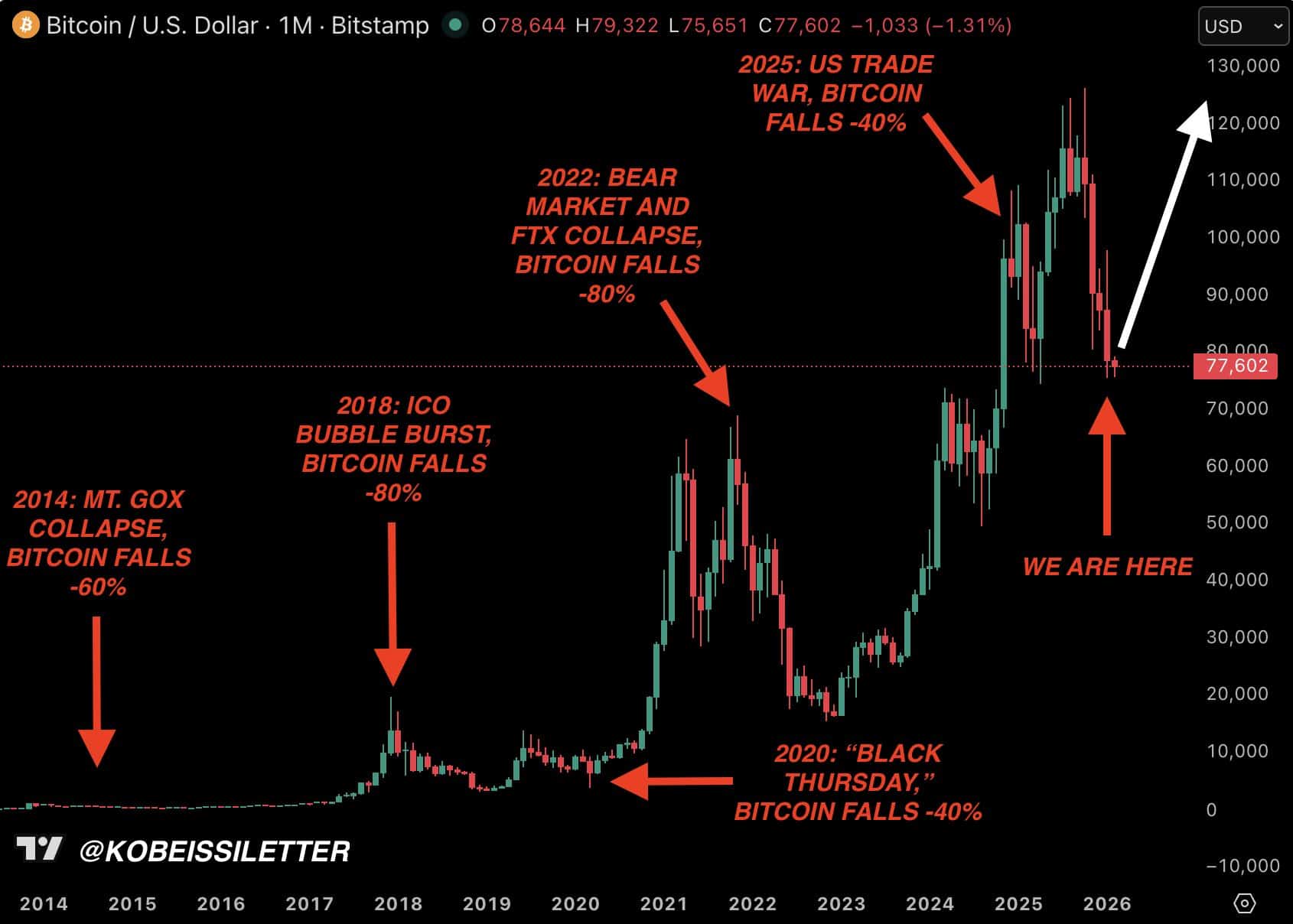
Bitcoin slid to around $76K at press time, with a market sell-off dragging major tokens lower in a matter of hours. While this seems like a reason to panic, zooming out will give you the real picture.

Source: X

The Kobeissi Letter’s recent X post puts this drop in familiar company.

Bitcoin has lived through far deeper falls: the Mt. Gox collapse in 2014, the ICO bubble burst in 2018, the Covid-era crash in 2020, and the 2022 bear market caused by FTX.

Each time, losses ranged from 40% to as much as 80%. Each time, Bitcoin eventually recovered. Every major crypto crash feels terminal in the moment but becomes a rounding error over time.

49% of Trump-linked WLFI bought out

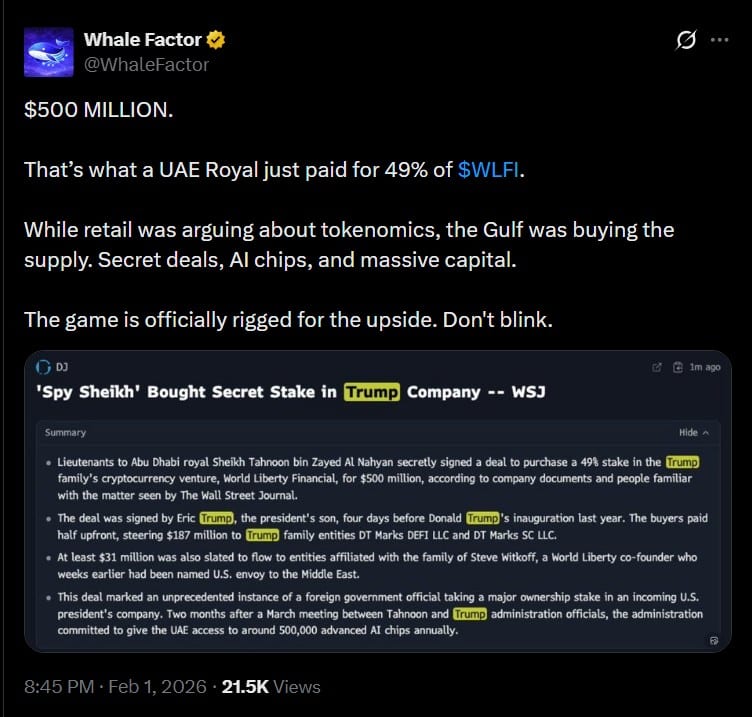
The Wall Street Journal has reported that World Liberty Financial sold a 49% stake to UAE-based Aryam Investment. The deal is said to be worth $500 million.

The agreement was allegedly signed just days before President Trump’s second inauguration, despite the company having no live products at the time. Notably, Aryam does not receive any rights tied to the WLFI token.

Source: X

Aryam is backed by Sheikh Tahnoon bin Zayed Al Nahyan, the UAE’s national security advisor and brother of the country’s president. Sheikh Tahnoon also chairs AI-focused firms MGX and G42.

Earlier this year, MGX invested $2 billion into Binance, settling the transaction using WLF’s newly launched stablecoin, USD1.

This was without disclosing its indirect ownership in WLF.

Russian Bitcoin mining firm CEO detained

Igor Runets, founder and CEO of Russian Bitcoin mining firm BitRiver, has reportedly been detained by authorities in Moscow on allegations of tax evasion.

Local media reports say Runets was taken into custody on Friday and formally charged the following day with three counts related to hiding assets to avoid paying taxes.

A Moscow court has ordered him to remain under house arrest, a decision his legal team can still appeal before it takes full effect later this week.

Runets built BitRiver into one of Russia’s largest Bitcoin mining operators after founding the company in 2017. At its peak, his crypto mining business was reported to be worth hundreds of millions of dollars.

Since being sanctioned by the U.S. in 2022, the firm has lost key clients, faced lawsuits, and struggled with delayed employee payments.

Cross-chain bridge breach causes emergency stop

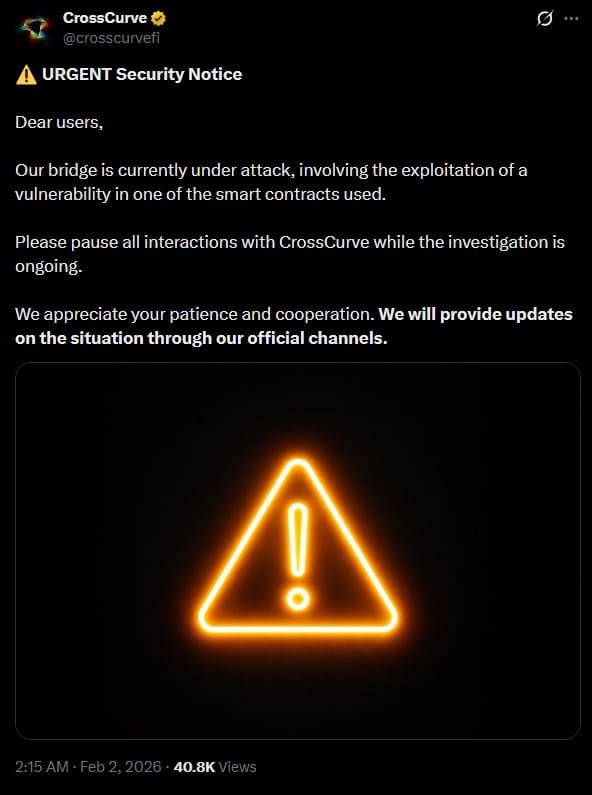
Crypto protocol CrossCurve has asked users to stop interacting with its platform after confirming that its cross-chain bridge was compromised in a smart contract attack.

An estimated $3 million was reportedly drained across multiple blockchain networks.

The team said the issue stemmed from a flaw in one of the contracts used by the bridge. This allowed unauthorized transactions to slip through normal checks.

Blockchain security trackers flagged the exploit shortly after it happened. They warned that the vulnerability could be used to unlock tokens without proper validation.

Source: X

The incident prompted partner protocol Curve Finance to caution users who had exposure to CrossCurve-related pools. They’ve asked users to reassess their positions and consider withdrawing support.

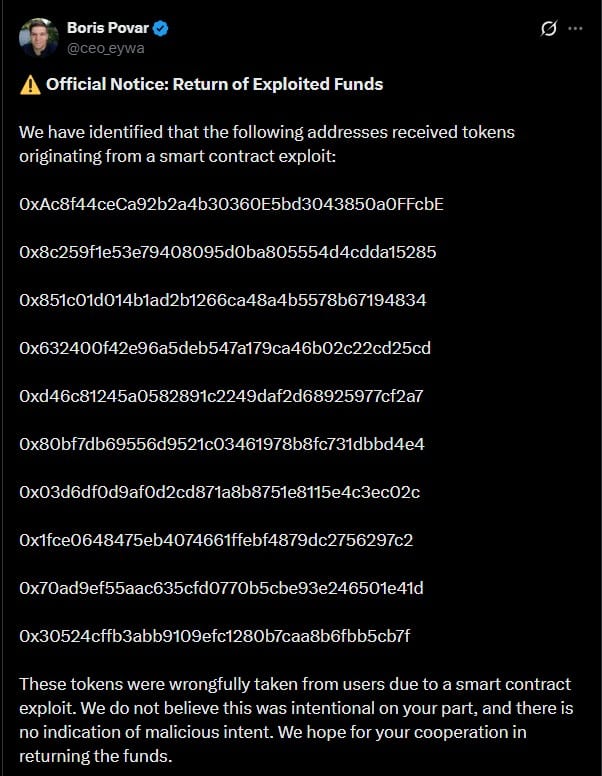
In response, CrossCurve CEO Boris Povar publicly addressed the wallets believed to have received the stolen funds. If the assets are returned in 72 hours, he’s offered a reward of up to 10%.

Source: X

The team has stated that it is prepared to involve law enforcement and pursue legal action if needed.


Final Thoughts

  • Bitcoin slipped to $76K, but patterns say the worries won’t last long.
  • In other news, WLFI has sold a major chunk of equity while the CEO of BitRiver got detained.
Next: Uniswap breaks multi-year support: Will UNI see a larger crash?
Share
  • Share
  • Tweet

Preguntas relacionadas

QWhat was the main event that caused Bitcoin to drop to around $76K?

AA market sell-off dragged major tokens lower, causing Bitcoin to slide to around $76K.

QWhich company sold a 49% stake to UAE-based Aryam Investment, and what was the deal's value?

AWorld Liberty Financial sold a 49% stake to Aryam Investment in a deal worth $500 million.

QWhy was Igor Runets, CEO of BitRiver, detained by authorities in Moscow?

AIgor Runets was detained on allegations of tax evasion, specifically for hiding assets to avoid paying taxes.

QWhat was the cause of the CrossCurve cross-chain bridge breach, and how much was estimated to be drained?

AThe breach was caused by a flaw in one of the smart contracts used by the bridge, allowing unauthorized transactions, and an estimated $3 million was drained.

QWhat did CrossCurve CEO Boris Povar offer to the wallets that received the stolen funds if they returned the assets within 72 hours?

ABoris Povar offered a reward of up to 10% if the stolen assets were returned within 72 hours.

Lecturas Relacionadas

Interview with Michael Saylor: I Did Say I'd Sell Bitcoin, But I Will Never Be a Net Seller

**Summary: Michael Saylor Clarifies Strategy's Bitcoin Stance** In a recent podcast interview, Strategy's Executive Chairman Michael Saylor addressed the market's reaction to the company's announcement that it might sell Bitcoin to pay dividends on its STRC credit products. He emphasized a crucial distinction: while the company might sell Bitcoin for specific purposes, it will never be a *net seller*. Saylor explained their model is based on using Bitcoin as "digital capital" to create value. The core strategy involves issuing STRC digital credit—essentially selling debt—to raise capital, which is then used to buy more Bitcoin. He estimates Bitcoin appreciates at roughly 40% annually. A small portion of these capital gains (e.g., ~2.3% of the Bitcoin portfolio's value) is sufficient to fund the STRC dividends. Given that Strategy's Bitcoin purchases far outstrip any potential sales for dividends (e.g., buying $3.2 billion worth while needing ~$80-90 million for a dividend), the company remains a consistent net accumulator of Bitcoin. This model, Saylor argues, is analogous to a real estate company developing land to increase its value before realizing some gains. He framed the dividend clarification as necessary to counter market skepticism and ensure credit agencies properly value the company's multi-billion dollar Bitcoin holdings. Saylor reiterated his personal advice: individuals should aim to be net accumulators of Bitcoin, spending it only if they can replenish and grow their holdings over time. Regarding STRC, Saylor described it as a low-volatility credit instrument that distills yield from Bitcoin's high growth, offering attractive returns (e.g., ~11-12% yield) for risk-averse investors. He noted that Strategy's STRC issuance now constitutes about 60% of the U.S. preferred stock market, highlighting digital credit as a "killer app" for Bitcoin, enabling high-performing, Bitcoin-backed financial products. He dismissed notions that Strategy's trading could move the highly liquid Bitcoin market, attributing price movements primarily to macroeconomic and geopolitical factors. Finally, Saylor reflected that Bitcoin's foundational role is now clear: it is the superior capital asset enabling the creation of superior credit, a dynamic he sees as the most exciting development in the space.

marsbitHace 4 min(s)

Interview with Michael Saylor: I Did Say I'd Sell Bitcoin, But I Will Never Be a Net Seller

marsbitHace 4 min(s)

380,000 Apps Exposed, 2,000+ Apps Leaked Secrets: AI Programming Turns 'Intranet' into Public Internet

Israeli cybersecurity firm RedAccess uncovered a severe data exposure trend linked to "vibe coding" or AI-powered software development tools. Their research found approximately 38,000 publicly accessible web applications built with platforms like Lovable, Base44, Netlify, and Replit. Of these, an estimated 2,000 apps exposed sensitive corporate and personal data, including medical records, financial information, internal strategic documents, and customer chat logs. In some cases, access even granted administrative privileges. The core issue stems from default privacy settings that make applications public by default, combined with a lack of built-in security controls (like authentication) in the AI-generated code. This allows employees without security expertise—"citizen developers"—to easily create and deploy applications that bypass standard corporate security reviews. The exposed apps, often indexed by search engines, are trivially discoverable. While some platform providers (Replit, Lovable, Wix/Base44) argue that security configuration is the user's responsibility and question the validity of some findings, security researchers confirm the widespread reality of such exposures. This pattern, also noted in prior studies, highlights a critical security gap as AI democratizes app creation, potentially leading to massive, unintentional data leaks.

marsbitHace 1 hora(s)

380,000 Apps Exposed, 2,000+ Apps Leaked Secrets: AI Programming Turns 'Intranet' into Public Internet

marsbitHace 1 hora(s)

Attracting Global Capital, Asia's New 'Super Cycle' Is Unfolding

Investors are turning to Asia as the next frontier for global equity growth, with a new "super cycle" unfolding across the region. Driven by the AI revolution, Asian markets, particularly South Korea, have seen significant rallies. According to Morgan Stanley analysis, the underlying drivers of Asia's industrial cycle are shifting from traditional sectors like real estate and manufacturing to massive investments in AI infrastructure, energy security and transition, and supply chain resilience. Fixed asset investment in Asia is projected to grow from around $11 trillion in 2025 to $16 trillion by 2030, with a 7% annual growth rate from 2026-2030. The AI wave is a primary catalyst, driving immense capital expenditure for chips, servers, data centers, and power systems. Asia is central to this hardware supply chain. In China, AI investment is focused on building a full-system domestic capability, with the local AI chip market potentially reaching $86 billion by 2030. Beyond AI, China's export story is expanding from EVs and batteries to robotics. The country already captures about half of new global industrial robot demand and over 90% of humanoid robot shipments. This growth phase mirrors the early stages of China's EV export boom. Simultaneously, energy security investments, spurred by AI's massive power needs, are rising, with China benefiting from its leadership in solar, batteries, and EVs. Regional defense spending is also increasing structurally, supporting demand for advanced manufacturing. The main beneficiaries are China, South Korea, and Japan, positioned in core supply chain areas. However, risks remain, including potential overcapacity, profit margin pressures from competition, persistent technological restrictions, geopolitical friction, and workforce displacement due to AI-driven automation. Market volatility is also expected to increase as investor expectations diverge on the realization of these capital investment and export themes.

marsbitHace 1 hora(s)

Attracting Global Capital, Asia's New 'Super Cycle' Is Unfolding

marsbitHace 1 hora(s)

Trading

Spot
Futuros

Artículos destacados

Cómo comprar 4

¡Bienvenido a HTX.com! Hemos hecho que comprar 4 (4) sea simple y conveniente. Sigue nuestra guía paso a paso para iniciar tu viaje de criptos.Paso 1: crea tu cuenta HTXUtiliza tu correo electrónico o número de teléfono para registrarte y obtener una cuenta gratuita en HTX. Experimenta un proceso de registro sin complicaciones y desbloquea todas las funciones.Obtener mi cuentaPaso 2: ve a Comprar cripto y elige tu método de pagoTarjeta de crédito/débito: usa tu Visa o Mastercard para comprar 4 (4) al instante.Saldo: utiliza fondos del saldo de tu cuenta HTX para tradear sin problemas.Terceros: hemos agregado métodos de pago populares como Google Pay y Apple Pay para mejorar la comodidad.P2P: tradear directamente con otros usuarios en HTX.Over-the-Counter (OTC): ofrecemos servicios personalizados y tipos de cambio competitivos para los traders.Paso 3: guarda tu 4 (4)Después de comprar tu 4 (4), guárdalo en tu cuenta HTX. Alternativamente, puedes enviarlo a otro lugar mediante transferencia blockchain o utilizarlo para tradear otras criptomonedas.Paso 4: tradear 4 (4)Tradear fácilmente con 4 (4) en HTX's mercado spot. Simplemente accede a tu cuenta, selecciona tu par de trading, ejecuta tus trades y monitorea en tiempo real. Ofrecemos una experiencia fácil de usar tanto para principiantes como para traders experimentados.

718 Vistas totalesPublicado en 2025.10.20Actualizado en 2025.10.20

Cómo comprar 4

Discusiones

Bienvenido a la comunidad de HTX. Aquí puedes mantenerte informado sobre los últimos desarrollos de la plataforma y acceder a análisis profesionales del mercado. A continuación se presentan las opiniones de los usuarios sobre el precio de 4 (4).

活动图片