From Subsidies to Token-Based Pricing to Price Cuts: Is OpenAI Sparking a Price War? Is the Inflection Point for Token Economics Nearing?

marsbitPublicado a 2026-06-11Actualizado a 2026-06-11

Resumen

The commercialization of generative AI is facing a critical inflection point as a potential price war looms. According to The Wall Street Journal, OpenAI is considering a significant cut to its token fees to compete with rival Anthropic, signaling a shift from a growth-at-all-costs model focused on token consumption. This move comes as both companies, reportedly losing billions on compute, prepare for IPOs, and as enterprise customers face "bill shock" from switching to usage-based token billing. Reports indicate poor ROI, with one analysis finding only 18 cents of every dollar spent on AI tokens generates user-facing value. The industry's initial phases—from flat-rate subscriptions to aggressive subsidies—have given way to a reckoning with real costs. Analysts debate the future: some predict a bifurcation between premium, high-cost models for complex tasks and cheaper alternatives for routine work, while others believe overall spending will still rise as agentic AI increases tokens per task. Notably, Chinese model DeepSeek's low-cost API is gaining traction with U.S. enterprises, adding competitive pressure. The core challenge is redefining value beyond token volume ("tokenmaxxing") toward measurable productivity ("valuemaxxing"), as the entire AI value chain, from cloud providers to chipmakers, feels the ripple effects of unsustainable pricing.

When a real Token price war erupts, how will the AI industry make money? The entire valuation logic for AI commercialization is at a moment where it needs to be rewritten. The era of competing on "cost-effectiveness" and "scarcity" may have arrived. For OpenAI, "the situation is deteriorating further." Analysis points out that "if OpenAI goes into decline, it could very likely drag down Nvidia, Oracle, Coreweave, and others."

The commercialization narrative of generative AI is facing its most profound self-examination in three years. From exchanging subsidies for users, to monthly subscription plans that hide costs, to Token-based billing exposing enterprise bill crises, the AI industry has completed a three-stage leap in commercialization within three years—and a potential price war could reset this entire monetization logic back to zero.

According to The Wall Street Journal, OpenAI is considering significantly lowering the Token fees it charges users, in order to compete for enterprise clients from rival Anthropic. Sources familiar with the matter stated that this move is partly to "seize the initiative," as OpenAI expects Anthropic to take similar price-cutting actions. OpenAI CEO Sam Altman recently admitted at an event that AI usage costs have become "a huge problem," and said the company will "help people get more value for less money."

The timing of this news is particularly sensitive. OpenAI secretly filed for an IPO this week, while Anthropic is also in the final countdown to its own listing. Meanwhile, Bloomberg's Silicon Data LLM Token Expenditure Index has fallen for seven consecutive trading days, marking its longest losing streak since January this year, reflecting the market's deep-seated anxiety about the sustainability of AI bills. The report bluntly states that a price war would directly erode the profit margins of both companies—and both are already losing tens of billions of dollars due to the massive computing power required by AI systems.
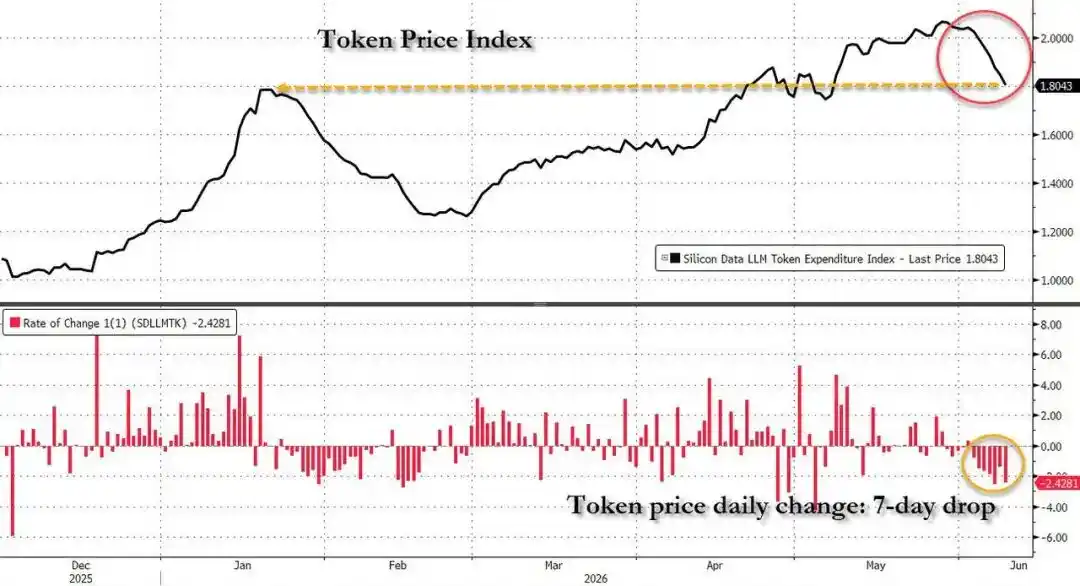
The core of this discussion is no longer just a single price-cut decision, but a more fundamental question: As the narrative of "more Token consumption is better" reaches its end, who will tell the next commercialization story for the AI industry, and how will it be told?

01

The Initial Three Stages: From Monthly Subsidies to Token Bills

The commercialization of generative AI has undergone a clear three-phase evolution in just three years.

Stage One: Monthly and Annual Subscriptions set the industry baseline. In February 2023, OpenAI launched ChatGPT Plus with a monthly fee of $19.99, pioneering paid C-end access for large models; Baidu, Alibaba, and Tencent followed suit, making fixed-fee subscriptions the standard for early-stage business models.

Stage Two: The subsidy war erupted in full force. To boost ARR (Annual Recurring Revenue), the core anchor for financing valuations, major players turned to large-scale subsidies: Google offered students 15 months of Gemini Advanced for free, OpenAI launched a Team membership plan at $1 for the first month, ByteDance's Doubao entered the market with pricing "99.3% lower than the industry standard," and Baidu announced its core models would be free. The essence of subsidies was trading losses for growth—reportedly, Microsoft lost an average of over $20 per user per month under the GitHub Copilot subscription model, with some heavy users costing up to $80 a month in losses.

Stage Three: The forced switch to usage-based billing. On June 1, 2026, Microsoft announced that all GitHub Copilot plans would officially transition to Token-based billing, converting the $19 monthly fee directly into an equivalent Token credit. This change brought the true costs long hidden by subscription models into the open—according to user calculations in the Reddit community, a single agent programming session could consume $30 to $40, depleting a monthly plan in just one use.

02

Bill Out of Control: When Tokens Cost More Than People

The implementation of Token-based pay-as-you-go billing fully revealed the true face of enterprise AI expenditure.

The numbers on the enterprise side are staggering. Uber COO Andrew Macdonald publicly stated in May 2026 that the link between the growth in Token consumption and substantive product improvement "does not yet exist," and even coined a term for it: "tokenmaxxing," describing employees performing valueless tasks to boost usage metrics.

More direct data: Uber exhausted its annual Token budget in just the first four months of 2026; Salesforce expects to pay Anthropic around $300 million for the full year.

Anthropic's own developer documentation shows that developers using Claude Code incur an average cost of about $13 per workday, with 90% of users having daily costs below $30—translating this, a 10-person development team could spend over $75,600 per year on Token fees alone.

The return on investment is equally alarming. Enterprise data platform Entelligence.AI, after aggregating data from 2,444 companies, found that for every $1 spent on AI Token fees, only 18 cents generated actual value that reached users; 44 cents were used to fix bugs introduced by the AI itself, 27 cents went towards rework, and 11 cents were consumed by review friction.
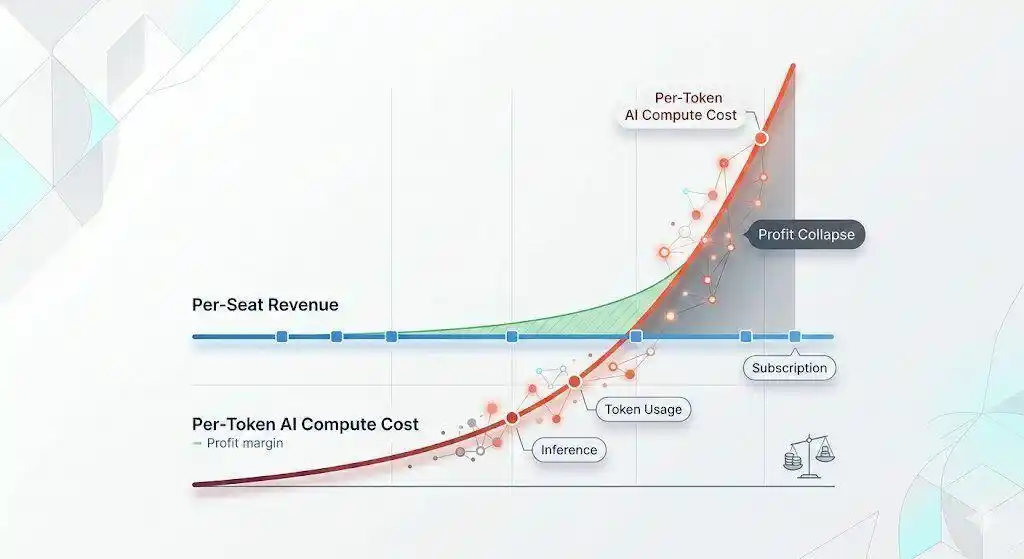
Faced with runaway bills, enterprises have begun proactive control measures. Amazon halted internal AI usage leaderboards, instructing employees "not to use AI just for the sake of using it"; Microsoft plans to gradually phase out Claude Code subscriptions for employees in some key product divisions. Goldman Sachs notes that some companies' spending on AI Tokens already accounts for 10% of their total employee labor costs, and this proportion could rise further in the coming quarters. This isn't about demand disappearing, but the end of the era of reckless AI spending.

03

Act Four: Price War Ignited, OpenAI Considers Major Price Cuts

It is against this backdrop that the fuse for a price war was lit.

According to The Wall Street Journal, Altman's consideration of price cuts was directly triggered by the pressure to catch up with Anthropic. Anthropic's revenue has grown significantly recently, its programming tool Claude Code has become popular among software engineers, and this five-year-old startup's valuation has even surpassed OpenAI's for the first time.

However, the cost of this price war will be exceptionally heavy. If prices are significantly lowered, it will further compress the already negative profit margins of both companies, and the competitive landscape offers very limited room for maneuver.

And a fundamental risk long identified by investors is that OpenAI and Anthropic's products are highly substitutable; clients can easily switch from one to the other—meaning price cuts, even if they retain customers in the short term, cannot truly build a moat and only delay market share loss.

This dilemma also transmits outwards through the financial cycle between cloud computing giants and AI labs.

According to corporate disclosure documents compiled by The Information, OpenAI and Anthropic together account for over half of the approximately $2 trillion in future cloud service commitments from Microsoft, Oracle, Google, and Amazon. If price cuts lead to downward revisions in revenue expectations, this transmission chain will face pressure from both ends.

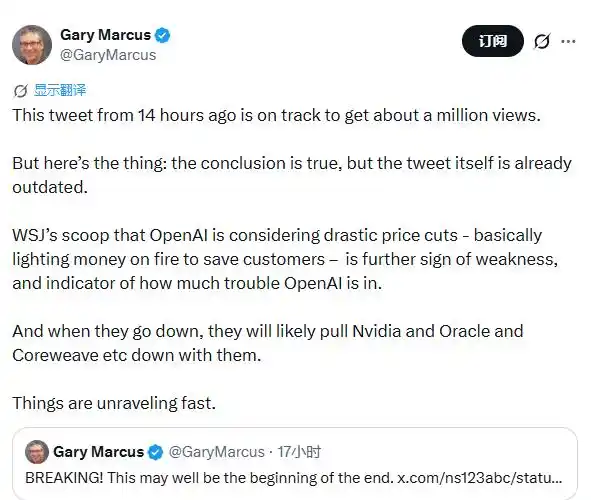
American neuroscientist and AI expert Gary Marcus said: "This further exposes the fragility of OpenAI and indicates how serious the predicament it faces is. If OpenAI goes into decline, it could very likely drag down companies like Nvidia, Oracle, Coreweave. The situation is deteriorating rapidly."
A divergence of views is playing out openly on Wall Street. JPMorgan TMT analyst Mark Schilsky believes the current billing anxiety is merely a "minimum speed bump on the road to higher spending": if the average price per million tokens falls, but the penetration rate of paid AI among US companies continues to rise, overall token usage will mathematically increase substantially; coupled with agentic AI pushing single-task token consumption to several times that of traditional Q&A modes, long-term total expenditure is expected to be significantly higher than current levels.

Goldman Sachs semiconductor analyst Jim Covello holds a more pessimistic view, believing that the current industry chain prosperity has directed almost all value towards semiconductor companies, a phenomenon "unprecedented in history and unsustainable." Once enterprises face the true price of usage-based billing, the capital flows supporting GPU procurement and model training could face a reversal.

04

Act Five: The Next Story for Token Economics?

After the price war, the next chapter of AI industry commercialization has yet to be written, but its outline is emerging.

A report from Citadel Securities offers a directional framework: tiered pricing and charging based on scarcity. Its core logic is that inference-intensive frontier AI won't disappear but will increasingly concentrate in the hands of a few large enterprises capable of bearing the compute costs; for the broader range of enterprises, simpler models might be a more productive path until physical constraints ease. This implies AI usage will move towards stratification—high-value, complex tasks will continue to use frontier models, while routine and batch tasks will shift towards cheaper or local models.

JPMorgan holds a relatively optimistic judgment: even if the per-unit token price falls, the proliferation of agentic AI will multiply token consumption per task—existing data shows that after agentification, token consumption per task can become 3.5 times the original—potentially still expanding the overall expenditure scale. The current billing anxiety might just be a "minimum speed bump on the road to higher spending."

Nebius Chief Revenue Officer Marc Boroditsky proposed the concept of "valuemaxxing," advocating for the industry to shift from pursuing Token consumption maximization to making every Token truly generate value. This direction is gradually becoming an industry consensus—but true commercial implementation still requires AI labs to find a pricing system that both reflects the true cost and is acceptable to enterprise clients. This is precisely the core unresolved proposition in all current debates.

However, perhaps the most overlooked variable in this price war is Chinese models.

According to June data from American corporate spend management platform Ramp, DeepSeek has topped the list for growth in US enterprise software subscriptions. Ramp Chief Economist Ara Kharazian specifically emphasized that this is not about local deployment of open-source models, but rather "enterprises are directly sending and receiving data through DeepSeek," indicating real paid direct usage—he admitted "did not anticipate US companies would go and use DeepSeek." According to third-party estimates, DeepSeek V4-Pro's API price is about one-tenth that of GPT-5.5, and about one-eleventh that of Claude Opus 4.7.
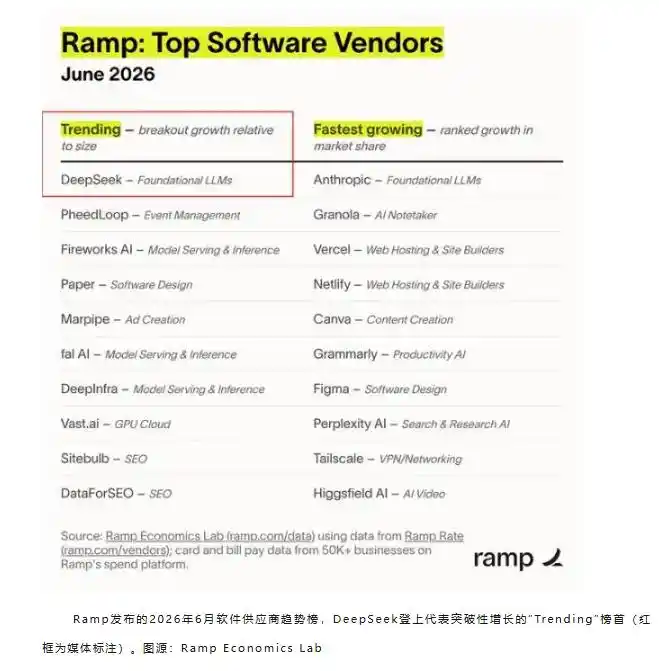
As OpenAI and Anthropic, two tigers, fight, the ultimate beneficiary might be the player that has long embedded "accessible pricing" into its DNA and doesn't need to answer to IPO investors about profit margins. This may not be the most popular ending for this price war, but it is becoming an increasingly hard-to-ignore reality.

This article is from the WeChat public account "Hard AI," author: Xu Chao

Criptos en tendencia

Preguntas relacionadas

QAccording to the article, what are the three main stages of generative AI's commercialization evolution?

AThe article outlines three stages: 1) Monthly/annual subscription plans establishing the baseline, like ChatGPT Plus. 2) A comprehensive subsidy war to drive user growth and valuations, with companies offering free or heavily discounted access. 3) The mandatory switch to usage-based (Token) billing, which exposed the true costs previously hidden by flat-rate subscriptions.

QWhat is 'tokenmaxxing' as mentioned in the article, and what problem does it highlight for businesses?

A'Tokenmaxxing' is a term coined by Uber's COO, describing the behavior where employees perform valueless tasks just to increase AI Token usage. It highlights the problem that increased Token consumption does not necessarily correlate with meaningful productivity gains or product improvements, leading to wasteful and uncontrolled AI spending for enterprises.

QWhy is a potential price war between OpenAI and Anthropic described as particularly costly and risky in the article?

AA price war is risky because both companies are already losing billions on the massive compute power required for AI systems. Lowering prices would further squeeze their negative profit margins. Furthermore, their products are highly substitutable, meaning price cuts may temporarily retain customers but do not build a sustainable competitive moat, potentially just delaying market share loss without solving the core profitability issue.

QWhat new pricing or usage frameworks are suggested as potential next chapters for AI commercialization after a price war?

AThe article suggests frameworks like tiered pricing based on scarcity/value, where advanced, compute-intensive models are reserved for high-value tasks at large enterprises, while simpler, cheaper models handle routine tasks. Another concept is 'valuemaxxing'—shifting the industry focus from maximizing Token consumption to ensuring each Token delivers actual value. Morgan Stanley also suggests that the rise of agentic AI could multiply Token use per task, potentially offsetting unit price declines.

QHow does the article characterize the role of Chinese AI models, specifically DeepSeek, in the current competitive landscape?

AThe article presents Chinese models like DeepSeek as a significant and often overlooked variable. It notes DeepSeek's API is priced at roughly one-tenth of GPT-5.5 and one-eleventh of Claude Opus. Data shows DeepSeek topping U.S. enterprise software subscription growth, indicating real paid adoption. The article suggests that while OpenAI and Anthropic compete, the ultimate beneficiary might be a player like DeepSeek, which has 'inclusive pricing' in its DNA and less immediate pressure to show profitability to IPO investors.

Lecturas Relacionadas

U.S. Tech Momentum Stocks Post Largest Single-Day Gain Ever, But Is the Plunge Over?

US tech momentum stocks staged a sharp rebound on Tuesday (July 21st). Morgan Stanley's TMT Momentum Factor surged over 12%, marking its largest single-day gain on record, exceeding even peaks from the 2000 dot-com bubble. Key momentum indices from Goldman Sachs also posted their strongest daily performances in years. The rally was led by semiconductors, with the Philadelphia Semiconductor Index jumping 4.6%. This rebound followed three consecutive down days and a cumulative 33% plunge in momentum stocks, one of the steepest drawdowns since the dot-com era. Analysts attribute the surge largely to a short squeeze. Heavy selling had pushed high-beta momentum stocks into deeply oversold territory, forcing many short sellers, particularly in Asia, to cover their positions, creating a self-reinforcing buying spiral. However, the rebound's internals appear weak. Trading volume was notably low, and advancing stocks still lagged decliners on the S&P 500, indicating a narrow, concentrated rally rather than broad market participation. Diverging views emerge on the outlook. BTIG warns the bounce has hit key resistance and recommends selling into strength, citing extreme volatility and historical parallels to past market tops. Conversely, Goldman Sachs and UBS believe the momentum unwind is nearing its end, suggesting it may be time to gradually add exposure, as positioning has been significantly reduced. They caution, however, that high volatility warrants a measured approach, potentially using defined-risk strategies. The upcoming earnings season, particularly reports from major tech firms like Alphabet, is seen as a critical test for the rally's sustainability. Simultaneously, bond markets flashed a warning, with yields rising partly due to spiking oil prices. Analysts note that if long-term Treasury yields break decisively higher, it could pose a significant headwind for equities, especially growth stocks.

marsbitHace 7 min(s)

U.S. Tech Momentum Stocks Post Largest Single-Day Gain Ever, But Is the Plunge Over?

marsbitHace 7 min(s)

U.S. Tech Momentum Stocks Record Largest Single-Day Gain Ever, but Has the Rout Ended?

U.S. tech momentum stocks staged a dramatic rebound on Tuesday, July 21st. Key momentum indices like the Morgan Stanley TMT Momentum Factor and Goldman Sachs' High Beta Momentum Long Index posted historic or near-historic single-day gains, fueled largely by semiconductor stocks. This sharp rally followed a severe three-day sell-off that saw momentum stocks plunge 33%, marking one of the steepest pullbacks since the dot-com bubble. Analysts attribute the bounce primarily to a short squeeze, as forced covering from over-leveraged traders, particularly in Asia, created a buying spiral. However, the rally's health is questioned due to weak market breadth—overall trading volume was low, and decliners outnumbered advancers in the S&P 500 despite the index's gain—suggesting a narrow, concentrated surge rather than broad recovery. Opinions on the sustainability diverge. BTIG strategists warn the rebound has hit key resistance levels, citing extreme volatility and historic stock dispersion as signs of an ongoing broader correction, and recommend selling into strength. Conversely, Goldman Sachs and UBS view the aggressive momentum unwinding as nearing its end, noting reduced positioning and a lack of new fundamental catalysts. They suggest the sell-off presents a selective opportunity to add exposure, albeit cautiously and gradually using defined-risk strategies. The immediate trajectory hinges on the ongoing earnings season, with market focus on Alphabet's capital expenditure guidance for AI investment clarity. Meanwhile, bond markets present a risk, with rising Treasury yields—potentially heading toward 5.5%—and widening credit spreads for mega-cap tech companies posing a threat to equity valuations. The combination of technical factors, earnings results, and macro conditions leaves the durability of the rebound in doubt.

链捕手Hace 10 min(s)

U.S. Tech Momentum Stocks Record Largest Single-Day Gain Ever, but Has the Rout Ended?

链捕手Hace 10 min(s)

Long-Divided Must Unite, Long-United Must Divide: When L1 Becomes Its Own Rollup, What Is Ethereum's Endgame?

"The Inevitable Cycle: When L1 Becomes Its Own Rollup – What is Ethereum's Endgame?" For years, the Ethereum community grappled with concerns that L2s were fragmenting the ecosystem and eroding L1's value. While L2s provided cheaper execution, they also splintered liquidity and the unified user experience of a single chain. This has prompted a fundamental reassessment of the relationship between L1 and L2. Ethereum's roadmap is evolving. The "Scale" initiative merges L1 and L2 expansion into a holistic framework. L1 itself is advancing with higher gas limits, statelessness, and zkEVM verification, no longer content to be just a low-throughput settlement layer. Consequently, the primary value proposition of L2s is shifting from merely providing cheap blockspace to offering L1 cannot easily provide: application-specific optimizations, privacy features, and flexible governance models. L2s are becoming a spectrum of execution environments with varying degrees of security inheritance from Ethereum. A critical challenge in this multi-chain future is interoperability. The vision is to make Ethereum "feel like one chain again." This relies on advancements in native account abstraction (like EIP-7702) and intent-based architectures (Open Intents Framework), where users declare desired outcomes, and solvers handle the complex cross-chain execution. Furthermore, shortening Ethereum's finality time from minutes to seconds is crucial, as it underpins trust between chains for bridges, stablecoins, and cross-chain applications. Perhaps the most provocative idea is that Ethereum L1 itself could become a form of "its own Rollup." As zkEVM and proof systems mature, high-performance nodes could execute transactions and generate validity proofs. Regular validators would then verify these proofs instead of re-executing all transactions. This blurs the traditional L1/L2 hierarchy, making "Rollup" more of a general execution-verification architecture. Native Rollup aims to integrate L2 validation more directly into the Ethereum protocol, allowing L2s to inherit L1's security more fully and move away from reliance on security councils. In the end, L2s are not destined to replace L1 or be made obsolete by it. The likely future is a unified system where diverse execution environments—each optimized for specific use cases like DeFi, gaming, or privacy—coexist. They will share a common foundation of security, liquidity, and verifiable state, seamlessly connected to restore a cohesive user experience. The next phase for Ethereum is not just about scaling through separation, but about intelligently reintegrating what was separated back into a coherent whole.

链捕手Hace 26 min(s)

Long-Divided Must Unite, Long-United Must Divide: When L1 Becomes Its Own Rollup, What Is Ethereum's Endgame?

链捕手Hace 26 min(s)

Agent Race Ends, Super Workbench Takes Over

The era of fragmented AI agents is ending. Over the past month, China's tech giants—Tencent, Alibaba, and ByteDance—have simultaneously shifted strategy: instead of launching new, standalone AI agents, they are consolidating their various agent projects into unified "super workbenches." Tencent integrated its QClaw teams into WorkBuddy, a strategic product hailed as a potential third flagship after QQ and WeChat. Alibaba is merging its QoderWork, Wukong, and MuleRun agents into a new "Qianwen Office" platform under DingTalk's leadership. ByteDance rebranded its TRAE SOLO coding agent to TRAE Work, signaling a broader focus on workflow collaboration. This convergence marks a pivotal industry consensus. The initial exploration phase, where companies rapidly built numerous overlapping agents for different scenarios, proved costly and inefficient. With open-source tools eroding technical barriers, competition has shifted from agent creation to resource consolidation and cost control. Historically, platform wars are won not by creating more products, but by simplifying them—as seen with browsers unifying web access and super-apps consolidating services. Now, the "super workbench" aims to become the unified AI entry point for work. This reflects a deeper market realization: the primary audience for AI is no longer just programmers (a market in the tens of millions) but all knowledge workers (a market of billions). The real opportunity lies in augmenting everyday tasks—managing emails, documents, data, and meetings—across the entire workday. The core battleground is becoming control over the primary AI entry point that employees use daily. Tencent's WorkBuddy leverages WeChat and Tencent Docs; Alibaba's Qianwen Office taps into DingTalk's organizational data; ByteDance's TRAE Work integrates with Feishu's workflows. Whoever owns this "super workbench" gains strategic control over orchestrating enterprise data and APIs. This shift is redefining enterprise software. Traditional SaaS applications, valued for their user interfaces, will recede into the background. Their core functionalities will be exposed as standardized "Skills" or APIs for the super workbench's agents to invoke. Software value will shift from selling user seats to charging based on API calls and outcomes delivered. The evolution of agents is moving through clear stages: first as novel standalone products, then as consolidated primary work entry points, and finally as pervasive, invisible capabilities embedded into the digital fabric. The recent moves by major tech firms signal the transition from the first stage into the second, accelerating toward the third. In the end, the most successful agent technology may become invisible—like electricity or the HTTP protocol—a fundamental, unnamed infrastructure powering work itself.

marsbitHace 53 min(s)

Agent Race Ends, Super Workbench Takes Over

marsbitHace 53 min(s)

Trading

Spot

Artículos destacados

Cómo comprar WAR

¡Bienvenido a HTX.com! Hemos hecho que comprar WAR (WAR) sea simple y conveniente. Sigue nuestra guía paso a paso para iniciar tu viaje de criptos.Paso 1: crea tu cuenta HTXUtiliza tu correo electrónico o número de teléfono para registrarte y obtener una cuenta gratuita en HTX. Experimenta un proceso de registro sin complicaciones y desbloquea todas las funciones.Obtener mi cuentaPaso 2: ve a Comprar cripto y elige tu método de pagoTarjeta de crédito/débito: usa tu Visa o Mastercard para comprar WAR (WAR) al instante.Saldo: utiliza fondos del saldo de tu cuenta HTX para tradear sin problemas.Terceros: hemos agregado métodos de pago populares como Google Pay y Apple Pay para mejorar la comodidad.P2P: tradear directamente con otros usuarios en HTX.Over-the-Counter (OTC): ofrecemos servicios personalizados y tipos de cambio competitivos para los traders.Paso 3: guarda tu WAR (WAR)Después de comprar tu WAR (WAR), guárdalo en tu cuenta HTX. Alternativamente, puedes enviarlo a otro lugar mediante transferencia blockchain o utilizarlo para tradear otras criptomonedas.Paso 4: tradear WAR (WAR)Tradear fácilmente con WAR (WAR) en HTX's mercado spot. Simplemente accede a tu cuenta, selecciona tu par de trading, ejecuta tus trades y monitorea en tiempo real. Ofrecemos una experiencia fácil de usar tanto para principiantes como para traders experimentados.

218 Vistas totalesPublicado en 2024.12.11Actualizado en 2026.06.02

Cómo comprar WAR

Discusiones

Bienvenido a la comunidad de HTX. Aquí puedes mantenerte informado sobre los últimos desarrollos de la plataforma y acceder a análisis profesionales del mercado. A continuación se presentan las opiniones de los usuarios sobre el precio de WAR (WAR).

活动图片













