Examining if STABLE’s uptrend is sustainable after its latest 5% price hike

ambcryptoPublicado a 2026-06-26Actualizado a 2026-06-26

Resumen

STABLE has shown notable resilience and strength against a weak broader crypto market, recently surging over 5% to trade around $0.362 while defending key support at $0.33. Its bullish structure is supported by trading above key moving averages, a rising Stochastic Momentum Index, and a significant negative Spot Netflow indicating strong sustained demand, with daily outflows exceeding inflows. However, the uptrend faces sustainability concerns. A persistently negative Price DAA Divergence for seven consecutive days reveals weak network usage and low user engagement, signaling underlying structural weakness. This historically increases the risk of a price correction. While strong demand could propel STABLE to close above $0.36 and challenge the $0.40 resistance, failure to maintain momentum could trigger a pullback toward the $0.32 support level.

While the broader crypto market has shown significant weakness, STABLE has consistently held up. As the market crashed on 24th June, STABLE defended the $0.33-support and climbed to a local high of $0.365.

At the time of writing, STABLE was trading at around $0.362, up 5.5% over the past 24 hours in addition to its 7% weekly gains.

At the same time, the trading volume of the altcoin rose by 25% to $20.8 million, indicating an uptick in market participation.

Why is STABLE holding up?

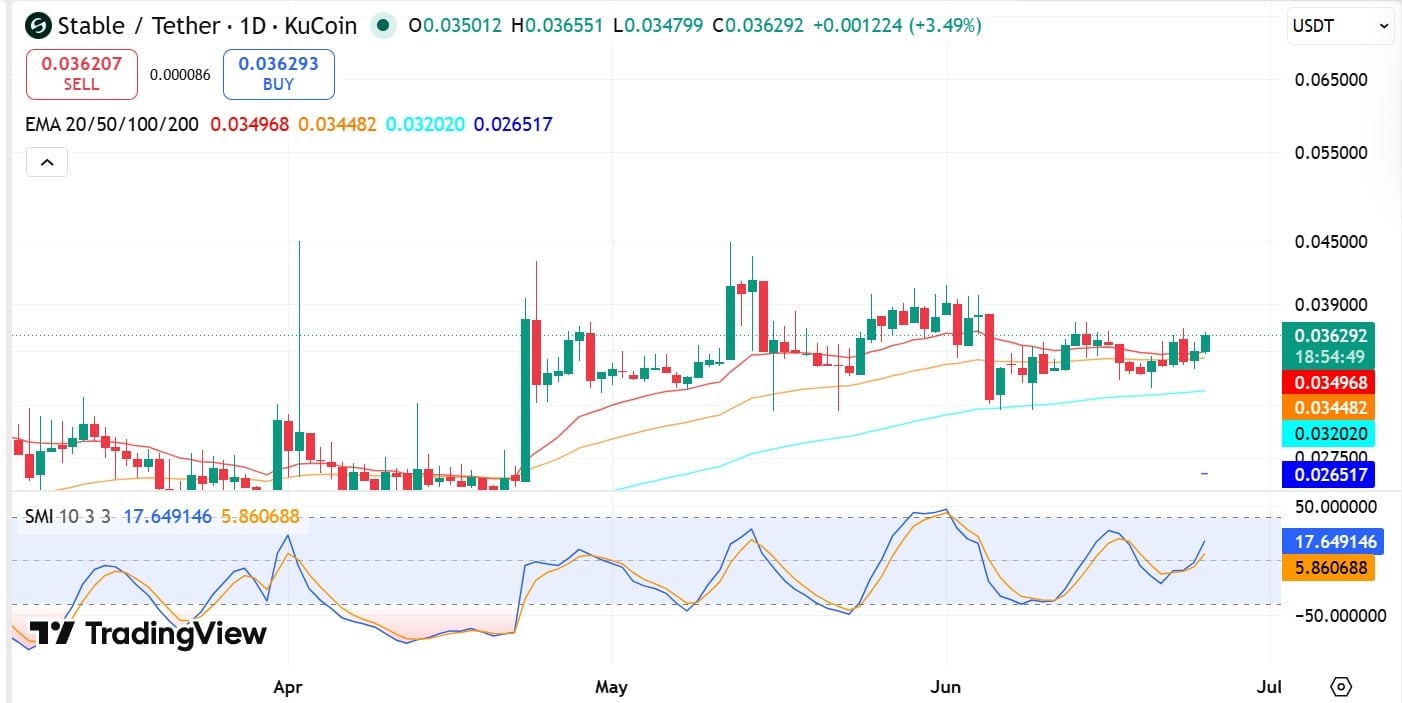
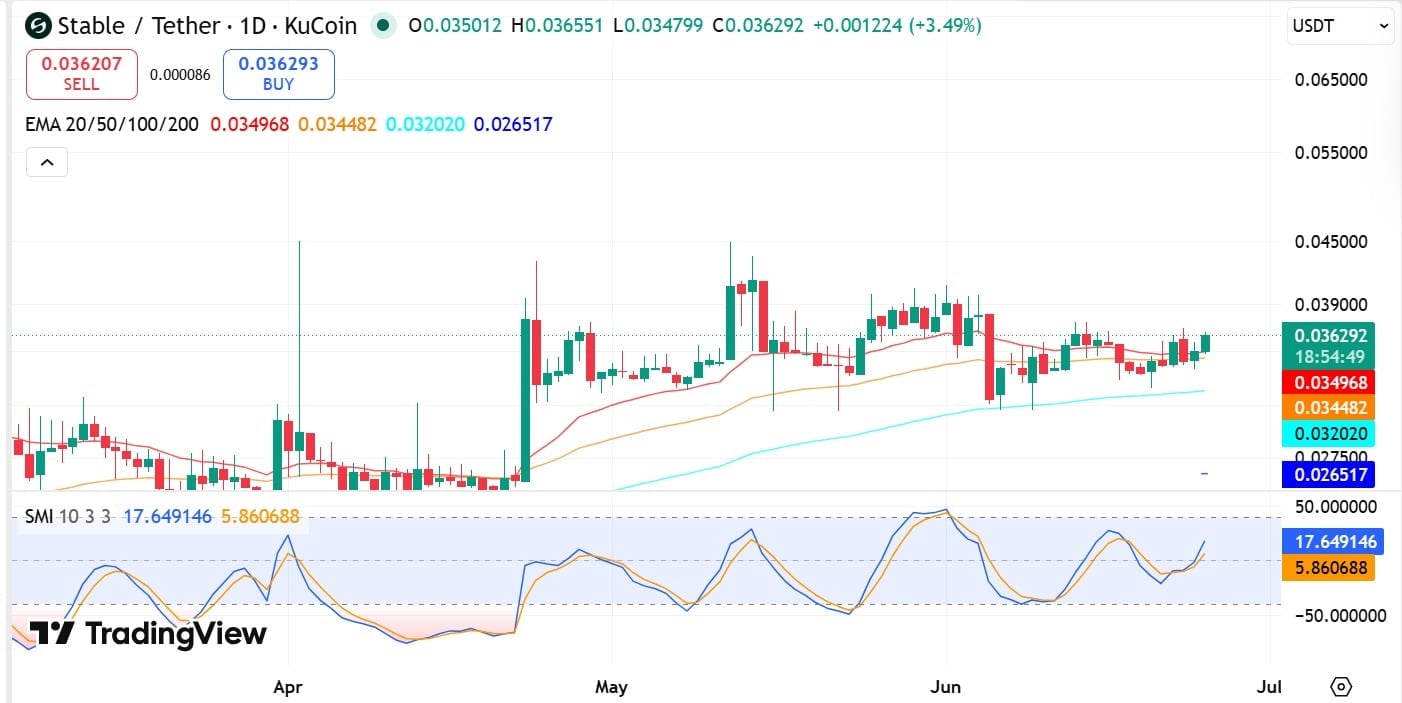
STABLE’s daily charts underlined a strengthening bullish structure. The altcoin jumped above its 20 and 50-day EMAs at $0.349 and $0.344, respectively.

In doing so, the altcoin clearly sat above both its short and long-term moving averages, confirming the trend’s strength on the charts.
Source: Tradingview

The Stochastic Momentum Index further validated these market conditions. The SMI indicator rose to 17, while its signal rose to 7. Although the SMI remained within the bearish zone, its upward trajectory reflected improving momentum and buyer presence.

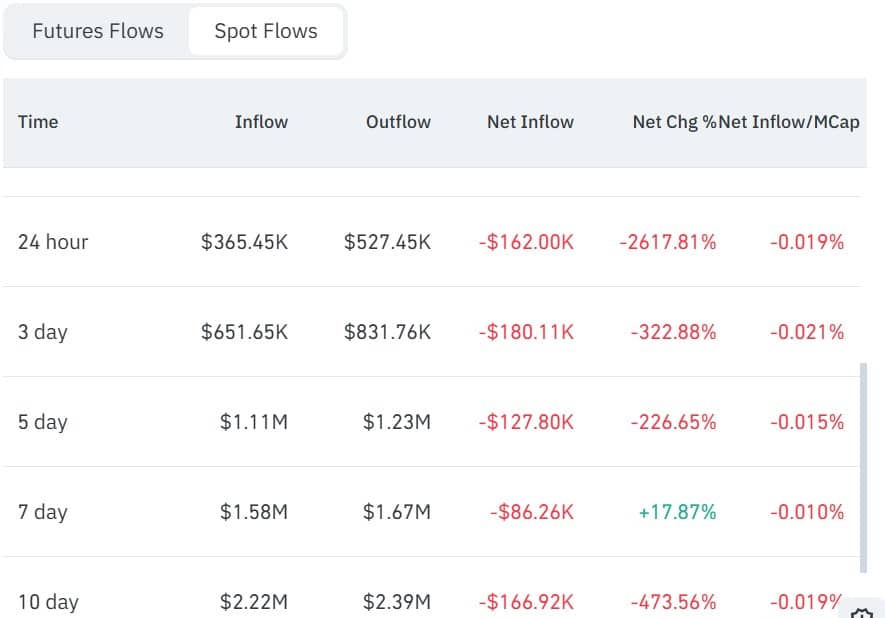
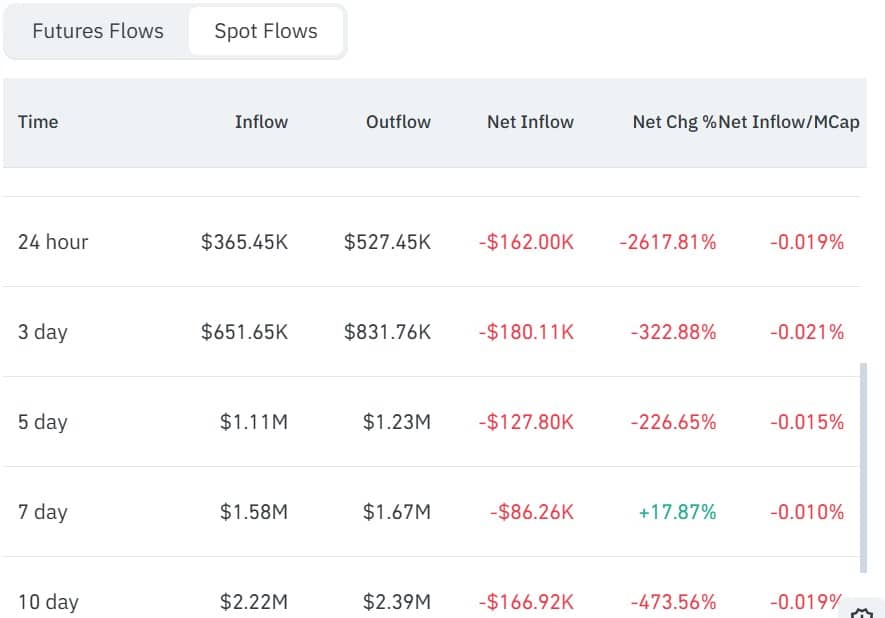
The spot activity further confirmed this point of view. The altcoin’s Spot Netflow extended its stay in negative territory, holding there for seven consecutive days.
Source: Coinglass

That’s not all though as over the last 24 hours, Spot Outflows rose to $527K while Inflows dropped to $365K. As a result, Netflow plunged 2617% to -$162K – A clear sign of sustained demand.

Therefore, it’s suitable to say that the altcoin has recently shown relative strength, largely driven by sustained spot demand.

Is the network’s sustainability of concern?

Although STABLE has been exhibiting some strength, demand-wise, the market did raise some concerns.

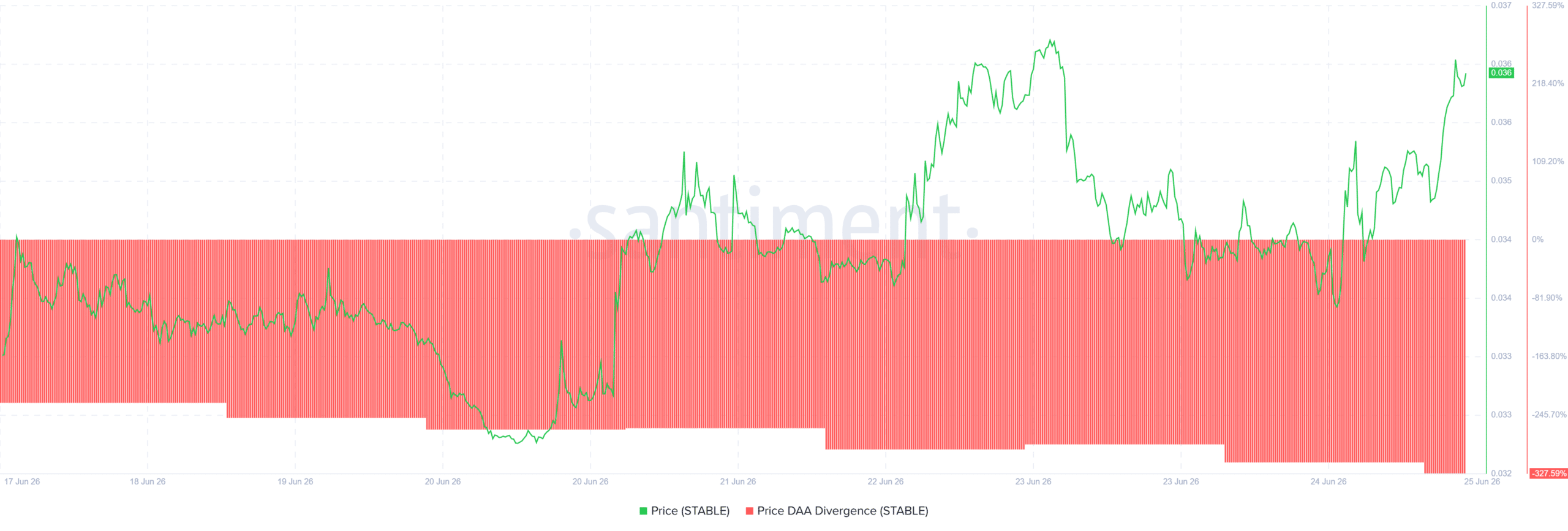
For starters, the network’s usage remains extremely weak. For instance, a look at STABLE’s Price DAA Divergence revealed that the metric has remained negative for 7 consecutive days.
Source: Santiment

A negative DAA Divergence means that Active Addresses have been failing and have not kept up with the price. User engagement often leads to weak network fundamentals, implying the uptrend lacks stronger user participation.

Historically, such structural weaknesses have extensively increased the risk of price correction.

Can the altcoin’s upside momentum hold?

STABLE exhibited relative strength, driven by strong market demand. With upside momentum holding up, the altcoin might be positioned for further gains too.

Therefore, under these conditions, STABLE will close above $0.36 and flip its $0.40-resistance.

However, as was observed, pullback risks remain due to structural weakness. If the bulls’ attempt fails and the price fails to close above $0.36, a retrace will follow.

Another pullback will see the altcoin drop below $0.34 and seek immediate support at $0.32.


Final Summary

  • STABLE surged by 5% and successfully defended $0.33, hiking to a local high of $0.36 amid sustained demand.
  • Altcoin remains structurally weak, with low user engagement posing a risk for another pullback towards $0.32.


Preguntas relacionadas

QWhat are the key price levels mentioned for STABLE in the article?

AThe article mentions STABLE defending the $0.33 support, climbing to a local high of $0.365, and trading at around $0.362 at the time of writing. It identifies a key resistance level at $0.40 and suggests a potential pullback support level at $0.32.

QWhat technical indicators are cited as evidence of STABLE's bullish structure?

AThe article cites STABLE trading above its 20-day EMA ($0.349) and 50-day EMA ($0.344) as confirmation of a strengthening bullish trend. It also mentions the upward trajectory of the Stochastic Momentum Index (SMI) from low levels, reflecting improving momentum.

QWhat on-chain metric raises concerns about the sustainability of STABLE's uptrend?

AThe article highlights the consistently negative Price DAA (Daily Active Addresses) Divergence for seven consecutive days. This indicates that user engagement (active addresses) is not keeping pace with the price increase, suggesting weak network fundamentals and a risk of correction.

QWhat does the spot market activity data (Netflow) indicate about STABLE's recent demand?

AThe Spot Netflow data shows sustained negative values for seven days, with a significant plunge to -$162K in the last 24 hours due to outflows exceeding inflows. The article interprets this negative netflow as a clear sign of sustained demand, as more tokens are being withdrawn from exchanges than deposited.

QWhat are the potential price scenarios for STABLE outlined in the article's conclusion?

AThe article presents two scenarios: 1) If bullish momentum holds, STABLE could close above $0.36 and challenge the $0.40 resistance level. 2) If the bullish attempt fails and the price fails to hold above $0.36, a pullback could occur, potentially driving the price below $0.34 towards support at $0.32.

Lecturas Relacionadas

Never expected that the first tangible application of AI x Crypto is in security auditing

Unexpectedly, the initial major application of AI in the Crypto sphere has turned out to be security auditing. In 2026, DeFi has faced significant security challenges, with 121 hacking incidents resulting in approximately $942 million in losses. While AI was expected to first impact areas like quantitative trading, its initial breakthrough has instead transformed security auditing by drastically lowering the cost and skill barrier for finding smart contract vulnerabilities. The traditional audit model is facing obsolescence. Advanced AI models, such as Claude Mythos, enable attackers to scan thousands of contracts and identify vulnerability patterns at scale, compressing the time from discovery to execution to mere minutes. This renders the month-long validity of traditional audit reports ineffective. Notably, attacks now frequently target well-audited, established protocols by exploiting business logic flaws, operational security weaknesses, and even years-old historical contracts, demonstrating that old audit reports offer zero protection. This pressure is forcing a fundamental shift in the industry. In the short term, a wave of defensive re-auditing is occurring, driven by projects seeking to meet new AI-era security standards and regulatory requirements. In the long run, audit firms' business models are diverging. The one-time report delivery model is declining in value, as evidenced by platforms like Code4rena shutting down. Leading firms are now pivoting towards AI-powered defense, integrating continuous monitoring, real-time on-chain risk detection, and embedding security directly into the development phase, as seen with tools like OpenZeppelin's Skills system. Ultimately, the era of "audit once, secure forever" is over. Security must become a continuous, embedded infrastructure investment for projects. For audit companies, survival depends on proactively transforming from traditional service providers into platforms offering AI-native, ongoing security solutions.

链捕手Hace 7 min(s)

Never expected that the first tangible application of AI x Crypto is in security auditing

链捕手Hace 7 min(s)

Who's Paying for the $64 Billion Paper Feast?

"The Illusion of Wealth: Who Bears the Burden of the $64 Billion Paper Bonanza?" Bitcoin recently broke below the critical $60,000 support level, triggering significant selling by major holders. While the price drop itself is concerning, a deeper issue lies with publicly traded companies that have bet their entire balance sheets on Bitcoin, creating a precarious financial link between their stock prices and crypto valuations. Leading the pack is Strategy (formerly MicroStrategy), holding 847,000 BTC at an average cost of ~$75,600, now facing over 20% unrealized losses. Its stock trades at a deep discount to its Bitcoin holdings. Other companies like Japan's Metaplanet (nearly 40% unrealized loss) and Solmate (which fully pivoted to Solana and saw its stock collapse 98%) illustrate the risks of this model without underlying business operations. A key misconception is that these firms face immediate, forced liquidation. Their debt structures provide a buffer. However, the core "financial flywheel" is stalling. Strategy's CEO has even hinted at potentially selling Bitcoin to cover obligations—a reversal of his long-standing "never sell" doctrine. New accounting rules (ASU 2023-08) exacerbate the problem, requiring quarterly mark-to-market adjustments. Bull markets create paper profits, attracting capital. In bear markets, they generate massive paper losses, potentially triggering index exclusions and forced selling by passive funds. The true crisis point is not the current price, but a looming debt reckoning. If Bitcoin fails to recover above key cost bases within 12-24 months, convertible note redemption windows opening in Fall 2027 could force companies to sell massive Bitcoin holdings for cash, potentially triggering a severe liquidity crisis. The model hasn't eliminated risk; it has merely transformed instant, price-triggered liquidation into a slow-burning, time-triggered debt crisis.

marsbitHace 17 min(s)

Who's Paying for the $64 Billion Paper Feast?

marsbitHace 17 min(s)

Base Halts for Two Hours: A Single Invalid Block Reveals the Centralized Reality of L2s

Base, an Ethereum Layer-2 Rollup, experienced a two-hour network outage starting around 00:03 UTC on June 26. The halt was caused by a consensus issue that led to an invalid block being sequenced, which prevented the generation of new blocks after block 47806542. The team identified the problem, restored block sequencing by 01:51 UTC, and confirmed full recovery of ecosystem infrastructure synchronization shortly after. This incident highlights the operational reality for many L2s: while they leverage Ethereum for security and data availability, their day-to-day usability heavily depends on their sequencer and internal systems. Base employs a high-availability sequencer system with one active leader, but this setup did not prevent the outage when a consensus-level problem arose. This follows a previous 33-minute outage in August 2025 related to a faulty sequencer handover process. The downtime occurred near the scheduled activation window for the "Beryl" network upgrade, which has since been postponed. Beryl introduces the native B20 token standard, among other improvements. The incident has sparked renewed discussion about Base potentially launching its own network token in the future, shifting the conversation from mere speculation to questions about how a token might relate to sequencer decentralization, governance, and accountability in such failure scenarios.

Foresight NewsHace 37 min(s)

Base Halts for Two Hours: A Single Invalid Block Reveals the Centralized Reality of L2s

Foresight NewsHace 37 min(s)

Trading

Spot
活动图片