Berkshire Hathaway's Q2 13F Portfolio Reshuffle: Increased Stakes in Google and Delta Air Lines, Consecutive Quarter of Cutting Bank of America

marsbitPublicado a 2026-08-16Actualizado a 2026-08-16

Resumen

Berkshire Hathaway's second-quarter 13F filing, released August 14th, reveals significant portfolio shifts under new leadership. The total portfolio value rose to approximately $299.3 billion. Key highlights include a major increase in Alphabet (Google) holdings. Berkshire's stake in Google-A surged 45.24% to $28.16 billion, while its Google-C holdings jumped 658% to $9.61 billion, making Alphabet the firm's third-largest combined holding after Apple and American Express. Conversely, Bank of America was the largest reduction, with shares cut by 5.89% for the second consecutive quarter, though it remains the fifth-largest holding. Berkshire also increased positions in Delta Air Lines (up 44%) and homebuilder Lennar, while initiating a small new position in D.R. Horton. The consumer sector saw Constellation Brands completely sold off. Overall, the portfolio reflects a continued move toward technology and specific cyclical sectors like housing and airlines, while trimming some financial and consumer stakes. Apple remains the top holding at 22% of the portfolio.

Author: Wall Street News

Following 'Oracle of Omaha' Warren Buffett's resignation as CEO, Berkshire Hathaway has released its second 13F filing.

According to documents disclosed on August 14, Eastern Time, Berkshire's 13F equity portfolio value was approximately $299.3 billion at the end of the second quarter, an increase of 12.09% from approximately $263.1 billion at the end of the first quarter. Overall, Berkshire initiated a position in 1 new stock, added to 7 stocks, reduced holdings in 6 stocks, and completely exited 1 stock in the second quarter.

It is evident that under the leadership of Greg Abel, Berkshire has been continuously increasing its bets on Alphabet, housing, and airlines, while gradually trimming traditional financials and some consumer holdings.
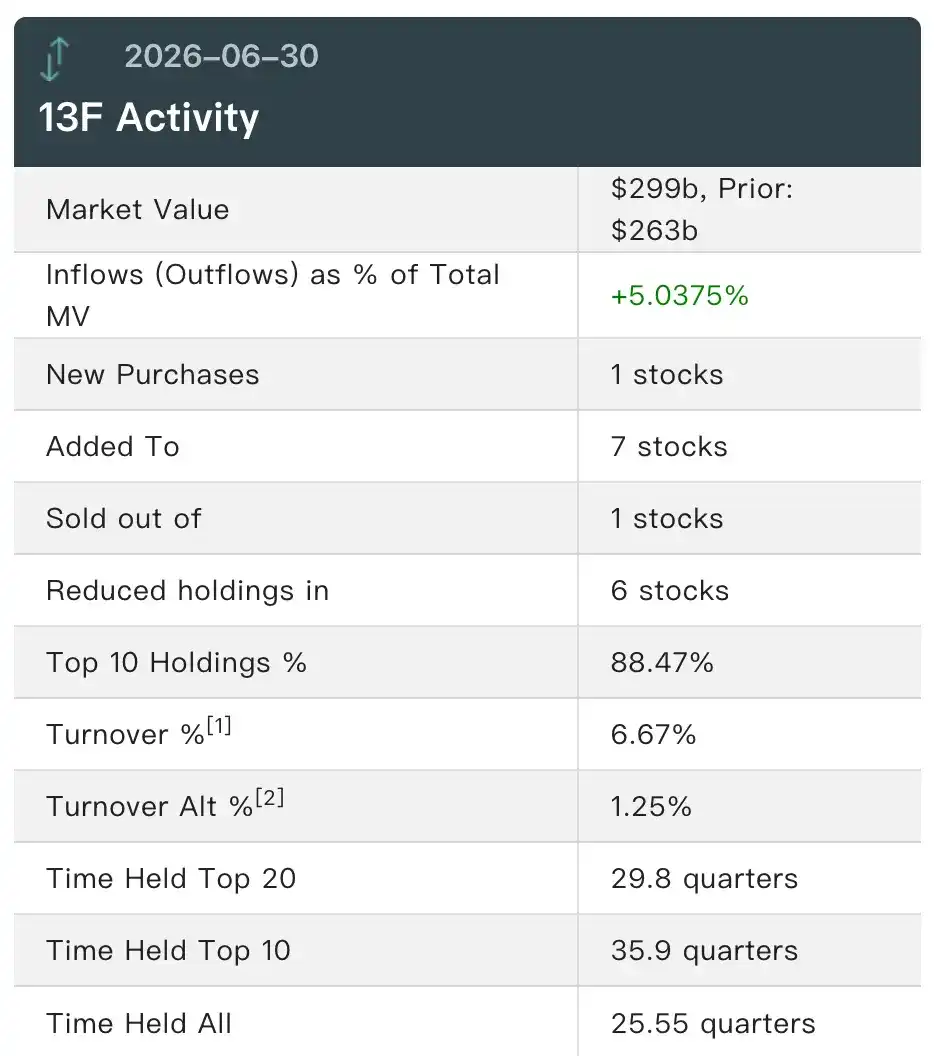
When consolidating Alphabet's two share classes, Berkshire's current top ten holdings are Apple, American Express, Alphabet, Coca-Cola, Bank of America, Chevron, Occidental Petroleum, Chubb, Moody's, and Kraft Heinz.
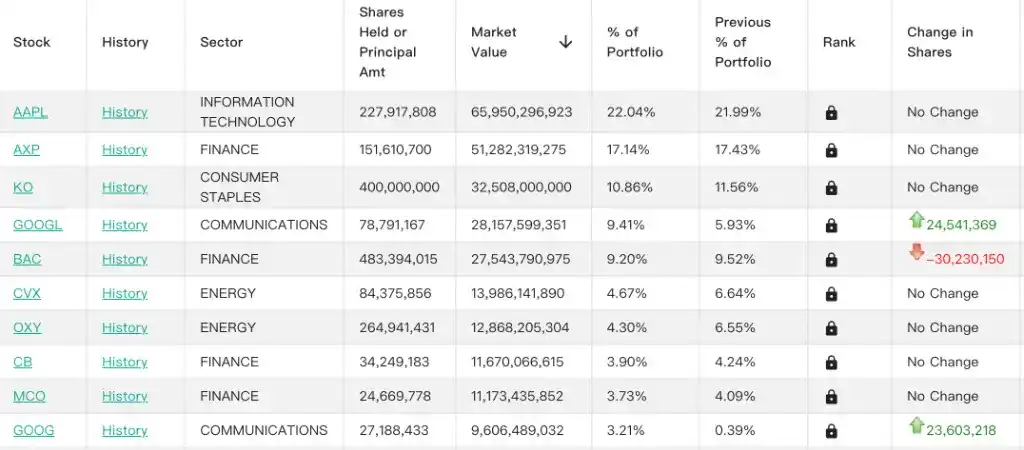
Apple remains Berkshire's largest holding, with a portfolio value of approximately $65.950 billion, accounting for about 22% of the 13F portfolio value. American Express ranks second with a value of approximately $51.282 billion, a 17.14% share. The combined Alphabet holds the third position. Coca-Cola and Bank of America rank fourth and fifth, respectively.

In the second quarter of this year, Berkshire continued to significantly increase its stake in Alphabet (Google's parent company). Berkshire added approximately 24.54 million shares of Alphabet-A, an increase of 45.24%, bringing the total holding to about 78.79 million shares valued at approximately $28.158 billion. It also added approximately 23.60 million shares of Alphabet-C, a staggering increase of 658.35%, bringing the total holding to about 27.19 million shares valued at approximately $9.606 billion.

This brings the combined value of Alphabet-A and Alphabet-C to approximately $37.764 billion at the end of Q2, representing about 12.62% of the 13F portfolio value, surpassing Coca-Cola to become Berkshire's third-largest holding after Apple and American Express on a consolidated basis.

Additionally, among the top ten holdings, the only stock that was reduced was Bank of America. In the quarter, Berkshire sold approximately 30.20 million shares (based on the period-end price, the reduction was about 30.23 million shares), a decrease of 5.89%, representing a reduction in value of approximately $1.72 billion. This made Bank of America the largest reduction for the quarter. At quarter-end, Berkshire still held 483 million shares of Bank of America valued at approximately $27.544 billion, accounting for 9.2% of the 13F portfolio value, making it the fifth-largest holding. Bank of America remains a significant investment for Berkshire but has now been reduced for two consecutive quarters.

Otherwise, Berkshire's holdings in the remaining top ten stocks remained unchanged in the second quarter.

Regarding other additions, in the second quarter of this year, Berkshire increased its stake in Delta Air Lines by approximately 17.51 million shares, an increase of about 44%, bringing the total holding to 57.32 million shares valued at approximately $5.369 billion. It added about 3.01 million shares of Lennar Corporation Class A, an increase of nearly 30%, and also added about 60,000 shares of Lennar Corporation Class B. Berkshire increased its stake in Macy's by approximately 4.31 million shares, a 141.82% increase. It slightly added about 550,000 shares of The New York Times Company.

The only new position initiated by Berkshire in the second quarter was D.R. Horton, with a small initiation of 3,564 shares worth approximately $580,000.

Regarding reductions, apart from Bank of America, Berkshire also reduced holdings in Ally Financial, Capital One Financial, kidney dialysis service provider DaVita, grocer Kroger, and steel manufacturer Nucor. The alcoholic beverage producer Constellation Brands, which was significantly reduced in the first quarter, was completely sold off by Berkshire in the second quarter.


Criptos en tendencia

Preguntas relacionadas

QAccording to the 13F filing, which company became Berkshire Hathaway's third largest holding when Google's Class A and C shares are combined?

AAlphabet (Google's parent company) became Berkshire Hathaway's third largest holding, with a combined value of approximately $37.764 billion, surpassing Coca-Cola.

QWhat were the main categories of stocks that saw increased investment from Berkshire Hathaway in Q2 under Greg Abel's leadership?

AUnder Greg Abel's leadership, Berkshire Hathaway increased investments in technology (Alphabet), housing (Lennar, Horton), and airlines (Delta Air Lines).

QWhich stock was the largest reduction for Berkshire Hathaway in Q2 2024, and was this part of a trend?

ABank of America was the largest reduction, with approximately 30.23 million shares sold (worth about $1.72 billion). This was part of a trend, as it was the second consecutive quarter of减持.

QWhat was the total market value of Berkshire Hathaway's 13F stock portfolio at the end of Q2 2024, and how did it change from the previous quarter?

AThe total market value was approximately $299.3 billion at the end of Q2 2024, representing an increase of 12.09% from the approximately $263.1 billion at the end of Q1.

QWhich company did Berkshire Hathaway completely exit (sell its entire position in) during the second quarter of 2024?

ABerkshire Hathaway completely exited its position in Constellation Brands during the second quarter of 2024.

Lecturas Relacionadas

Upbit is Anxious: A Hasty Counterattack Aimed at Regaining Stablecoin Market Share

Title: Upbit's Rushed Counterattack to Reclaim Stablecoin Market Share Facing a dramatic shift in South Korea's stablecoin market, leading exchange Upbit launched a promotional campaign from July 26 to August 9, waiving the 0.05% trading fee for stablecoins paired with the Korean Won (KRW) and rapidly listing new stablecoins like RLUSD and USDG. This move is a direct response to its plummeting market share in this sector. Historically a duopoly with Bithumb, the market has been reshaped since October 2025 when Coinone permanently removed fees for USDC trading. By June 2026, Coinone led with 34.8% of stablecoin volume, followed by Bithumb (31.1%) and Upbit (30.1%). This contrasts sharply with the overall crypto market, where Upbit commands 60%. The data shows stablecoin demand is highly sensitive to fees, as users primarily buy them to transfer capital overseas for derivatives trading or forex arbitrage. South Korean exchanges have seen a net outflow of stablecoins for 18 consecutive months, totaling approximately 14.9 trillion KRW, underscoring their role as a cross-border capital conduit. Upbit's limited-time promotion initially boosted its daily stablecoin volume by 162%, but the surge was almost entirely in USDT (98.1% of volume). The newly listed stablecoins saw negligible, fleeting interest. Furthermore, the promotional effect quickly waned in the second week, with volume dropping 33% on weekdays. A concurrent weakening of the KRW also contributed to the trading spike, independent of the fee waiver. The analysis suggests that once the promotion ends, Upbit is unlikely to retain its temporary gains unless it matches Coinone's permanent zero-fee policy, forcing a choice between market share and fee revenue. Upbit's strategic push may be less about immediate profit and more about preparing for future regulatory shifts. With South Korea's *Digital Asset Basic Act* on the horizon, which will regulate KRW-backed stablecoins, and following Dunamu's (Upbit's parent) integration into Naver Financial to build a payment ecosystem, securing a dominant position in the dollar stablecoin distribution channel holds long-term strategic value. However, potential regulatory conflicts could prevent Upbit from listing a future Naver-issued KRW stablecoin, making the current fight for dollar stablecoin flow even more critical.

marsbitHace 8 min(s)

Upbit is Anxious: A Hasty Counterattack Aimed at Regaining Stablecoin Market Share

marsbitHace 8 min(s)

Michael Saylor Compares Bitcoin and Gold!

Michael Saylor, founder of MicroStrategy, argues that Bitcoin fundamentally changes how wealth is stored and transferred by transforming digital scarcity into economic value. He describes Bitcoin as the first digital monetary network, combining computers, digital networks, and cryptography. It digitizes monetary assets, allowing their supply to be controlled by public protocols rather than institutions, thus converting economic value into information transmissible over global networks. Comparing Bitcoin to gold, Saylor states that while increasing Bitcoin's supply is harder, its integration with software and transfer is easier. He highlights Bitcoin's proof-of-work mechanism, which ties it to the physical world by consuming real energy to secure the ledger, making past transactions immutable. This creates a shared security system involving miners, energy companies, and investors. Saylor suggests "digital monetary energy" is a more accurate term than "digital gold." He emphasizes that the Bitcoin network is an adaptive ecosystem of miners, nodes, developers, and users. Its core design is intentionally simple, focused on maintaining a secure ledger for scarce digital assets, with complex functionalities built in higher-layer applications. This architecture allows Bitcoin to serve as a foundation for transmitting value and fostering innovation in payments and financial services. Saylor notes Bitcoin's deeper impact lies in creating digital sovereignty, where private keys give individuals permissionless control over their economic power, with ownership verified mathematically, not by institutions. He concludes that while gold's physical scarcity makes it money, Bitcoin's digital scarcity does the same, characterizing Bitcoin as the monetary energy of the digital age.

cryptonews.ruHace 1 hora(s)

Michael Saylor Compares Bitcoin and Gold!

cryptonews.ruHace 1 hora(s)

Trading

Spot

Artículos destacados

Qué es $BANK

Banco AI: Un Paso Revolucionario en el Futuro de la Banca Introducción En una era marcada por avances rápidos en tecnología, Banco AI se sitúa en la intersección de la inteligencia artificial (IA) y los servicios bancarios. Este proyecto innovador busca redefinir el panorama financiero, mejorando la eficiencia operativa, las medidas de seguridad y las experiencias del cliente a través del poder de la IA. Al embarcarnos en esta exploración de Banco AI, profundizaremos en lo que implica el proyecto, sus dinámicas operativas, su contexto histórico y hitos significativos. ¿Qué es Banco AI? En su esencia, Banco AI representa una iniciativa transformadora destinada a integrar la inteligencia artificial en varias operaciones bancarias. Este proyecto aprovecha las capacidades de la IA para automatizar procesos, mejorar los protocolos de gestión de riesgos y mejorar la interacción con los clientes a través de servicios personalizados. Los objetivos principales de Banco AI incluyen: Automatización de Funciones Bancarias: Al aprovechar las tecnologías de IA, Banco AI tiene como objetivo automatizar tareas rutinarias, reduciendo la carga sobre los recursos humanos y mejorando la eficiencia. Mejora en la Gestión de Riesgos: El proyecto utiliza algoritmos de IA para predecir e identificar riesgos, fortaleciendo así las medidas de seguridad contra fraudes y otras amenazas. Personalización de Servicios Bancarios: Banco AI se centra en ofrecer productos y servicios financieros a medida al analizar datos y comportamientos de los clientes. Mejoramiento de la Experiencia del Cliente: La implementación de soluciones impulsadas por IA, como chatbots y asistentes virtuales, tiene como objetivo proporcionar a los usuarios interacciones más humanas, revolucionando la forma en que los clientes se relacionan con los bancos. Con estos objetivos, Banco AI se posiciona como un jugador crucial para hacer que la banca sea más eficiente, segura y centrada en el usuario. ¿Quién es el Creador de Banco AI? Los detalles sobre el creador de Banco AI siguen siendo desconocidos. Como tal, no se ha identificado a ninguna persona u organización específica en la información disponible. El anonimato que rodea el inicio del proyecto plantea preguntas, pero no resta valor a su ambiciosa visión y objetivos. ¿Quiénes Son los Inversores de Banco AI? Al igual que con el creador del proyecto, no se ha divulgado información específica sobre los inversores u organizaciones que apoyan a Banco AI. Sin esta información, es un desafío delinear el respaldo financiero y el apoyo institucional que podrían estar impulsando el proyecto hacia adelante. No obstante, la importancia de contar con una sólida base de inversión es fundamental para sostener el desarrollo en un campo tan innovador. ¿Cómo Funciona Banco AI? Banco AI opera en múltiples frentes innovadores, centrándose en factores únicos que lo diferencian de los marcos bancarios tradicionales. A continuación, se presentan las características operativas clave: Automatización: Al aplicar algoritmos de aprendizaje automático, Banco AI automatiza varios procesos manuales dentro de los bancos. Esto resulta en la reducción de costos operativos y permite que los trabajadores humanos redirijan sus esfuerzos hacia actividades más estratégicas. Gestión Avanzada de Riesgos: La integración de la IA en las prácticas de gestión de riesgos equipa a los bancos con herramientas para predecir con precisión amenazas potenciales como el fraude, garantizando que la información y los activos de los clientes permanezcan seguros. Recomendaciones Financieras Personalizadas: A través del aprendizaje continuo a partir de las interacciones con los clientes, los sistemas de IA desarrollan una comprensión matizada de las necesidades del usuario, lo que les permite ofrecer consejos adaptados sobre decisiones financieras. Interacciones Mejoradas con los Clientes: Al utilizar chatbots y asistentes virtuales impulsados por IA, Banco AI permite una experiencia más atractiva para el cliente, permitiendo a los usuarios resolver sus consultas rápidamente, reduciendo así los tiempos de espera y mejorando los niveles de satisfacción. En conjunto, estas características operativas posicionan a Banco AI como un pionero en el sector bancario, estableciendo nuevos parámetros para la entrega de servicios y la excelencia operativa. Línea de Tiempo de Banco AI Entender la trayectoria de Banco AI requiere mirar su contexto histórico. A continuación, se presenta una línea de tiempo que destaca hitos y desarrollos importantes: Inicios de 2010: La conceptualización de la integración de la IA en los servicios bancarios comenzó a ganar atención a medida que las instituciones bancarias reconocieron los posibles beneficios. 2018: Se produjo un aumento notable en la implementación de tecnologías de IA cuando los bancos comenzaron a utilizar herramientas de IA como chatbots para el servicio al cliente básico y sistemas de gestión de riesgos para mejorar la seguridad. 2023: La sofisticación de la IA continuó avanzando, con la introducción de IA generativa para tareas más complejas como el procesamiento de documentos y análisis de inversiones en tiempo real. Este año marcó un salto significativo en las capacidades que la tecnología de IA otorgó a los bancos. 2024-Estatus Actual: A partir de este año, Banco AI se encuentra en una trayectoria ascendente, con investigaciones y desarrollos en curso que pronto mejorarán las capacidades en las operaciones bancarias. La continua exploración de las aplicaciones de IA sugiere emocionantes desarrollos aún por venir. Puntos Clave Sobre Banco AI Integración de la IA en la Banca: Banco AI se centra en adoptar inteligencia artificial para optimizar los procesos bancarios y mejorar la experiencia del usuario. Enfoque en Automatización y Gestión de Riesgos: El proyecto enfatiza fuertemente estas áreas, con el objetivo de desplazar la carga de tareas rutinarias mientras mejora los marcos de seguridad a través de análisis predictivos. Soluciones Bancarias Personalizadas: Al aprovechar los datos de los clientes, Banco AI permite servicios bancarios adaptados a las necesidades individuales de los usuarios. Compromiso con el Desarrollo: Banco AI se mantiene comprometido con esfuerzos de investigación y desarrollo continuos, asegurando su adaptabilidad y relevancia continua a medida que la tecnología sigue evolucionando. Conclusión En resumen, Banco AI ejemplifica un paso crucial hacia adelante en la industria bancaria, aprovechando la inteligencia artificial para redefinir los paradigmas operativos, mejorar la seguridad y promover la satisfacción del cliente. A pesar de las lagunas en la información sobre el creador y los inversores, los objetivos claros y los mecanismos funcionales de Banco AI proporcionan una sólida base para su evolución continua. A medida que la tecnología de IA sigue avanzando y fusionándose con el sector bancario, Banco AI está bien posicionado para impactar significativamente el futuro de los servicios financieros, mejorando la forma en que entendemos e interactuamos con la banca.

296 Vistas totalesPublicado en 2024.04.06Actualizado en 2024.12.03

Qué es $BANK

Cómo comprar BANK

¡Bienvenido a HTX.com! Hemos hecho que comprar Lorenzo Protocol (BANK) sea simple y conveniente. Sigue nuestra guía paso a paso para iniciar tu viaje de criptos.Paso 1: crea tu cuenta HTXUtiliza tu correo electrónico o número de teléfono para registrarte y obtener una cuenta gratuita en HTX. Experimenta un proceso de registro sin complicaciones y desbloquea todas las funciones.Obtener mi cuentaPaso 2: ve a Comprar cripto y elige tu método de pagoTarjeta de crédito/débito: usa tu Visa o Mastercard para comprar Lorenzo Protocol (BANK) al instante.Saldo: utiliza fondos del saldo de tu cuenta HTX para tradear sin problemas.Terceros: hemos agregado métodos de pago populares como Google Pay y Apple Pay para mejorar la comodidad.P2P: tradear directamente con otros usuarios en HTX.Over-the-Counter (OTC): ofrecemos servicios personalizados y tipos de cambio competitivos para los traders.Paso 3: guarda tu Lorenzo Protocol (BANK)Después de comprar tu Lorenzo Protocol (BANK), guárdalo en tu cuenta HTX. Alternativamente, puedes enviarlo a otro lugar mediante transferencia blockchain o utilizarlo para tradear otras criptomonedas.Paso 4: tradear Lorenzo Protocol (BANK)Tradear fácilmente con Lorenzo Protocol (BANK) en HTX's mercado spot. Simplemente accede a tu cuenta, selecciona tu par de trading, ejecuta tus trades y monitorea en tiempo real. Ofrecemos una experiencia fácil de usar tanto para principiantes como para traders experimentados.

975 Vistas totalesPublicado en 2025.05.09Actualizado en 2026.06.02

Cómo comprar BANK

Discusiones

Bienvenido a la comunidad de HTX. Aquí puedes mantenerte informado sobre los últimos desarrollos de la plataforma y acceder a análisis profesionales del mercado. A continuación se presentan las opiniones de los usuarios sobre el precio de BANK (BANK).

活动图片