Everything On Cardano Depends On This, IOG Warns

bitcoinistPublicado a 2026-05-02Actualizado a 2026-05-02

Input Output Group has put Cardano’s maintenance layer at the center of its latest governance pitch, arguing that the network’s future upgrades, applications and daily operations all depend on sustained funding for core infrastructure work.

In a post on X, IOG said the effort is led by Michael Karg and covers “Rigorous Testing/QA and Performance tuning,” “Bug fixes & security patches,” and “Node, network and community support.” The message was deliberately blunt: “Everything on Cardano depends on this.”

Why This Proposal Is Crucial For Cardano

The proposal, published on the Momentum Cardano site, frames maintenance as the baseline condition for the rest of the ecosystem. It describes the initiative as “core platform maintenance, support, and operational infrastructure for the Cardano network,” with a scope that runs from Q3 2026 through Q1 2027. The proposal’s treasury ask is ₳62,134,630.

The central argument is not that maintenance is a new feature, but that it is the layer that makes feature delivery possible. The proposal states: “Every proposal in this portfolio depends on one thing: a stable, reliable, operational Cardano network. Maintenance is the foundation everything else is built on.” It adds that Cardano “powers billions of dollars in value and thousands of applications across a global user base,” making continued codebase upkeep, security work and predictable releases a matter of operational stewardship rather than optional spending.

The proposal says the programme covers disaster recovery, knowledge sharing through the Cardano Blueprint, security reviews, monitoring data and performance metrics, all of which are to be published transparently. The underlying message is clear: new capabilities can only ship safely if the base layer remains stable.

The funded work is broad. According to the proposal, the maintenance envelope includes node bugfixing and architecture, DevOps and infrastructure, monitoring, documentation, open-source support, performance, quality assurance, release support and security, and component maintenance. That translates into work on CI/CD systems, compiler and platform compatibility, testnets, mainnet monitoring, global mempool data, GitHub issue triage, ledger performance, benchmarking, incident management, Plutus Core updates, DB-Sync consistency and Cardano API/CLI upkeep.

IOG also emphasizes that these deliverables are not staged as a conventional roadmap. The proposal says all deliverables are continuous and “run for the full duration of the funded period,” with no sequential phasing or quarterly gating. In other words, the request is structured around parallel operational coverage rather than discrete milestone releases.

The proposal includes a direct defense of the size of the line item. “People ask why Maintenance is the biggest line item. The answer is simple: everything else depends on it. Every stake pool operator, every DApp, every transaction on Cardano runs on the work this team does every day.”

A second quote from Christos Palaskas, the operator of the Skepsis Pool, makes the same point from a stake-pool perspective. “I’ve been running my stake pool Skepsis for 5+ years now. There have been numerous occasions where improvements to the node were welcomed with relief. There have been memory footprint improvements, security fixes, new features.” He warned that Cardano must keep maintaining the node “or we will not survive the next storm.”

At press time, ADA traded at $0.2476.
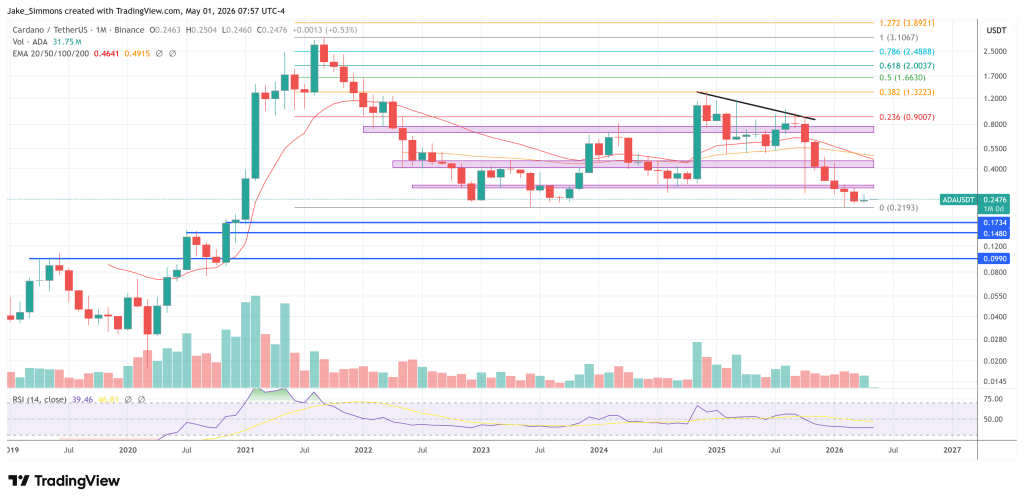
ADA remains below key resistance, 1-monthly chart | Source: ADAUSDT on TradingView.com

Criptos en tendencia

Lecturas Relacionadas

No Sales Team, $20 Million in Revenue: How Did AI Employee Viktor Win Over 30,000 Companies?

The AI employee Viktor, developed by a team with DeepMind background, has achieved $20 million in annual revenue without a traditional sales team, serving over 30,000 companies. Its core innovation lies in positioning itself as a "Tier 3 AI Coworker" capable of "end-to-end execution and delivery of results," moving beyond the "draft and wait for human completion" model of typical AI assistants. Users can simply mention Viktor in Slack or Microsoft Teams using natural language commands, and it autonomously performs tasks like pulling sales data from a CRM, generating reports, or even cross-tool operations like creating board meeting PPTs by aggregating data from six different sources. Key to its growth is a pure Product-Led Growth (PLG) model, eliminating complex implementation cycles and per-seat licensing. Instead, it charges based on task credits or consumption, lowering the trial barrier with a $100 free credit offer and no credit card required. This enabled viral, bottom-up adoption within organizations. Viktor's interaction paradigm removes the barrier of prompt engineering, allowing non-technical employees to delegate complex workflows seamlessly. It also features proactive, automated task execution (e.g., overnight bookkeeping, scheduled reports) based on triggers, effectively embedding AI as an automated "process layer" within business operations. However, its expansion into Microsoft Teams—a platform with 320 million users—highlights challenges. Large enterprises require stringent IT compliance, security reviews (e.g., SOC 2), and governance, potentially hindering the frictionless, user-driven adoption that succeeded in Slack. Additionally, the "black box" nature of its autonomous decision-making raises concerns about operational risks, data integrity, and the need for robust audit logs and permission controls. Balancing efficiency gains with security and trust remains a critical hurdle for Viktor and similar AI agents aiming to become core enterprise infrastructure.

marsbitHace 1 hora(s)

No Sales Team, $20 Million in Revenue: How Did AI Employee Viktor Win Over 30,000 Companies?

marsbitHace 1 hora(s)

Trading

Spot
Futuros

Artículos destacados

Cómo comprar ADA

¡Bienvenido a HTX.com! Hemos hecho que comprar Cardano (ADA) sea simple y conveniente. Sigue nuestra guía paso a paso para iniciar tu viaje de criptos.Paso 1: crea tu cuenta HTXUtiliza tu correo electrónico o número de teléfono para registrarte y obtener una cuenta gratuita en HTX. Experimenta un proceso de registro sin complicaciones y desbloquea todas las funciones.Obtener mi cuentaPaso 2: ve a Comprar cripto y elige tu método de pagoTarjeta de crédito/débito: usa tu Visa o Mastercard para comprar Cardano (ADA) al instante.Saldo: utiliza fondos del saldo de tu cuenta HTX para tradear sin problemas.Terceros: hemos agregado métodos de pago populares como Google Pay y Apple Pay para mejorar la comodidad.P2P: tradear directamente con otros usuarios en HTX.Over-the-Counter (OTC): ofrecemos servicios personalizados y tipos de cambio competitivos para los traders.Paso 3: guarda tu Cardano (ADA)Después de comprar tu Cardano (ADA), guárdalo en tu cuenta HTX. Alternativamente, puedes enviarlo a otro lugar mediante transferencia blockchain o utilizarlo para tradear otras criptomonedas.Paso 4: tradear Cardano (ADA)Tradear fácilmente con Cardano (ADA) en HTX's mercado spot. Simplemente accede a tu cuenta, selecciona tu par de trading, ejecuta tus trades y monitorea en tiempo real. Ofrecemos una experiencia fácil de usar tanto para principiantes como para traders experimentados.

1.5k Vistas totalesPublicado en 2024.12.10Actualizado en 2026.06.02

Cómo comprar ADA

Discusiones

Bienvenido a la comunidad de HTX. Aquí puedes mantenerte informado sobre los últimos desarrollos de la plataforma y acceder a análisis profesionales del mercado. A continuación se presentan las opiniones de los usuarios sobre el precio de ADA (ADA).

活动图片