EDGE Price Plummets 77%: External Manipulation or Internal Script?

marsbitPublicado a 2026-06-02Actualizado a 2026-06-02

Resumen

On June 2, the native token EDGE of the edgeX protocol experienced a violent flash crash, plummeting over 77% from around $1.14 to a low of $0.32 before partially recovering to approximately $0.64. edgeX officially ruled out a hack or platform security flaw, attributing the event to suspected market manipulation by external actors. The incident reignited community concerns regarding the project's transparency and past controversies. Prominent on-chain investigator ZachXBT highlighted that EDGE supply has long been controlled by a small group, with low circulating liquidity. This structure traces back to a disputed airdrop in April 2026, where the majority of tokens were allocated to partner wallets instead of the community, leading to accusations of a "well-designed rug pull." Despite having notable backers like Circle Ventures and Amber Group, and generating substantial protocol fees, edgeX faces criticism for a recurring pattern of "low float, high control, and opaque market making." While the team investigates the crash and emphasizes its core contracts are operational, user sentiment remains severely damaged, with many expressing a lack of trust in the team's integrity. Meanwhile, prediction markets have already opened betting pools on EDGE's future price.

Original Author: Ma He, Foresight News

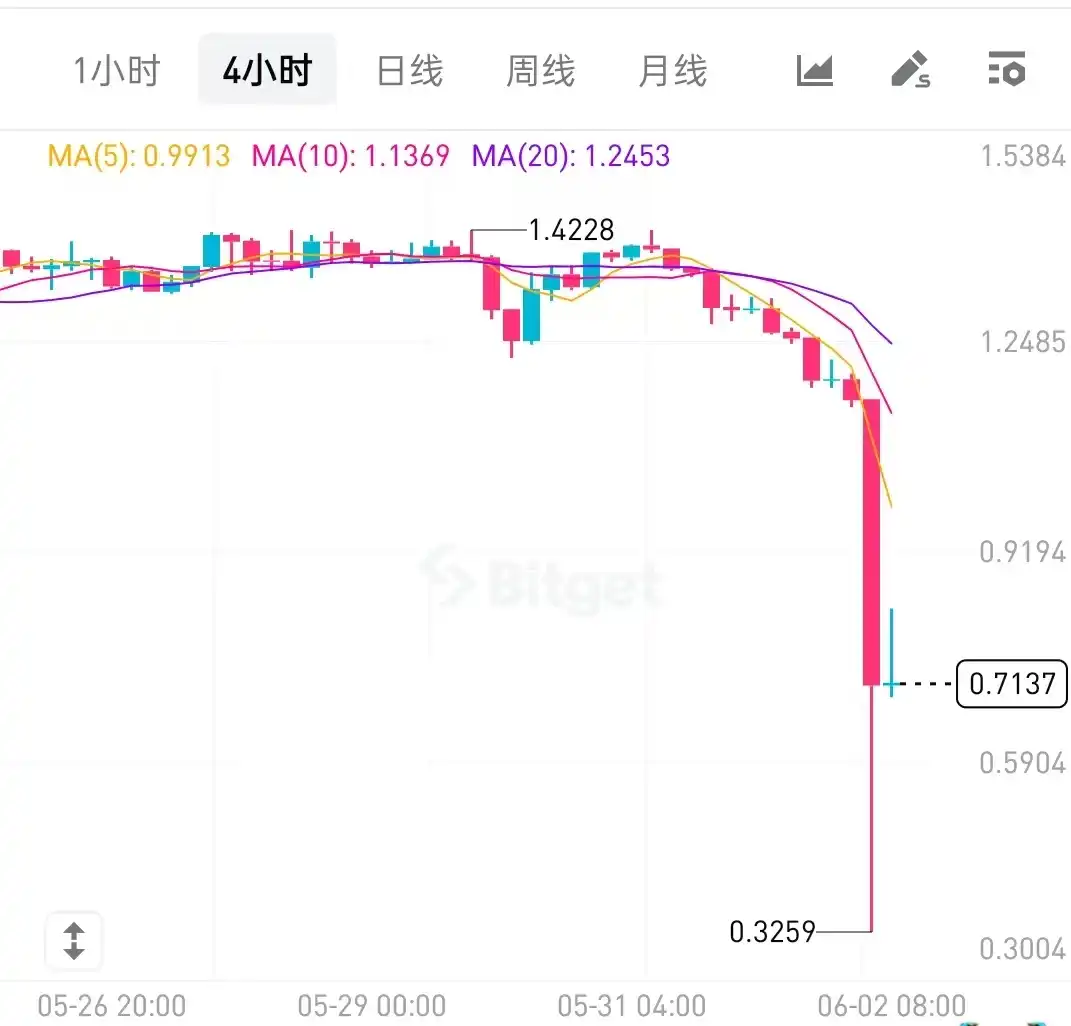
Around 4:00 AM on June 2, the native token EDGE of edgeX experienced severe and abnormal volatility. The price plummeted over 77% in a short period from around $1.14, hitting a low of $0.32, and has since rebounded to around $0.64, with a market cap of approximately $250 million.
edgeX responded immediately, explicitly ruling out hacking or platform security vulnerabilities, and pointed the finger at "intentional market manipulation by external specific entities."
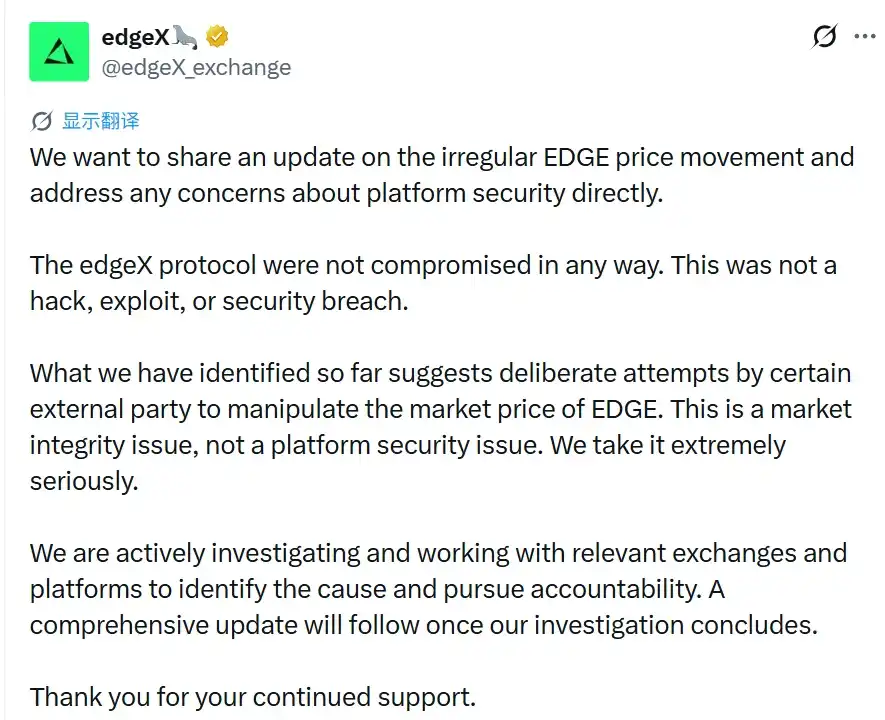
edgeX stated that its protocol was not breached, and there was no hacking or security vulnerability. This price anomaly is suspected to be market manipulation intentionally carried out by external specific entities, making it a market issue rather than a platform security issue. The team is actively investigating and cooperating with relevant exchanges and platforms to trace the responsible parties. Complete investigation results will be announced upon conclusion.

edgeX emphasized that core contracts like SpotVault are operating normally, with no suspicious activity detected, further focusing attention on external market behavior rather than the protocol itself.

On-chain investigator ZachXBT commented after the incident, pointing out that edgeX supply has long been controlled by a few insiders, with low circulation. He called for the project to disclose market maker and counterparty information to improve transparency.
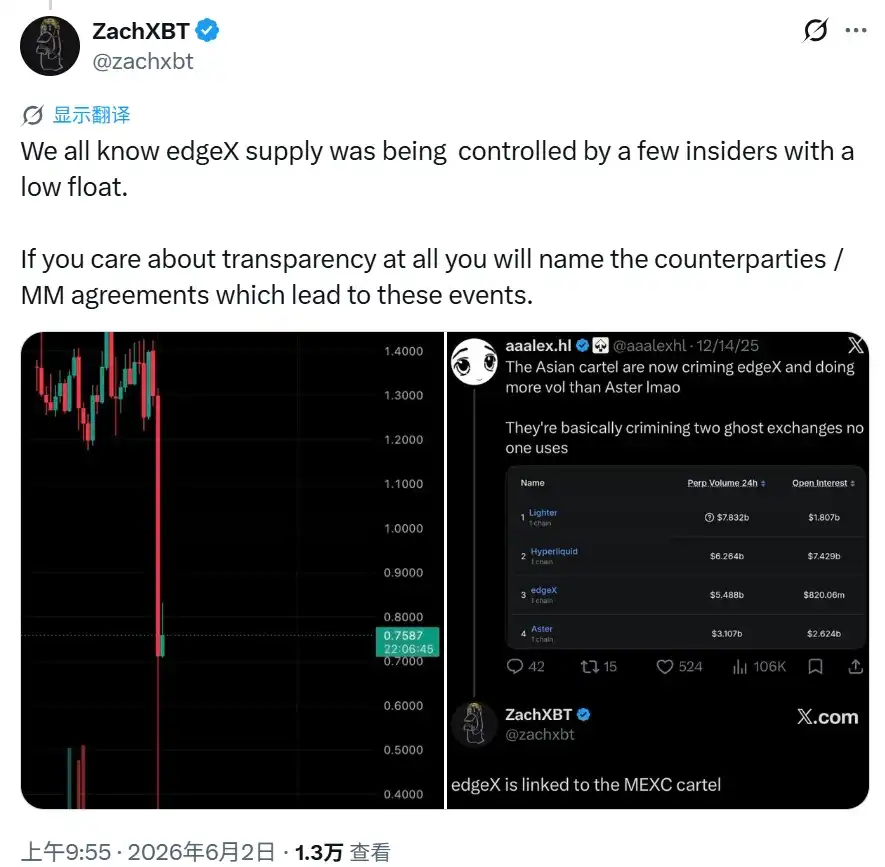
As the incident developed, many users linked this volatility directly to the project's past operations, expressing disappointment in the team's integrity. One community member bluntly stated: "No one is even discussing the EDGE crash anymore. This project team lacks integrity, goes back on their word, there's really little desire to bottom-fish."

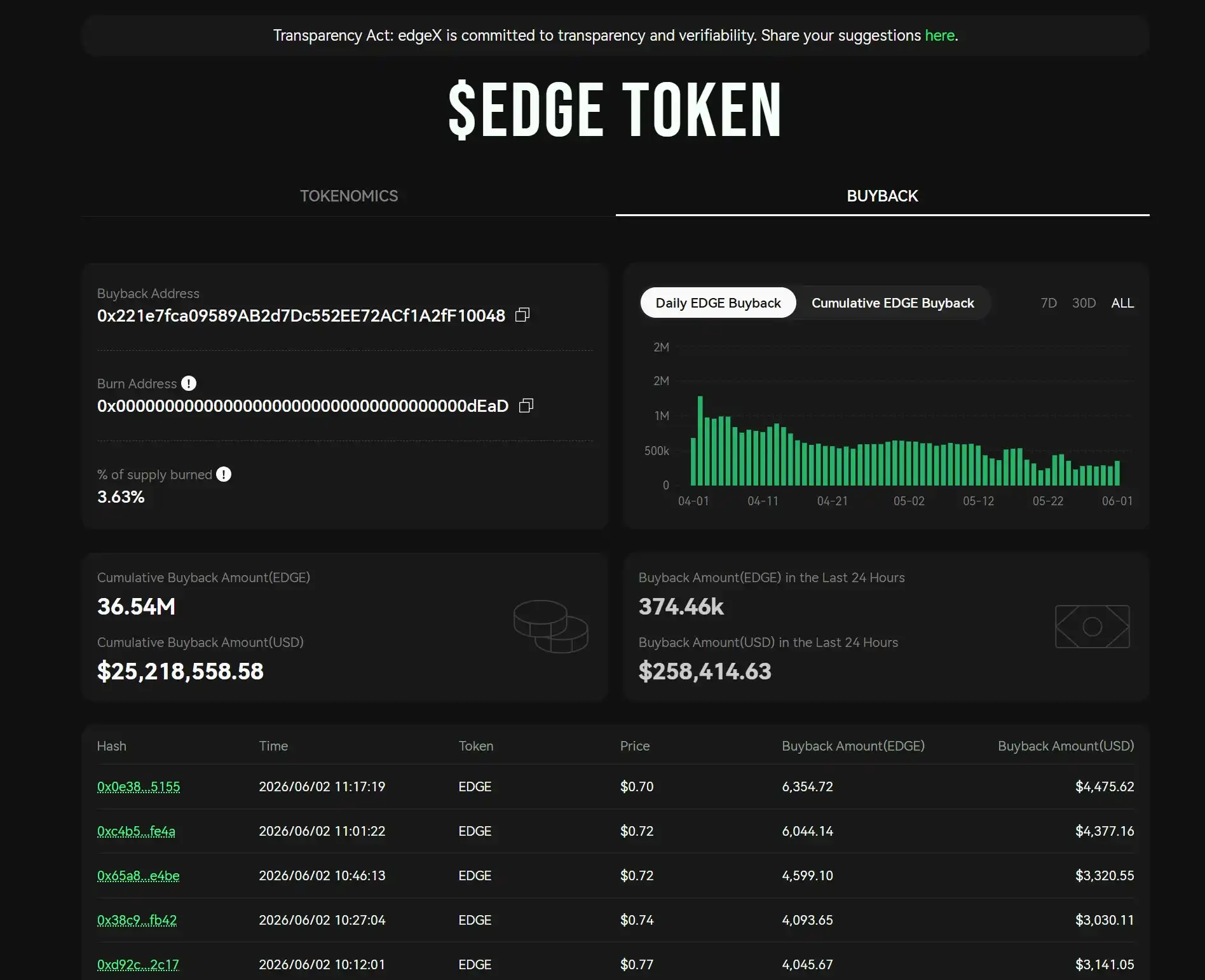
Since its TGE, the EDGE token price rose from $0.7 to $1.5, and subsequently fluctuated around $1.4. The official team also launched a dedicated token website to prove transparency. In late May this year, the protocol launched V2 and adjusted its tokenomics to allocate all profits to repurchasing EDGE. According to its website data, approximately 36.54 million tokens have been repurchased so far, with a total value of around $25 million.
Additionally, related information shows the protocol received investment from Circle Ventures and Amber Group, though specific amounts were not disclosed.

Past Airdrop Controversy Planted Seeds for Subsequent Crash

This incident cannot be separated from the context of edgeX's previous airdrop controversy. In April 2026, the author detailed the entire process of the TGE sparking community dissatisfaction in the article "The Complete Story of the edgeX Airdrop Debacle: An Elaborately Designed Scheme?". The project had promised the community would receive 25% of the token supply, but the actual proportion allocated to ordinary traders was only about 4%, while approximately 14% (valued at around $94.6 million at the time) flowed to partner wallets. Arkham's token flow chart showed at least 80 related addresses were created in 2025, exhibiting consistent behavioral patterns: small test deposits followed by large deposits, and concentrated outflows after TGE, involving about $90 million in token transfers, with some funds flowing to exchanges.

The more core controversy lay in the opaque points exchange mechanism. User feedback indicated huge discrepancies in exchange ratios despite identical trading volumes. Furthermore, the gap between estimated point value (pre-TGE market expectations of $30-40 per point or higher FDV) and actual received amount exceeded 80%. Early contributors and NFT holders also encountered cases of "lowest allocation across the network." Community members flooded the official Twitter account with angry comments, prompting the team to temporarily disable comments.

Afterward, edgeX announced it would lock the controversial 14% share for one year and initiate a buyback, but rejected the community's demand to burn the tokens on Ethereum.
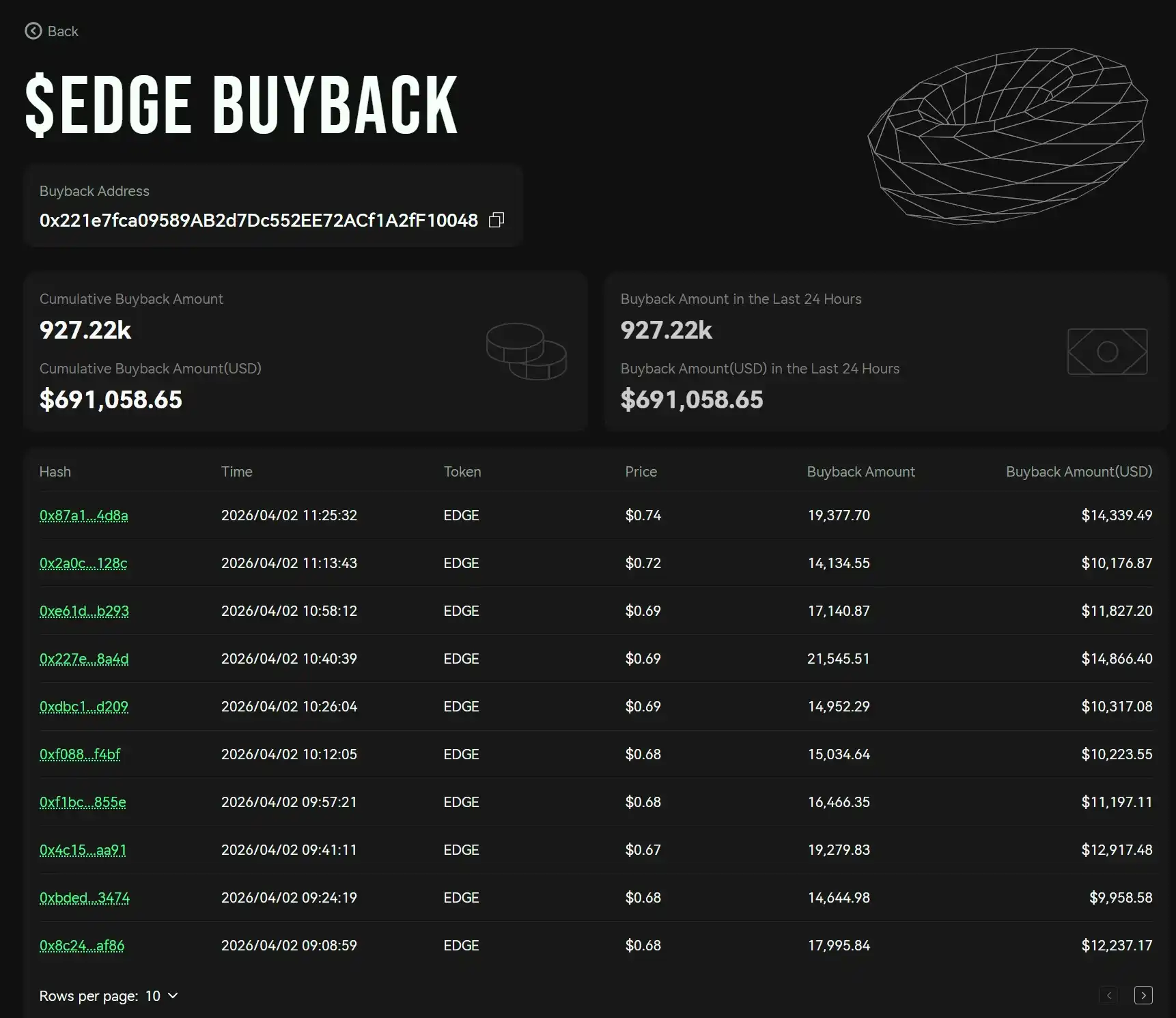
These unresolved issues directly planted the seeds for the current volatility: concentration of chips in a few addresses or related parties makes it easier for external entities to influence prices through large-scale operations. Low circulation is not accidental but an inevitable result of early allocation and lock-up arrangements. When abnormal selling pressure appears in the market, the lack of sufficient depth as a buffer easily triggers a chain reaction.

Structural Risks and Transparency Test

edgeX once carved a niche in the sector with its trading speed, low slippage, and perpetual contract innovation. After TGE, the project experienced a phase of price increase, and its trading volume and fee revenue repeatedly ranked high in DeFi. According to the latest data from DefiLlama, the protocol's total fee revenue over the past 30 days was $10.7 million, and the perpetual DEX's trading volume over the past 30 days reached $42.765 billion.
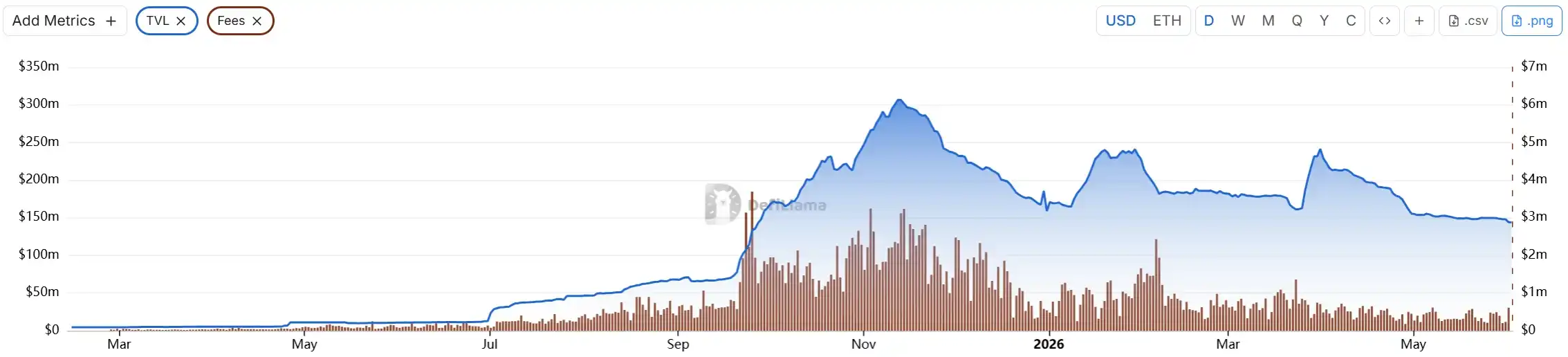
However, from the airdrop allocation controversy to this price anomaly, this model of 'low circulation + high control + opaque market making' has become a tried-and-true 'serial scam scheme' for new projects in recent years. Mouthing 'community first' while wallets honestly dump tokens to related parties is just a single-player game dressed in DeFi clothing.

The accusation of external manipulation is difficult to prove immediately, but the traceable abnormal on-chain transfers are enough to raise community alarm.

Ironically, just as it faces the whirlpool of plummeting token prices, a price prediction market for its EDGE token has quietly launched on Polymarket.
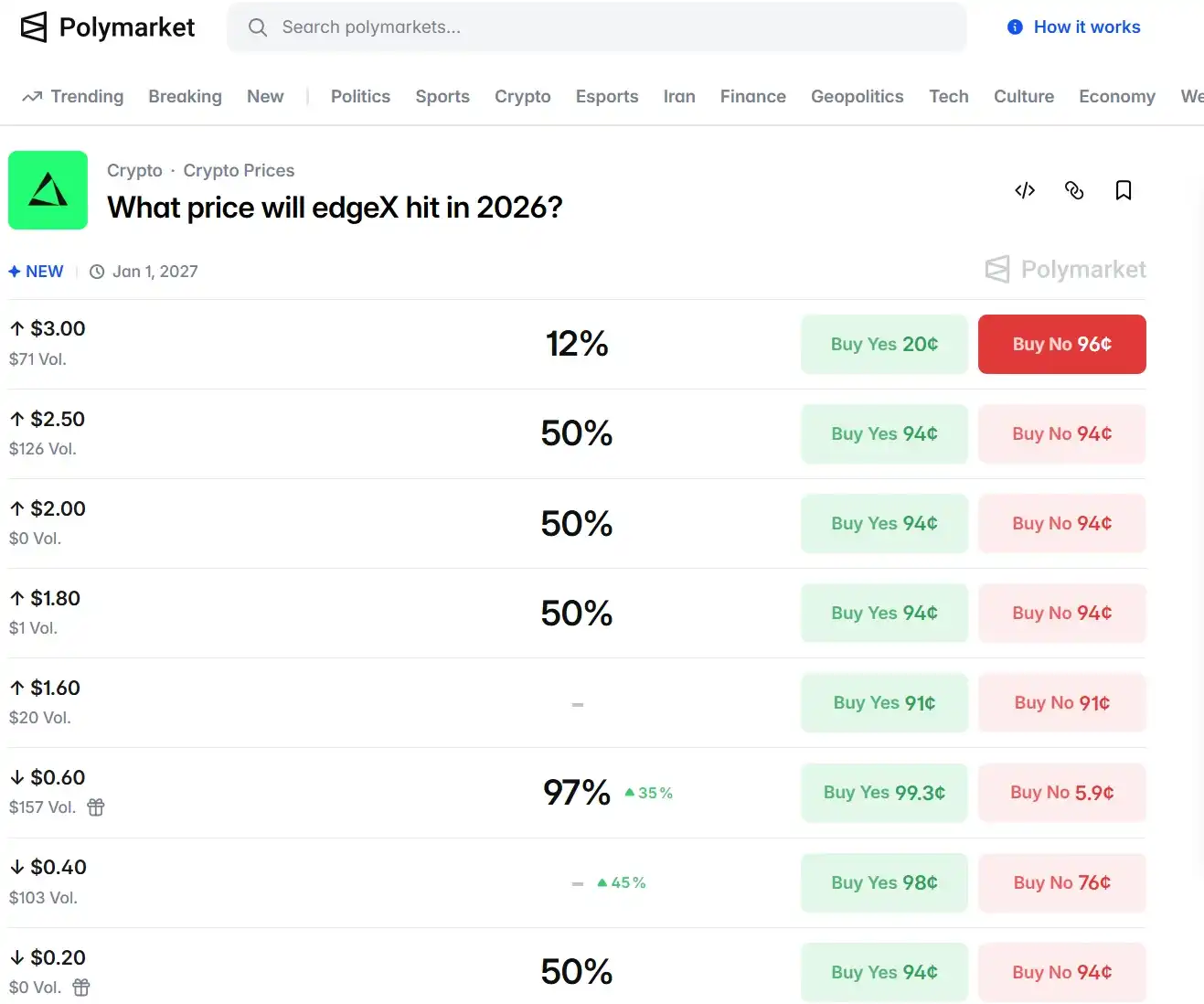
The project team is busy proving its innocence, trapped retail investors are angrily demanding justice. And on Polymarket, some players have already started betting on how much it will rise or fall by this year.


Criptos en tendencia

Preguntas relacionadas

QWhat caused the sharp 77% price drop in EDGE token according to the edgeX team?

AThe edgeX team explicitly ruled out a hack or platform security vulnerability. They attributed the price drop to 'market manipulation intentionally carried out by a specific external entity', framing it as a market problem rather than a security problem with their platform.

QWhat criticism did ZachXBT level against the edgeX project following the price crash?

AZachXBT criticized the project's lack of transparency. He pointed out that the EDGE supply has long been controlled by a small number of insiders with low circulation, and demanded that the project publicly disclose information about its market makers and counterparties.

QWhat past controversy is mentioned as setting the stage for this price volatility event?

AThe article mentions a significant airdrop controversy from April 2026. The project promised 25% of tokens to the community, but only allocated about 4% to regular traders, while about 14% (worth roughly $94.6 million at the time) went to partner wallets, causing major community discontent and distrust.

QWhat structural risk pattern does the article accuse edgeX and similar new projects of following?

AThe article accuses edgeX of following a pattern common in recent new projects: 'low circulation + high control by insiders + non-transparent market making'. It describes this as a 'serial harvesting scheme' that acts like a single-player game disguised as DeFi.

QHow did the edgeX protocol perform in terms of trading activity prior to this incident according to DefiLlama data?

AAccording to DefiLlama data cited in the article, the edgeX protocol had strong performance metrics. Its total fee revenue over the past 30 days was $10.7 million, and the trading volume for its perpetual DEX over the past 30 days reached $42.765 billion.

Lecturas Relacionadas

7 Months After the Collapse of Huiwang, Southeast Asia's Escrow Platforms Undergo a Major Reshuffle

Following the collapse of Huione Pay—dubbed the "Alipay of Southeast Asia"—seven months ago, the region's underground financial guarantee platform sector is undergoing a significant reshuffle. This power vacuum has been swiftly filled by emerging platforms such as XinBi, Tiger/Navigator, JinBei (renamed JinBo), Dali/Tiancheng, and FullyLight. These platforms, operating largely via Telegram and offering services like escrow for illicit transactions, have absorbed the vast user base and markets left behind by Huione. While positioning themselves as "trust intermediaries," their primary clientele consists of networks involved in online scams, money laundering, illegal gambling, and even human trafficking. For instance, the Tiger/Navigator platform explicitly provides "escrow" services for kidnapping-for-ransom operations ("强押车交易"). Data underscores the immense scale: Huione alone processed over $103 billion in cryptocurrency payments and facilitated over $31 billion through its escrow market before its downfall, linking it to Cambodia's notorious Prince Group. Since its collapse, competitors have seen explosive growth. For example, the XinBi platform has accumulated over $1.6 billion in total USDT revenue, while platforms like NewPay, OkPay (under Dali), and FullyLight Wallet collectively processed over $4.8 billion in USDT in a single year. This ecosystem thrives in regions like Cambodia and Myanmar, where regulatory gaps allow these platforms to act as critical financial infrastructure for sprawling cybercrime industries, from scam compounds to online casinos. The article concludes that the moniker "Southeast Asian Alipay" is a misnomer, obscuring the platforms' fundamental role in enabling serious criminal enterprises rather than representing legitimate financial innovation.

Odaily星球日报Hace 29 min(s)

7 Months After the Collapse of Huiwang, Southeast Asia's Escrow Platforms Undergo a Major Reshuffle

Odaily星球日报Hace 29 min(s)

The Changing Landscape: What Are Crypto VCs Experiencing?

Title: The Shifting Landscape of Crypto Venture Capital The era of dedicated crypto venture capital funds is undergoing a significant transformation. Once essential for navigating the sector's complexity and high risk, these specialized funds are now facing an identity crisis as the market matures. This shift mirrors historical patterns in other specialized investment classes like cleantech and SPACs, where initial information advantages dissipate as technologies become mainstream and integrated into existing industry frameworks. The article argues that crypto is reaching a critical inflection point, transitioning from a "building phase" to an "integration phase." Major players like Stripe, BlackRock, and Visa now engage with crypto not for its novel mechanics but as a foundational financial infrastructure. Their needs—regulatory compliance, banking partnerships, distribution channels—align with traditional fintech, a domain easily understood by large, generalist funds like Sequoia and Founders Fund. This evolution creates a "barbell effect" within the VC landscape. On one end are massive, diversified platforms that can incorporate crypto as one vertical among many. On the other are small, nimble funds focused on niche, experimental projects. The middle ground—medium-sized dedicated crypto funds—is being squeezed out. Their typical fund size makes it impossible to generate sufficient returns solely from early-stage crypto bets, yet they cannot compete with giants for later-stage deals. Consequently, leading crypto-native firms like Paradigm and Framework Ventures are expanding into AI, robotics, and other sectors, driven partly by LP pressure for better returns amid a broader VC DPI crisis. Others, like Dragonfly and a16z, have narrowed their crypto focus predominantly to financial infrastructure like stablecoins, reframing the sector's core narrative. For crypto entrepreneurs, this consolidation presents challenges. While generalist funds offer larger checks and broader resources, crypto projects now compete fiercely with AI for attention and capital within these firms. Furthermore, the long-term, non-commercial foundational work that built the ecosystem—funded by dedicated crypto VCs—is less likely to attract generalist capital focused on direct returns. The conclusion is that "crypto investor" as a standalone category is becoming obsolete, akin to "internet investor." Crypto is becoming a baseline infrastructure layer. The future will see a barbell structure: large-scale growth financing handled by generalist funds, while pioneering, speculative projects are funded by small, specialized vehicles. The dedicated crypto funds of the 2017-2021 boom, which incubated core infrastructure, are giving way to this new, bifurcated reality.

Foresight NewsHace 47 min(s)

The Changing Landscape: What Are Crypto VCs Experiencing?

Foresight NewsHace 47 min(s)

As Consensus Accelerates, What Are Young Investors Betting On?

Title: As Consensus Forms Faster, What Are Young Investors Betting On? In the rapid evolution of tech investment, a new generation of young investors is navigating a landscape where AI, robotics, commercial aerospace, and quantum computing are advancing simultaneously. Traditional investment logic based on financial models is giving way to a need for deep technical understanding and the ability to act before industry consensus forms. An analysis of trends from the "WAIC FUTURE TECH" list of young investment leaders reveals key shifts in focus. The first major trend is the movement of AI from the digital screen into the physical world. Investment is shifting from large language models and chatbots towards embodied AI, robotics, AI hardware, and edge computing. While demonstrations generate excitement, the real challenge lies in achieving scalable, reliable, and cost-effective delivery in complex real-world environments like factories and logistics. Success depends not just on algorithms but on the integration of sensors, actuators, and control systems. Second, the competitive focus for large models is moving beyond raw capability toward building an "intelligence flywheel." The goal is to create self-reinforcing systems where user interaction generates data, improving the model, which in turn enhances the user experience and attracts more engagement. Companies that successfully embed AI into workflows to create these closed-loop systems can build lasting value that isn't easily erased by the next model upgrade. Third, facing a potential bottleneck in high-quality human-generated data, investors are looking at new underlying technologies. Reinforcement learning and self-play, as demonstrated by AlphaGo Zero, offer paths for AI to generate its own experience. Scientific foundation models, which aim to build general AI capabilities for fields like life sciences and materials discovery, represent a non-consensus direction that could unlock new frontiers of knowledge and data. Finally, in deep-tech areas like quantum computing, commercial aerospace, and space-based infrastructure, patient capital is essential. These fields have long, uncertain development and validation cycles involving complex engineering, supply chains, and regulations. Investment here requires a long-term view, focusing on foundational team capabilities and the eventual emergence of market demand, even if commercial returns are distant. Collectively, these trends illustrate how young investors are adapting to a new era. They are learning to make earlier, technically-informed judgments, balance hype with real-world viability, and provide the patient capital needed to build the deep-tech foundations of the future.

marsbitHace 1 hora(s)

As Consensus Accelerates, What Are Young Investors Betting On?

marsbitHace 1 hora(s)

Trading

Spot

Artículos destacados

Cómo comprar EDGE

¡Bienvenido a HTX.com! Hemos hecho que comprar edgeX (EDGE) sea simple y conveniente. Sigue nuestra guía paso a paso para iniciar tu viaje de criptos.Paso 1: crea tu cuenta HTXUtiliza tu correo electrónico o número de teléfono para registrarte y obtener una cuenta gratuita en HTX. Experimenta un proceso de registro sin complicaciones y desbloquea todas las funciones.Obtener mi cuentaPaso 2: ve a Comprar cripto y elige tu método de pagoTarjeta de crédito/débito: usa tu Visa o Mastercard para comprar edgeX (EDGE) al instante.Saldo: utiliza fondos del saldo de tu cuenta HTX para tradear sin problemas.Terceros: hemos agregado métodos de pago populares como Google Pay y Apple Pay para mejorar la comodidad.P2P: tradear directamente con otros usuarios en HTX.Over-the-Counter (OTC): ofrecemos servicios personalizados y tipos de cambio competitivos para los traders.Paso 3: guarda tu edgeX (EDGE)Después de comprar tu edgeX (EDGE), guárdalo en tu cuenta HTX. Alternativamente, puedes enviarlo a otro lugar mediante transferencia blockchain o utilizarlo para tradear otras criptomonedas.Paso 4: tradear edgeX (EDGE)Tradear fácilmente con edgeX (EDGE) en HTX's mercado spot. Simplemente accede a tu cuenta, selecciona tu par de trading, ejecuta tus trades y monitorea en tiempo real. Ofrecemos una experiencia fácil de usar tanto para principiantes como para traders experimentados.

570 Vistas totalesPublicado en 2026.03.31Actualizado en 2026.06.02

Cómo comprar EDGE

Discusiones

Bienvenido a la comunidad de HTX. Aquí puedes mantenerte informado sobre los últimos desarrollos de la plataforma y acceder a análisis profesionales del mercado. A continuación se presentan las opiniones de los usuarios sobre el precio de EDGE (EDGE).

活动图片












