Don't Care if You Know Football or Not, Buying the Draw Is the Best Strategy for This World Cup?

Odaily星球日报Publicado a 2026-06-22Actualizado a 2026-06-22

Resumen

The article analyzes the 2026 FIFA World Cup group stage and argues that betting on a draw has been a surprisingly profitable strategy. Based on data from the prediction market Polymarket, a strategy of betting $1000 on a draw for each of the first 40 matches would have yielded a return of over 100%, despite only 13 matches ending in a draw. The core of the strategy is not the frequency of wins, but the high payout when low-probability draws occur, such as Spain's 0-0 draw with Cape Verde, where pre-match odds for a draw were only 5.5%. The article identifies common draw scores, like 1-1, which provide stability, and high-value 0-0 stalemates, where favorites fail to break down resilient defenses. It highlights Group G as an example, where 3 of the first 4 matches ended in draws, illustrating that draws are a tactical part of group stage calculus as teams often prioritize not losing. In conclusion, while strong teams remain favorites on the pitch, the article claims that for traders, betting on draws has so far produced the most significant profits.

Original | Odaily Planet Daily (@OdailyChina)

Author | Asher(@Asher_ 0210)

As the World Cup group stage progresses, a very counter-intuitive phenomenon is becoming increasingly clear—buying the favorite, doesn't necessarily make money; buying the underdog, isn't necessarily easy to hold onto either, but if you blindly buy the draw for every match, you might actually be raking it in.

Calculated based on Polymarket pre-match prediction data, if you put $1000 on "Draw" for every match, there have been 11 draws in the previous 36 matches (as shown below). That is to say, with a total investment of $36,000, the winnings from successful bets amount to $73,214. After deducting the principal, the net profit is $37,214, representing a return of over 100%.
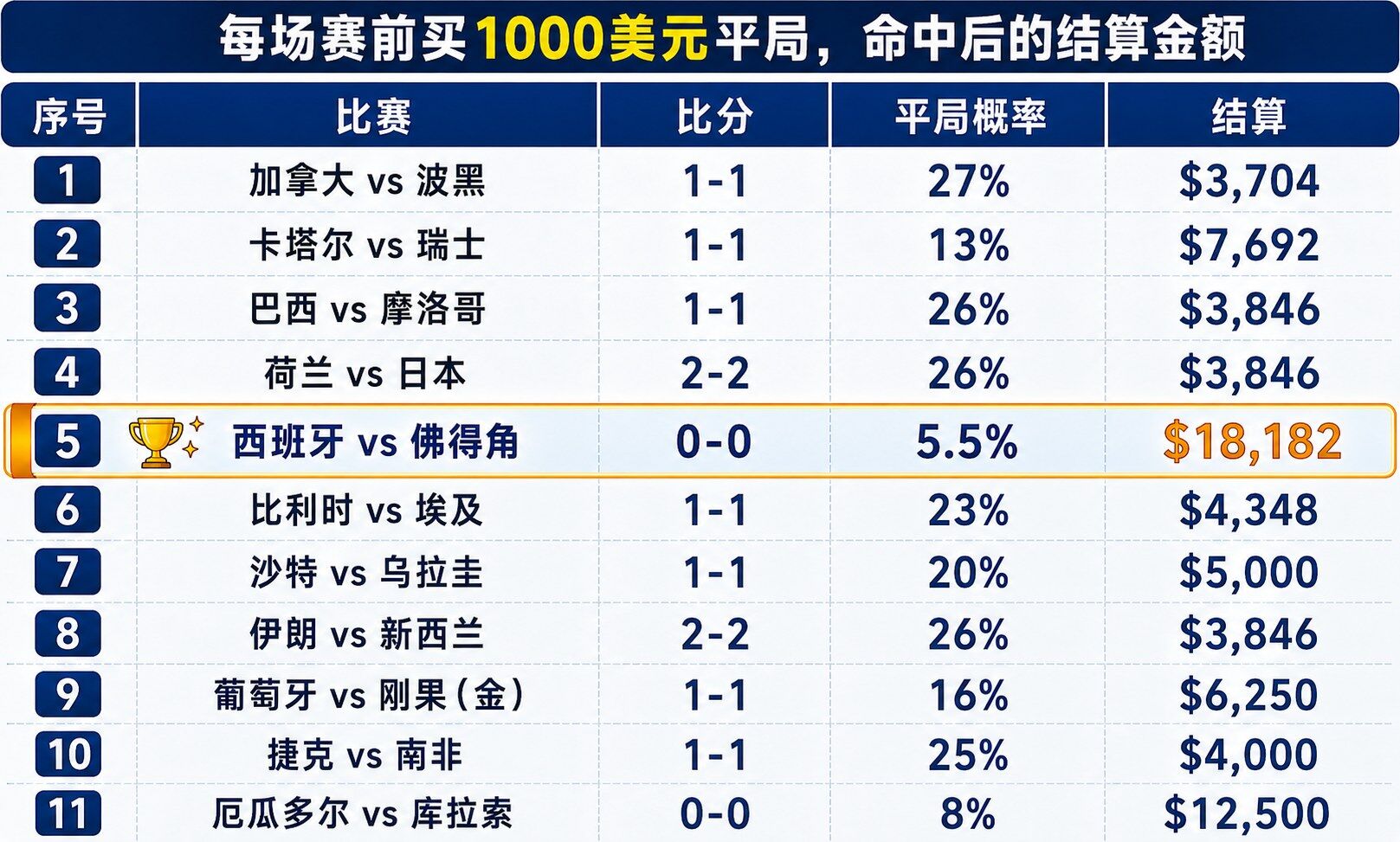
Even more impressive, according to Polymarket pre-match prediction data, if we continue the strategy of "$1000 on Draw per match" for today's 4 matches (total investment of $4000). Looking at the results: Spain 4-0 Saudi Arabia, New Zealand 1-3 Egypt—these two resulted in a loss of the stake; but Belgium 0-0 Iran and Uruguay 2-2 Cape Verde were hits, with a combined payout of approximately $8,700. This means that even with only 2 hits out of the 4 matches today, the daily net profit is still around $4,700.

Including today's 4 matches, out of 40 World Cup group stage matches, there have been 13 draws. With a total investment of $40,000, the total payout from winning bets is approximately $81,914. After deducting all investments, the net profit is about $41,914, representing a return of nearly 105%.

A hit rate of 13/40 isn't particularly high, but the key to the draw strategy is never about "hitting often," but about "hitting big." The lower the pre-match probability of a draw, the higher the payout multiplier when it hits. Matches like Spain vs. Cape Verde with a 5.5% draw probability, Ecuador vs. Curaçao with an 8% draw probability, or Qatar vs. Switzerland with a 13% draw probability—hitting just a few of these is enough to turn the entire strategy from a small loss into a massive gain.

Cape Verde's Draw Against Spain Is the Most Typical "Liquidation Game" of the World Cup So Far

The Spain vs. Cape Verde group stage match wasn't just a big win for the draw strategy; it was also a nightmare for pre-match buyers backing the favorite.

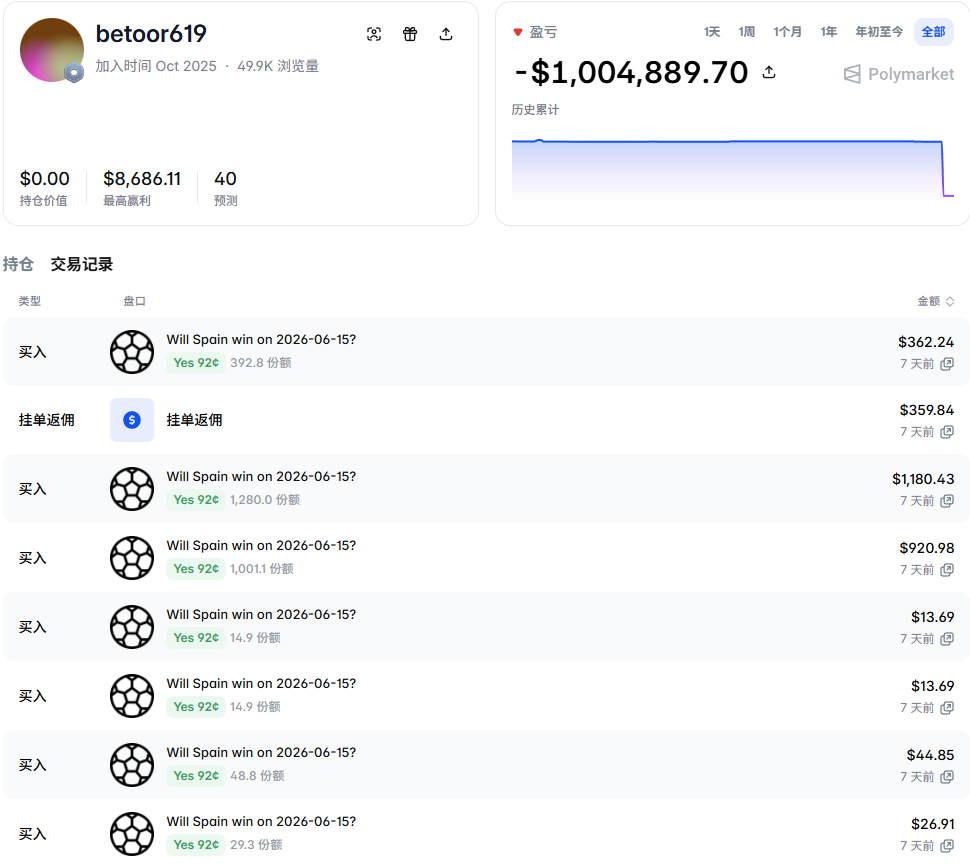
In this group stage match, Spain's pre-match win probability was as high as 92%. Polymarket data shows that account @betoor619 (address: 0x70088c990ffae782c699b9250f5aa6cbe4e3c666) bought Spain to win in the World Cup group stage match Spain vs. Cape Verde. The match ended 0:0, resulting in a loss of $999,000 for this user.

It's worth noting that this user bought in at the 92-cent moment, meaning they staked $1 million in principal for a potential profit of $85,000. A seemingly sure-win trade ultimately resulted in a cold loss due to the 7 incredible saves by Cape Verde's 40-year-old goalkeeper and Cape Verde's extremely resilient defense.
0-0 and 1-1 Are Becoming the Main Theme of This World Cup So Far

Looking at the draw results that have hit so far, draws in this World Cup group stage aren't appearing randomly but are concentrated in a few typical scorelines.

The most common is 1-1. Canada vs. Bosnia and Herzegovina, Qatar vs. Switzerland, Brazil vs. Morocco, Belgium vs. Egypt, Saudi Arabia vs. Uruguay, Portugal vs. DR Congo, Czech Republic vs. South Africa—all ended with this score. The commonality in these matches is that neither side was completely without chances, nor did the weaker team simply park the bus until the end. More often, the stronger team failed to convert their advantage into a win, while the weaker team seized an opportunity to respond. The matches seemed back-and-forth, but in the end, neither side could truly break through the other.

For traders, the value of 1-1 lies in its stability. It's not the most exaggerated source of profit, but it occurs frequently, forming the foundation of this "buy draw every match" strategy.

What really boosts the profits are the 0-0 draws.

Spain vs. Cape Verde is the most typical example. Spain was considered the absolute favorite pre-match, with only a 5.5% draw probability. But the match ended 0-0. If $1,000 was invested pre-match on the draw, the payout would be approximately $18,182. Ecuador vs. Curaçao follows a similar logic. With only an 8% draw probability, it also resulted in 0-0, with $1,000 invested corresponding to a payout of $12,500.

Therefore, the real money-making aspect of the draw strategy isn't about hitting every match, but rather that a few low-probability draws, when they do hit, come with very exaggerated payout multipliers. This is especially true for 0-0 matches, where the on-field action often involves the favorite team attacking constantly while the underdog's goalkeeper and defense repeatedly clear the ball.

Group G Is Even More Ridiculous: 3 Draws in 4 Matches

If Spain vs. Cape Verde represents low-probability draws, then Group G is more like a microcosm of the "draw density" in this group stage.

Out of the first 4 matches, Group G has produced 3 draws. In the first round: Belgium 1-1 Egypt, Iran 2-2 New Zealand; in the second round: Belgium 0-0 Iran. The only match with a decisive result was New Zealand vs. Egypt, but this doesn't change one fact: the overall rhythm of this group has been completely slowed down by draws.

Especially Belgium, who have drawn both of their group stage matches so far. For the team, this means the pressure to qualify from the group continues; but for those who bought a Belgium win pre-match, the outcome of both matches was the same—no loss, but their position wiped out.

This is also where the draw is most underestimated in prediction markets. The market prefers to buy the favorite to win because it seems more intuitive; but the real logic of group stage football isn't "the favorite must win," but rather that many teams are willing to settle for 1 point. The weaker team doesn't want to lose, the stronger team doesn't want to take risks too early. Once a match reaches a stalemate, a draw becomes a very realistic outcome.

3 draws in the first 4 matches of Group G indicates that draws are not accidental upsets, but part of the group stage tactical game. Especially when the points haven't been significantly separated, every team starts calculating—winning is of course best, but avoiding losing first is often the safer choice.

Summary

In this World Cup, the strong teams are still the main characters.

Spain will win, Brazil will win, and favorites will always have matches where they deliver a crushing victory. But if we look purely at trading profits, the most profitable script in the group stage so far might not be the big wins by the giants, but rather those recurring 1-1s, 0-0s, and 2-2s.

Those who bought the favorites are waiting for goals, those who bought the draw are waiting for the final whistle, and so far, the latter are laughing louder.

Preguntas relacionadas

QAccording to the article, what has been the most profitable betting strategy for the World Cup group stage so far?

AAccording to the article, the most profitable betting strategy so far has been to consistently bet on a draw in every match. Using a hypothetical strategy of betting $1000 on a draw for each of the first 40 group stage matches, the strategy yielded a net profit of approximately $41,914, representing a return of nearly 105%.

QWhy is the 'bet on draw' strategy considered effective despite a relatively low win rate?

AThe 'bet on draw' strategy is effective not because it wins frequently, but because it 'wins valuably'. The pre-match probability for a draw is often very low, which means the payout multiplier is very high when a draw does occur. Hitting just a few of these low-probability draws can turn the overall strategy from a slight loss into a significant profit.

QWhich specific match is highlighted as the most typical 'liquidation game' for favorite bettors?

AThe match between Spain and Cape Verde is highlighted as the most typical 'liquidation game'. One user on Polymarket bet $1 million on Spain to win when the probability was 92%, aiming for an $85,000 profit. The match ended 0-0, resulting in a loss of 99.9% of their stake.

QWhat are the two most common draw scorelines mentioned, and how do they differ in their impact on the betting strategy?

AThe two most common draw scorelines are 1-1 and 0-0. The 1-1 draws are more frequent and form the 'base' of the strategy's returns. The 0-0 draws, while less frequent, are the key profit drivers because they often occur in matches where one team is a heavy favorite, leading to very low pre-match draw probabilities and therefore extremely high payout multipliers when they hit.

QWhat does the high frequency of draws in Group G (3 draws in 4 matches) illustrate about the nature of group stage matches?

AThe high frequency of draws in Group G illustrates that draws are not merely accidental upsets, but are an integral part of group stage tactics. In the early stages, many teams prioritize not losing over aggressively seeking a win. The calculus for teams often involves securing at least 1 point to maintain their position, leading to more cautious play and a higher likelihood of drawn matches.

Lecturas Relacionadas

The $6.4 Billion CRO Accumulation Plan of Trump Media Group Falls Apart

A $6.4 billion plan to create a publicly-listed CRO treasury company, announced a year ago by Trump Media & Technology Group (DJT), Crypto.com, and SPAC Yorkville, has been terminated. The ambitious deal, which aimed to accumulate approximately 6.3 billion CRO tokens (nearly 20% of supply at the time), never progressed beyond a framework agreement. Related plans for a prediction market integrated into Truth Social and ETF custody services by Crypto.com were also shelved, scaled back to a simple marketing partnership. The collaboration followed significant political alignment, with Crypto.com donating to Trump's inauguration and a pro-Trump super PAC, and its CEO meeting with Trump. The SEC also closed an investigation into the exchange shortly before the deal was announced, raising conflict-of-interest concerns. Officially, the termination was attributed to an unfavorable market environment. CRO's price has fallen roughly 70% since the announcement, and the broader market for publicly-traded digital asset treasuries has cooled significantly, with Bitcoin nearly halving from its late-2025 peak. The only completed transaction from the 2025 agreements remains intact: Trump Media's ~$105 million CRO purchase and Crypto.com's $50 million purchase of DJT stock. The termination aligns with DJT's strategic pivot away from crypto; the company is now pursuing a multi-billion dollar all-stock merger with nuclear fusion firm TAE Technologies, shifting its focus to clean energy.

marsbitHace 12 min(s)

The $6.4 Billion CRO Accumulation Plan of Trump Media Group Falls Apart

marsbitHace 12 min(s)

Tiger Research: The $43 Million Gray Area of Asian Prediction Markets

Tiger Research: Asia's $43 Million Grey Zone in Prediction Markets Western jurisdictions have created regulatory pathways for prediction markets through derivatives law (like the U.S. CFTC framework) or flexible gambling licenses (like the UK's "betting intermediary" category). In contrast, Asia lacks a comparable regulatory architecture. The absence of a general gambling license framework adaptable to private operators, coupled with closed financial product definitions (e.g., positive lists of assets in Korea and Japan), leaves prediction markets in a regulatory grey area. This lack of a clear classification—whether as gambling, financial derivatives, or a novel third category—has not stopped market activity. Significant liquidity, evidenced by over $52 million tied to a single South Korean election, flows to offshore platforms. However, this results in forgone tax revenue (estimated at $4-43 million annually per major Asian market), no consumer protection, and no oversight for market integrity. The core issue is not cultural opposition to gambling, which exists legally in many Asian markets, but a missing institutional design. Without a deliberate regulatory pathway, authorities are left with suboptimal options: expanding criminal sanctions or blocking access, which fail to address the underlying economic activity or achieve key policy goals. Establishing a regulatory foundation requires initiating a formal public discourse to first define prediction markets' legal status and societal value, a foundational step that has yet to occur in most Asian jurisdictions.

marsbitHace 22 min(s)

Tiger Research: The $43 Million Gray Area of Asian Prediction Markets

marsbitHace 22 min(s)

How Singapore's Retail Giant Masters the Gold Trade: Selling Thousands of Pounds Monthly Without Betting on Price, Gold Leasing Inspires RWA Income Design on Chain

A Singapore retail giant, Mustafa Centre, sells around 1,100 pounds of gold jewelry monthly, holding nearly a ton of inventory valued over $100 million, yet avoids gold price speculation. They achieve this by maintaining a constant inventory—buying back the exact amount of gold sold each day, earning only from sales margins, not price movements. This practice is enabled by the century-old gold leasing market. Retailers borrow physical gold to meet inventory needs without tying up capital or bearing price risk, paying a lease rate. Lenders earn yield on otherwise idle gold. This real-economy demand, driven by operational needs rather than speculation, provides a stable income stream. The article highlights how this traditional leasing model inspires on-chain Real World Asset (RWA) protocols like thUSD and thGOLD. These protocols channel gold lease yields—generated from borrowers like Mustafa—to token holders. The key challenge has been access, not yield availability. Platforms like Libeara, with institutional backing (e.g., SC Ventures), facilitate this by tokenizing funds (e.g., the MG 999 Gold Fund) that lend to vetted commercial borrowers, making this off-chain yield accessible on-chain. Thus, gold leasing demonstrates a proven, non-speculative revenue source for crypto protocols seeking sustainable "real yield," connecting physical trade finance to decentralized finance.

marsbitHace 32 min(s)

How Singapore's Retail Giant Masters the Gold Trade: Selling Thousands of Pounds Monthly Without Betting on Price, Gold Leasing Inspires RWA Income Design on Chain

marsbitHace 32 min(s)

Trading

Spot
活动图片