How has your 2025 been? As the founder of Infini, Christian, a post-00s entrepreneur, frankly hopes it to pass quickly. For a Fintech startup established just a year ago, neither experiencing a trust crisis due to a theft nor making the choice to pivot—essentially having to tear down previous solutions—can be lightly dismissed as mere setbacks.
Rewind three years to 2022, Christian was a typical crypto degen, obsessed with NFTs, later diving into DeFi and memes, his emotions fluctuating with market trends, judgments relying on intuition and feel. It was an era where daring to jump in was enough, where narratives outpaced risk control, and growth掩盖了太多细节 (covered up too many details). But when he actually started building—from product, asset management to payment links—the industry's feedback changed. The brutality of having credibility reset to zero by a single incident made Christian realize that the most expensive thing in finance isn't efficiency, but trust.
Christian's generation's financial enlightenment was almost product-fed: from QR code payments to password-free deductions, from one-click installments to tap-to-pay, the golden age of Fintech pushed the financial threshold lower and lower, making smoothness the default. But when they started entrepreneurship, the industry's climate had changed. Many previous-generation entrepreneurs first grew big relying on红利 (dividends/opportunities), then made up lessons later, while this generation often learns while doing.
So this dialogue isn't just about the path of a product or a company, but a portrait of an entrepreneur closer to the present: in an era where fees are getting thinner, channels are pickier, and compliance feels more like a time cost, what truly pushes the business forward is an experience that can be兑现 (delivered/fulfilled) long-term.
Finance isn't just a game for the "old guards." New markets need to retain young ambition while learning to become harder at the most脆弱的 (fragile/vulnerable) links. 2025 is destined to be remembered by Christian for a long time because, starting this year, Infini and he truly entered the core of the finance business—not only needing to run fast but also enduring slowness and pain.
Beating Highlights:
· Bigger opportunities may not only lie in B2B cross-border settlements but in scenarios closer to where transactions happen. How to make it easier for the new generation of entrepreneurs to receive payments and manage funds, and how to face the global market from the business's inception, is the value stablecoins are about to兑现 (realize/deliver).
· What's truly hard to copy is a company's core: how you treat customers, how you serve them, especially whether you truly value their assets, and whether you're willing to respond 24/7 when they have problems. Many product functions aren't that different now; faster iteration, more meticulously polished user experience, more timely response, and patience are instead decisive.
· Good entrepreneurs need the courage to舍弃 (discard/abandon), even if the business is doing well at the time. If it can't lead us to our goal within the expected time, we should lead the team to find a direction more worth investing in (investing effort into).
· Rather than just providing a seemingly better wealth management product, it's better to let users truly understand risk. Don't place trust in any single asset or institution; at least maintain independent judgment.
· What truly makes a product and team stand out often lies in the details: every detail of the product, every piece of copy, every design element, the implementation method behind every function—these will ultimately determine what the product becomes.
· The more layers and politics in a startup, the more it drags down efficiency and delivery. Everyone makes mistakes, I do too, and I'm willing to admit it. But more importantly, dare to speak up when you see a problem; don't stay silent due to顾虑 (concerns/apprehensions), otherwise it affects the entire team's goals in the end.
Below is the full interview content:
"Young People Should Have Awe"
动察 (Dongcha, likely the interviewer/platform name): You said you had been smooth sailing before, but when your "trial" hit in the form of $50 million, what was your first reaction?
Christian: My first reaction was definitely shock, my mind went blank, thinking how could this happen to me. I had just seen a similar incident not long ago, and we paid special attention to it, never expecting to be next.
But I quickly realized there were only two outcomes: either solve the problem, shoulder it, and move forward with the team; or handle it poorly, which for most people basically means game over.
The result later, as everyone saw, was that we managed to pull through, and growth even became smoother after March-April. That was my most genuine reaction at the time; I didn't think too much, just felt this was what I should do.
动察: What's the biggest thing, something you didn't have before, in your mindset after going through this?
Christian: I think the biggest gain is "awe." Many young people don't understand awe, especially when things have been smooth sailing, it's easier to get carried away. Cases like SBF essentially lack awe and respect for the industry, the market, and users.
After this incident, I became more certain of two things. First, I'm not omnipotent, and I will make mistakes. The goal of risk control isn't to never make mistakes, but to minimize losses when errors occur, preventing a single misstep from becoming a致命一击 (fatal blow).
Second, many problems ultimately boil down to people. Whether intentional or not, someone didn't do their job properly. So after the incident, we spent a lot of effort rebuilding and strengthening our recruitment, screening standards, and team mechanisms.
I'm actually grateful for this experience. If it hadn't happened, Infini's team state and capabilities might not be as good as they are now. It forced me to iterate continuously, align standards, and made me clearer that people whose values and rhythm don't match can't walk the long term together. Of course, it was frustrating at first, but now it's more of a continuous gratitude. Things will eventually be resolved; the key is how you resolve them and whether your reputation and trust can be maintained long-term.
动察: "The general public不一定需要 (doesn't necessarily need) wealth management products; they need a wealth management mindset." Why this insight?
Christian: This year we experienced black swan events in the industry. Whether in Crypto or traditional finance, there's no product that will never have problems. So-called better people are just those who understand risk control better, are more responsible, and can do things more sustainably.
But if someone trusts and bets their entire fortune, even if the probability of an incident is only one in ten thousand, once it happens, it's unbearable for them.
So I increasingly feel that helping everyone establish the correct wealth management mindset is more important. Rather than just providing a seemingly better wealth management product, it's better to let users truly understand risk, not to place trust in any single asset or institution, at least maintain independent judgment.
It's also because of these reflections that our direction adjusted, from initially只做 (only doing) asset management to now wanting to do payments,收款 (receivables/collections) first. I increasingly believe the two will eventually combine. You must first solve "how to make money, how to receive money" before you can talk about accumulating principal and then managing and protecting it. This is my biggest takeaway from this year.
Unafraid of First-Mover Advantage, Infini's Underlying Ambition
动察: Infini made a relatively major pivot in the middle, withdrawing from to C business and starting to adjust focus. How did you make that judgment at the time? Where did the决心 (determination) to change come from?
Christian: During the ToC period, our team was relatively young and lacked relevant experience, so we stepped into many pitfalls. Some pits you simply don't know about until you step in them yourself, and no one will proactively tell you. For many, this information opacity is even key to their赚钱 (money-making) and arbitrage. But I actually dislike this system very much; I've always felt the payment industry should be more transparent. Plus, we overall weren't in a very ready state at the time, so it was particularly strenuous.
Also, the business model wasn't clear enough. For example, our U card business almost didn't make money because we wanted to keep costs最低 (lowest), letting more people use it with a lower threshold, not just serving big players.
But with more users, problems arose. These users未必能给你带来收入 (might not necessarily bring you income), yet you have to invest大量 (a lot of) time and energy handling various situations. During that time, the team was basically pushed along by problems; everyone was tired and unhappy. R&D was often firefighting, customer service had to stay up late replying, complaint volume was huge, and many problems weren't even something we could solve because the entire chain was too long, with too many links; any segment having problems was hard to cover.
It was also because of this that we wanted to do something based on blockchain more, with a more certain underlying链路 (link/pipeline), fewer supply chain problems. As long as we do our part well, we can deliver a more stable product and experience.
Second, we realized that no matter how well we did on that path, it本质上并没有真正创造新价值 (essentially didn't truly create new value). It was more like regulatory arbitrage. It确实给 (did give) convenience to some people who found traditional bank cards inconvenient, but the underlying network didn't change, costs and efficiency weren't fundamentally improved, and even because the链路 (chain) was more complex, optimization costs were higher, ultimately passed on to consumers.
Rather than continuing to grow in a赛道 (track/field) where differentiation is ultimately very limited and can only compete on price in the end, I prefer to believe that good entrepreneurs need the courage to舍弃 (discard/abandon). Even if the business was doing well at the time, if it couldn't lead us to our goal within the time I expected, we should lead the team to find a direction more worth投入 (investing in). Comparatively, the path we're on now, I feel, is truly worth someone building long-term, and there's still a lot of infrastructure and standards that need to be filled.
动察: Now Infini has expanded into acquiring business, a direction that heavily emphasizes channels and operations. How did you find your first batch of customers? What need did you hit?
Christian: Acquiring is of course our core板块 (sector/part), but we won't stop only at acquiring. Our positioning is more like a financial OS, aiming to provide at least an experience and functionality接近 (close to) bank-level.
Specifically for acquiring, the problems to solve are roughly two types. The first type is providing lighter-weight收付款账户 (payment and collection accounts) for overseas entrepreneurs and small teams. My judgment is that in the future, many people making products and starting to receive money won't necessarily need to have a bank account first.
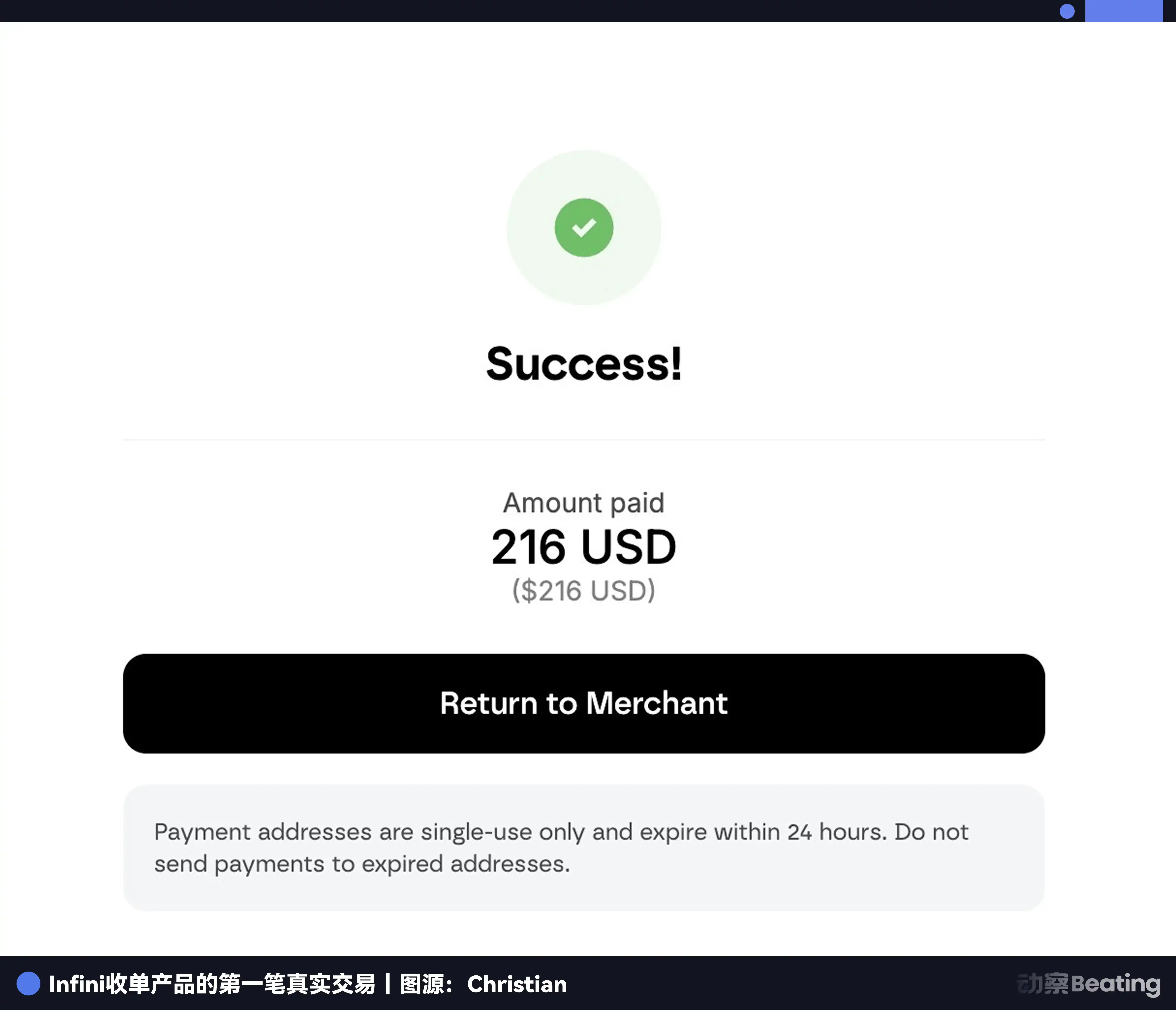
Especially in the AI era, the time from development to launch is greatly compressed by various tools; you can't still follow the traditional pace waiting for bank processes. In the past, it might take a month to get开户 (account opening),对接 (integration), and such things done. But with Infini, an account can probably be opened in ten minutes, and with speed, integration can be completed in a day, starting收款 (collection).
This is very practical for independent developers, super individuals, and small startup teams. Among our less than 20 seed merchants now, AI application developers account for a quite high proportion, and there are indeed "one-person companies" using it; their most urgent need is to get收款 (collections) running first.
The second type is letting merchants connect to the stablecoin collection链路 (chain) earlier. Today, the vast majority of companies' revenue still relies on the fiat system for settlement, but I think the proportion of stablecoins in wallets will become higher and higher in the future, especially in regions like Latin America, where it's more obvious.
When we did U cards before, we also observed that many users actually just wanted to pay for Netflix, Starlink, or shop on Amazon. Then why must they first绕一圈 (go around a circle) turning stablecoins into cards to spend? There is必然有磨损 (inevitable wear and tear/friction) in the middle. If they could pay directly with stablecoins, the chain would be shorter, the experience better.
For merchants, having one more stablecoin收款方式 (collection method) is essentially one more income source. Just like in traditional payments, adding one more wallet channel often increases the customer base a bit.
We also see some cases where stablecoin acquiring brings new users, not just making the experience smoother for old users. The scale is certainly small now, but the earlier you接入 (integrate/access), as merchants grow and user habits improve, the proportion of this channel will follow.
动察: Mature Fintech companies like Revolut, after ten years of accumulation, already have scale, data, and strong compliance capabilities. Even if not the first to launch new features, they can quickly replicate and distribute them to tens of millions of users. In contrast, Crypto Native enterprises are often constrained by financing, licenses, and compliance. Facing this first-mover advantage, how do you compete? In your mentioned Financial OS route, what is Infini's core moat?
Christian: I think it can be viewed from two angles. First, the Fintech industry itself doesn't have that strong network effects, unlike social products where the winner takes all. Many small Fintech companies can also live well because the core of customer choice is often trust.
Actually, every era has giants, and challengers are never lacking. It's just that today, this trend is intensified. Some large domestic companies might indeed quickly launch product functions you引起关注 (draw attention to), then use multiple, hundredfold resources to compete; this situation exists, and the probability is increasing. But I actually wouldn't focus on preventing copying. Ideas are本来就不值钱 (inherently worthless); functions, interfaces can all be copied.
What's truly hard to copy is a company's core: how you treat customers, how you serve them, especially whether you truly value their assets, whether you're willing to respond 24/7 when customers have problems. Many product functions aren't that different now; faster iteration, more meticulously polished user experience, more timely response, and patience are instead decisive.
The True Mission of Financial Products is Equalization
动察: Many views believe that innovation in the past two decades mostly stayed at the distribution layer, optimizing experience, but the underlying logic of fund flow remains traditional, leading to homogenization, thin profits, and internal competition. As a new-generation Fintech entrepreneur, what do you most want to improve?
Christian: I agree with this judgment. Pulling the timeline longer, many familiar fintech products on the market were actually born in the last fifteen years or so. The first generation of successful unicorns did make a lot of innovation, but most of their innovation was still completed under the traditional banking and payment paradigm, essentially building better products and experiences on the old system.
And within this traditional paradigm, there is a long-term problem that is hard to truly solve: the barrier to entry. Many fintech products require users to have a traditional bank account first to be used. No matter how much innovation you do on top, you still have to sync大量信息 (a lot of information), details to the underlying bank; as long as you rely on bank licenses and systems, you can't bypass these restrictions. Second is the cost of transfer networks, especially cross-border, with high fees, difficulty for small transfers to be viable, unstable timeliness, and complex mutual recognition and anti-money laundering processes between different countries.
动察: Where is your value capture?
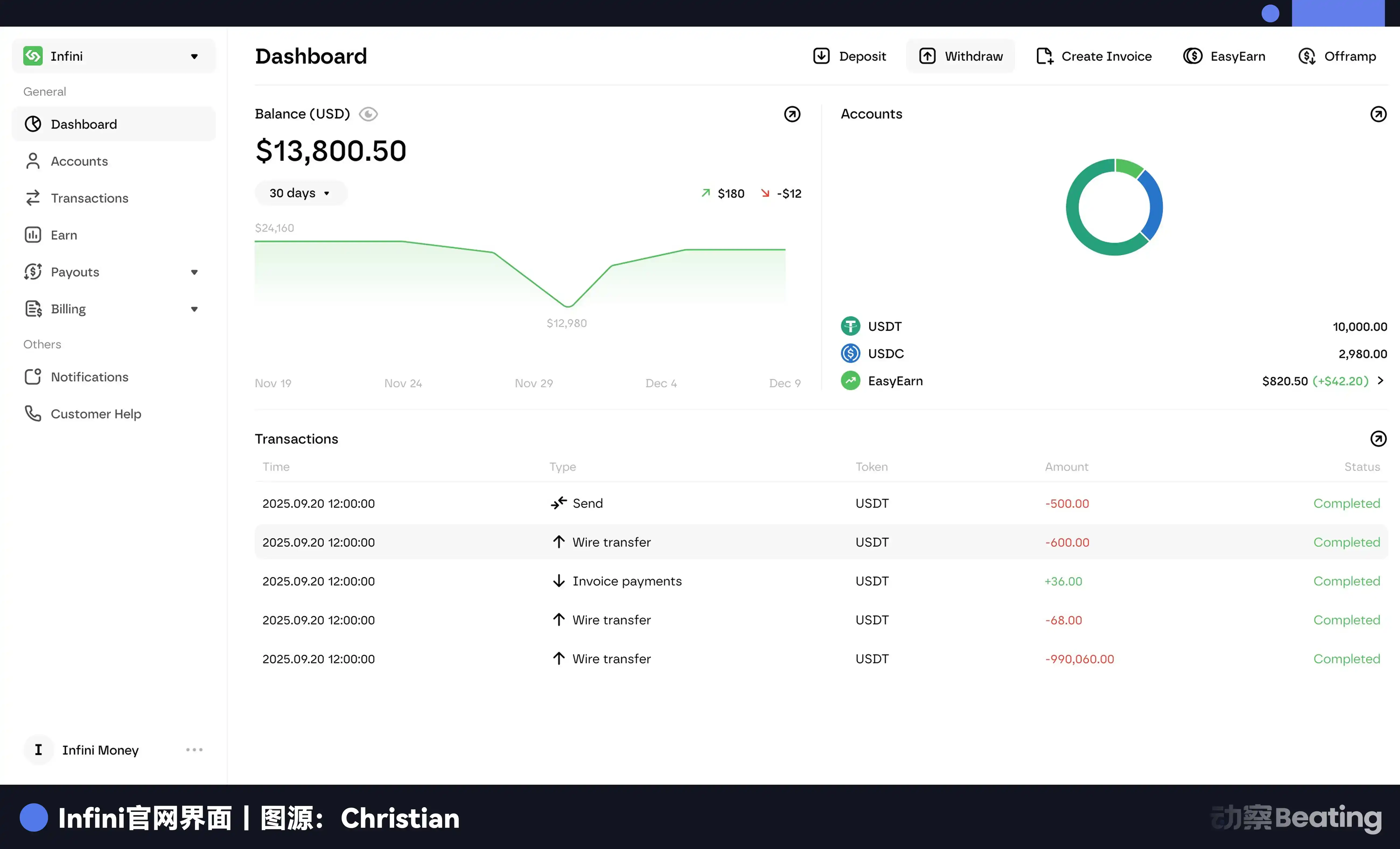
Christian: For ToB companies, one of the biggest future values is enabling enterprises to open and use financial services without relying on traditional bank accounts as a cornerstone. For independent developers, small teams, or small startups, this will bring an order-of-magnitude change to onboarding efficiency.
And the advantage of us new-generation entrepreneurs is that, from an infrastructure and technical level, we can do a more globalized business today, especially covering emerging markets faster, allowing users to register and use more freely and smoothly. Of course, long-term, everyone will still move towards more complete compliance and license布局 (layout), but the path at the起步阶段 (starting stage) is different.
Product-wise, we try to build a new payment network based on stablecoins as much as possible. Traditional players are also doing similar directions, but most still settle around card networks like Visa, Mastercard. My judgment is that bigger opportunities未必只在 (may not only be in) B2B cross-border settlements, but in scenarios closer to where transactions happen. How to make it easier for the new generation of entrepreneurs to收款 (collect and manage) funds, how to face the global market from the business's inception, is the value stablecoins are about to兑现 (realize/deliver).
动察: The previous generation of Fintech entrepreneurs also tried "specialization" early on,比如针对 (e.g., targeting) students, hourly workers, teenagers, but were eventually forced to become large, all-encompassing super apps.
Christian: I think this isn't just Fintech logic, but a path all applications eventually walk. Real growth often first comes from accurately hitting the pain point of a very small人群 (group of people). First penetrate this pain point deeply, then extend outward along the demand, discovering more similar problems of adjacent groups, then continuously design, iterate, pushing the boundaries bit by bit.
Of course, enterprises will differentiate at a certain stage. Some founders are more satisfied with taking a very niche field to the extreme; since this problem is solved well enough, they are willing to hold the position, making the service deeper and more specialized. Others think further ahead, hoping to serve more people, see more needs, and also from a business perspective pursue larger scale, profit, and capitalization paths.
动察: If you had to describe your ideal Fintech product in one sentence, how would you describe it?
Christian: My ideal, and also what we hope to create in the future, is a form of equalization: providing the capabilities of banking and financial services to everyone who needs them in a more indiscriminate, fairer way—especially every person who wants to start a business. In my view, the true mission of financial products lies right here.
The Management Philosophy of the New Generation Entrepreneur
动察: Some say doing finance favors older age, what do you think about this statement?
Christian: I think the phenomenon "Fintech prefers older, more experienced founders" is more common in Asia, but there are also many very young and excellent entrepreneurs in Europe and America.
The difference背后首先是 (is first behind) environment and ecosystem choices. I've asked many investors; they确实更愿意投 (are indeed more willing to invest in) slightly older, more experienced people, especially in a strongly regulated, strongly risk-controlled industry like Fintech, which is very reasonable. Many pitfalls are known only by experience堆出来的 (piled up over time); from this angle, they have more advantage.
But I don't think age itself is the determining factor. We ourselves don't use absolute age to judge ability when hiring; being older doesn't mean lacking innovation, being young doesn't mean necessarily doing poorly. The key is two things: have you stepped into pitfalls, and what is your understanding of risk and bottom-line control.
Since everyone will step into pitfalls, another variable is growth and iteration speed. Young people may need to pay some tuition; I've paid quite a bit myself. But if you can progress quickly in the process, truly sort out compliance and risk control, you can also do very well.
动察: You said you were假装在创业 (pretending to be entrepreneuring) for a period; what was fake about it?
Christian: It's a state, especially for some older founders who previously worked in management at large companies. After starting up, it's easy to延续原来的习惯 (continue old habits), feeling that just doing a few things well at the management level is enough: finding money, building a team, setting direction. These are certainly duties the CEO must bear because no one else can do them for you.
If you think that doing these three things well will make things naturally go ideally, I think it's a false proposition and the reason many people step into pitfalls. What truly makes a product and team stand out often lies in the details: every detail of the product, every piece of copy, every design element, the implementation method behind every function—these will ultimately determine what the product becomes.
Team management is the same. It's not that the team can't do well, but if the founder can personally set the example and establish standards at the very beginning, the team's subsequent execution will be much smoother, and it's easier to achieve consistent high quality overall.
动察: You must have had many insights into organizational management during entrepreneurship recently.
Christian: Besides what was said earlier about not pretending to entrepreneur, another is to lead by example; you have to be on the front line with the team, at least willing to understand things. If you yourself don't understand, have no interest, no curiosity to figure it out, then colleagues can hardly truly take it as something they need to be responsible for till the end. You certainly can't be proficient in everything, but your attitude is important—letting everyone see you are continuously thinking, progressing. Often, morale is boosted this way.
Then you must find the right people. The most fatal thing about hiring the wrong person isn't poor ability, but slowing down the organization's iteration speed. Some people are very good themselves, just more suitable for large companies; arriving at a startup, they will水土不服 (not acclimatize), fail to integrate into the rhythm, and delivery doesn't meet expectations. One of the most important traits of a startup is daring to取舍 (make trade-offs/decisions), letting unsuitable people leave as early as possible, while continuously寻找 (searching for) more suitable people.
Seeing whether a startup team is strong lies in whether the overall average quality is high enough;最好每个人都能独当一面 (best if everyone can work independently), delivery can maintain high standards. In the future with AI tool augmentation, team size will likely be more精简 (streamlined/simplified),不太可能再是 (unlikely to be again) the expansion method of hundreds or thousands of people. But the smaller the team, the more it requires everyone's level to be on the same line, because any one person's attitude or ability falling behind may拖垮 (drag down) the entire team's speed. So besides making products, continuously evaluating, timely adjusting, constantly making the team stronger—this matter itself is very important.
动察: Then how do you screen创业伙伴 (entrepreneurial partners) you think are suitable?
Christian: I value three things more, more important than experience, background, or education. First is iteration speed and curiosity, aka learning ability. It has no necessary relation to age, especially since we work in a new field with almost no mature paradigms and few products to copy; learning and thinking ability come first. Also, if someone到现在 (until now) hardly uses AI or other productivity tools in their workflow, I'd feel they lack the consciousness to maximize efficiency.
Second is long-termism, whether they can work with the team to get things done. Many in the币圈 (coin circle/crypto space) are more accustomed to short-term变现 (monetization), which is reasonable, but we don't consider ourselves a pure Web3/Crypto company, more like making long-term internet products and platforms.
We don't plan to issue coins or do things for short-term monetization; often we also need to sacrifice short-term cash flow for long-term value. There are many decisions in this process,容错很低 (fault tolerance is very low). If anyone just has a mindset of making quick money first, they naturally aren't very suitable here.
Third is absolute坦诚 (candor/honesty). The more layers and politics in a startup, the more it drags down efficiency and delivery. Everyone makes mistakes, I do too, I'm willing to admit it. But more importantly, dare to speak up when you see a problem; don't stay silent due to顾虑 (concerns/apprehensions), otherwise it affects the entire team's goals in the end.
动察: Who do you admire most in your entrepreneurial process?
Christian: Revolut's founder; Revolut is also a company I greatly admire. They have absolute execution power and极致要求 (extremely high demands) on team standards.
Looking at the product itself, what Revolut did early on wasn't划时代式的创新 (epoch-making innovation); issuing cards, foreign exchange—these functions are actually the most essential things of traditional banks. But what I truly admire is their drive and推进速度 (advancement speed).
The常规印象 (common impression) is that European companies are slow, inefficient, but Revolut proved Europe can also have the speed and relentlessness of domestic internet companies. Its厉害的地方 (impressive aspect) is being able to replicate basic functions of a product very quickly, then continuously optimize, then beat you. This ability is very strong, and I hope we can cultivate it too.
But not just for speed; the premise is that every function must truly solve user problems and be done better than others. Revolut's iteration speed, on one hand, is fast development implementation; on the other hand, more importantly, they can very accurately grasp user needs, ensuring the product is used as soon as it's out. This I greatly appreciate.
The second is the founder's attitude towards team management. He has a famous saying: "get shit done." I even use this phrase as the signature in our internal collaboration tool. It's not promoting 996, nor pressuring people靠规章制度 (relying on rules and regulations), but making a two-way choice when building the team: people coming in must have a sense of responsibility. How is responsibility reflected? First is curiosity, second is wanting to do things well,尽可能做到极致 (as极致 (perfect) as possible).
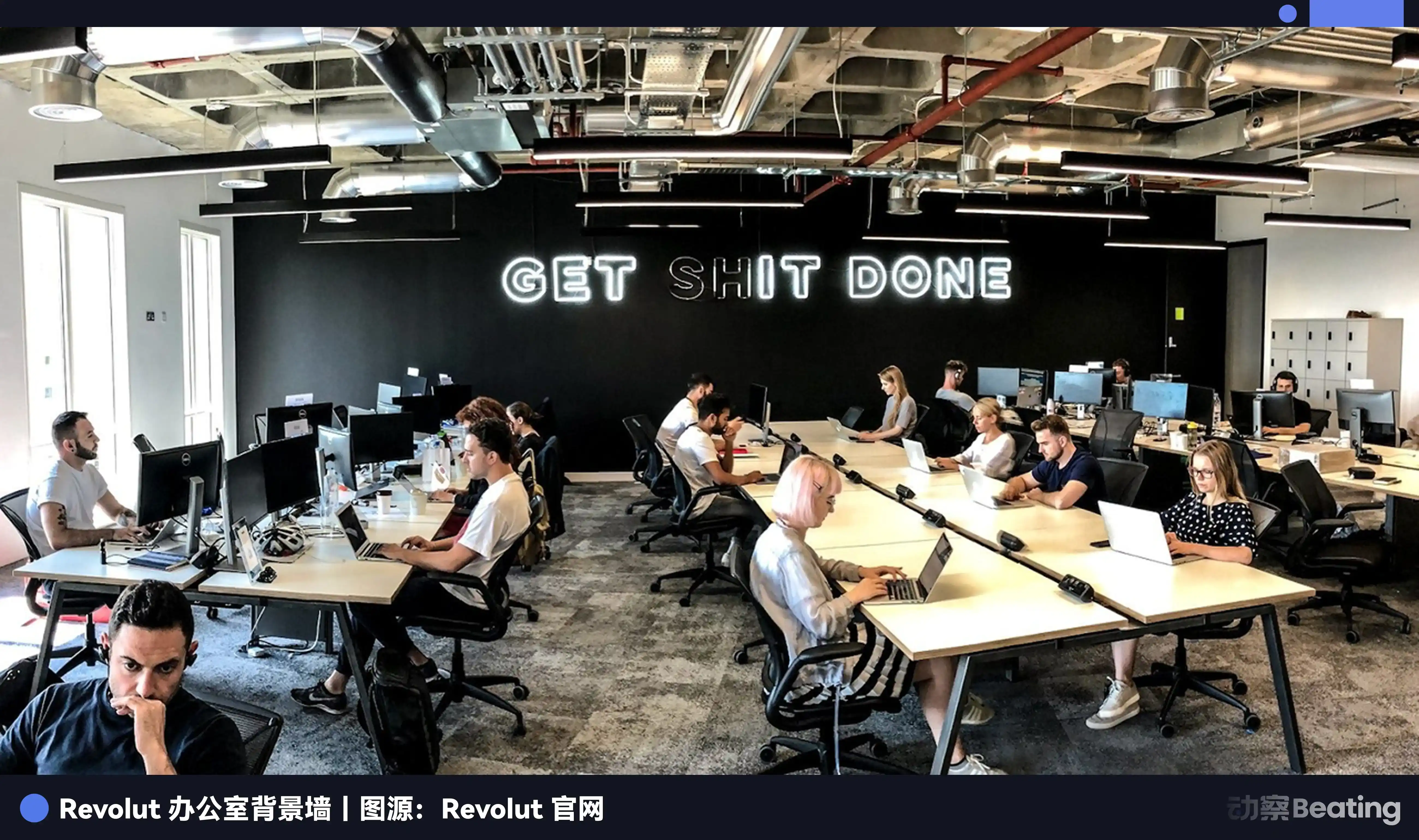
Behind this is actually a very strict management philosophy. He has very high demands on the team; whoever isn't capable will be asked to leave. This近乎无情 (almost ruthless) standard, in turn, makes the team's overall combat strength very strong, quality very high, and advancement very fast. This is what I aspire to; I also hope to get as close as possible. Of course, everyone will eventually find their own different management style.
动察: Which book inspired you the most or was your favorite this year?
Christian: After reading "长安的荔枝" (Lychees of Chang'an), I found I didn't know much about the Tang Dynasty, so I read three related books in a row. Reading them, I felt quite touched. The most exciting parts of history often绕不开 (cannot bypass) Li Shimin, and his experience gave me strong inspiration.古代打天下 (Conquering the world in ancient times) and entrepreneuring today are actually very similar; the essence is both needing someone to lead, bringing a group of people to accomplish something.
I particularly admire Li Shimin's胸怀和格局 (breadth of mind and pattern/vision), which is almost公认的 (recognized) among历代皇帝 (emperors throughout history). He could收拢 (gather), trust, even重用 (heavily reuse) former enemies and strong opponents after victory. Entrepreneurs should also have this kind of breadth of mind because the most outstanding people are often桀骜不驯 (proud and unruly), not easy to persuade. If you can still make this group of people follow you服服口服 (convinced and口服 (verbally agreeing)), that is a very rare and crucial ability.
Also, he seized power through a兵变 (military coup), even rebelling against his father. Maybe because I study philosophy, I would think about in what kind of situation a person would make this choice,被视为 (seen as) greatly逆不道 (rebellious and impious) in the traditional moral framework? For me, this matter isn't simply good or bad,功过评判 (evaluation of merits and faults). It's more like providing a perspective; perhaps there is a type of person in another moral state (state of morality). How everyone chooses in different situations in the end is very耐人寻味 (thought-provoking) and worth long-term thinking.
动察: 2025 might have been a bit坎坷 (bumpy) for you; what will you write in your year-end summary?
Christian: I sincerely hope 2025 passes quickly now (laughs). It's not that this year was only坎坷 (bumpy), but it was indeed quite not easy. But looking back, I反而觉得 (instead feel) very lucky to experience so many things at this age; this was also my fastest year of growth.
My year-end summary is actually one thing: which places could I have done better if I could do it over? What lessons should I learn? Of course,更多时候还是在想 (more often I'm still thinking about) what to do next. Another very lucky point is that in this process, I found many people have been by my side all along; colleagues, friends, family accompanied me through this difficult time.
At the same time, this year also made me see more clearly who are the people who can solve problems with you even in difficult times. I will be more willing to believe and feel it's worth working together long-term, walking the path together.



















