Crypto Project Pudgy Penguins Appears on the Sphere Dome in Las Vegas

RBK-cryptoPublicado a 2025-12-25Actualizado a 2025-12-25

Resumen

Popular NFT project Pudgy Penguins has achieved a major marketing milestone by placing its advertisement on the exterior of the Sphere in Las Vegas, the world's largest spherical LED media platform. The project, which began as a flagship NFT collection on Ethereum, has transformed into a global retail brand by 2025. It now boasts global sales of toys, partnerships with retailers like Walmart and Amazon, the release of animated content, and the launch of its PENGU token on the Solana network. The project has deliberately avoided crypto-themed advertising for this campaign, focusing instead on its physical goods and animated content without mentioning tokens or NFTs. This contrasts with a previous attempt by the Dogwifhat (WIF) meme coin community to run a similar campaign, which was rejected by Sphere despite raising $700,000. The floor price for a Pudgy Penguins NFT is currently around 4 ETH (approximately $12,000). The PENGU token was one of the top-performing major crypto assets in 2025, though it later corrected by more than 70% from its July peak alongside most altcoins. Its previous growth was accompanied by the launch of the Pengu Clash mini-game on Telegram and partnerships with Lufthansa and NASCAR. The project also gained significant attention when dozens of executives from major crypto companies temporarily changed their social media avatars to Pudgy Penguins images.

The team behind the popular NFT project became the first in the crypto industry to secure advertising placement on the world's largest LED screen

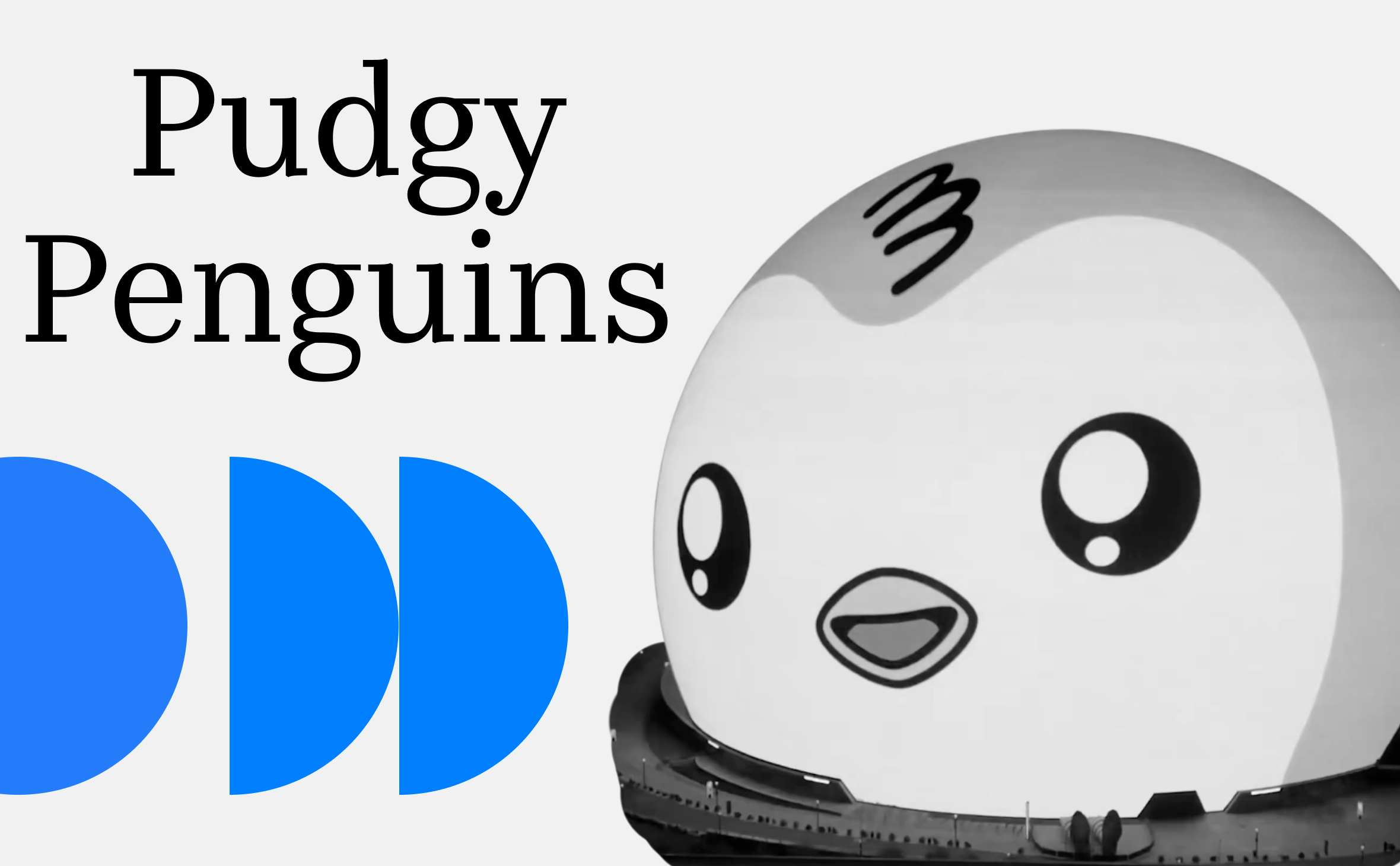
The characters of the Pudgy Penguins brand have become part of the outdoor advertising on the giant LED screen Sphere — the world's largest spherical media platform, located in Las Vegas.

Animation on the LED screen of the Sphere in Las Vegas. Source: pudgypenguins / X

The Pudgy Penguins project began as one of the flagship NFT collections on the Ethereum network, but by 2025 it had transformed into a retail brand with global sales of toys, partnerships with retailers Walmart and Amazon, the release of animated films, and the launch of the PENGU token on the Solana network.

NFT (non-fungible tokens) — these are unique digital objects with ownership confirmed on the blockchain. They became part of the crypto-mania of 2021-2022, when images, videos, and other collectible tokens on the Ethereum or Solana networks were sold for hundreds of thousands of dollars.

The project avoided a ban on crypto advertising from the sphere's operators by focusing on physical goods — toys, merchandise, and animated content, without mentioning tokens or NFTs. Earlier, an attempt by the Dogwifhat (WIF) meme coin community to run a similar campaign was rejected, despite raising $700 thousand for it.

The minimum price (floor price) for one NFT image from the collection is 4 ETH (about $12 thousand), according to CoinGecko data on December 25th.

RBC-Crypto Telegram channel — subscribe and stay up to date with the most important and current news about cryptocurrency.

Join the RBC-Crypto forum on Telegram to discuss news and trends in the crypto world.

The PENGU token showed one of the best growth results among major crypto assets in 2025, but by the end of the year, along with most altcoins, it corrected by more than 70% from its July peak.

That period of growth was accompanied by the launch of the game Pengu Clash as a mini-app on Telegram, a partnership of the project with the airline Lufthansa and the organizer of NASCAR auto races. The same period was marked by a mass flashmob when dozens of leaders and managers of large crypto companies temporarily changed their avatars on social network X to images of Pudgy Penguins.

Volatility interrupted. How the price of bitcoin changed over 10 years at Christmas

AI beat people in a crypto trading tournament. What were the results?

"Capitalization" of miners was called a bullish factor for bitcoin. Why?

Lecturas Relacionadas

Both Suffer Massive Losses Exceeding $90 Billion, Which Is in Greater Peril: Strategy or Bitmine?

Facing massive paper losses exceeding $90 billion each amidst a sharp market downturn, "Digital Asset Treasury" (DAT) giants Strategy and Bitmine find themselves in a precarious position, but with different underlying risks. Strategy, heavily invested in Bitcoin (BTC), faces significant financial strain. Its strategy relies heavily on debt, including convertible notes and preferred stock (STRC) requiring substantial dividend payments. With its cash reserves dwindling and BTC offering no staking yield for cash flow, Strategy's high leverage makes it vulnerable. A continued price decline could force asset sales to meet obligations, potentially creating a negative feedback loop. Its market value has already fallen sharply. In contrast, Bitmine, an Ethereum (ETH) holder, appears on firmer financial ground. It primarily funds its purchases through equity offerings (like ATM programs), avoiding debt pressure. It also generates income by staking a large portion of its ETH holdings. While not immune to market drops and shareholder dilution concerns, Bitmine maintains more flexibility, recently announcing a new preferred share offering to raise further capital. The core divergence lies in their financing: Bitmine uses equity (investor money), while Strategy uses debt (borrowed money). Consequently, Bitmine currently faces less immediate liquidity pressure than Strategy, which must navigate the dual challenge of servicing debt/dividends and a declining core asset (BTC) price.

marsbitHace 9 min(s)

Both Suffer Massive Losses Exceeding $90 Billion, Which Is in Greater Peril: Strategy or Bitmine?

marsbitHace 9 min(s)

Where the AI Bubble Really Is: Which Layer of Players Are Naked

AI Bubble: Where It Really Is and Who's Swimming Naked This analysis dissects the AI industry not as a single entity but as a five-layer pyramid, arguing that bubbles are concentrated in specific tiers, not uniformly distributed. **Key Distinction from the 2000 Dot-com Bubble:** Unlike 2000, where companies had stock prices before revenue, today's leading AI players have massive, contract-backed revenue driving their valuations. Core infrastructure demand is real, with every GPU running at full capacity for paying customers. **The Five-Layer Pyramid & Bubble Assessment:** * **L0 (Fab/Manufacturing) & Top L4 (Leading AI Apps): NO BUBBLE.** Companies like TSMC, NVIDIA, major cloud providers (Microsoft, Google, Meta, Amazon), and top AI labs have real revenues and orders. Supply is tightly constrained by TSMC's disciplined capacity control and physical limits like power/land for data centers, preventing a supply glut. * **L1 (Memory): BATTLEGROUND.** Sky-high HBM margins could signal a new structural cycle or a classic "boom before bust." The oligopoly of three major players may enforce supply discipline, making this a high-stakes bet. * **L2 (Interconnect/Optical Modules): BUBBLE TERRITORY.** Companies like Lumentum and AAOI have seen stock surges (4-10x) far outpacing revenue growth. This hardware segment has lower physical barriers to expansion than fabs, allowing speculation. It mirrors the 2000 bubble's epicenter—optics. * **L3 (Infrastructure/"GPU Landlords"): VULNERABLE.** GPU leasing companies profit from the current compute shortage but own no long-term moat. Their business model relies on a temporary bottleneck that will ease as big tech expands and new tech (e.g., potential space-based data centers) emerges. * **L4 Long Tail (VC-backed Startups): STRONG BUBBLE SIGNALS.** VC funding concentration in AI is twice that of the 1999 peak. Many startups with little revenue use the valuation logic of successful giants to justify their own, creating high risk of a "valuation crunch" when funding dries up. **Critical Risks to Monitor:** 1. **GPU Depreciation & Accounting:** Companies extending the assumed useful life of GPUs artificially boost profits. The true economic life depends on future generational leaps from NVIDIA. 2. **"GPU Credit" & Off-Balance-Sheet Leverage:** Emerging structures where shell companies borrow to buy GPUs and lease them out (with chipmakers sometimes investing) move debt off major balance sheets. This echoes the "vendor financing" of 2000 and the securitization risks of 2008, though currently small-scale. 3. **TSMC Abandoning Caution:** If the primary supply bottleneck (TSMC's conservative capacity planning) breaks, runaway supply could trigger a bust. 4. **Algorithmic Efficiency Breakthrough:** A major leap in software efficiency could drastically reduce the need for raw compute hardware, undermining the investment thesis. **Conclusion:** The AI boom is expensive and has frothy areas, but its core is underpinned by real demand and physical supply constraints. The bubble risk is layered: most present in optical components, GPU leasing, and the long-tail startup ecosystem, while the foundational chip manufacturing and leading application layers remain relatively solid—for now.

marsbitHace 22 min(s)

Where the AI Bubble Really Is: Which Layer of Players Are Naked

marsbitHace 22 min(s)

Trading

Spot
Futuros
活动图片




