On December 11, the Federal Reserve announced a 25 basis point interest rate cut as expected. On the surface, this decision was highly consistent with market expectations and was even interpreted as a signal of a shift towards monetary easing. However, the market reaction quickly turned cold, with U.S. stocks and crypto assets falling simultaneously, and risk appetite contracting significantly. This seemingly counterintuitive trend actually reveals a key fact in the current macro environment: a rate cut itself does not equate to liquidity easing. During this super central bank week, the message conveyed by the Fed was not "re-flooding the market with liquidity" but rather a clear constraint on future policy space. From a policy perspective, changes in the dot plot had a substantial impact on market expectations. The latest forecast indicates that the Fed may only cut rates once in 2026, significantly lower than the previously priced path of 2 to 3 cuts. More importantly, in the voting structure of this meeting, 3 out of 12 voting members explicitly opposed the rate cut, with 2 advocating for keeping rates unchanged. This divergence is not marginal noise but clearly indicates that the Fed's internal vigilance toward inflation risks is far higher than the market previously understood. In other words, the current rate cut is not the start of an easing cycle but rather a technical adjustment to prevent financial conditions from tightening excessively in a high-interest-rate environment.
For this reason, what the market truly anticipates is not a "one-time rate cut" but a clear, sustainable, and forward-looking easing path. The pricing logic of risk assets relies not on the absolute level of current interest rates but on the discounting of future liquidity conditions. When investors realize that this rate cut does not open new easing space but may instead lock in future policy flexibility prematurely, the original optimistic expectations are quickly revised. The signal released by the Fed is akin to a "painkiller," temporarily alleviating tension but not changing the underlying issue. At the same time, the restrained stance revealed in the forward guidance forces the market to reassess future risk premiums. In this context, the rate cut has instead become a classic case of "buy the rumor, sell the news." Long positions built around easing expectations began to unwind, with high-valuation assets bearing the brunt. Growth and high-beta sectors in U.S. stocks were the first to come under pressure, and the crypto market was no exception. The pullback in Bitcoin and other major crypto assets was not due to a single negative factor but rather a passive reaction to the reality that "liquidity will not return quickly." When futures basis converges, marginal ETF buying weakens, and overall risk appetite declines, prices naturally gravitate toward a more conservative equilibrium level. A deeper change lies in the shifting risk structure of the U.S. economy. A growing body of research suggests that the core risk facing the U.S. economy in 2026 may no longer be a traditional cyclical recession but rather a demand-side contraction directly triggered by a significant correction in asset prices. After the pandemic, the U.S. saw an "excess retirement" group of approximately 2.5 million people. The wealth of this group is highly dependent on the performance of the stock market and risk assets, and their consumption behavior is highly correlated with asset prices. If the stock market or other risk assets experience a sustained decline, the consumption capacity of this group will contract simultaneously, creating a negative feedback loop for the overall economy. In this economic structure, the Fed's policy options are further constrained. On one hand, stubborn inflationary pressures persist, and premature or excessive easing could reignite price increases. On the other hand, if financial conditions continue to tighten and asset prices experience a systemic correction, it could quickly transmit to the real economy through the wealth effect, triggering a downturn in demand. The Fed is thus caught in an extremely complex dilemma: continuing to aggressively suppress inflation could trigger a collapse in asset prices, while tolerating higher inflation levels could help maintain financial stability and asset prices.
A growing number of market participants are beginning to accept the judgment that, in future policy games, the Fed is more likely to choose to "protect the market" rather than "protect inflation" at critical moments. This means that the long-term inflation center may shift upward, but short-term liquidity releases will be more cautious and intermittent rather than forming a sustained wave of easing. For risk assets, this is an unfriendly environment—the pace of interest rate declines is insufficient to support valuations, while liquidity uncertainty persists. It is against this macro backdrop that the impact of this super central bank week extends far beyond a single 25 basis point rate cut. It marks a further correction in market expectations of the "unlimited liquidity era" and sets the stage for the subsequent Bank of Japan rate hike and year-end liquidity contraction. For the crypto market, this is not the end of the trend but a critical phase where risks must be recalibrated and macro constraints re-understood.
II. Bank of Japan Rate Hike: The True "Liquidity Bomb Disposer"
If the Fed's role during the super central bank week was to disappoint and correct market expectations for "future liquidity," then the action the Bank of Japan is set to take on December 19 is closer to a "bomb disposal operation" directly affecting the底层 structure of global finance. The market's probability expectation for the BOJ to raise rates by 25 basis points, pushing the policy rate from 0.50% to 0.75%, is now close to 90%. This seemingly modest adjustment would mean Japan is raising its policy rate to its highest level in three decades. The key issue is not the absolute value of the rate itself but the chain reaction this change could trigger in the global capital flow logic. For a long time, Japan has been the most important and stable source of low-cost financing in the global financial system. Once this premise is broken, its impact will far exceed the Japanese domestic market.
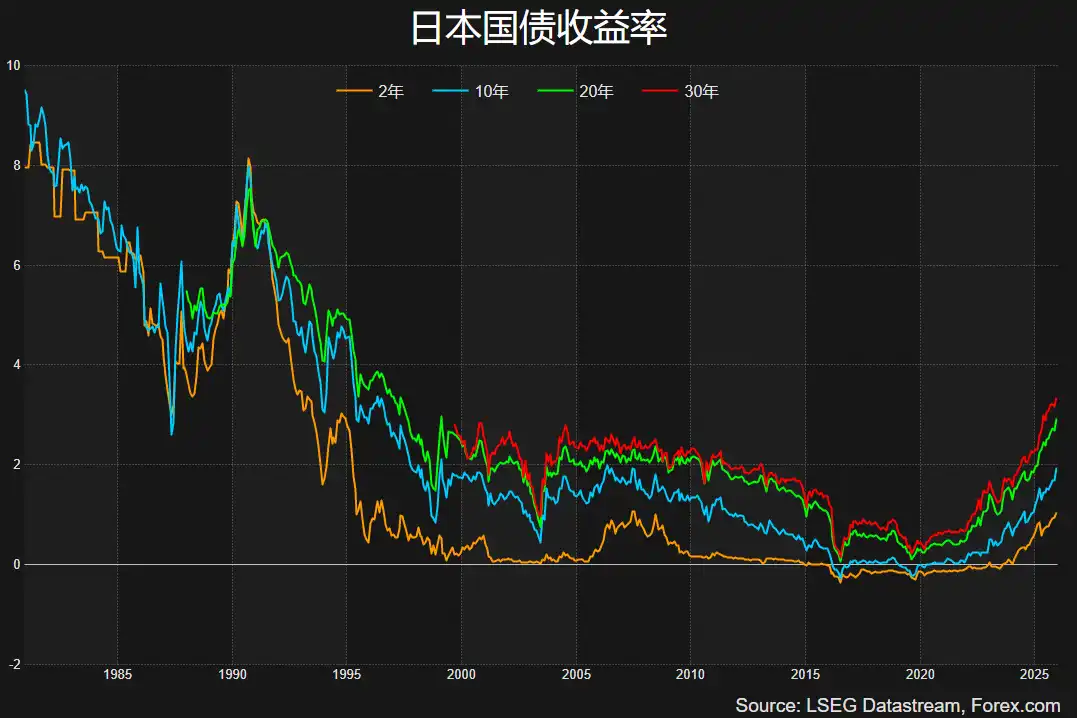
Over the past decade-plus, global capital markets have gradually formed an almost default structural consensus: the yen is a "permanent low-cost currency." Supported by long-term ultra-loose policies, institutional investors could borrow yen at near-zero or even negative costs, convert it into U.S. dollars or other high-yielding currencies, and allocate to U.S. stocks, crypto assets, emerging market bonds, and various risk assets. This model evolved from short-term arbitrage into a long-term capital structure worth trillions of dollars, deeply embedded in the global asset pricing system. Because it lasted so long and was so stable, yen carry trade gradually shifted from a "strategy" to a "background assumption," rarely priced by the market as a core risk variable. However, once the BOJ clearly enters a rate-hiking cycle, this assumption is forced to be reassessed. The impact of a rate hike is not limited to a marginal increase in financing costs; more importantly, it changes market expectations regarding the long-term direction of the yen exchange rate. When policy rates rise, and inflation and wage structures change, the yen is no longer just a passively depreciating funding currency but may transform into an asset with appreciation potential. Under such expectations, the logic of carry trade is fundamentally disrupted. Capital flows originally centered on "interest rate differentials" now incorporate considerations of "exchange rate risk," rapidly deteriorating the risk-reward ratio for capital.
In this situation, the choices facing carry trade capital are not complex but highly destructive: either close positions early to reduce exposure to yen liabilities, or passively endure the double squeeze of exchange rates and interest rates. For large-scale, highly leveraged capital, the former is often the only viable path. The specific method of closing positions is also extremely direct—selling the held risk assets, converting back to yen, and using the proceeds to repay financing. This process does not distinguish between asset quality, fundamentals, or long-term prospects but has the sole goal of reducing overall exposure, thus exhibiting clear "indiscriminate selling" characteristics. U.S. stocks, crypto assets, and emerging market assets often come under pressure simultaneously, forming highly correlated declines. History has repeatedly verified the existence of this mechanism. In August 2025, the BOJ unexpectedly raised its policy rate to 0.25%, a move not traditionally considered aggressive, yet it triggered a violent reaction in global markets. Bitcoin fell 18% in a single day, and multiple risk assets came under simultaneous pressure, taking nearly three weeks for the market to gradually complete the repair. The reason that impact was so severe was precisely because the rate hike came suddenly, forcing carry trade capital to deleverage rapidly without preparation. The upcoming December 19 meeting is different from that "black swan" event; it is more like a "gray rhino" whose tracks have been revealed in advance. The market already has some expectation of a rate hike, but expectation itself does not mean the risk has been fully priced in, especially when the hike is larger and叠加 with other macro uncertainties.
More notably, the macro environment in which this BOJ rate hike is occurring is more complex than in the past. Policies of major global central banks are diverging: the Fed is cutting rates nominally but tightening future easing space in terms of expectations; the ECB and the Bank of England are relatively cautious; while the BOJ is becoming one of the few major economies explicitly tightening policy. This policy divergence will exacerbate the volatility of cross-currency capital flows, making the unwinding of carry trades not a one-time event but potentially an evolving process that occurs in stages and repeats. For crypto markets, which are highly dependent on global liquidity, the persistence of this uncertainty means the center of price volatility may remain at a higher level for some time. Therefore, the BOJ's rate hike on December 19 is not merely a regional monetary policy adjustment but a potential trigger for a rebalancing of the global capital structure. What it "disposes of" is not the risk of a single market but the long-accumulated assumption of low-cost leverage embedded in the global financial system. In this process, crypto assets often bear the impact first due to their high liquidity and high-beta attributes. This impact does not necessarily mean a reversal of the long-term trend but is almost certain to amplify volatility, depress risk appetite in the short term, and force the market to re-examine the capital logic taken for granted over many years.
III. Christmas Holiday Market: The Underestimated "Liquidity Amplifier"
Starting December 23, major North American institutional investors gradually enter the Christmas holiday mode, and global financial markets随之 enter the most typical and最容易 underestimated period of liquidity contraction of the year. Unlike macro data or central bank decisions, the holiday does not change any fundamental variables but significantly weakens the market's "absorption capacity" for shocks in a short time. For markets like crypto assets, which highly rely on continuous trading and market maker depth, this structural decline in liquidity is often more damaging than any single negative event itself. In a normal trading environment, the market has sufficient counterparties and risk-bearing capacity. A large number of market makers, arbitrage funds, and institutional investors continuously provide two-way liquidity, allowing selling pressure to be dispersed, delayed, or even hedged.
More alarmingly, the Christmas holiday does not occur in isolation but恰好 overlaps with the current集中 release of a series of macro uncertainties. The "dovish cut but hawkish stance" signal released by the Fed during the super central bank week has significantly tightened market expectations for future liquidity; meanwhile, the upcoming BOJ rate hike decision on December 19 is shaking the long-standing capital structure of global yen carry trade. Under normal circumstances, these two types of macro shocks can be gradually digested by the market over a longer period, with prices completing repricing through repeated博弈. But when they恰好 occur during the Christmas holiday, the window of weakest liquidity, their impact is no longer linear but exhibits a clear amplification effect. The essence of this amplification effect is not panic itself but a change in market mechanisms. Insufficient liquidity means the price discovery process is compressed; the market cannot gradually absorb information through continuous trading but is forced to complete adjustments through more drastic price jumps. For the crypto market, a decline in such an environment often does not require new major negatives; merely the集中 release of existing uncertainty is enough to trigger a chain reaction: price drops trigger passive liquidation of leveraged positions, passive liquidation further increases selling pressure, selling pressure is rapidly amplified in shallow order books, ultimately forming剧烈 volatility within a short time. Historical data shows this pattern is not an exception. Whether in Bitcoin's early cycles or in the more mature stages in recent years, the period from late December to early January has always been a time when crypto market volatility is significantly higher than the annual average. Even in years with relatively stable macro environments, holiday liquidity declines are often accompanied by rapid price surges or plunges; in years with higher macro uncertainty, this time window is more likely to become an "accelerator" for trend行情. In other words, the holiday does not determine the direction but greatly amplifies the price performance once the direction is confirmed.
IV. Conclusion
In summary, the current pullback in the crypto market is closer to a阶段性 repricing triggered by changes in the global liquidity path, rather than a simple reversal of a trend行情. The Fed's rate cut did not provide new valuation support for risk assets; on the contrary, its constraints on future easing space in the forward guidance have led the market to gradually accept a new environment of "falling interest rates but insufficient liquidity." Against this backdrop, high-valuation and high-leverage assets naturally face pressure, and the adjustment in the crypto market has a clear macro logic foundation.
At the same time, the BOJ's rate hike constitutes the most structurally significant variable in this adjustment. The yen's long-standing role as the core funding currency for global carry trade means that once its low-cost assumption is broken, it triggers not just局部 capital flows but a systemic contraction of global risk asset exposure. Historical experience shows that such adjustments are often phased and repetitive; their impact is not fully released in a single trading day but rather completes the deleveraging process through sustained volatility. Crypto assets, due to their high liquidity and high-beta attributes, often reflect this pressure first, but this does not necessarily mean their long-term logic is negated.
For investors, the core challenge at this stage is not judging the direction but recognizing the environmental changes. When policy uncertainty and liquidity contraction coexist, the importance of risk management significantly outweighs trend judgment. Truly valuable market signals often appear after macro variables gradually land and arbitrage funds complete阶段性 adjustments. For the crypto market, the current period更像是一个过渡期 for recalibrating risks and rebuilding expectations, rather than the final chapter of the行情. The medium-term direction of future prices will depend on the actual recovery of global liquidity after the holiday ends and whether the policy divergence among major central banks deepens further.



















