Crypto At The Casino? UK Weighs Letting Online Bettors Pay With Digital Currency

bitcoinistPublicado a 2026-03-01Actualizado a 2026-03-01

Resumen

British gamblers seeking to use cryptocurrency are often directed to illegal websites, a key reason the UK Gambling Commission is considering allowing licensed online platforms to accept crypto payments. Tim Miller, the Commission's executive director, stated that crypto is a top search term leading users to unregulated sites, suggesting that blocking it on legal platforms may push consumers toward riskier alternatives. The review, with no set deadline, will be conducted alongside the Financial Conduct Authority's new crypto oversight framework, expected in 2027. Strict conditions, including affordability checks and full regulatory compliance, would still apply to any crypto transactions.

British gamblers searching for ways to bet with cryptocurrency are more likely to end up on an illegal website than a regulated one. That is part of what prompted the UK Gambling Commission to start asking whether something needs to change.

Tim Miller, the regulator’s executive director for research and policy, told an industry gathering in London last Thursday that the Commission now wants to look seriously at allowing crypto to be used as a payment method at licensed online gambling platforms in Great Britain.

Illegal Sites Are Driving The Conversation

Miller’s case for taking another look at crypto payments was not built purely on demand, though he acknowledged that appetite among bettors is growing. He made the remarks during the Betting and Gaming Council’s annual general assembly.

The more pointed argument was about where that demand currently goes. According to reports, Miller told attendees that crypto ranks among the two most common search terms that lead British gamblers straight to unregulated, illegal sites.
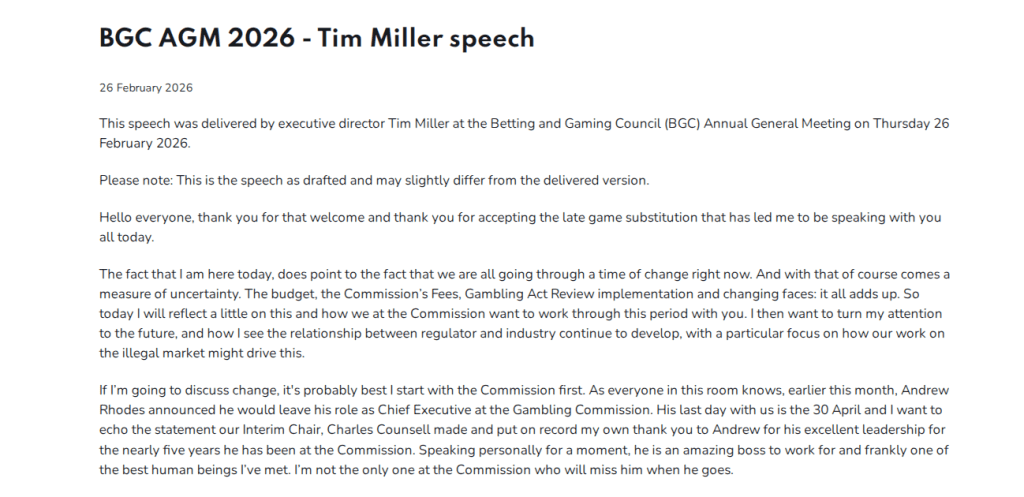
A screenshot of Tim Miller’s speech during the Betting and Gaming Council’s annual gathering in London. Source: Gambling Commission UK

Blocking crypto from licensed platforms, in other words, may be sending consumers somewhere far less protected rather than discouraging them altogether.

That framing marks a shift. For years, the default position from regulators has been that crypto and gambling together create too much risk. Miller’s comments suggest the Gambling Commission is now weighing whether the bigger risk is doing nothing.

Image: Unsplash

No deadline was attached to the review. Miller said he had asked the Industry Forum — an advisory group made up of representatives from across the gambling sector — to map out the available options.

Whatever path is chosen, he made clear it would come with strict conditions. Affordability checks, suitability assessments, and full compliance with UK gambling rules would all still apply. Accepting crypto would not give casinos any special treatment or exemptions.

BTCUSD now trading at $63,988. Chart: TradingView

A Bigger Regulatory Framework Sets The Timeline

The Gambling Commission’s exploration does not exist in isolation. Any move toward crypto payments at licensed venues would be tied directly to the Financial Conduct Authority’s new crypto oversight framework, which is currently being finalized.

According to reports, the FCA is expected to wrap up its consultation process in March, with the full regime set to take effect in October 2027. Companies wanting to operate under the new rules will need to seek authorization from the FCA, with the application window expected to open in September 2026.

Crypto firms that miss that window face a more restricted path. Reports say they would be allowed to continue running existing products under transitional rules but would not be permitted to roll out new offerings until full authorization is granted.

Featured image from Pexels, chart from TradingView

Preguntas relacionadas

QWhat is the main reason the UK Gambling Commission is considering allowing cryptocurrency payments on licensed online gambling platforms?

AThe main reason is that crypto is one of the two most common search terms leading British gamblers to unregulated, illegal sites. Blocking it from licensed platforms may be driving consumers to less protected environments rather than discouraging them.

QWho is Tim Miller and what did he announce at the Betting and Gaming Council's annual gathering?

ATim Miller is the executive director for research and policy at the UK Gambling Commission. He announced that the Commission is seriously considering allowing cryptocurrency as a payment method on licensed online gambling platforms in Great Britain.

QWhat strict conditions would be applied if crypto payments were allowed on licensed gambling platforms?

AStrict conditions would include affordability checks, suitability assessments, and full compliance with all existing UK gambling rules. Accepting crypto would not grant casinos any special treatment or exemptions.

QHow is the Gambling Commission's exploration of crypto payments connected to the Financial Conduct Authority (FCA)?

AAny move toward crypto payments would be directly tied to the FCA's new crypto oversight framework, which is currently being finalized. Companies would need to seek authorization from the FCA to operate under these new rules.

QWhat is the expected timeline for the FCA's new crypto regime to take full effect?

AThe FCA is expected to finalize its consultation process in March, with the full regulatory framework set to take effect in October 2027. The application window for companies to seek authorization is expected to open in September 2026.

Lecturas Relacionadas

The Era Has Arrived Where Human Writers Must Prove They Are Not Machines

The article describes an era where AI-generated content is flooding the market, forcing human authors to prove they are not machines. It begins with the example of dozens of AI-written, error-ridden biographies of Henry Kissinger appearing on Amazon within hours of his death, a pattern repeated for other deceased celebrities and even living experts who find fraudulent books under their names. This spam content has exploded, with monthly new book releases on platforms like Amazon reaching 300,000 by late 2025. The issue spans genres, from suspiciously high proportions of AI-written teen romance and self-help books to dangerous, AI-generated foraging guides containing lethal advice. The platforms' automated review systems, designed to catch plagiarism and banned words, are ill-equipped to detect AI-generated text that avoids these pitfalls while being nonsensical or fraudulent. The problem has infiltrated traditional publishing. A major publisher, Hachette, had to recall a bestselling horror novel after AI detection tools suggested 78% of its content was machine-generated. An acclaimed European philosophy book was later revealed to be entirely written by AI under a fake author persona. In response, authors are fighting back. At the 2026 London Book Fair, 10,000 writers published a blank book titled "Don't Steal This Book" containing only their signatures—using emptiness as a protest weapon in an age of AI overproduction. Initiatives like the "Human Author Certification" program have emerged, ironically placing the burden on humans to prove their work is not machine-made. The article warns of a vicious cycle: AI-generated low-quality books pollute the data used to train future AI models, leading to "model collapse" and an ever-worsening flood of digital waste, eroding trust in publishing and devaluing human creativity.

marsbitHace 16 min(s)

The Era Has Arrived Where Human Writers Must Prove They Are Not Machines

marsbitHace 16 min(s)

The King of Blind Date Attire in Korea: How SK Hynix Made a Comeback Against Samsung?

In South Korea's dating scene, SK Hynix employees are now highly sought after, a status shift fueled by the company's astronomical profits and employee bonuses, projected to reach up to 6.1 million RMB per person by 2027. This marks a dramatic reversal for the long-time second-place player in memory semiconductors, which has now surpassed its rival Samsung in annual operating profit. The turnaround story began in 2008 when a struggling Hynix, emerging from bankruptcy restructuring, took a risky bet by agreeing to develop High Bandwidth Memory (HBM) with AMD. At the time, HBM had no clear market beyond high-end graphics cards and was a costly, complex technology. Major players like Samsung, pursuing its own HMC technology, declined. For Hynix, with only memory as its core business, it was a gamble born of necessity. The pivotal moment came in 2012 when SK Group Chairman Chey Tae-won acquired Hynix. Defying industry downturns, he invested heavily in R&D and fabrication, sustaining the HBM project through over a decade of commercial uncertainty and internal challenges. A key break occurred around 2016-2017 when Samsung faced production issues supplying HBM2 for Google's TPU, allowing SK Hynix to gain a crucial foothold in the data center market. The AI explosion post-ChatGPT in 2022 was the catalyst, turning HBM into a critical bottleneck for AI accelerators like NVIDIA's GPUs. By 2025, SK Hynix captured 62% of the global HBM market, leaving Samsung at 17%. For the first time, its annual operating profit exceeded Samsung's. Analysts point to the "innovator's dilemma" to explain Samsung's miss: its vast, successful business portfolio made it risk-averse, preventing an all-in bet on the initially niche HBM technology. In contrast, SK Hynix, as a challenger with its back against the wall, had no choice but to commit fully. The story highlights how Korea's chaebol system allows for ultra-long-term bets beyond quarterly pressures. However, SK Hynix's lead isn't guaranteed. Samsung is aggressively catching up on HBM4, and challenges like customer concentration (heavy reliance on NVIDIA) and technical hurdles in advanced packaging remain. The narrative underscores a market truth: the greatest alpha often comes from betting on uncertain, long-term directions others dismiss, much like HBM in 2008.

marsbitHace 56 min(s)

The King of Blind Date Attire in Korea: How SK Hynix Made a Comeback Against Samsung?

marsbitHace 56 min(s)

Trading

Spot
Futuros

Artículos destacados

Cómo comprar T

¡Bienvenido a HTX.com! Hemos hecho que comprar Threshold Network Token (T) sea simple y conveniente. Sigue nuestra guía paso a paso para iniciar tu viaje de criptos.Paso 1: crea tu cuenta HTXUtiliza tu correo electrónico o número de teléfono para registrarte y obtener una cuenta gratuita en HTX. Experimenta un proceso de registro sin complicaciones y desbloquea todas las funciones.Obtener mi cuentaPaso 2: ve a Comprar cripto y elige tu método de pagoTarjeta de crédito/débito: usa tu Visa o Mastercard para comprar Threshold Network Token (T) al instante.Saldo: utiliza fondos del saldo de tu cuenta HTX para tradear sin problemas.Terceros: hemos agregado métodos de pago populares como Google Pay y Apple Pay para mejorar la comodidad.P2P: tradear directamente con otros usuarios en HTX.Over-the-Counter (OTC): ofrecemos servicios personalizados y tipos de cambio competitivos para los traders.Paso 3: guarda tu Threshold Network Token (T)Después de comprar tu Threshold Network Token (T), guárdalo en tu cuenta HTX. Alternativamente, puedes enviarlo a otro lugar mediante transferencia blockchain o utilizarlo para tradear otras criptomonedas.Paso 4: tradear Threshold Network Token (T)Tradear fácilmente con Threshold Network Token (T) en HTX's mercado spot. Simplemente accede a tu cuenta, selecciona tu par de trading, ejecuta tus trades y monitorea en tiempo real. Ofrecemos una experiencia fácil de usar tanto para principiantes como para traders experimentados.

581 Vistas totalesPublicado en 2024.12.10Actualizado en 2025.03.21

Cómo comprar T

Discusiones

Bienvenido a la comunidad de HTX. Aquí puedes mantenerte informado sobre los últimos desarrollos de la plataforma y acceder a análisis profesionales del mercado. A continuación se presentan las opiniones de los usuarios sobre el precio de T (T).

活动图片