Connecticut can’t take action against Kalshi for now, judge rules

cointelegraphPublicado a 2025-12-10Actualizado a 2025-12-10

Resumen

A US judge has temporarily blocked Connecticut from taking enforcement action against prediction markets platform Kalshi, which received a cease and desist order from the state’s Department of Consumer Protection (DCP) for allegedly conducting unlicensed sports gambling. Kalshi sued the DCP, arguing its event contracts are legal under federal law and fall under the exclusive jurisdiction of the Commodity Futures Trading Commission. The court has paused enforcement while it reviews Kalshi’s motion for a preliminary injunction, with further legal proceedings scheduled through February. Kalshi, a CFTC-regulated platform that saw record trading volume in November, is also engaged in similar legal battles with multiple states, including New York, Massachusetts, New Jersey, Nevada, Maryland, and Ohio, over regulatory jurisdiction and gambling licensing.

A US judge has granted prediction markets platform Kalshi a temporary reprieve from enforcement after the state of Connecticut sent it a cease and desist order last week for allegedly conducting unlicensed gambling.

The Connecticut Department of Consumer Protection (DCP) sent Kalshi, along with Robinhood and Crypto.com, cease and desist orders on Dec. 2, accusing them of “conducting unlicensed online gambling, more specifically sports wagering, in Connecticut through its online sports event contracts.”

Kalshi sued the DCP a day later, arguing its event contracts “are lawful under federal law” and its platform was subject to the Commodity Futures Trading Commission’s “exclusive jurisdiction,” and filed a motion on Friday to temporarily stop the DCP’s action.
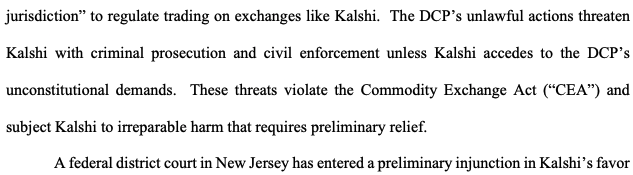
An excerpt from Kalshi’s preliminary injunction motion arguing that the DCP’s action violates federal commodities laws. Source: CourtListener

Connecticut federal court judge Vernon Oliver said in an order on Monday that the DCP must “refrain from taking enforcement action against Kalshi” as the court considers the company’s bid to temporarily stop the regulator.

The order adds that the DCP should file a response to the company by Jan. 9 and Kalshi should file further support for its motion by Jan. 30, with oral arguments for the case to be held in mid-February.

Kalshi is in a battle with multiple US states

Kalshi is a federally regulated designated contract maker under the CFTC and, in January, began offering contracts nationally that allow bets on the outcome of events such as sports and politics.

Related: How prediction markets raise insider trading and credit risks

Its platform has become hugely popular this year and saw a record $4.54 billion monthly trading volume in November, attracting billions in investments, with Kalshi closing a $1 billion funding round earlier this month at a valuation of $11 billion.

However, multiple US state regulators have taken issue with Kalshi’s offerings, which have led to the company being embroiled in lawsuits over whether it is subject to state-level gambling laws.

Kalshi sued the New York State Gaming Commission in October after the regulator sent a cease and desist order claiming it offered a platform for sports wagering without a license.

In September, Massachusetts’ state attorney general sued Kalshi in state court, which the company asked to be tossed. So far this year, Kalshi has sued state regulators in New Jersey, Nevada, Maryland and Ohio, accusing each of regulatory overreach.

Magazine: Can Robinhood or Kraken’s tokenized stocks ever be truly decentralized?

Lecturas Relacionadas

The King of Blind Date Attire in Korea: How SK Hynix Made a Comeback Against Samsung?

In South Korea's dating scene, SK Hynix employees are now highly sought after, a status shift fueled by the company's astronomical profits and employee bonuses, projected to reach up to 6.1 million RMB per person by 2027. This marks a dramatic reversal for the long-time second-place player in memory semiconductors, which has now surpassed its rival Samsung in annual operating profit. The turnaround story began in 2008 when a struggling Hynix, emerging from bankruptcy restructuring, took a risky bet by agreeing to develop High Bandwidth Memory (HBM) with AMD. At the time, HBM had no clear market beyond high-end graphics cards and was a costly, complex technology. Major players like Samsung, pursuing its own HMC technology, declined. For Hynix, with only memory as its core business, it was a gamble born of necessity. The pivotal moment came in 2012 when SK Group Chairman Chey Tae-won acquired Hynix. Defying industry downturns, he invested heavily in R&D and fabrication, sustaining the HBM project through over a decade of commercial uncertainty and internal challenges. A key break occurred around 2016-2017 when Samsung faced production issues supplying HBM2 for Google's TPU, allowing SK Hynix to gain a crucial foothold in the data center market. The AI explosion post-ChatGPT in 2022 was the catalyst, turning HBM into a critical bottleneck for AI accelerators like NVIDIA's GPUs. By 2025, SK Hynix captured 62% of the global HBM market, leaving Samsung at 17%. For the first time, its annual operating profit exceeded Samsung's. Analysts point to the "innovator's dilemma" to explain Samsung's miss: its vast, successful business portfolio made it risk-averse, preventing an all-in bet on the initially niche HBM technology. In contrast, SK Hynix, as a challenger with its back against the wall, had no choice but to commit fully. The story highlights how Korea's chaebol system allows for ultra-long-term bets beyond quarterly pressures. However, SK Hynix's lead isn't guaranteed. Samsung is aggressively catching up on HBM4, and challenges like customer concentration (heavy reliance on NVIDIA) and technical hurdles in advanced packaging remain. The narrative underscores a market truth: the greatest alpha often comes from betting on uncertain, long-term directions others dismiss, much like HBM in 2008.

marsbitHace 39 min(s)

The King of Blind Date Attire in Korea: How SK Hynix Made a Comeback Against Samsung?

marsbitHace 39 min(s)

Trading

Spot
Futuros

Artículos destacados

Cómo comprar T

¡Bienvenido a HTX.com! Hemos hecho que comprar Threshold Network Token (T) sea simple y conveniente. Sigue nuestra guía paso a paso para iniciar tu viaje de criptos.Paso 1: crea tu cuenta HTXUtiliza tu correo electrónico o número de teléfono para registrarte y obtener una cuenta gratuita en HTX. Experimenta un proceso de registro sin complicaciones y desbloquea todas las funciones.Obtener mi cuentaPaso 2: ve a Comprar cripto y elige tu método de pagoTarjeta de crédito/débito: usa tu Visa o Mastercard para comprar Threshold Network Token (T) al instante.Saldo: utiliza fondos del saldo de tu cuenta HTX para tradear sin problemas.Terceros: hemos agregado métodos de pago populares como Google Pay y Apple Pay para mejorar la comodidad.P2P: tradear directamente con otros usuarios en HTX.Over-the-Counter (OTC): ofrecemos servicios personalizados y tipos de cambio competitivos para los traders.Paso 3: guarda tu Threshold Network Token (T)Después de comprar tu Threshold Network Token (T), guárdalo en tu cuenta HTX. Alternativamente, puedes enviarlo a otro lugar mediante transferencia blockchain o utilizarlo para tradear otras criptomonedas.Paso 4: tradear Threshold Network Token (T)Tradear fácilmente con Threshold Network Token (T) en HTX's mercado spot. Simplemente accede a tu cuenta, selecciona tu par de trading, ejecuta tus trades y monitorea en tiempo real. Ofrecemos una experiencia fácil de usar tanto para principiantes como para traders experimentados.

581 Vistas totalesPublicado en 2024.12.10Actualizado en 2025.03.21

Cómo comprar T

Discusiones

Bienvenido a la comunidad de HTX. Aquí puedes mantenerte informado sobre los últimos desarrollos de la plataforma y acceder a análisis profesionales del mercado. A continuación se presentan las opiniones de los usuarios sobre el precio de T (T).

活动图片













