Coinbase Hit With Nevada Lawsuit Over Illegal Betting Claims

bitcoinistPublicado a 2026-02-05Actualizado a 2026-02-05

Resumen

Coinbase faces a civil lawsuit from the Nevada Gaming Control Board for offering event contracts that regulators claim constitute unlicensed sports betting. The state seeks a temporary restraining order and injunction to halt these operations, arguing they violate Nevada gaming laws. Coinbase contends that such contracts fall under federal CFTC jurisdiction, not state oversight, and has sued multiple states in response. The legal conflict highlights ongoing tension between state and federal regulators regarding prediction markets, as the CFTC considers new rules clarification. Similar enforcement actions are occurring in other states.

Coinbase is facing a civil enforcement action in Nevada after state gaming regulators said the company offered event contracts that look like wagers to local users.

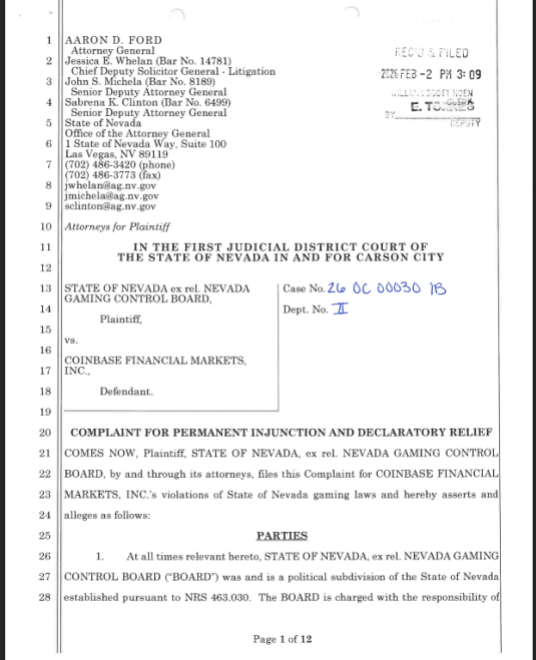
Based on reports, the Nevada Gaming Control Board filed suit in state court asking a judge to stop Coinbase from offering these contracts inside Nevada and to grant a temporary restraining order and preliminary injunction.

Nevada Files Civil Enforcement Action

The complaint says Coinbase’s event contracts operate like unlicensed sports betting under Nevada law, and that the exchange did not hold the required state gaming license to offer them.
Source: Nevada Gaming Control Board

The filing seeks immediate court steps to halt the products while the state pursues its claims. Reports note the move follows similar actions against other prediction platforms and comes as the legal fight over where these products belong—state gaming law or federal derivatives law—intensifies.

Background On Prediction Markets And Coinbase’s Response

Prediction markets have grown quickly. Coinbase rolled out a prediction market product that lets customers take positions on the outcomes of sports and other real-world events, working with established market operators.

BTCUSD currently trading at $76,059. Chart: TradingView

Coinbase has pushed back by suing multiple states in federal court, arguing that event contracts are regulated by the federal Commodity Futures Trading Commission and not by individual state gaming regulators. Those federal suits targeted Connecticut, Illinois, and Michigan, among others.

Federal Regulator Signals New Rules

Reports say the CFTC’s chair has signaled a shift toward clearer federal rules for event contracts and suggested the agency may issue new guidance that affects ongoing state cases.

That announcement could change the legal balance, since a stronger federal stance would bolster exchanges that claim CFTC jurisdiction over these products. Still, state claims press on, and courts will have to sort out who has the power to regulate.

Nevada’s Push Comes As Other States Act

Nevada’s action is not isolated. A Nevada state court recently granted a temporary restraining order that barred another major prediction platform from offering event contracts in the state for a short period while the matter moved toward a hearing.

Regulators in several states have issued cease-and-desist letters or sued operators they say are offering unlicensed wagering.

Featured image from Shutterstock, chart from TradingView

Preguntas relacionadas

QWhat is the main reason Nevada is taking legal action against Coinbase?

ANevada is taking legal action because state gaming regulators claim Coinbase offered event contracts that operate like unlicensed sports betting without holding the required state gaming license.

QWhat specific legal measures did the Nevada Gaming Control Board request from the court?

AThe Nevada Gaming Control Board filed a suit asking the court to stop Coinbase from offering these contracts in Nevada and to grant a temporary restraining order and preliminary injunction.

QHow has Coinbase responded to similar regulatory challenges from other states?

ACoinbase has pushed back by suing multiple states, including Connecticut, Illinois, and Michigan, in federal court, arguing that event contracts are regulated by the federal CFTC and not by state gaming regulators.

QWhat potential shift in the regulatory landscape is mentioned regarding the CFTC?

AThe CFTC's chair has signaled a shift toward clearer federal rules for event contracts and suggested the agency may issue new guidance, which could bolster exchanges' claim of CFTC jurisdiction.

QIs Nevada's action an isolated case, or are other states taking similar steps?

ANevada's action is not isolated; regulators in several states have issued cease-and-desist letters or sued operators they allege are offering unlicensed wagering.

Lecturas Relacionadas

Bitwise: Bullish on Bitcoin's Performance in the Second Half of the Year, AI and Regulation Will Spark a New Altcoin Season

Bitwise CIO Matt Hougan and Research Lead Ryan Rasmussen express strong bullish sentiment on Bitcoin's long-term prospects, suggesting that its $1 million price target may be too conservative. They argue Bitcoin serves a dual role: as digital gold and a potential global settlement asset, especially amid declining trust in traditional monetary systems. Despite a weak Q1 2026 where nearly all crypto assets and prices saw double-digit declines, the analysts remain optimistic due to strong forward-looking catalysts, including institutional adoption via Bitcoin ETFs from major firms like Morgan Stanley and Goldman Sachs. Geopolitical instability, such as Iran’s mention of using Bitcoin for international payments, increases the value of Bitcoin’s “out-of-the-money call option” as a non-political, global settlement currency. This enhances its appeal beyond a mere store of value. . Additionally, Hougan highlights that a clearer regulatory token framework under current SEC leadership, combined with AI efficiency gains and high-performance blockchains, could fuel a new “altseason” by late 2026. This may lead to a wave of legitimate, value-capturing token projects, unlike the earlier ICO boom. . Bitwise also announced an Avalanche ETF, citing its unique architecture and rapid growth in real-world asset (RWA) tokenization, which has surged 10x to nearly $30 billion in two years. The firm believes Layer 1 blockchains are still early in their growth cycle, with significant potential ahead.

marsbitHace 9 min(s)

Bitwise: Bullish on Bitcoin's Performance in the Second Half of the Year, AI and Regulation Will Spark a New Altcoin Season

marsbitHace 9 min(s)

Trading

Spot
Futuros
活动图片