Circle stock recovers 150% as USDC supply hits ATH – Here’s what happened

ambcryptoPublicado a 2026-03-17Actualizado a 2026-03-17

Resumen

Circle's stock (CRCL) has surged by 150% since its February low of $49.9, closing at $125.83 on March 17. The rebound follows an 83% decline from its post-IPO peak of $298, driven by fading hype and a broader crypto downturn. Analysts attribute the recovery primarily to the growing adoption of Circle’s stablecoin, USDC, whose supply reached a record $79 billion—a 13% increase in two months. Over 10% of USDC is concentrated on Solana, and platforms like Hyperliquid saw 155% growth in USDC supply in a month. The expansion occurred despite a contraction in crypto trading, suggesting a decoupling from the broader market. Additionally, AI agentic payments were highlighted as a future growth driver, with Circle betting on stablecoins disrupting the global FX market. While Bitcoin’s recovery lifted other crypto stocks, CRCL outperformed on a YTD basis. Wall Street maintains a "HOLD" rating with a $145 price target.

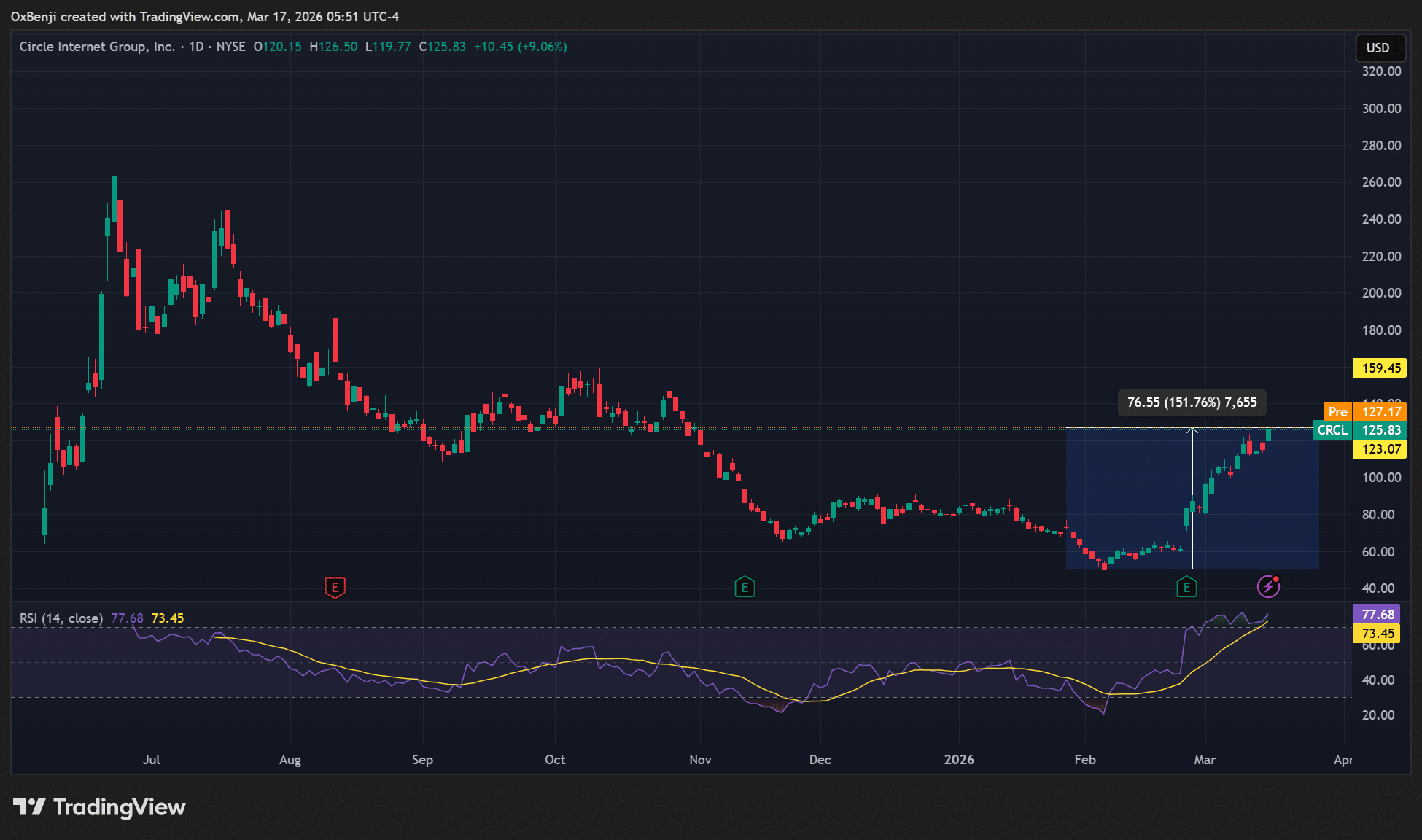
Circle Internet Group stock, CRCL, has recovered by over 150% from its February lows of $49.9 – A 2.5x pump in a month. On the 17th of March alone, the stock added an extra 9%, closing at $125.83.

Despite the remarkable bounce, the stock had fallen hard in late 2025 and early this year. After the initial IPO hype faded and the crypto rout intensified, CRCL slumped 83%, dropping from $298 to $49.

While Bitcoin’s rebound could be partly responsible for the CRCL lift-off, analysts singled out the growing adoption of Circle’s stablecoin USDC as a key driver.

USDC supply hits record $79B

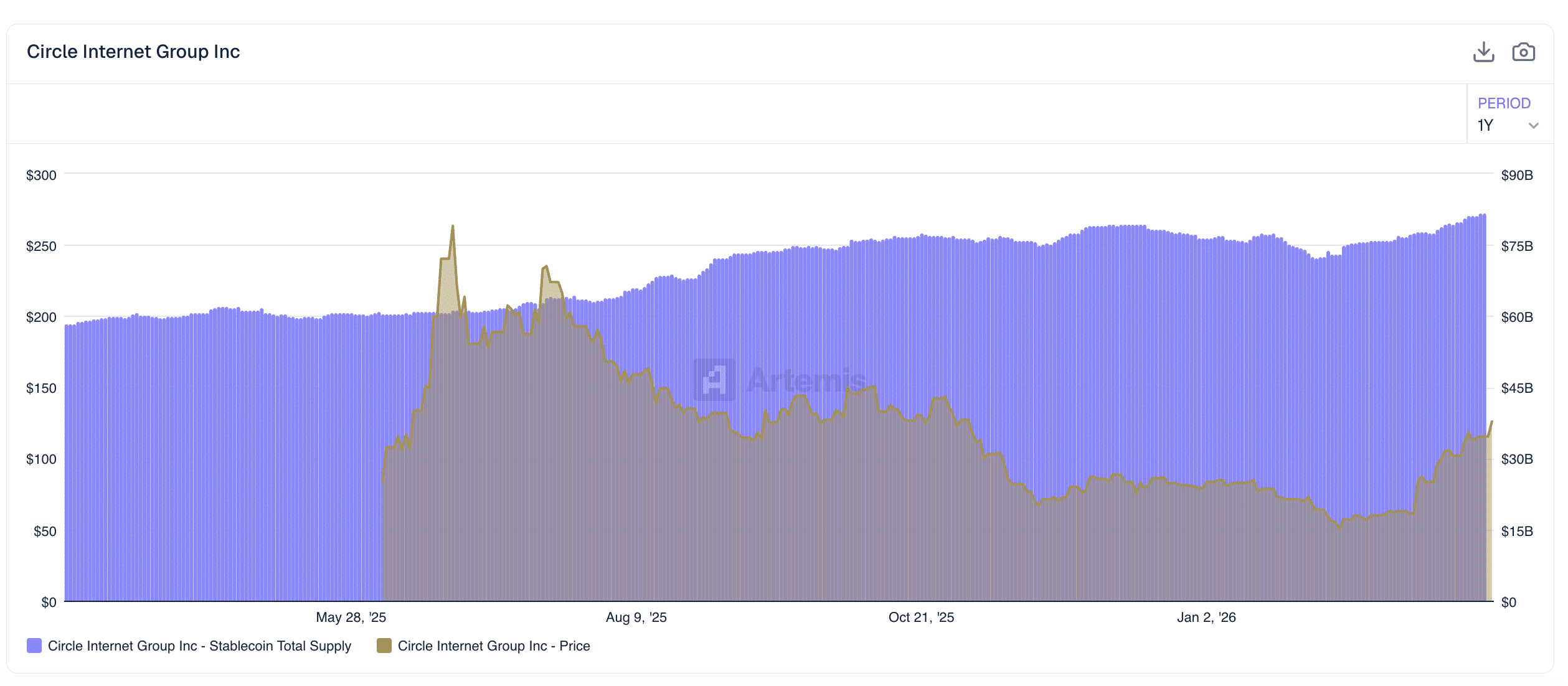
According to Jon Ma, founder of the crypto analytics platform Artemis, USDC adoption could be the greatest catalyst for CRCL’s Q1 recovery.

Noting that the $50 was an evident buy zone, Ma added,

Circle at $50/share was obvious. Stablecoin supply was $73B +25% YoY. Agentic payments were mentioned by Citrini as a winner in 2028.
Source: Artemis

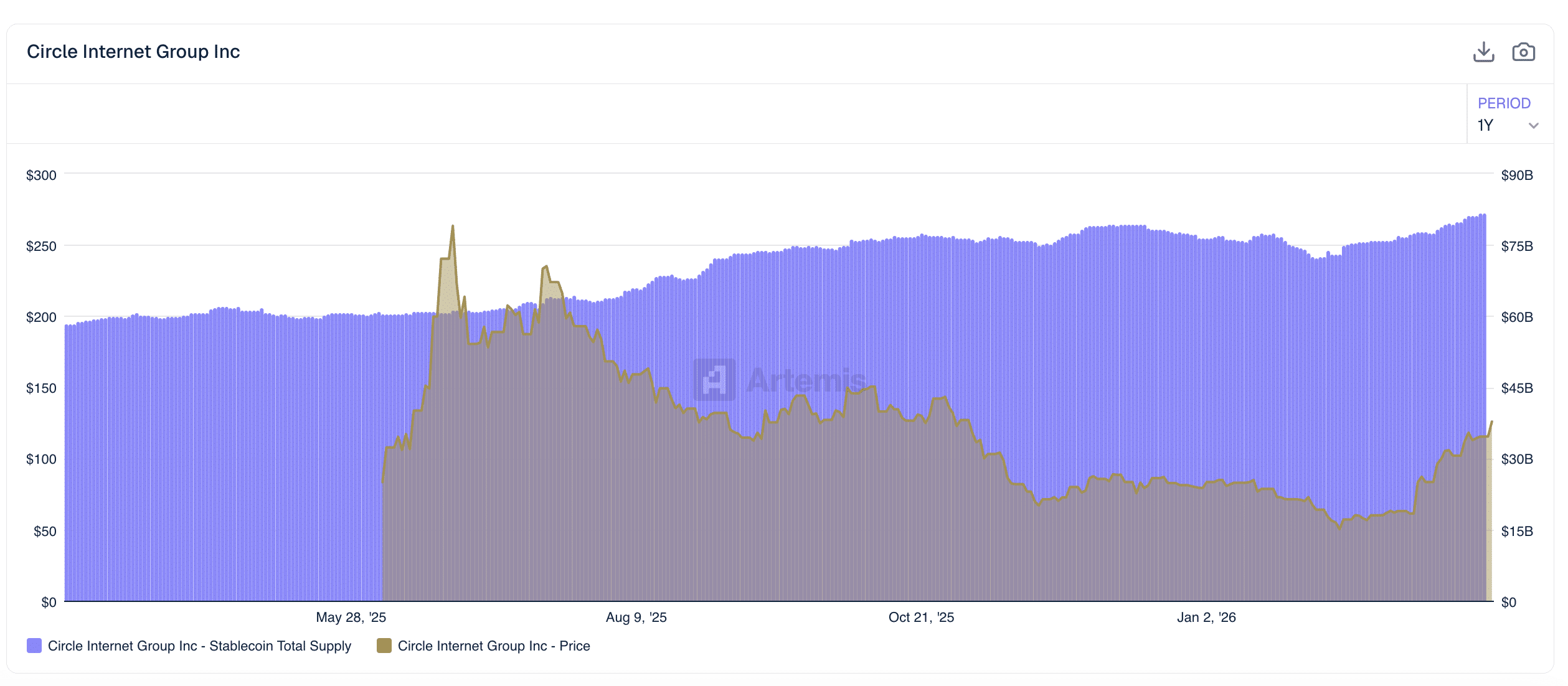
During the February dip, USDC supply was about $70B. Now, its has expanded to $79B, marking a 13% increased in two months.

At the network level, over 10% of the USDC supply is concentrated in Solana [SOL]. Other trading platforms like Hyperliquid have seen 155% growth in USDC supply in the past month alone.

Interestingly, USDC’s push toward a record supply came amid a broader contraction in crypto trading. For analysts, this meant stablecoin was decoupling from the broader crypto market.

Ma’s agentic payments comment referenced a Citrini Research report that theorized that AI agents will transact on stablecoin rails and bypass traditional intermediaries by 2028.

In fact, Circle is already betting on AI agentic payment systems and the possibility that stablecoins could replace the current global foreign exchange (FX) market.

Can CRCL reclaim key levels?

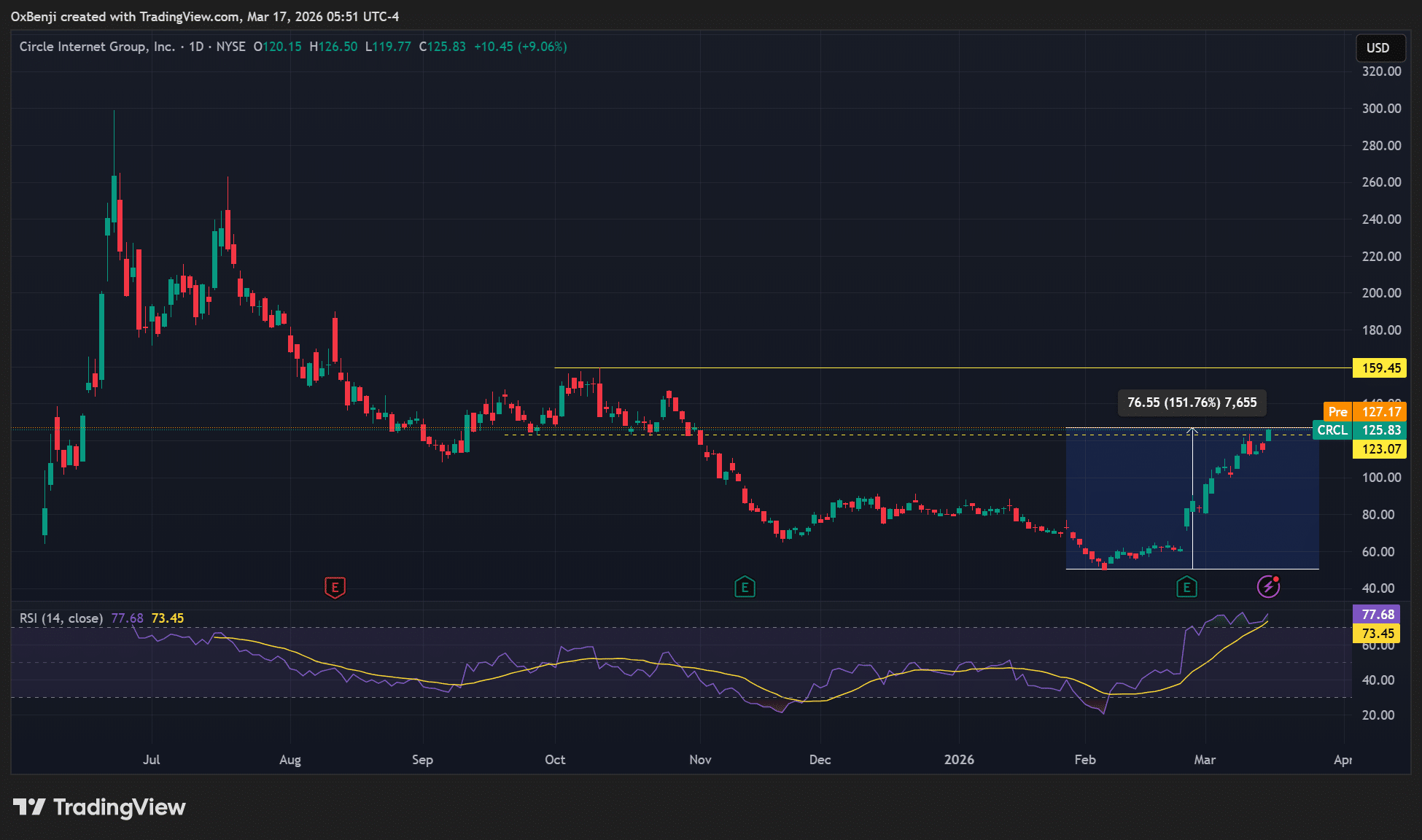
Amid strong fundamentals growth, CRCL has reversed most of its late 2025 losses. Reclaiming the $125-$160 price range could effectively erase all the H2 2025 losses.
Source: CRCL price, TradingView

Meanwhile, the BTC recovery lifted other crypto stocks too, including Robinhood (Nasdaq: HOOD), Coinbase (Nasdaq: COIN), and Strategy (Nasdaq: MSTR). Notably, MSTR was up 14%, and COIN had recovered 22% over the past month.

But on a year-to-date (YTD) basis, Circle’s CRCL still outperformed them all. Despite the 150% upswing, the Wall Street analyst consensus rating for CRCL was a ‘HOLD’ with some projecting a price target of $145.
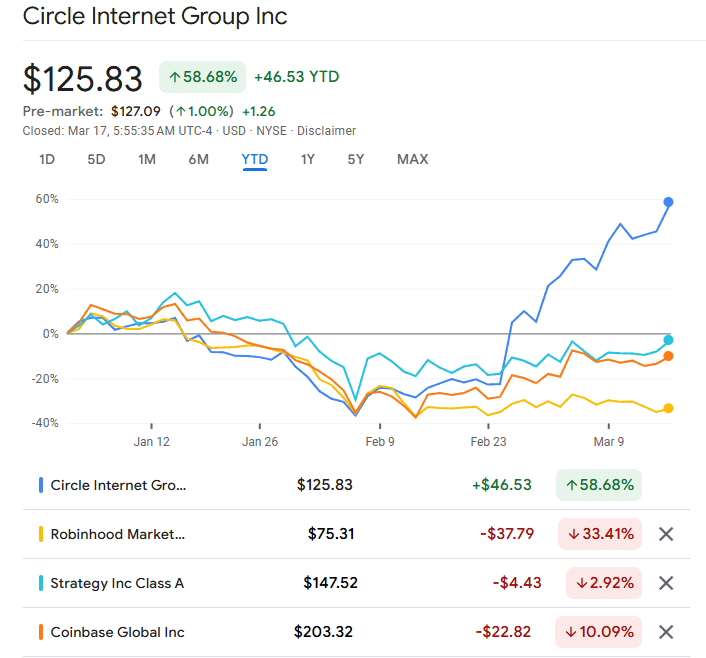
Source: Google Finance (as of March 17, Tuesday, GMT 10.00)

Final Summary

  • CRCL stock has recovered by 150% from the February low of $49, reversing all Q1 2026 losses.
  • Analysts cited strong USDC adoption and AI agentic payments as key catalysts behind the explosive run.


Preguntas relacionadas

QWhat is the percentage recovery of Circle's stock (CRCL) from its February lows, and what was the closing price on March 17th?

ACircle's stock (CRCL) has recovered by over 150% from its February lows of $49.9, and it closed at $125.83 on March 17th.

QAccording to analysts, what was a key driver behind CRCL's Q1 recovery besides Bitcoin's rebound?

AAnalysts singled out the growing adoption of Circle's stablecoin, USDC, as a key driver for CRCL's Q1 recovery.

QWhat milestone did the supply of USDC reach, and what was the percentage growth from February to the time of writing?

AThe supply of USDC hit a record $79 billion, marking a 13% increase from approximately $70 billion in February.

QWhat future application for stablecoins was cited by Citrini Research and is being bet on by Circle?

ACitrini Research theorized that AI agents will transact on stablecoin rails by 2028, and Circle is betting on AI agentic payment systems and the possibility that stablecoins could replace the global foreign exchange market.

QWhat is the Wall Street analyst consensus rating for CRCL stock, and what is one projected price target mentioned?

AThe Wall Street analyst consensus rating for CRCL was a 'HOLD', with some projecting a price target of $145.

Lecturas Relacionadas

Unlocking $100 Million in Liquidity? Pump.fun's New Policy Tests the 5-Minute Pump Technique

Pump.fun, a popular meme coin launchpad, has introduced a new standard mechanism called BOOST. It aims to address a significant capital efficiency issue: when a newly launched token graduates from its initial bonding curve to a liquidity pool (LP), roughly 20% of its liquidity becomes permanently locked as "dead liquidity," estimated to waste over $100 million annually. Instead of locking these funds permanently, BOOST repurposes them. Upon a token's migration, approximately 20% of the settlement funds (e.g., 17.6 SOL or ~$2516 USDC) are used to buy back the token on the open market over a 5-minute period via a Time-Weighted Average Price (TWAP) mechanism. All purchased tokens are immediately burned. This creates a brief, systematic buy pressure immediately after migration, potentially generating a short-term price surge ("pump") while permanently reducing the token's circulating supply. The goal is to enhance the immediate post-launch trading experience, potentially increasing trader retention and sustainable protocol revenue, which funds ongoing token buybacks. However, concerns exist that this artificial 5-minute boost could lower the barrier for launching low-quality tokens and lead to steeper price crashes once the buy pressure stops, if followed by large sell-offs. The feature automatically applies to tokens migrating after July 21, 2024, but not to previously migrated tokens or those launched via the Mayhem AI Agent lab.

marsbitHace 5 min(s)

Unlocking $100 Million in Liquidity? Pump.fun's New Policy Tests the 5-Minute Pump Technique

marsbitHace 5 min(s)

Podcast Notes | Conversation with GSR Asset Management Head: To Determine if This Crypto Rally is Real, Just Watch the Lending Rates on Aave

Podcast Summary: Dialogue with GSR's Head of Asset Management: To Determine if This Crypto Rally is Real, Just Check Lending Rates on Aave Andy Baehr, Managing Director of Asset Management at GSR, discusses the current crypto market, characterizing it as stuck in a state of "ambivalence" with short-lived, unsustainable rallies. He outlines a simple framework: the market moves between "ambivalence" and "conviction" (sustained upward momentum). Currently, every rally resembles a single-stage rocket booster that quickly fizzles out. Baehr identifies three key signals to watch: 1) DeFi lending rates, 2) the potential passage of the CLARITY Act, and 3) the market forming a consensus on the "Fed hawkish peak." He emphasizes that the most immediate indicator for the sustainability of the recent CPI-triggered rally is the USDC borrowing rate on Aave, currently around 3.75%—close to U.S. Treasury yields. The absence of a credit spread indicates low leverage demand and a lack of market energy. He explains that a healthy, sustained rally requires layered buying pressure. Last year's rally progressed from an ETH short squeeze to crypto-native trader influx and finally to ETF inflows. Currently, this structure is missing. Other potential structural buyers like Digital Asset Treasury (DAT) companies are absent, and ETF flows have proven transient. Baehr notes that while small-cap crypto tokens outperformed large caps in Q2—a potential sign of capitation in major assets—capital is also flowing to more exciting opportunities like AI stocks and tech IPOs, leaving crypto sidelined. Regarding DeFi, he highlights that platforms like Aave provide a clear, real-time signal of leverage demand through their supply/demand-driven interest rates. A significant, sustained rate increase would signal genuine market conviction. He also observes the quiet emergence of fixed-income-like products and vaults in DeFi. On regulation, the probability of the CLARITY Act passing before the August 7th deadline has dropped linearly from 75% to below 40% on Polymarket. Baehr suggests its passage would be treated as a bullish surprise, a potent driver for price movement. However, political hurdles, including ethical clause debates and disclosures about the First Family's crypto profits, remain significant obstacles. Ultimately, the market awaits clarity on the Fed's terminal rate under Chair Warsh. Until the "Fed Solstice"—the point where the market collectively understands the peak of hawkish policy—sustained conviction will be difficult to achieve.

marsbitHace 36 min(s)

Podcast Notes | Conversation with GSR Asset Management Head: To Determine if This Crypto Rally is Real, Just Watch the Lending Rates on Aave

marsbitHace 36 min(s)

Trading

Spot
活动图片




