Cardano Founder Calls For Simpler, Safer Crypto Across All Chains

bitcoinistPublicado a 2026-05-08Actualizado a 2026-05-08

Resumen

Cardano founder Charles Hoskinson argued at Consensus 2026 that the crypto industry must overcome its complex and intimidating user experience to achieve mainstream adoption. He highlighted the burdens of managing seed phrases, navigating exchanges, and understanding DeFi risks as major barriers. Hoskinson's solution involves simplifying self-custody, identity, privacy, and multi-chain access without reverting to centralized control. He praised efforts like Ethereum's account abstraction but warned that abstraction must be paired with privacy to avoid recreating Web2's surveillance model. Hoskinson introduced Midnight Passport as a framework designed to offer secure, mobile-native management across multiple blockchains. He also discussed the future role of AI agents in handling transactions, emphasizing that privacy will be critical as these agents require deep personal context to operate effectively.

Cardano founder Charles Hoskinson used a Wednesday keynote at Consensus 2026 in Miami to argue that crypto’s next phase will not be won by another isolated chain, token or wallet. The Cardano founder said the industry must make self-custody, identity, privacy and multi-chain access simple enough for mainstream users without handing control back to centralized intermediaries.

Hoskinson framed the problem bluntly: crypto still asks users to manage seed phrases, navigate exchanges, wait for withdrawals, choose between networks, avoid fake apps and understand DeFi risk before they can do anything useful. That, he said, remains the core barrier to bringing “the next few billion people” into the industry.

“The number one problem that people say again and again and again when they think about cryptocurrencies, whether you’re an experienced user and you’ve been in the industry a long time or you’re a completely new person, you’ve heard about the industry is, I’m gonna fuck it up. The safety side,” Hoskinson said. “That is the user experience in 2026. That make any sense to you? Is this like a product you wanna use?”

Cardano Founder Targets Crypto’s UX Problem

His answer was not to abandon crypto’s original principles, but to make them usable. Hoskinson contrasted crypto’s current experience with Web2 products such as Google Wallet, which he said has around 1.5 billion users and trains consumers to expect one-click setup, recovery and seamless mobile access. Crypto, in his view, cannot keep insisting it is “different” if the product experience remains too punishing for ordinary users.

A central theme of the keynote was abstraction. Hoskinson credited Ethereum with advancing account abstraction and chain abstraction standards, arguing that these efforts became necessary as fragmented layer-2 environments created a poor user experience. He also pointed to Near Protocol as an example of embedding those ideas at the protocol level, citing $71 million in transaction fees in a year and billions of dollars traded through Near intents.

But Hoskinson warned that abstraction carries a tradeoff. When users delegate complexity to third parties, those parties often gain visibility into assets, transactions, preferences, identity and business data. For crypto to scale without repeating the surveillance model of Web2, he argued, abstraction must be paired with privacy.

“When you abstract things, you delegate to people. You trust people. You give them something to do that on your behalf somewhere else,” he said. “You don’t worry about the doing, but when they do the doing, they know you. They know what you’re buying. They know where you’re at.”

That argument led into Hoskinson’s pitch for Midnight Passport, a framework he described as combining mobile-native key management, recovery, self-sovereign identity, selective disclosure, wallet credentials, name services and multi-chain signatures. The idea, according to Hoskinson, is to let users scan a QR code, rely on trusted execution hardware already built into phones, encrypt off-chain data client-side and create wallets across networks such as Bitcoin, Ethereum, Solana and XRP.

“I don’t care what networks you want to use. I don’t care what assets you want to have,” Hoskinson said. “I want you to have control of those assets. I want you to custody those assets. I want you to be in control of your identity and your data.”

The keynote also expanded into AI agents, which Hoskinson described as an incoming force that could reshape internet commerce and crypto usage. He argued that agents may eventually handle most searches, transactions and online activity, while humans interact with a smaller “human internet.” For crypto, that raises a practical question: if users cannot safely evaluate DeFi protocols, counterparties or risks themselves, AI systems may become the layer that performs diligence and execution.

Hoskinson said this makes privacy even more important, because effective agents require deep personal context. Midnight Passport, he said, is being developed not only for people but also for agents, allowing rules to be set around identity, data access and execution.

At press time, Cardano traded at $0.2689.
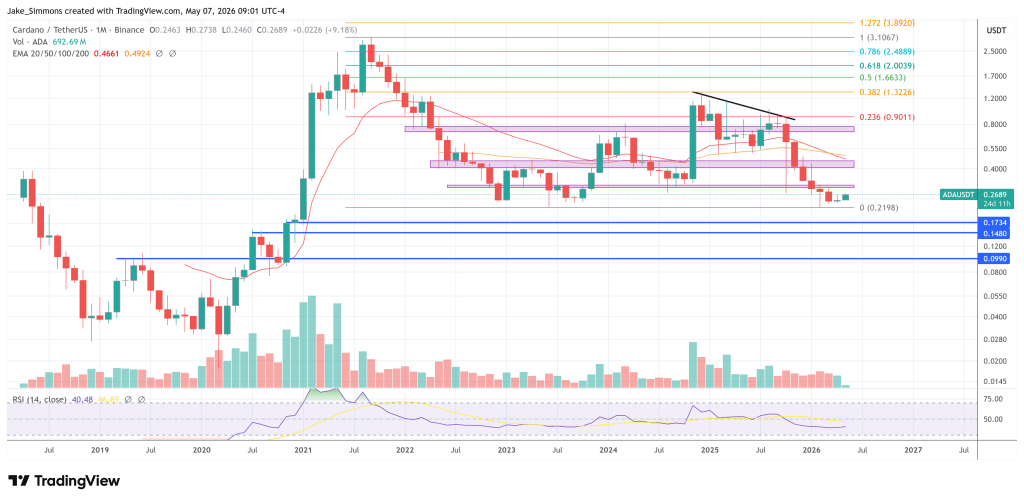
Cardano remains below key resistance, 1-monthly chart | Source: ADAUSDT on TradingView.com

Preguntas relacionadas

QWhat is the main barrier to bringing mainstream users into crypto, according to Charles Hoskinson?

AAccording to Hoskinson, the main barrier is the poor user experience, which asks users to manage seed phrases, navigate exchanges, wait for withdrawals, choose between networks, avoid fake apps, and understand DeFi risks before they can do anything useful.

QWhat does Hoskinson identify as a necessary tradeoff that comes with simplifying crypto through abstraction?

AHoskinson identifies that the tradeoff with abstraction is often a loss of privacy. When users delegate complexity to third parties, those parties gain visibility into their assets, transactions, preferences, identity, and business data.

QWhat is the proposed solution, Midnight Passport, designed to combine?

AMidnight Passport is designed to combine mobile-native key management, recovery, self-sovereign identity, selective disclosure, wallet credentials, name services, and multi-chain signatures to simplify user experience across different blockchains.

QAccording to the keynote, why will privacy become even more critical with the rise of AI agents?

APrivacy will become more critical because effective AI agents require deep personal context to operate. Therefore, systems are needed to set rules around identity, data access, and execution for these agents, protecting user data.

QHow did Hoskinson contrast the current crypto user experience with that of successful Web2 products?

AHe contrasted it with products like Google Wallet, which trains consumers to expect one-click setup, recovery, and seamless mobile access. He argued crypto cannot insist it is 'different' if its product experience remains too punishing compared to these seamless mainstream options.

Lecturas Relacionadas

From Parallel Finance to Mainstream Finance: The On-Chain Securities Era Ushers in a Historic Window

From Parallel Finance to Mainstream: The Dawn of On-Chain Securities For over a decade, the crypto industry has operated as a parallel financial system with its own currencies, markets, and assets—from Bitcoin and ICOs to DeFi, NFTs, and memecoins. Despite building a robust internal ecosystem, a wall has separated it from the traditional financial world. That barrier is now crumbling. The industry's first act was one of internal evolution: ICOs streamlined fundraising, DeFi recreated financial services on-chain, and layer-2 networks competed for scalability—all within the crypto bubble. While innovative, this cycle remained closed, with capital and users circulating internally, leading to volatile boom-bust cycles. Even Bitcoin ETFs, while attracting Wall Street capital, merely provided a channel to buy crypto assets without bridging the systems. The next, larger narrative is Real-World Assets (RWA) moving on-chain. This involves tokenizing stocks, bonds, funds, and future cash flows. Blockchain can compress the complex traditional processes of trading, settlement, clearing, and custody into a seamless, automated network operating in seconds. This shift is creating a new financial gateway: the native crypto securities broker. This entity will combine functions of an exchange, broker, bank, and custodian into a unified global financial operating system. Consequently, the next major battleground won't be the "public chain wars" focused on speed and cost, but the competition to build the financial infrastructure capable of hosting high-quality, liquid real-world assets. Access to global equities, index funds, or stakes in companies like SpaceX could erase the boundary between crypto and traditional finance, unlocking a market orders of magnitude larger than crypto's current valuation. In summary, after years of creating a separate financial world, crypto's next decade will be defined by its integration into the existing global financial system, marking the true beginning of its largest growth story.

marsbitHace 14 min(s)

From Parallel Finance to Mainstream Finance: The On-Chain Securities Era Ushers in a Historic Window

marsbitHace 14 min(s)

Wang Chuan: When the Neighbor Old Wang Made 30x on Memory Stocks, How to Avoid Anxiety (Part Six) - The Trap of Commoditized Goods

Wang Chuan: When the Neighbor Lao Wang Made 30x on Storage Stocks, How to Stay Anxiety-Free (Part 6) - The Trap of Commoditized Goods. This essay uses historical and current examples to analyze the cyclical and high-risk nature of the data storage industry. It begins with the 1990s rise and dramatic fall of Iomega, whose stock soared over 160x in 18 months before collapsing 97% from its peak, illustrating the fleeting success of storage "meme stocks." The core problem is that storage products, like DRAM and flash memory, are highly commoditized. This leads to extreme volatility: prices have plummeted over 80% multiple times, and company stocks often crash 95% or go bankrupt. The industry's dynamic is defined by "elastic demand facing heavy-asset, long-cycle, rigid supply." When demand spikes and supply is fixed, prices skyrocket, as seen recently with AI-driven demand for High Bandwidth Memory (HBM). Companies like Sandisk and Micron have reported massive revenue and gross margin jumps (e.g., Sandisk's gross margin rising from 22.5% to 78.3%) despite minimal increases in production volume. However, these high margins are self-defeating. They incentivize massive new capacity investments (hundreds of billions planned from 2026), with supply expected to surge by late 2027. Once new supply meets demand, prices and profits will crash, potentially leading to a scenario where "selling more results in earning less." The article debunks the safety of long-term supply agreements, comparing them to fragile non-aggression pacts easily broken when market conditions shift. It warns that when an industry is highly profitable but trades at low P/E ratios, the risk is greatest, as plummeting prices quickly erase those earnings. Multiple asymmetric risks loom, including economic recession, reduced AI spending, faster-than-expected capacity expansion (especially from Chinese firms), and technological innovations that reduce memory requirements. In conclusion, the storage sector is a cyclical trap where periods of euphoric profits are often precursors to devastating downturns, luring unprepared investors into a "wealth incinerator."

marsbitHace 23 min(s)

Wang Chuan: When the Neighbor Old Wang Made 30x on Memory Stocks, How to Avoid Anxiety (Part Six) - The Trap of Commoditized Goods

marsbitHace 23 min(s)

Wang Chuan: When the neighbor Lao Wang earned thirty times from investing in memory storage stocks, how can you still avoid anxiety (6) - The trap of homogeneous products

The article, "Wang Chuan: How to Remain Unanxious After Neighbor Lao Wang's Thirty-Fold Gain on Storage Stocks (Part 6) - The Trap of Commoditized Goods," analyzes the cyclical and perilous nature of the data storage industry through historical and current case studies. It begins with the example of Iomega, whose Zip drives led to a stock surge of over 160x in the mid-1990s before collapsing over 97% from its peak due to competition from cheaper CD-R technology. This pattern is characteristic of storage, where products like DRAM are highly commoditized, leading to extreme price volatility. The sector has seen prices crash over 80% multiple times, with companies often facing bankruptcy. The core dynamic is "elastic demand facing heavy-asset, long-cycle, rigid supply." High prices attract new capacity, but the long lead time means supply eventually overshoots, causing sharp price corrections. The current AI-driven boom, exemplified by surging demand for High-Bandwidth Memory (HBM), has led to skyrocketing prices and profit margins for companies like SanDisk and Micron, despite relatively flat production volumes. However, the author warns this high-margin environment is self-defeating. The high profits are already triggering massive new capacity investments (hundreds of billions starting 2026), with supply expected to ramp up by late 2027. When supply catches up, total revenue and profits may fall even as more units are sold. Long-term supply agreements offer little protection, as buyers can find ways to renegotiate if market prices drop, similar to fragile political treaties. Key risks include economic downturns, cuts in AI spending, faster-than-expected capacity expansion (especially from Chinese firms), and innovations in chip/algorithm design that reduce memory needs. A critical trap is that at the cycle's peak, storage stocks often appear cheap with low P/E ratios, luring value investors just before an impending downturn where profits evaporate. The conclusion cautions that for commoditized goods like storage, high margins inevitably destroy themselves, and the current asymmetry favors downside risk over further upside. The neighbor's dream of easy wealth from storage stocks is portrayed as a precarious illusion.

链捕手Hace 41 min(s)

Wang Chuan: When the neighbor Lao Wang earned thirty times from investing in memory storage stocks, how can you still avoid anxiety (6) - The trap of homogeneous products

链捕手Hace 41 min(s)

AI PCs Are Here, Going Toe-to-Toe with 120B Models Locally! NVIDIA Redefines the "Personal AI Computer" Foundation with RTX Spark

NVIDIA has redefined the "AI PC" standard with the launch of the RTX Spark super chip at GTC 2026. Boasting 1 petaflop (1000 TOPS) of AI performance, it dwarfs the 45-50 TOPS NPUs in current AI PCs. The SoC features a Blackwell GPU, a 20-core Arm CPU co-designed with MediaTek, and crucially, up to 128GB of unified memory shared between CPU and GPU. This architectural shift enables local execution of 120-billion-parameter large language models with million-token context windows, a massive leap from the 9B-40B models typical on current consumer hardware. Beyond AI, use cases include 12K video editing and high-fps ray-traced gaming. Key to enterprise adoption is a security collaboration with Microsoft. Windows security is upgraded, and NVIDIA's OpenShell sandbox runtime is integrated to safely contain AI agent actions. Major software support comes from Adobe, which announced a deep,底层-level rewrite of Photoshop and Premiere to leverage the unified memory for up to 2x performance gains. Six OEMs, including Dell, HP, Lenovo, and Microsoft Surface, will release RTX Spark-based轻薄本 and compact desktops this fall. However, questions remain about real-world performance,功耗, thermal management in laptops, pricing, and the actual impact of the OpenShell sandbox. The RTX Spark represents a fundamental power shift in the PC industry, moving from an x86 CPU-centric model to a GPU-centric SoC platform, but its ultimate success hinges on the upcoming product rollouts and ecosystem validation.

marsbitHace 55 min(s)

AI PCs Are Here, Going Toe-to-Toe with 120B Models Locally! NVIDIA Redefines the "Personal AI Computer" Foundation with RTX Spark

marsbitHace 55 min(s)

Trading

Spot
Futuros

Artículos destacados

Cómo comprar ADA

¡Bienvenido a HTX.com! Hemos hecho que comprar Cardano (ADA) sea simple y conveniente. Sigue nuestra guía paso a paso para iniciar tu viaje de criptos.Paso 1: crea tu cuenta HTXUtiliza tu correo electrónico o número de teléfono para registrarte y obtener una cuenta gratuita en HTX. Experimenta un proceso de registro sin complicaciones y desbloquea todas las funciones.Obtener mi cuentaPaso 2: ve a Comprar cripto y elige tu método de pagoTarjeta de crédito/débito: usa tu Visa o Mastercard para comprar Cardano (ADA) al instante.Saldo: utiliza fondos del saldo de tu cuenta HTX para tradear sin problemas.Terceros: hemos agregado métodos de pago populares como Google Pay y Apple Pay para mejorar la comodidad.P2P: tradear directamente con otros usuarios en HTX.Over-the-Counter (OTC): ofrecemos servicios personalizados y tipos de cambio competitivos para los traders.Paso 3: guarda tu Cardano (ADA)Después de comprar tu Cardano (ADA), guárdalo en tu cuenta HTX. Alternativamente, puedes enviarlo a otro lugar mediante transferencia blockchain o utilizarlo para tradear otras criptomonedas.Paso 4: tradear Cardano (ADA)Tradear fácilmente con Cardano (ADA) en HTX's mercado spot. Simplemente accede a tu cuenta, selecciona tu par de trading, ejecuta tus trades y monitorea en tiempo real. Ofrecemos una experiencia fácil de usar tanto para principiantes como para traders experimentados.

1.5k Vistas totalesPublicado en 2024.12.10Actualizado en 2025.03.21

Cómo comprar ADA

Discusiones

Bienvenido a la comunidad de HTX. Aquí puedes mantenerte informado sobre los últimos desarrollos de la plataforma y acceder a análisis profesionales del mercado. A continuación se presentan las opiniones de los usuarios sobre el precio de ADA (ADA).

活动图片













