Cardano Builder IO Says It Delivered 16 Of 18 Treasury Commitments

bitcoinistPublicado a 2026-04-30Actualizado a 2026-04-30

Input Output said it progressed 16 of 18 treasury-funded Cardano commitments across Q4 2025 and Q1 2026, framing the period as a test of whether ecosystem funding can translate into publicly verifiable delivery. Two commitments, Acropolis and tiered pricing, were canceled, with funding returned to the treasury, according to IO’s delivery report.

The report positions Cardano’s treasury model in unusually direct terms: funding either produces trackable output, or it goes back. “In Q4 2025 and Q1 2026, IO delivered measurable progress across 18 treasury-funded commitments. Sixteen were progressed successfully. Two – Acropolis and tiered pricing – were canceled, and their funding returned. Every outcome in this report is publicly verifiable.”

Cardano Adoption Moves From Roadmap To Usage

The most immediate adoption milestone was the launch of USDCx on Cardano in Q1 2026. IO said the asset went live 84 days after announcement, with more than 15 million USDCx minted in its first week. During that period, Cardano DeFi total value locked rose from $127 million to $142 million, while Minswap, Liqwid and SundaeSwap supported live liquidity pools.

Interoperability was the second major adoption theme. LayerZero’s announced integration with Cardano and Midnight connects the ecosystem to more than 160 blockchains and over $80 billion in omnichain assets, according to the report. IO called it “the single largest interoperability unlock in the ecosystem’s history,” with particular relevance for Midnight’s selective disclosure and zero-knowledge proof architecture.

The report also cited several external milestones around the Cardano ecosystem, including CME Group’s launch of Cardano futures in February, Coinbase adding ada as collateral for on-chain loans, Midnight’s mainnet launch, and ada acceptance at 137 SPAR stores in Switzerland.

IO’s engineering update centered on node reliability, security and upgrade readiness. The company shipped Cardano node versions 10.5.4 and 10.6.2, with improvements to network connectivity, system monitoring, and support for future protocol versions, including v11 and v12.

The KES agent also reached version 1.0. The tool separates cryptographic key management from the main node process, reducing key-related attack surface for stake pool operators. IO linked that work directly to the needs of Cardano’s more than 3,000 stake pools.

UTXO HD was another major infrastructure item. By moving the UTXO set from memory to disk, IO said Cardano node memory utilization was reduced by up to 80%. That matters for operators because lower memory requirements can reduce infrastructure costs and make running nodes less resource-intensive.

Mithril, Hydra And Leios All Reach Working Code

Scaling was presented as a three-track strategy rather than a single upgrade. Mithril reached its first stable release, with distribution 2603.1 adding support for the decentralized message queue protocol. IO said this moves Mithril closer to operating without a central coordinator.

Hydra moved further into production-oriented work, with releases from 1.0.0 through 1.3.0. The report highlighted faster node restarts, chain-sync drift reporting, deposit and decommit fixes, and active work with real users. It also cited Pondora’s Echo as the first non-custodial Hydra implementation and noted the VTech Hydra SDK.

Leios, Cardano’s base-layer throughput upgrade, produced its first working prototype. IO said the prototype now produces and distributes endorser blocks in a local multi-node network, including large blocks with hundreds of transactions and optional simulated network delays.

Beyond scaling, IO emphasized developer tooling and formal methods. Plutus received Van Rossem hard fork features, faster Flat decoding, optimized bytestring-integer primitives, and improved Plinth tooling. Cardano High Assurance opened early access to five companies testing automated formal verification at the UPLC level.

Research also remained part of the delivery narrative. IO said Work Package 25 closed with all funding milestones complete after a public consultation reaching more than 24,000 people. Two papers were published at Financial Cryptography 2026, and IO chief scientist Professor Aggelos Kiayias was named an ACM Fellow.

Looking ahead, IO listed several Q2 targets: the protocol version 11 intra-era hard fork coordinated by Intersect, node v10.7, Mithril 2608, a Leios public testnet, Work Package 26, and the Cryptographic Tools for the Blockchain workshop at Eurocrypt 2026.

At press time, Cardano traded at $0.2491.
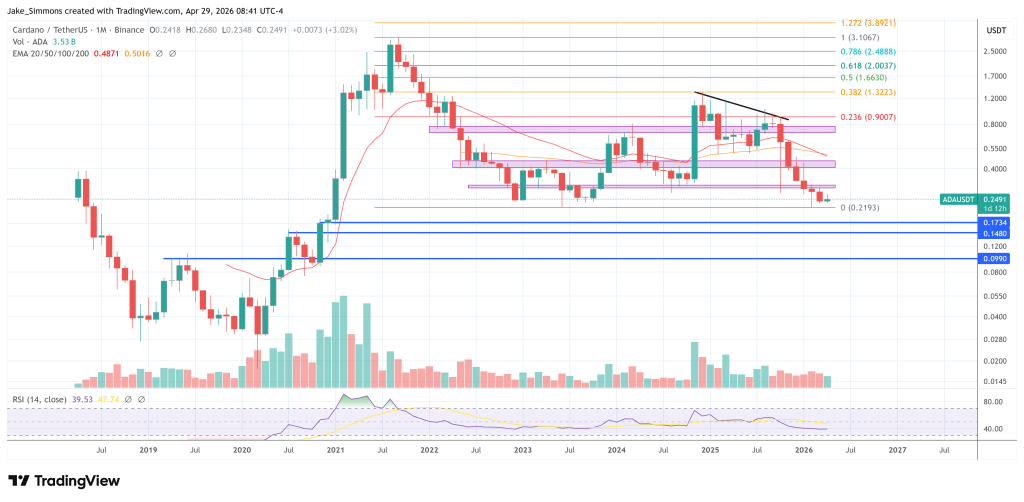
ADA remains below key resistance, 1-monthly chart | Source: ADAUSDT on TradingView.com

Criptos en tendencia

Lecturas Relacionadas

CPU Makes a Comeback to the Table, A $170 Billion "Power Seizure" Drama Begins

A new era is dawning for the server CPU (Central Processing Unit), driven by the shift from AI model training to large-scale reasoning and the rise of Agentic AI. This article explores how the CPU is reclaiming a central role in the AI data center. For years, the focus has been on the GPU (Graphics Processing Unit) for AI training. However, as AI moves to the inference and Agent phase—where tasks involve complex, multi-step reasoning, tool calls, and data management—the workload balance is flipping. Studies show CPUs now handle over 70% of the workload in Agentic AI, up from 10-30% in training. This is because Agent tasks generate massive intermediate data (KV Cache) that exceeds GPU memory, forcing it to be offloaded to the CPU's larger, more scalable memory pools. This increased importance is translating into market changes. Major players are taking note: NVIDIA launched its first standalone CPU line, Vera, based on ARM architecture and optimized for Agent performance. AMD doubled its server CPU market forecast to over $1200 billion by 2030. Analyst reports project the total server CPU market could reach $1700 billion by 2030, with AI-driven demand being a primary driver. Furthermore, the classic ratio of CPUs to GPUs in AI servers is rapidly changing, converging from 1:8 toward 1:1 for Agent deployments. This surge in demand has led to a rare industry-wide price increase of 10-15% for server CPUs from Intel and AMD, breaking a decade-long trend of "more performance for the same price." Demand is bifurcating into high-core-count CPUs for in-rack GPU support and moderate-core CPUs for standalone Agent task orchestration. In China, this global trend presents an opportunity for domestic CPU manufacturers like Hygon (海光信息) and Huawei Kunpeng, who are bolstered by both growing AI infrastructure needs and national policies promoting technological self-reliance ("xin chuang"). The maturity of their software ecosystems is also accelerating, evidenced by faster adaptation to new AI models. In conclusion, the narrative is shifting from a GPU-centric view to one where CPU-GPU synergy is critical. The CPU is no longer a peripheral component but a performance-defining bottleneck and a key growth driver in the AI hardware stack, opening a massive new market estimated in the hundreds of billions of dollars.

marsbitHace 7 hora(s)

CPU Makes a Comeback to the Table, A $170 Billion "Power Seizure" Drama Begins

marsbitHace 7 hora(s)

TechFlow Intelligence: AMD AI Director Publicly Criticizes Claude Code for "Becoming Dumber and Lazier", Trump Claims Full Ceasefire in Hormuz But Strait Still Has 80 Unexploded Mines

TechFlow Intelligence Report: This daily digest covers key developments in AI, crypto, hardware, and geopolitics. In AI, SK Telecom faces US export control scrutiny over its partnership with Anthropic, while a Gemini user reports being misled in a scam scenario, sparking safety debates. China's Z.AI launches the GLM-5.2 model, rivaling Claude Opus without NVIDIA chips. In crypto, Bithumb lists ReProtocol, and Upbit delists KernelDAO. On the hardware front, MIT researchers build a custom OS to study chips, ASML denies US claims its advanced lithography machines are in China, and Amazon considers selling its in-house AI chips. Apple's future A21 Pro chip may use TSMC's latest N2P process. Major tech issues include 10,000 GitHub repositories distributing malware and Apple patching a critical eavesdropping flaw in Beats earbuds. US stocks rise, led by semiconductors, with Intel surging 10.6%, while SpaceX falls 3.5%. Geopolitically, despite a US-Iran deal, the Strait of Hormuz remains risky with ~80 uncleared mines, stalling 80M barrels of oil on standby tankers. Iran postpones Switzerland talks, and Trump calls the agreement an "unconditional surrender." The report highlights a contrast: temporary geopolitical calm versus the ongoing, fundamental restructuring of tech supply chains and chip independence.

marsbitHace 8 hora(s)

TechFlow Intelligence: AMD AI Director Publicly Criticizes Claude Code for "Becoming Dumber and Lazier", Trump Claims Full Ceasefire in Hormuz But Strait Still Has 80 Unexploded Mines

marsbitHace 8 hora(s)

Trading

Spot
Futuros

Artículos destacados

Cómo comprar ADA

¡Bienvenido a HTX.com! Hemos hecho que comprar Cardano (ADA) sea simple y conveniente. Sigue nuestra guía paso a paso para iniciar tu viaje de criptos.Paso 1: crea tu cuenta HTXUtiliza tu correo electrónico o número de teléfono para registrarte y obtener una cuenta gratuita en HTX. Experimenta un proceso de registro sin complicaciones y desbloquea todas las funciones.Obtener mi cuentaPaso 2: ve a Comprar cripto y elige tu método de pagoTarjeta de crédito/débito: usa tu Visa o Mastercard para comprar Cardano (ADA) al instante.Saldo: utiliza fondos del saldo de tu cuenta HTX para tradear sin problemas.Terceros: hemos agregado métodos de pago populares como Google Pay y Apple Pay para mejorar la comodidad.P2P: tradear directamente con otros usuarios en HTX.Over-the-Counter (OTC): ofrecemos servicios personalizados y tipos de cambio competitivos para los traders.Paso 3: guarda tu Cardano (ADA)Después de comprar tu Cardano (ADA), guárdalo en tu cuenta HTX. Alternativamente, puedes enviarlo a otro lugar mediante transferencia blockchain o utilizarlo para tradear otras criptomonedas.Paso 4: tradear Cardano (ADA)Tradear fácilmente con Cardano (ADA) en HTX's mercado spot. Simplemente accede a tu cuenta, selecciona tu par de trading, ejecuta tus trades y monitorea en tiempo real. Ofrecemos una experiencia fácil de usar tanto para principiantes como para traders experimentados.

1.5k Vistas totalesPublicado en 2024.12.10Actualizado en 2026.06.02

Cómo comprar ADA

Discusiones

Bienvenido a la comunidad de HTX. Aquí puedes mantenerte informado sobre los últimos desarrollos de la plataforma y acceder a análisis profesionales del mercado. A continuación se presentan las opiniones de los usuarios sobre el precio de ADA (ADA).

活动图片