Cardano (ADA) Attracts Fresh Institutional Capital As Grayscale Expands Holdings

bitcoinistPublicado a 2026-02-20Actualizado a 2026-02-20

Resumen

Despite a declining price in a weak crypto market, Cardano (ADA) is attracting renewed institutional investment. Grayscale Investments has significantly increased its ADA holdings, raising its allocation in the Smart Contract Fund from 19.50% to over 20.12%. This consecutive growth signals strong confidence in the altcoin's long-term fundamentals. The move is seen as strategic positioning, potentially linked to Cardano's recent push into Bitcoin DeFi, aiming to restore external BTC liquidity through non-custodial collateral and stablecoin-based lending. While overall network activity has decreased since 2021, the ecosystem is now advancing with long-term, privacy-focused projects like Midnight, separating speculative projects from substantive ones. ADA was trading at $0.27 at the time of reporting.

Cardano’s price may be in a downward action due to a weakening crypto environment, but there has been a resurgence in buying activity from both retail and institutional investors across the sector. This resurgence in buying activity is indicated by the steady purchase by Grayscale, one of the leading treasury companies in the world.

Grayscale Makes More Cardano Allocations

Despite its persistent pullback in price over the past few months, institutional interest in Cardano (ADA) appears to be strengthening once again. According to a recent report from Dave, a crypto enthusiast, Grayscale Investments has increased its exposure to ADA after a fresh purchase.

With its steady allocation move, the ADA weighting in the company’s Smart Contract Fund now sits at over 20.12% from its prior level of 19.50%. This marks another consecutive rise and signals that investors are once again confident in the altcoin’s long-term fundamentals, as they attentively examine high-conviction holdings in the cryptocurrency market.

As ADA secures a larger share within the firm’s holdings, the allocation can also be seen as strategic positioning for what’s ahead. It is worth noting that the latest allocation was conducted just a week after the previous one.
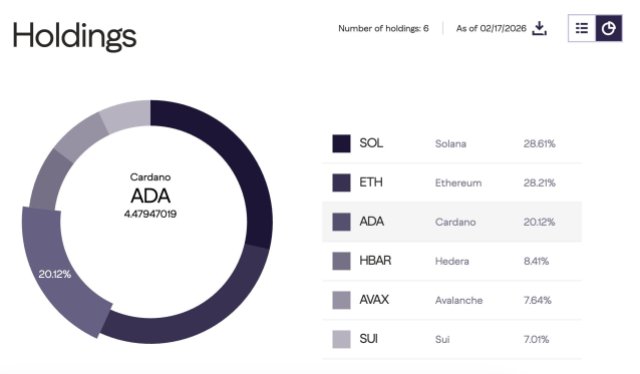
Grayscale adds to its ADA holdings | Source: Chart from Dave on X

During the period, the firm’s ADA allocation moved from 19.50% to 19.55% in the smart contract fund. There are speculations that the move could be linked to recent rapid momentum and integration work around Bitcoin Decentralized Finance (DeFi) within the Cardano ecosystem.

Dave highlighted that this is taking place as Cardano bolsters its push into the Bitcoin DeFi ecosystem. The purpose of his move is to restore external BTC liquidity on the network via non-custodial Collateral, stablecoin-based credit, and lending structures built to avoid fragility driven by liquidation.

Furthermore, Cardano’s smart contract layer makes this possible, and this approach clarifies why large asset managers would be covertly expanding their exposure. Thus, institutions that need predictable, non-liquidating borrowing, and retail users looking for high-quality yield on idle Bitcoin could be able to utilize the network.

The Projects On The Leading Network Are Just Real Ones

Currently, the activity across the Cardano ecosystem is decreasing at a remarkable pace. Mintern, a market expert and Chief Meme Officer (CMO) of Minswap, has reported a sharp drop in the number of projects launched on the network since 2021.

In 2021, the number of projects on the network skyrocketed with more than 100 projects within the year, signaling confidence in the network’s scalability, governance model, and long-term roadmap. Meanwhile, in 2026, the projects have fallen, leaving only the real ones.

Mintern noted that the network is now advancing with Midnight building privacy-focused rails for long-term adoption, not short-term speculation. Amid the reduced network activity, the main question circulating across the community is who is still building in 2026.

ADA trading at $0.27 on the 1D chart | Source: ADAUSDT on Tradingview.com

Preguntas relacionadas

QWhat is the main reason for the resurgence in buying activity for Cardano (ADA) despite its price decline?

AThe resurgence in buying activity is due to increased purchases by both retail and institutional investors, notably Grayscale Investments, which has been steadily increasing its ADA holdings.

QHow much has Grayscale's ADA weighting in its Smart Contract Fund increased to after the recent purchase?

AGrayscale's ADA weighting in its Smart Contract Fund has increased to over 20.12% from its prior level of 19.50%.

QWhat recent development in the Cardano ecosystem might be linked to Grayscale's increased allocation to ADA?

AThe move could be linked to Cardano's recent rapid momentum and integration work around Bitcoin Decentralized Finance (DeFi), which aims to restore external BTC liquidity via non-custodial collateral and stablecoin-based credit structures.

QWhat trend has been observed regarding the number of projects launched on the Cardano network since 2021?

AThe number of projects launched on the Cardano network has sharply decreased since 2021, with only the 'real ones' remaining, as the network focuses on long-term adoption rather than short-term speculation.

QWhat is the current price of ADA mentioned in the article, and on which chart is it referenced?

AThe current price of ADA mentioned is $0.27, as shown on the 1D chart sourced from ADAUSDT on Tradingview.com.

Lecturas Relacionadas

The Niche Consensus Among Elites: Has College Become an Expensive Waste?

**Summary:** A growing "anti-college" movement is gaining traction among elite circles in Silicon Valley, challenging the traditional value of a four-year university degree. Proponents argue that college has become an expensive, slow, and increasingly irrelevant waste of time, especially in the fast-paced tech world where opportunities pass by quickly. The movement is led by figures like billionaire Peter Thiel, who criticizes universities for high costs, ideological indoctrination, and stifling true innovation. His "Thiel Fellowship" pays young people to drop out and pursue ventures. Companies like Palantir Technologies (co-founded by Thiel) fuel this trend with programs like the "Meritocracy Fellowship," which offers high school graduates paid internships as an alternative to immediate college enrollment, promising a practical "Palantir Degree." Key drivers include: 1. **Economics:** Skyrocketing student debt versus the allure of immediate, high-paying tech jobs or startup funding. 2. **Technology:** AI and online tools lowering barriers to self-education and product development, making formal instruction seem inefficient. 3. **Culture:** A backlash against perceived "woke" ideology and DEI policies in universities, coupled with a belief that these institutions suppress meritocracy and masculine drive. The movement is notably male-dominated. Critics, like economist David Deming, warn against overgeneralizing from dropout success stories (survivorship bias). He emphasizes that genuine autodidacts are rare, corporate training is narrowly focused, and the "college wage premium" remains high for most people. University liberal arts education, he argues, builds adaptable problem-solving skills and broad perspectives. The debate highlights a deeper crisis in education. The core model of the modern university appears increasingly mismatched with the speed of the information age. The movement signals a shift in the locus of learning from institutional "education" to personal, active "learning" powered by the internet and AI. Ultimately, this may not mean the end of university, but rather a painful evolution. The future likely holds more hybrid, personalized, and lifelong learning pathways. The central question becomes: in a world changing faster than any curriculum, how do we best learn?

marsbitHace 14 min(s)

The Niche Consensus Among Elites: Has College Become an Expensive Waste?

marsbitHace 14 min(s)

From Subsidies to Token-Based Pricing to Price Cuts: Is OpenAI Sparking a Price War? Is the Inflection Point for Token Economics Nearing?

The commercialization of generative AI is facing a critical inflection point as a potential price war looms. According to The Wall Street Journal, OpenAI is considering a significant cut to its token fees to compete with rival Anthropic, signaling a shift from a growth-at-all-costs model focused on token consumption. This move comes as both companies, reportedly losing billions on compute, prepare for IPOs, and as enterprise customers face "bill shock" from switching to usage-based token billing. Reports indicate poor ROI, with one analysis finding only 18 cents of every dollar spent on AI tokens generates user-facing value. The industry's initial phases—from flat-rate subscriptions to aggressive subsidies—have given way to a reckoning with real costs. Analysts debate the future: some predict a bifurcation between premium, high-cost models for complex tasks and cheaper alternatives for routine work, while others believe overall spending will still rise as agentic AI increases tokens per task. Notably, Chinese model DeepSeek's low-cost API is gaining traction with U.S. enterprises, adding competitive pressure. The core challenge is redefining value beyond token volume ("tokenmaxxing") toward measurable productivity ("valuemaxxing"), as the entire AI value chain, from cloud providers to chipmakers, feels the ripple effects of unsustainable pricing.

marsbitHace 18 min(s)

From Subsidies to Token-Based Pricing to Price Cuts: Is OpenAI Sparking a Price War? Is the Inflection Point for Token Economics Nearing?

marsbitHace 18 min(s)

Trading

Spot
Futuros

Artículos destacados

Cómo comprar ADA

¡Bienvenido a HTX.com! Hemos hecho que comprar Cardano (ADA) sea simple y conveniente. Sigue nuestra guía paso a paso para iniciar tu viaje de criptos.Paso 1: crea tu cuenta HTXUtiliza tu correo electrónico o número de teléfono para registrarte y obtener una cuenta gratuita en HTX. Experimenta un proceso de registro sin complicaciones y desbloquea todas las funciones.Obtener mi cuentaPaso 2: ve a Comprar cripto y elige tu método de pagoTarjeta de crédito/débito: usa tu Visa o Mastercard para comprar Cardano (ADA) al instante.Saldo: utiliza fondos del saldo de tu cuenta HTX para tradear sin problemas.Terceros: hemos agregado métodos de pago populares como Google Pay y Apple Pay para mejorar la comodidad.P2P: tradear directamente con otros usuarios en HTX.Over-the-Counter (OTC): ofrecemos servicios personalizados y tipos de cambio competitivos para los traders.Paso 3: guarda tu Cardano (ADA)Después de comprar tu Cardano (ADA), guárdalo en tu cuenta HTX. Alternativamente, puedes enviarlo a otro lugar mediante transferencia blockchain o utilizarlo para tradear otras criptomonedas.Paso 4: tradear Cardano (ADA)Tradear fácilmente con Cardano (ADA) en HTX's mercado spot. Simplemente accede a tu cuenta, selecciona tu par de trading, ejecuta tus trades y monitorea en tiempo real. Ofrecemos una experiencia fácil de usar tanto para principiantes como para traders experimentados.

1.5k Vistas totalesPublicado en 2024.12.10Actualizado en 2026.06.02

Cómo comprar ADA

Discusiones

Bienvenido a la comunidad de HTX. Aquí puedes mantenerte informado sobre los últimos desarrollos de la plataforma y acceder a análisis profesionales del mercado. A continuación se presentan las opiniones de los usuarios sobre el precio de ADA (ADA).

活动图片













