Can the Dual Currency Win Strategy Really Weather Bull and Bear Markets? A 6-Year Backtest Provides the Answer

marsbitPublicado a 2026-02-27Actualizado a 2026-02-27

Resumen

"Can the Dual Currency Win (Wheel Strategy) truly weather bull and bear markets? A 6-year backtest (2020-2026) on Bitcoin and Ethereum provides the answer. The study compared two approaches: the 'Standard Rolling Strike' method, which dynamically sells covered calls at 105% of the current spot price, and the 'Fixed Anchor' method, which stubbornly sells calls at the original, higher cost basis after a drop, refusing to sell at a loss. Key findings reveal a significant performance gap. The Standard method, while sacrificing some upside, demonstrated superior risk-adjusted returns. For a 50/50 BTC/ETH portfolio, it achieved a +1347.32% total return with a -49.9% max drawdown and a Sharpe Ratio of 0.983, outperforming both Buy & Hold (+1665.52%, -77.8% drawdown, 0.85 Sharpe) on risk metrics and crushing the Fixed Anchor method (+592.77%, -61.8% drawdown, 0.766 Sharpe). The data shows the Standard strategy's strength lies in its dynamic adjustment mechanism, continuously resetting its strike price to balance income generation with participation in bullish trends. Conversely, the Fixed Anchor strategy's poor performance highlights the costly pitfall of the 'anchoring bias'—the human tendency to fixate on the entry price. This psychological trap cripples the ability to collect meaningful premium during bear markets and causes investors to miss subsequent bull runs when positions are called away at breakeven. The conclusion is clear: discipline and adaptability are far more valua...

Author: Michel Athayde

Can the Dual Currency Win Strategy Really Weather Bull and Bear Markets?

Using real market data from 2020-2026 for backtesting, we discovered:

Even with the same Dual Currency Win strategy, just by changing how the Calls are sold, the final profit difference can be nearly double.

The data tells us the problem isn't the strategy, it's human nature.

In the crypto market, the "Dual Currency Win" (Wheel Strategy) is often seen as a tool for collecting rent through bull and bear markets. But how do different underlying execution logics reshape long-term profit distribution?

To find the truth, we backtested Bitcoin and Ethereum over a complete bull-bear cycle from 2020-2026. In this sample, which includes crashes and an epic bull market, we compared two截然不同的双币赢玩法:

  • Standard Dual Currency Win (Rolling Strike): Follows the market. After taking delivery of the spot asset, each time a Covered Call is sold dynamically at 105% of the current price.

  • Break-even Type Dual Currency Win (Fixed Anchor): Anchors to cost. Once taking delivery at a high price, no matter how far the price falls, it stubbornly sells Calls at the "last delivery strike price," refusing to give up the chips until breaking even.

This is no longer a simple contest of "selling strategy vs. holding spot," but a deep test of "how trading psychology changes long-term profit distribution."

Core Data: Re-evaluating Risk and Return

(Note: Backtest span 2020-2026, Puts priced at 30% annualized, Calls at 25% annualized, 7-day cycles)

Investment Strategy Total Return Annualized (CAGR) Max Drawdown Sharpe Ratio
BTC HODL (Buy & Hold) +1133.73% 51.95% 0.83
BTC Standard (Rolling) +859.43% 45.72% -42.74% 0.929
BTC Break-even (Fixed) +558.81% 36.88% -61.19% 0.783
--- --- --- --- ---
ETH HODL (Buy & Hold) +2197.31% 68.52% -79.30% 0.87
ETH Standard (Rolling) +1835.21% 63.78% -54.27% 0.971
ETH Break-even (Fixed) +626.74% 39.13% -64.87% 0.724
--- --- --- --- ---
50/50 HODL Portfolio +1665.52% 61.30% <极速赛车开奖网em data-index-in-node="0" data-path-to-node="11,9,3,0">-77.80% 0.85
50/50 Standard Portfolio +1347.32% 56.05% -49.90% 0.983
50/50 Break-even Portfolio +592.77% 38.03% -61.80% 0.766

Faced with this real data, we need to re-examine two core propositions in trading.
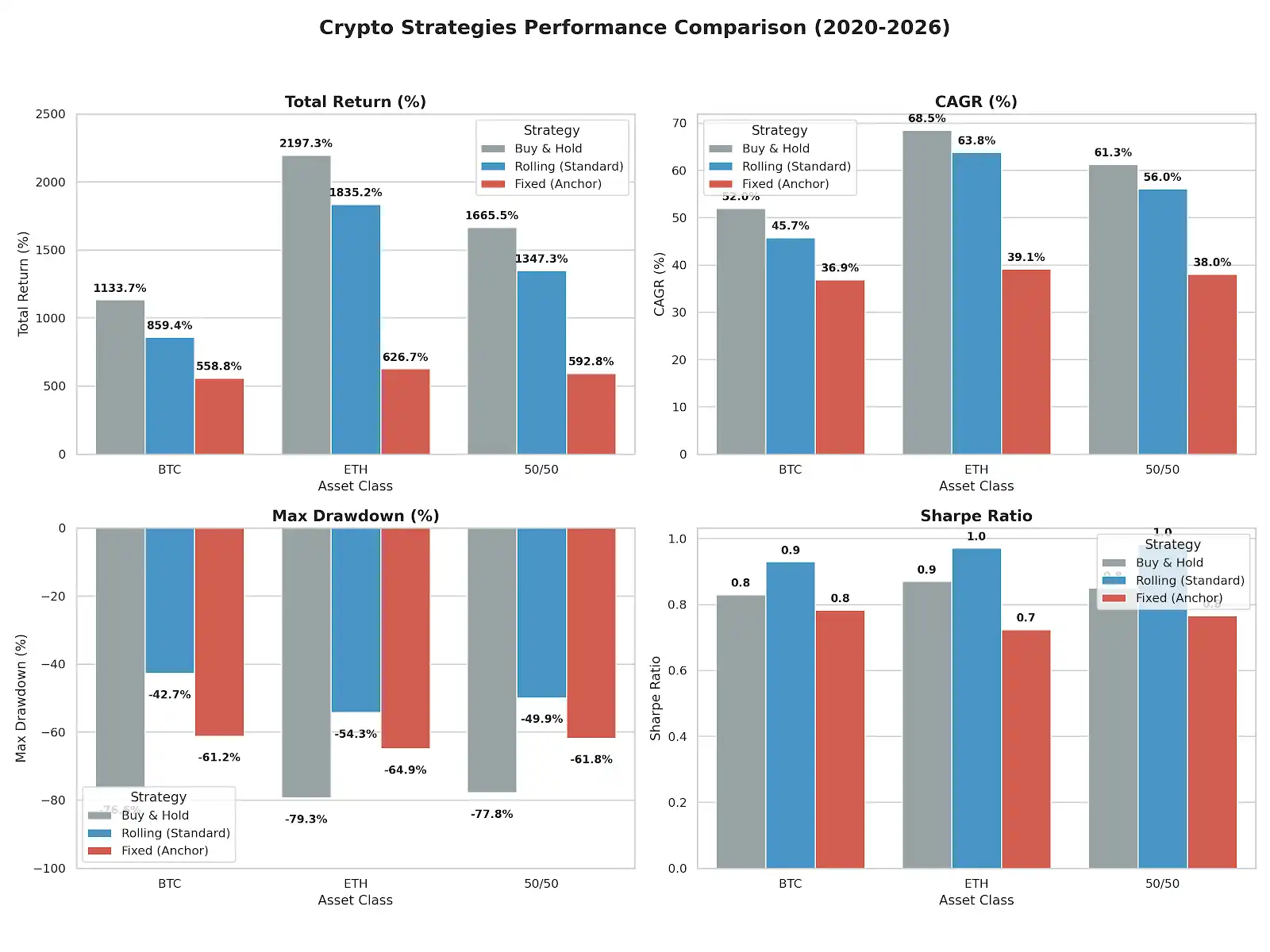
The Risk-Return Balancing Act of the Standard Dual Currency Win

Many mistakenly believed the standard strategy would severely underperform in bull markets, but the data proves that with just a 5% upside buffer (spot price * 1.05), it exhibits极强的 risk-return balancing ability over a full cycle.

In the 50/50 portfolio, its Sharpe Ratio (0.983) thoroughly crushed buy-and-hold (0.85) and drastically compressed the nearly -78% abysmal drawdown to -49.9%.

Its advantage doesn't come from predicting the market, but from the mechanism of "continuously dynamically raising the strike price."

With every price change, the standard version relentlessly adjusts its target. Rolling本质上是在牛市中不断“重置成本”,而 Fixed Anchor 却是在不断“确认错误”. The standard version sacrifices a极小部分 of potential暴利上限,换取来了平滑资金曲线的巨大战略纵深.

"Anchoring to Cost" is the Most Expensive Psychological Placebo

The most thought-provoking part of the data is the comprehensive failure of the "Break-even (Fixed Anchor)" type. It fell far short of the standard version in both return and drawdown control.

This exposes the most common weakness in human trading psychology: Anchoring Effect. If you took delivery at a high of 60k, and stubbornly hang a Call at 60k when the price drops to 30k, you not only lose the "bleeding stop" ability of option premiums during the long bear market, but also risk having your chips called away at 60k during a V-shaped market reversal, completely missing the subsequent main upward浪.

The break-even strategy seems conservative, but it's actually using time to fight the trend. And in a trend-driven market, time is often on the side of the trend. Obsessing over "not selling at a loss" is ironically the fastest way to perfectly miss out on major cycle红利.

Conclusion

Markets are full of volatility, but data doesn't lie.

In trending assets like Bitcoin and Ethereum, the real risk is not drawdown, but being limited on the upside by your own psychological anchor.

The standard Dual Currency Win tells us:

As long as you keep adjusting dynamically and rolling continuously, a selling strategy can also coexist with the trend.

And the break-even strategy reminds us:

The market won't change direction because of your cost basis.

Discipline is far more important than breaking even.

Preguntas relacionadas

QWhat is the main finding of the 6-year backtest (2020-2026) comparing the two versions of the Wheel Strategy?

AThe backtest revealed that the standard 'Rolling Strike' version significantly outperformed the 'Fixed Anchor' version, with the performance gap being nearly double in some cases. The key difference lies not in the strategy itself, but in the human psychology of anchoring to a cost basis.

QHow does the 'Rolling Strike' (Standard) version of the Wheel Strategy manage risk and return compared to simply holding the asset (Buy & Hold)?

AThe 'Rolling Strike' version demonstrated superior risk-adjusted returns. For the 50/50 portfolio, it achieved a higher Sharpe Ratio (0.983 vs 0.85 for Buy & Hold) and significantly reduced the maximum drawdown (-49.9% vs -77.8% for Buy & Hold), while still capturing substantial upside.

QWhy did the 'Fixed Anchor' version of the strategy perform poorly in the backtest?

AThe 'Fixed Anchor' strategy performed poorly because it falls victim to the 'anchoring effect' in behavioral finance. By stubbornly selling calls at the original, higher cost basis during a bear market, it loses the ability to collect meaningful premium ('stop the bleeding') and risks having the asset called away at the break-even point, missing out on a subsequent major bull run.

QAccording to the article, what is the most significant risk when investing in trend assets like Bitcoin and Ethereum using such strategies?

AThe most significant risk is not the price drawdown itself, but the psychological limitation of one's upside potential by being anchored to a specific cost price, which can cause an investor to miss out on major market trends.

QWhat is the core lesson about discipline from the article's conclusion?

AThe core lesson is that maintaining discipline by dynamically adjusting and rolling positions (as in the standard version) is far more important than the psychological desire to simply 'break even' on a trade. The market will not change direction based on an individual's cost basis.

Lecturas Relacionadas

The AI Agent Era Accelerates Its Arrival: Questflow Defines a New Paradigm of Financial Intelligence with On-Chain AI Brokerage

The AI Agent era is accelerating, with the CB Insights AI 100 list highlighting global investment confidence. The focus has shifted from whether AI works to its speed of deployment and ability to manage complex workflows, with autonomous AI Agents driving this transformation. At the forefront is Questflow, a Singapore-based startup redefining financial intelligence through its on-chain AI brokerage. Unlike tools that merely provide data dashboards, Questflow deploys AI Agents that proactively scan markets, form judgments, and execute trades via a conversational interface—operating 24/7 without requiring manual confirmation for each decision. This embodies the new AI paradigm of agents capable of executing multi-step workflows autonomously. Questflow's mission is to democratize institutional-grade trading intelligence. Historically reserved for the ultra-wealthy, this capability is now accessible starting from just $1 through Questflow's "AI Clone + Copy Trade" model. The platform charges only a 1% execution fee, aligning its incentives directly with users and eliminating traditional management or performance fees. The timing is opportune, aligning with key trends identified by CB Insights: the scalable deployment of AI Agents, accelerated AI adoption in financial services, and the maturation of on-chain infrastructure. With robust liquidity on platforms like Hyperliquid and Polymarket, alongside advancements in AI reasoning and non-custodial wallet security, Questflow is positioned to merge the roles of broker, fund, and exchange into a single, accessible platform for millions.

链捕手Hace 37 min(s)

The AI Agent Era Accelerates Its Arrival: Questflow Defines a New Paradigm of Financial Intelligence with On-Chain AI Brokerage

链捕手Hace 37 min(s)

Why Pricing Social Interactions is Doomed to Fail?

Titled "Why Putting a Price on Social Interaction Is Doomed to Fail," this article critiques attempts to monetize social networks directly through SocialFi models, arguing their inevitable failure stems from a fundamental misunderstanding of media dynamics. Using Marshall McLuhan's theory of "hot" and "cold" media, the author posits that social networks are inherently "cold" media. Their value isn't contained in individual posts but is co-created through user participation, interpretation, and fragmented, ongoing interaction (e.g., replies, shares). This ambiguity and need for user involvement are core to their function. The article asserts that SocialFi projects like Friend.tech failed because introducing real-time, tradable financial pricing (a definitive "hot" signal) into this "cold" environment doesn't add a layer—it replaces the medium's essence. The unambiguous price signal overshadows and nullifies the nuanced, participatory social signal. Users become traders, not participants, and when speculative profits vanish, the underlying social ecosystem—never genuinely cultivated—collapses entirely. This principle extends beyond crypto. The author argues platforms like Twitter have gradually "heated up" through metrics (likes, retweets counts, algorithmically defined value), shifting users from participants to performers and eroding organic engagement. The solution isn't to abandon capital but to manage its entry point. Successful models like Substack, Patreon, or Bandcamp allow capital to "condense" at specific, isolated nodes (e.g., subscriptions, one-time payments) without permeating and "heating" every social interaction. They preserve the core "cold," participatory medium while enabling monetization at designated boundaries. The NFT boom and bust serves as a stark parallel: the ancient "cold" medium of collecting (valued for story, community, gradual accumulation) was rapidly destroyed by platforms that introduced real-time floor prices, rarity scores, and trading dashboards, transforming collectors into speculators and vaporizing cultural value when prices fell. The core lesson: "Liquidity equals heat." Injecting high liquidity and definitive pricing into a "cold" participatory medium doesn't optimize it; it fundamentally alters and destroys its value-creating mechanism. The future lies not in pricing every social gesture but in finding precise, non-invasive points for capital to condense without overheating the entire ecosystem.

marsbitHace 45 min(s)

Why Pricing Social Interactions is Doomed to Fail?

marsbitHace 45 min(s)

Trading

Spot
Futuros
活动图片





