Can crypto recover from its $2.6T market cap wipeout? If not, what’s next?

ambcryptoPublicado a 2026-06-29Actualizado a 2026-06-29

Resumen

Cryptocurrency markets are entering Q3 under significant pressure, with the total market cap falling from a record $4.7 trillion to around $2.05 trillion. Macroeconomic uncertainty, a strengthening U.S. dollar, and rising Treasury yields are driving a flight to safety, dampening investor appetite for risk assets like crypto. This negative backdrop is compounded by weak crypto-specific fundamentals, including a sharp decline in DeFi Total Value Locked (TVL) from $115 billion to $70 billion and a record number of hacks resulting in major losses. With technical indicators and market performance lagging behind other asset classes like the NASDAQ, the outlook for a recovery in Q3 appears increasingly bearish.

As the market heads into Q3, the timing couldn’t be more volatile.

On the macro side, FUD hasn’t fully faded, with geopolitical uncertainty still keeping investors on edge. That continues to weigh on crypto, especially as the market has been in a steady QoQ pullback since the October peak, when total market cap hit a record $4.7 trillion and has now slid to around $2.05 trillion.

That pressure continues to show up in positioning.

As the chart below highlights, the U.S. Dollar Index (DXY) has pushed above the 100 level for the first time since early Q2 2025. More importantly, this move comes after four consecutive quarters of upside, creating a divergence that’s hard to ignore.
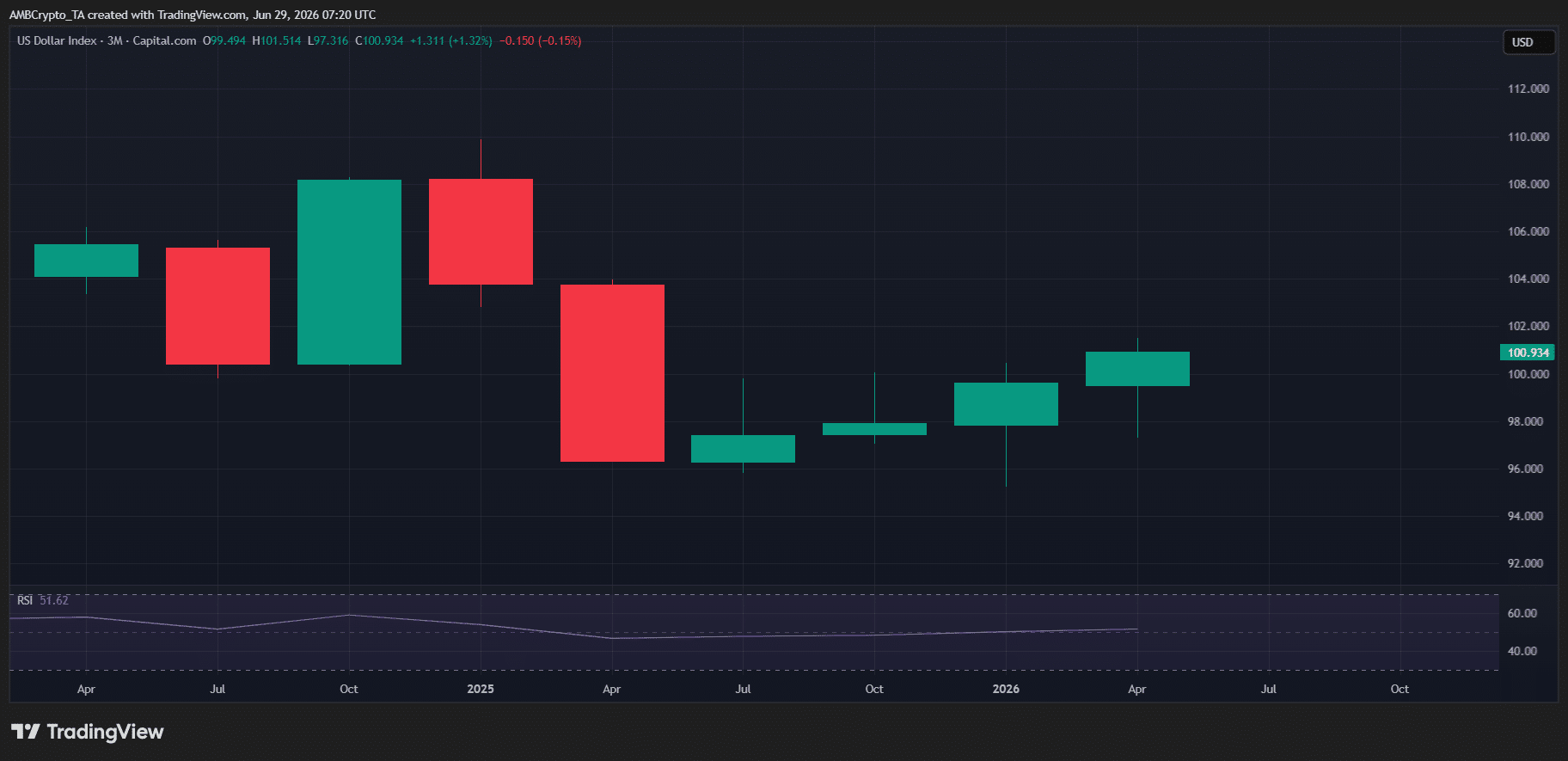
Source: TradingView (DXY)

Technically, it’s showing a textbook flight-to-safety move, with investors rotating capital into safe-haven assets instead of risk assets. This is largely being driven by ongoing macro uncertainty around geopolitics, regulatory clarity, and expectations around Fed rate cuts.

But this backdrop isn’t just technical. Instead, the fundamentals are looking shaky as well.

According to CryptoRank, DeFi platforms have suffered 121 hacks this year, with $942 million stolen. Moreover, Q2 alone recorded 85 exploits and $775 million in losses, making it the most active quarter ever for crypto hacks.

Meanwhile, DeFi TVL has dropped from $115 billion in January to around $70 billion by late June.

Taken together, it points to weakening confidence across both capital flows and on-chain fundamentals. Against this backdrop, it’s fair to say crypto is heading into Q3 with a setup that’s already leaning bearish.

Crypto faces renewed macro pressure in early Q3

Q3 is set to kick off, and macro pressure is already building on crypto.

According to the Kobeissi Letter, there are six key macro releases scheduled this week, with the main focus on inflation and employment data that will help set the tone for rate cuts in the months ahead.

However, investors are already leaning less dovish, with nearly 30% odds now pricing in a rate hike instead.

Against this backdrop, the rising DXY doesn’t look like a short-term move.

Supporting this further, the 30-year Treasury yield has climbed from 4.82% to 4.86% in under a month, reinforcing a stronger yield-driven environment.

Meanwhile, the NASDAQ is up over 23%, clearly showing that crypto has lagged in attracting capital, making its recent breakdown look less market-driven and more crypto-specific, as both technicals and fundamentals remain weak.
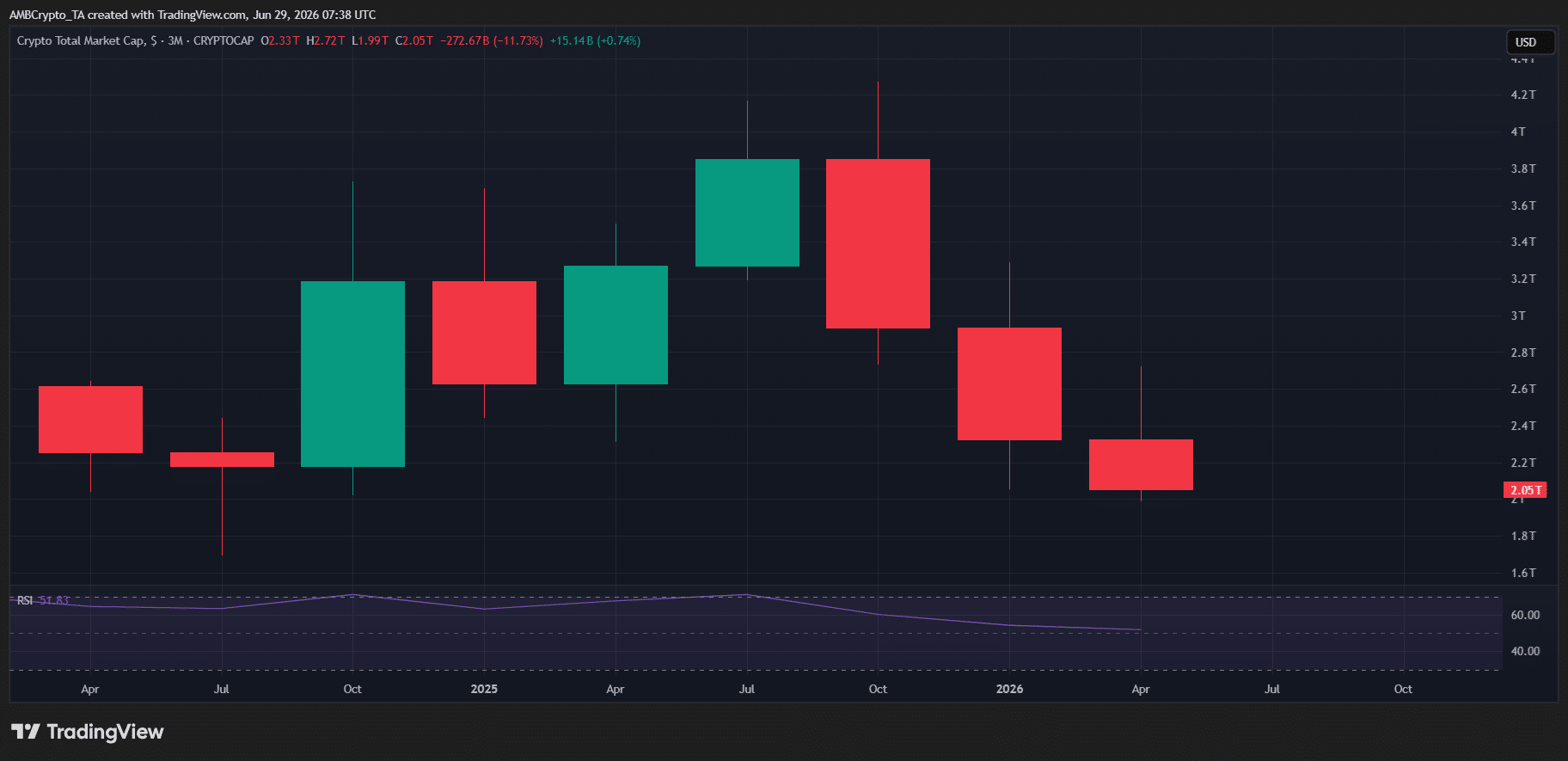
Source: TradingView (TOTAL/USDT)

In essence, the upcoming macro setup isn’t favoring crypto so far.

Hence, the timing could hardly be worse for digital assets. With Bitcoin [BTC] already posting 22% and 11% corrections in Q1 and Q2, respectively, another downside leg in Q3 looks increasingly likely as investors continue rotating into other assets, especially as macro FUD continues to intensify.


Final Summary

  • Q3 is starting with strong macro pressure on crypto, as DXY rises, yields stay elevated, and rate-cut expectations weaken.
  • Crypto is already weak on its own fundamentals, with falling TVL, rising hacks, and lagging performance vs other markets.


Criptos en tendencia

Preguntas relacionadas

QWhat is the current total market capitalization of the crypto market and how much has it fallen from its peak?

AThe current total crypto market cap is around $2.05 trillion. It has fallen from its peak of $4.7 trillion in October 2025, representing a wipeout of approximately $2.65 trillion.

QWhat are the two main technical and fundamental factors contributing to the bearish outlook for crypto entering Q3?

ATechnically, a strong U.S. Dollar Index (DXY) above 100 signals a flight to safety, diverting capital away from risk assets like crypto. Fundamentally, the DeFi sector is weakening with falling Total Value Locked (TVL) and a record number of hacks, eroding investor confidence.

QAccording to the article, how does the performance of the NASDAQ contrast with the crypto market, and what does this indicate?

AThe NASDAQ is up over 23%, while the crypto market has been in a steady decline. This indicates that capital is flowing into traditional tech stocks but not into crypto, suggesting the crypto downturn is more specific to its own weaknesses rather than a broad market issue.

QWhat key macro data releases are expected in early Q3 that could impact the crypto market?

AThere are six key macro releases scheduled, with the main focus on inflation and employment data. This data will help set the tone for future Federal Reserve interest rate decisions.

QWhat is the market's current expectation regarding Federal Reserve interest rate moves, according to the article?

AInvestors are leaning less dovish. Nearly 30% of market odds are now pricing in a potential interest rate hike instead of a cut, indicating a shift towards tighter monetary policy expectations.

Lecturas Relacionadas

Bitcoin Soars Over 24% in a Week, Best Weekly K in Recent Years, $2.7B Short Squeeze Sets Record, Policy Tailwinds Ignite Rally

Bitcoin surged over 24% this week, breaking above $78,000 and marking its best weekly performance since March 2024. The rally accelerated following a series of crypto-friendly signals from Washington and was further amplified by a record wave of forced short liquidations. Data from CoinGlass shows approximately $27.4 billion in crypto short positions were liquidated within 24 hours, the largest such event since the platform's records began in 2021. Total liquidations neared $30 billion, with shorts accounting for about 92%. Key drivers included a new SEC proposal ("Regulation Crypto Assets") to simplify token offerings, progress on the stalled CLARITY法案, comments from CFTC Chairman Michael Selig about moving forward independently if Congress delays, and former President Trump's remarks regarding bringing the Hyperliquid exchange into the US compliantly. Macroscopically, the US Treasury's announcement to double its long-term bond buyback program helped lower yields, improving liquidity expectations for risk assets. The market, previously stagnant near $60,000 with high short positioning, saw a violent squeeze. This created a self-reinforcing cycle where rising prices triggered further short liquidations. The interplay between shifting policy expectations and this massive deleveraging event fueled the historic weekly gain.

marsbitHace 5 min(s)

Bitcoin Soars Over 24% in a Week, Best Weekly K in Recent Years, $2.7B Short Squeeze Sets Record, Policy Tailwinds Ignite Rally

marsbitHace 5 min(s)

19 New Decacorns in Half a Year: Why is the Primary Market Chasing 'Certainty'?

In the first half of 2026, China’s primary market saw a notable increase in unicorns, adding 19 new companies each valued over 100 billion RMB, particularly in sectors like embodied AI and large language models (LLMs). Firms such as Galaxy General, Zibian, and ZhiPingFang even surpassed 200 billion RMB valuations within months. Moonshot AI's valuation surged from around $10 billion to $35 billion by July 2026, with a pre-IPO target of $50 billion. This concentration of capital into a few "certain" sectors highlights a market shift. The driving force is not a general abundance of capital but a chase for "certainty"—primarily clearer exit pathways like imminent IPOs. Companies with defined public listing timelines attract intense investment despite higher valuations, as they reduce exit uncertainty for investors. Secondary market valuations of listed peers also serve as new anchors, boosting the perceived value of private companies in similar fields, though this creates dependency on public market sentiment. Another form of certainty comes from the expectation of rising valuations in subsequent funding rounds. The investment logic has shifted in some cases from assessing long-term fundamental value to betting on the next round attracting higher prices. This dynamic is also seen in deep-tech areas like nuclear fusion, where firms like NeoFusion secured a 10.6 billion RMB valuation despite early commercial stages, driven by scarcity and strategic bets. However, this trend signals a risk transfer: technical uncertainties remain but are temporarily masked by valuation inflation. As valuations climb—50 billion to 200 billion or 500 billion RMB—companies face increasing pressure to demonstrate real revenue, profit, and sustainable business models. The danger lies not in the rise of unicorns itself, but if valuations become detached from value creation and rely merely on the expectation of future funding or exits. Ultimately, the surge reflects investors seeking perceived safety in shorter-term exit certainty and transactional momentum, rather than a renewed appetite for risk. The true test will come when the market inevitably refocuses on fundamentals, questioning how many of today’s high valuations are backed by genuine economic value.

marsbitHace 35 min(s)

19 New Decacorns in Half a Year: Why is the Primary Market Chasing 'Certainty'?

marsbitHace 35 min(s)

Just Now, Sam Altman Blasts Dario Amodei as 'Anti-Human', Secret Model Exposed the Same Day

Just now, Sam Altman strongly criticized Dario (Amodei, co-founder of Anthropic), denouncing his "doomsday marketing" as "anti-human dictator rhetoric." This came alongside the accidental exposure of OpenAI's next-generation model, codenamed "gpt-nathree," hinting at the imminent release of GPT-6 Astra. The leak occurred when an OpenAI employee's public GitHub commit mentioned the codename. Combined with previous leaks of "gpt-mewfour," it suggests these are iterative checkpoints for OpenAI's upcoming agent model, Astra. Astra is known for multi-agent collaboration and long-duration task handling, having reportedly solved previously unsolved mathematical problems. Meanwhile, two new Anthropic model codenames, "claude-marshmallow-eap" and "claude-melon-eap," were also exposed but are believed to be iterations of the Claude 5 series, not a new flagship. In a wide-ranging podcast interview, Altman admitted he was wrong about the speed of AI-driven disruption, acknowledging societal inertia slows adoption. He fiercely criticized rivals' marketing that simultaneously promises immense benefits (like curing cancer) and warns of existential risk, calling it a dangerous "benevolent dictator" narrative that seeks to concentrate power. He emphasized that people are the ultimate purpose of AI. Altman also revealed OpenAI's unconventional, consensus-defying path: spending four and a half years in the "dark" without a public product before ChatGPT's breakthrough, driven by scaling laws rather than early customer feedback. He concluded that even with superintelligent AI, genuine human connection will remain irreplaceably valuable.

marsbitHace 1 hora(s)

Just Now, Sam Altman Blasts Dario Amodei as 'Anti-Human', Secret Model Exposed the Same Day

marsbitHace 1 hora(s)

Trading

Spot

Artículos destacados

Cómo comprar CAP

¡Bienvenido a HTX.com! Hemos hecho que comprar Cap (CAP) sea simple y conveniente. Sigue nuestra guía paso a paso para iniciar tu viaje de criptos.Paso 1: crea tu cuenta HTXUtiliza tu correo electrónico o número de teléfono para registrarte y obtener una cuenta gratuita en HTX. Experimenta un proceso de registro sin complicaciones y desbloquea todas las funciones.Obtener mi cuentaPaso 2: ve a Comprar cripto y elige tu método de pagoTarjeta de crédito/débito: usa tu Visa o Mastercard para comprar Cap (CAP) al instante.Saldo: utiliza fondos del saldo de tu cuenta HTX para tradear sin problemas.Terceros: hemos agregado métodos de pago populares como Google Pay y Apple Pay para mejorar la comodidad.P2P: tradear directamente con otros usuarios en HTX.Over-the-Counter (OTC): ofrecemos servicios personalizados y tipos de cambio competitivos para los traders.Paso 3: guarda tu Cap (CAP)Después de comprar tu Cap (CAP), guárdalo en tu cuenta HTX. Alternativamente, puedes enviarlo a otro lugar mediante transferencia blockchain o utilizarlo para tradear otras criptomonedas.Paso 4: tradear Cap (CAP)Tradear fácilmente con Cap (CAP) en HTX's mercado spot. Simplemente accede a tu cuenta, selecciona tu par de trading, ejecuta tus trades y monitorea en tiempo real. Ofrecemos una experiencia fácil de usar tanto para principiantes como para traders experimentados.

561 Vistas totalesPublicado en 2026.06.26Actualizado en 2026.06.26

Cómo comprar CAP

Discusiones

Bienvenido a la comunidad de HTX. Aquí puedes mantenerte informado sobre los últimos desarrollos de la plataforma y acceder a análisis profesionales del mercado. A continuación se presentan las opiniones de los usuarios sobre el precio de CAP (CAP).

活动图片