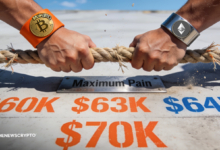
BTC Needs to Soar 92% to Rescue Buyers from Last Year's $120k Entry; First Escape Exit at $72k

marsbitPublicado a 2026-07-17Actualizado a 2026-07-17

Resumen

Bitcoin's price hovers around $64,000, leaving buyers who entered near the $123,000 peak in July 2025 down nearly 48%. These investors require a 92.2% rally just to break even. On-chain data from Glassnode highlights key resistance levels that will test the market's strength on any potential recovery path. The Short-Term Holder cost basis sits at approximately $72,200, while the Realized Market Mean is around $76,600. These levels represent the first major supply tests, as some holders may look to exit once losses narrow or profits are restored. BTC has traded below these benchmarks for about five months. Glassnode reports that while long-term holder capitulation is cooling and buyers absorbed the June lows, a definitive market bottom remains unconfirmed. Downside risk still exists, with the bear market lower bound near $53,000 identified as residual risk. For a sustainable recovery, stronger demand must first absorb potential selling pressure at the $72,200 and $76,600 levels. Only after reclaiming these cost bases would targets like $100,000 or the $123,000 breakeven for last year's peak buyers become relevant. The market's ability to handle supply at these initial checkpoints will be crucial for any further upward movement.

Author: Liam "Akiba" Wright, CryptoSlate

Compiled by: TechFlow

TechFlow Insight: With BTC's current price around $64,000, buyers who entered last July at $120,000 are facing a loss of nearly 48%, requiring a 92.2% rally to break even. Glassnode on-chain data reveals the Short-Term Holder cost basis sits at approximately $72,200, and the Realized Market Mean is around $76,600 – these levels will be the first pressure tests on the rebound path, as some holders might choose to sell when losses narrow.

Buyers from Last Year's $120k Peak Remain Deep Underwater

With BTC currently priced around $64,000, a $1,000 investment made last July when BTC first breached $120,000 is now worth only about $520 – a loss of 47.98%, necessitating a 92.2% rally to recover the initial capital (excluding fees).

In July 2025, BTC first surpassed $120,000, setting a new all-time high of $123,165; on October 6 of the same year, it climbed further to a higher record of $126,198. Currently, however, the price remains far below either of these milestones.

The First Pressure Test on the Road to Break-Even

According to Glassnode's Week 27 research report, the Short-Term Holder cost basis (the aggregate break-even point for recent buyers) is around $72,200; the Realized Market Mean (a broader cost baseline for active investors) is approximately $76,600. BTC has been trading below these two metrics for about 5 months.

As the price approaches these two cost bases, losses for high-entry buyers will shrink, while other holders will gain earlier exit opportunities. Some may continue holding upon returning to profit, while others might reduce their positions after prolonged losses – the strength of demand at these levels will determine whether the potential supply can be absorbed.
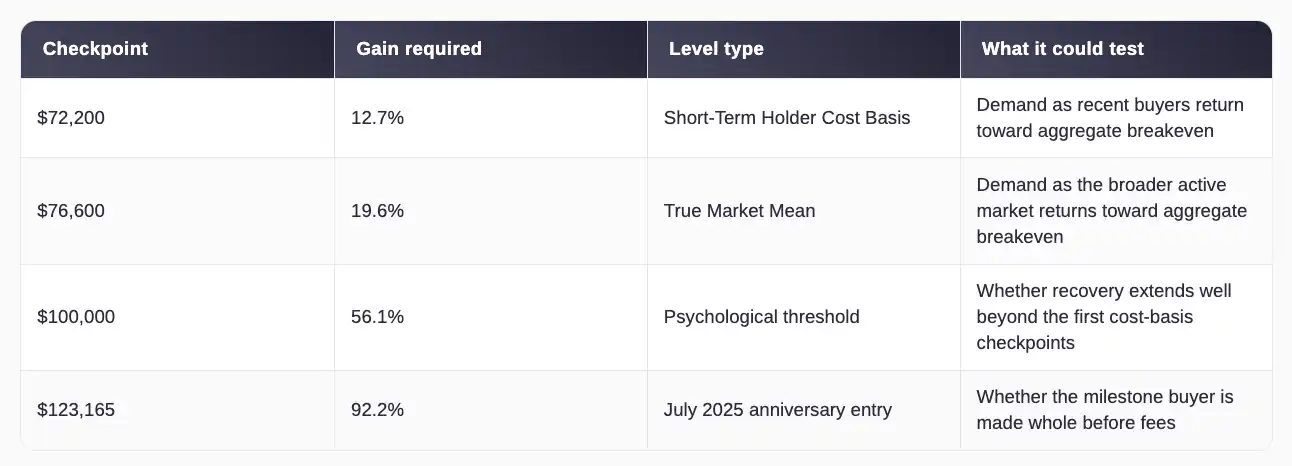
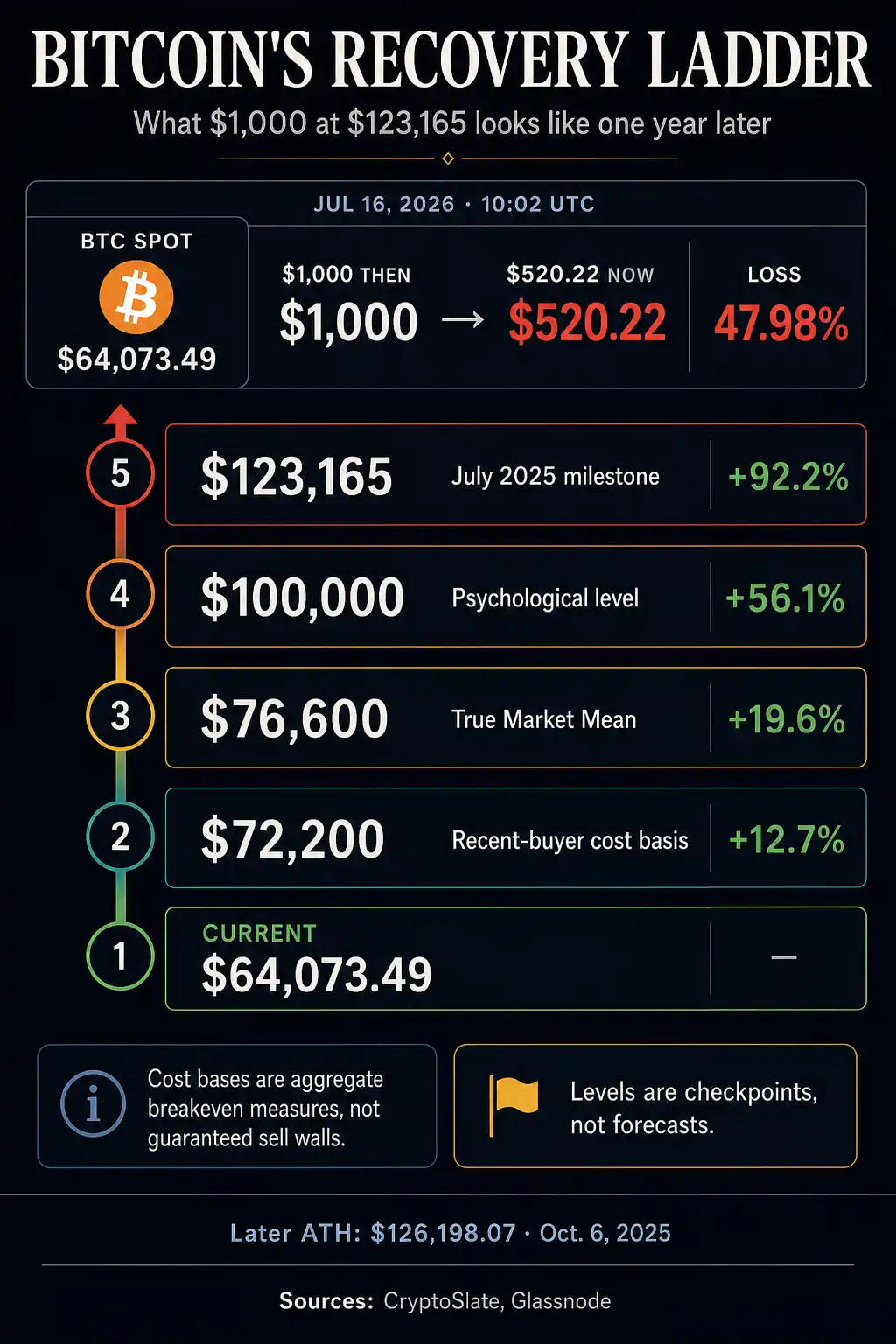
Key Level Overview:

  • $72,200 (Requires a 12.7% increase): Short-Term Holder cost basis – a test of demand as recent buyers return to break-even.
  • $76,600 (Requires a 19.6% increase): Realized Market Mean – a test of demand as the broader active market returns to break-even.
  • $100,000 (Requires a 56.1% increase): A psychological threshold, testing whether recovery extends well beyond the first cost basis checkpoints.
  • $123,000 (Requires a 92.2% increase): The July 2025 entry price – whether last year's peak buyers can break even.

Bottom Still Not Confirmed

In a July 13th update, Glassnode noted that BTC's movement towards $64,000 lacked broad consensus, with weak spot market participation and on-chain activity. On July 15th, Glassnode stated that the Long-Term Holder capitulation was cooling, with buyers absorbing the June lows, but the bottom remains "a work in progress."

These two updates point towards gradual improvement – but stronger demand is still required to break through the aforementioned cost bases. At the two key levels of $72,200 and $76,600, the core question is: how much potential selling pressure emerges, and can buyers absorb it.

Glassnode also maintains exposure to downside risks – a July 8th report noted that the bear market lower bound, the Realized Price around $53,000, could still be tested. Glassnode views $53,000 as a residual risk and continues to characterize the bottom as unconfirmed.

BTC must first recapture the two cost bases at $72,200 and $76,600 before $100,000 and $123,000 become meaningful. A stronger recovery first depends on whether demand can absorb potential risk release around $72,200, followed by $76,600. Until these checkpoints are reclaimed and confirmed by broader participation, last year's peak buyers face the presence of holders who can exit much earlier.


Criptos en tendencia

Preguntas relacionadas

QAccording to the article, what is the current price of Bitcoin mentioned and how much loss do buyers from last July face?

AThe current price of Bitcoin is approximately $64,000. Buyers who entered at the peak of $120,000 last July are facing a loss of nearly 48%, as a $1,000 investment is now worth about $520.

QWhat is the first key cost basis level that Bitcoin needs to reclaim according to Glassnode's data, and what does it represent?

AThe first key cost basis level is $72,200, which represents the Short-Term Holder Cost Basis. It is the aggregate break-even point for recent buyers and will be an initial test of demand as sellers may look to exit when their losses narrow at this level.

QWhat percentage increase is required for Bitcoin to reach the $72,200 Short-Term Holder Cost Basis level from the current price?

AA 12.7% increase from the current price of approximately $64,000 is required for Bitcoin to reach the $72,200 Short-Term Holder Cost Basis level.

QWhat is the second, broader cost basis level mentioned, and what is it called?

AThe second, broader cost basis level mentioned is $76,600. It is called the Realized Price, which serves as a cost benchmark for the wider active investor market.

QAccording to the article, what is identified as a residual downside risk for Bitcoin?

AA downside risk level of approximately $53,000 is identified as a residual risk. This is mentioned as the bear market lower bound and the Realized Price, which could still be tested.

Lecturas Relacionadas

Who Is Shaping Ethereum's Future: The Takeover by Token-Holding Companies Could Be the Best Thing for ETH in Years

**Title: Who is Building Ethereum's Future? Corporate ETH Holders Take Over Funding, Possibly the Best Thing for ETH in Years.** **Summary:** The Ethereum Foundation is scaling back due to fiscal concerns, but publicly traded companies holding large amounts of ETH, like Bitmine and SharpLink, are stepping in to fund protocol development. These firms collectively hold nearly 5% of ETH's circulating supply and are using their staking yields to pay for R&D. Unlike MicroStrategy, which merely accumulates Bitcoin, these ETH treasury companies are reinvesting profits directly into the protocol's development—potentially allowing all ETH holders to benefit from this free "spillover." Key drivers for this shift include these companies' stalled business model. Their "flywheel" of issuing stock to buy more ETH broke as their stock prices fell below the net value of their crypto holdings (mNAV < 1). With their ETH holdings also deeply underwater, simply waiting for price appreciation failed. By funding Ethereum's roadmap—through new non-profits like ETH Labs and Ethereum Institutional—they aim to increase the utility and value of the underlying asset that dominates their balance sheets. This creates a new alignment of interests: these companies are highly incentivized to see Ethereum succeed and are less likely to sell en masse. However, risks remain. The exact funding amounts are undisclosed, and these treasury firms themselves are vulnerable if ETH prices fall further, which could halt their contributions. **Additional Context:** The article also contrasts Jito's new "token-centric" proposal (JIP-38), which credibly directs platform fees to token buybacks, with Venice's less concrete promises, highlighting the importance of where revenue legally lands and who controls the mechanisms. Other notable industry updates include the rise of TradFi perpetuals on Hyperliquid, new Bitcoin staking via Stacks, and various DeFi product launches.

marsbitHace 29 min(s)

Who Is Shaping Ethereum's Future: The Takeover by Token-Holding Companies Could Be the Best Thing for ETH in Years

marsbitHace 29 min(s)

Visa Takes Another Step Upstream in the Stablecoin Industry

Visa has launched the Visa Stablecoin Platform (VSP), a comprehensive enterprise platform enabling banks and fintechs to handle stablecoins directly within Visa's existing payments and treasury workflows, covering approximately 15,000 financial institutions and over 200 million merchants. The platform launches with the new OUSD stablecoin and also supports USDC and USDG, providing integrated wallet infrastructure, controls, and workflows for various institutional use cases. This move marks Visa's strategic progression within the stablecoin ecosystem. It began as a user, piloting USDC for settlement in 2021, later evolving into a distributor through cards like Bridge and empowering banks with its VTAP platform. VSP consolidates these capabilities into a unified hub, positioning Visa as the central entry point for its stablecoin services rather than an issuer. Crucially, Visa is opting not to issue its own stablecoin, a move that would create conflicts with partners like Circle and Paxos and entail significant regulatory burdens. Instead, Visa leverages its neutral network role. The choice of OUSD—a zero-fee, alliance-managed stablecoin—allows Visa to benefit from the issuance layer economically without becoming a direct competitor. This strategy aims to make Visa's network the default infrastructure layer in the stablecoin era, avoiding the need to mint its own coin.

Foresight NewsHace 31 min(s)

Visa Takes Another Step Upstream in the Stablecoin Industry

Foresight NewsHace 31 min(s)

Opening Claude's Brain Is Useless; The True Key to the AI Black Box Lies in Ontology Engineering

"Dissecting Claude's Brain Is Futile: The Real Key to the AI Black Box Lies in Ontology Engineering" This article critiques the limitations of Anthropic's "J-Space" research, which attempts to explain AI models by observing their internal neural activation patterns, akin to fMRI brain scans. While this "internalist" approach offers unprecedented visibility into model states, it fundamentally conflates observability with true explainability. The core issue is that understanding a model's output requires more than tracing neural activity; it necessitates examining the meaning of the information it processes—its relationship to the world, semantic norms, and human cognitive frameworks. The author proposes a paradigm shift: moving from a neuroscience-inspired focus on the model itself to an "information ontology" approach centered on the knowledge the model handles. Drawing from Kant's philosophical categories, the argument posits that true explainability lies in structuring and understanding information within a formal conceptual framework, not in peering into the "black box." The practical application of this theory is ontology engineering. Ontologies provide a structured, computable framework for knowledge, serving as a semantic anchor for model outputs. The article details a bidirectional synergy: Large Language Models (LLMs) can automate and scale ontology construction, while ontologies, in turn, enhance AI explainability. They act as a verification framework, allowing model reasoning to be traced back to defined concepts, properties, and relationships. This transforms explainability from the impossible task of making neural networks transparent into the achievable engineering goal of making their outputs and impacts understandable, traceable, and accountable. The future of AI explainability, therefore, lies not in explaining the model's internal mechanics but in explaining and governing the knowledge structures and real-world effects of its outputs.

marsbitHace 38 min(s)

Opening Claude's Brain Is Useless; The True Key to the AI Black Box Lies in Ontology Engineering

marsbitHace 38 min(s)

Trading

Spot

Artículos destacados

Qué es BITCOIN

Entendiendo HarryPotterObamaSonic10Inu (ERC-20) y Su Posición en el Espacio Cripto En los últimos años, el mercado de criptomonedas ha sido testigo de un aumento en la popularidad de las monedas meme, capturando el interés no solo de los comerciantes, sino también de aquellos que buscan compromiso comunitario y valor de entretenimiento. Entre estos tokens únicos se encuentra HarryPotterObamaSonic10Inu (ERC-20), un proyecto intrigante que mezcla referencias culturales en el tejido de las criptomonedas. Este artículo profundiza en los aspectos clave de HarryPotterObamaSonic10Inu, explorando sus mecanismos, ethos impulsado por la comunidad y su relación con el paisaje cripto más amplio. ¿Qué es HarryPotterObamaSonic10Inu (ERC-20)? Como su nombre sugiere, HarryPotterObamaSonic10Inu es una moneda meme construida sobre la blockchain de Ethereum, clasificada bajo el estándar ERC-20. A diferencia de las criptomonedas tradicionales que pueden enfatizar la utilidad práctica o el potencial de inversión, este token prospera en el valor de entretenimiento y la fuerza de su comunidad. El proyecto tiene como objetivo fomentar un entorno donde los usuarios comprometidos puedan reunirse, compartir ideas y participar en actividades inspiradas por diversos fenómenos culturales. Una característica notable de HarryPotterObamaSonic10Inu es su cero impuestos en las transacciones. Este atractivo elemento tiene como objetivo incentivar el comercio y la participación comunitaria, sin cargos adicionales que puedan disuadir a los comerciantes de pequeña escala. El suministro total de la moneda está establecido en mil millones de tokens, una cifra que marca su intención de mantener una circulación sustancial dentro de la comunidad. Creador de HarryPotterObamaSonic10Inu (ERC-20) Los orígenes de HarryPotterObamaSonic10Inu están algo envueltos en misterio; los detalles sobre el creador siguen siendo desconocidos. El desarrollo de este token carece de un equipo identificable o de un plan explícito, lo cual no es inusual dentro del sector de monedas meme. En cambio, el proyecto ha surgido de manera orgánica, con su progreso muy dependiente del entusiasmo y la participación de su comunidad. Inversores de HarryPotterObamaSonic10Inu (ERC-20) En cuanto a inversiones externas y respaldo, HarryPotterObamaSonic10Inu también sigue siendo ambiguo. El token no lista ninguna fundación de inversión conocida o apoyo organizacional significativo. En cambio, la savia del proyecto es su comunidad de base, que informa su crecimiento y sostenibilidad a través de la acción colectiva y el compromiso en el espacio cripto. ¿Cómo Funciona HarryPotterObamaSonic10Inu (ERC-20)? Como una moneda meme, HarryPotterObamaSonic10Inu opera principalmente fuera de los marcos tradicionales que a menudo rigen el valor de los activos. Hay varios aspectos distintivos que definen cómo funciona el proyecto: Transacciones Sin Impuestos: Sin tarifas impositivas en las transacciones, los usuarios pueden comprar y vender el token libremente sin preocuparse por costos ocultos. Compromiso Comunitario: El proyecto prospera en la interacción comunitaria, aprovechando plataformas de redes sociales para crear entusiasmo y facilitar la participación. Las discusiones, el intercambio de contenido y el compromiso son elementos cruciales que ayudan a expandir su alcance y fomentar la lealtad entre los seguidores. Sin Utilidad Práctica: Cabe señalar que HarryPotterObamaSonic10Inu no ofrece utilidad concreta dentro del ecosistema financiero. Más bien, se clasifica como un token principalmente para actividades de entretenimiento y comunitarias. Referencia Cultural: El token incorpora astutamente elementos de la cultura popular para atraer interés, conectando con entusiastas de los memes y seguidores de las criptomonedas por igual. HarryPotterObamaSonic10Inu ejemplifica cómo las monedas meme operan de manera diferente a los proyectos de criptomonedas más tradicionales, ingresando al mercado como construcciones sociales innovadoras en lugar de activos utilitarios. Cronología de HarryPotterObamaSonic10Inu (ERC-20) La historia de HarryPotterObamaSonic10Inu está marcada por varios hitos notables: Creación: El token surgió de un meme viral, capturando la imaginación de muchos entusiastas de las criptomonedas. Las fechas específicas de creación no están disponibles, subrayando su ascenso orgánico. Listado en Exchanges: HarryPotterObamaSonic10Inu ha llegado a varios exchanges, permitiendo un acceso y comercio más fácil por parte de la comunidad. Iniciativas de Compromiso Comunitario: Actividades continuas destinadas a mejorar la interacción comunitaria, incluyendo concursos, campañas en redes sociales y generación de contenido por parte de fanáticos y defensores. Planes de Expansión Futuros: La hoja de ruta del proyecto incluye el lanzamiento de una colección de NFT, mercancía y un sitio de comercio electrónico relacionado con sus temas culturales, involucrando aún más a la comunidad e intentando añadir más dimensiones a su ecosistema. Puntos Clave Sobre HarryPotterObamaSonic10Inu (ERC-20) Naturaleza Impulsada por la Comunidad: El proyecto prioriza la participación colectiva y la creatividad, asegurando que la involucración de los usuarios esté a la vanguardia de su desarrollo. Clasificación como Moneda Meme: Representa la epítome de las criptomonedas basadas en el entretenimiento, diferenciándose de los vehículos de inversión tradicionales. Sin Afiliación Directa con Bitcoin: A pesar de la similitud en el nombre del ticker, HarryPotterObamaSonic10Inu es distinto y no tiene relación con Bitcoin u otras criptomonedas establecidas. Enfoque en la Colaboración: HarryPotterObamaSonic10Inu está diseñado para crear un espacio para la colaboración y el intercambio de historias entre sus poseedores, proporcionando una vía para la creatividad y el vínculo comunitario. Perspectivas Futuras: La ambición de expandirse más allá de su premisa inicial hacia NFTs y mercancías describe un camino para que el proyecto potencialmente ingrese a avenidas más tradicionales dentro de la cultura digital. A medida que las monedas meme continúan capturando la imaginación de la comunidad de criptomonedas, HarryPotterObamaSonic10Inu (ERC-20) se destaca debido a sus lazos culturales y su enfoque centrado en la comunidad. Si bien puede no encajar en el molde típico de un token impulsado por la utilidad, su esencia radica en la alegría y la camaradería fomentadas entre sus seguidores, destacando la naturaleza en evolución de las criptomonedas en una era cada vez más digital. A medida que el proyecto continúa desarrollándose, será importante observar cómo las dinámicas comunitarias influyen en su trayectoria en el cambiante paisaje de la tecnología blockchain.

2.0k Vistas totalesPublicado en 2024.04.01Actualizado en 2024.12.03

Qué es BITCOIN

Cómo comprar BTC

¡Bienvenido a HTX.com! Hemos hecho que comprar Bitcoin (BTC) sea simple y conveniente. Sigue nuestra guía paso a paso para iniciar tu viaje de criptos.Paso 1: crea tu cuenta HTXUtiliza tu correo electrónico o número de teléfono para registrarte y obtener una cuenta gratuita en HTX. Experimenta un proceso de registro sin complicaciones y desbloquea todas las funciones.Obtener mi cuentaPaso 2: ve a Comprar cripto y elige tu método de pagoTarjeta de crédito/débito: usa tu Visa o Mastercard para comprar Bitcoin (BTC) al instante.Saldo: utiliza fondos del saldo de tu cuenta HTX para tradear sin problemas.Terceros: hemos agregado métodos de pago populares como Google Pay y Apple Pay para mejorar la comodidad.P2P: tradear directamente con otros usuarios en HTX.Over-the-Counter (OTC): ofrecemos servicios personalizados y tipos de cambio competitivos para los traders.Paso 3: guarda tu Bitcoin (BTC)Después de comprar tu Bitcoin (BTC), guárdalo en tu cuenta HTX. Alternativamente, puedes enviarlo a otro lugar mediante transferencia blockchain o utilizarlo para tradear otras criptomonedas.Paso 4: tradear Bitcoin (BTC)Tradear fácilmente con Bitcoin (BTC) en HTX's mercado spot. Simplemente accede a tu cuenta, selecciona tu par de trading, ejecuta tus trades y monitorea en tiempo real. Ofrecemos una experiencia fácil de usar tanto para principiantes como para traders experimentados.

5.3k Vistas totalesPublicado en 2024.12.12Actualizado en 2026.06.02

Cómo comprar BTC

Qué es $BITCOIN

ORO DIGITAL ($BITCOIN): Un Análisis Integral Introducción al ORO DIGITAL ($BITCOIN) ORO DIGITAL ($BITCOIN) es un proyecto basado en blockchain que opera en la red Solana, cuyo objetivo es combinar las características de los metales preciosos tradicionales con la innovación de las tecnologías descentralizadas. Aunque comparte un nombre con Bitcoin, a menudo referido como “oro digital” debido a su percepción como un refugio de valor, ORO DIGITAL es un token separado diseñado para crear un ecosistema único dentro del paisaje Web3. Su meta es posicionarse como un activo digital alternativo viable, aunque los detalles sobre sus aplicaciones y funcionalidades aún están en desarrollo. ¿Qué es ORO DIGITAL ($BITCOIN)? ORO DIGITAL ($BITCOIN) es un token de criptomoneda diseñado explícitamente para su uso en la blockchain de Solana. A diferencia de Bitcoin, que proporciona un papel de almacenamiento de valor ampliamente reconocido, este token parece centrarse en aplicaciones y características más amplias. Aspectos notables incluyen: Infraestructura Blockchain: El token está construido sobre la blockchain de Solana, conocida por su capacidad para manejar transacciones de alta velocidad y bajo costo. Dinámicas de Suministro: ORO DIGITAL tiene un suministro máximo limitado a 100 cuatrillones de tokens (100P $BITCOIN), aunque los detalles sobre su suministro circulante no se han divulgado actualmente. Utilidad: Si bien las funcionalidades precisas no están delineadas explícitamente, hay indicios de que el token podría ser utilizado para diversas aplicaciones, potencialmente involucrando aplicaciones descentralizadas (dApps) o estrategias de tokenización de activos. ¿Quién es el Creador de ORO DIGITAL ($BITCOIN)? En la actualidad, la identidad de los creadores y el equipo de desarrollo detrás de ORO DIGITAL ($BITCOIN) sigue siendo desconocida. Esta situación es típica entre muchos proyectos innovadores dentro del espacio blockchain, particularmente aquellos alineados con las finanzas descentralizadas y fenómenos de monedas meme. Si bien tal anonimato puede fomentar una cultura impulsada por la comunidad, intensifica las preocupaciones sobre la gobernanza y la responsabilidad. ¿Quiénes son los Inversores de ORO DIGITAL ($BITCOIN)? La información disponible indica que ORO DIGITAL ($BITCOIN) no tiene patrocinadores institucionales conocidos ni inversiones destacadas de capital de riesgo. El proyecto parece operar en un modelo de peer-to-peer centrado en el apoyo y la adopción de la comunidad en lugar de rutas de financiamiento tradicionales. Su actividad y liquidez se sitúan principalmente en intercambios descentralizados (DEX), como PumpSwap, en lugar de plataformas de trading centralizadas establecidas, lo que resalta aún más su enfoque de base. Cómo Funciona ORO DIGITAL ($BITCOIN) Los mecanismos operativos de ORO DIGITAL ($BITCOIN) pueden elaborarse en función de su diseño blockchain y atributos de red: Mecanismo de Consenso: Al aprovechar el único proof-of-history (PoH) de Solana combinado con un modelo de proof-of-stake (PoS), el proyecto asegura una validación de transacciones eficiente que contribuye al alto rendimiento de la red. Tokenómica: Si bien los mecanismos deflacionarios específicos no se han detallado extensamente, el vasto suministro máximo de tokens implica que podría atender microtransacciones o casos de uso nicho que aún están por definirse. Interoperabilidad: Existe el potencial de integración con el ecosistema más amplio de Solana, incluyendo varias plataformas de finanzas descentralizadas (DeFi). Sin embargo, los detalles sobre integraciones específicas permanecen no especificados. Cronología de Eventos Clave Aquí hay una cronología que destaca hitos significativos relacionados con ORO DIGITAL ($BITCOIN): 2023: El despliegue inicial del token ocurre en la blockchain de Solana, marcado por su dirección de contrato. 2024: ORO DIGITAL gana visibilidad al estar disponible para trading en intercambios descentralizados como PumpSwap, permitiendo a los usuarios comerciar contra SOL. 2025: El proyecto presencia actividad de trading esporádica y potencial interés en compromisos liderados por la comunidad, aunque no se han documentado asociaciones notables o avances técnicos hasta el momento. Análisis Crítico Fortalezas Escalabilidad: La infraestructura subyacente de Solana soporta altos volúmenes de transacciones, lo que podría mejorar la utilidad de $BITCOIN en varios escenarios de transacción. Accesibilidad: El potencial bajo precio de trading por token podría atraer a inversores minoristas, facilitando una participación más amplia debido a oportunidades de propiedad fraccionada. Riesgos Falta de Transparencia: La ausencia de patrocinadores, desarrolladores o un proceso de auditoría conocidos públicamente puede generar escepticismo sobre la sostenibilidad y confiabilidad del proyecto. Volatilidad del Mercado: La actividad de trading depende en gran medida del comportamiento especulativo, lo que puede resultar en una volatilidad de precios significativa y en incertidumbre para los inversores. Conclusión ORO DIGITAL ($BITCOIN) surge como un proyecto intrigante pero ambiguo dentro del ecosistema de Solana en rápida evolución. Si bien intenta aprovechar la narrativa del “oro digital”, su alejamiento del papel establecido de Bitcoin como refugio de valor subraya la necesidad de una diferenciación más clara de su utilidad y estructura de gobernanza previstas. La aceptación y adopción futura dependerán probablemente de abordar la actual opacidad y de definir sus estrategias operativas y económicas de manera más explícita. Nota: Este informe abarca información sintetizada disponible hasta octubre de 2023, y pueden haber ocurrido desarrollos más allá del período de investigación.

120 Vistas totalesPublicado en 2025.05.13Actualizado en 2025.05.13

Qué es $BITCOIN

Discusiones

Bienvenido a la comunidad de HTX. Aquí puedes mantenerte informado sobre los últimos desarrollos de la plataforma y acceder a análisis profesionales del mercado. A continuación se presentan las opiniones de los usuarios sobre el precio de BTC (BTC).

活动图片