Breaking Away from Traditional Investment Paths: Cryptocurrency Emerges as the Primary Battlefield for Wealth Among the Younger Generation

比推Publicado a 2025-12-17Actualizado a 2025-12-17

Resumen

Coinbase's latest industry report, in collaboration with Ipsos, reveals a significant generational shift in investment strategies. Younger investors, including Gen Z and millennials, are increasingly moving away from traditional wealth-building paths like buying real estate and investing in stocks. The survey of over 2,000 U.S. investors found that 73% of young people believe it's harder for their generation to build wealth through conventional means compared to their parents' generation. This sentiment is reflected in their portfolios: younger investors allocate 25% of their investments to non-traditional assets like cryptocurrencies, derivatives, and NFTs—three times the allocation of older investors. Nearly half (45%) of young investors already hold cryptocurrency, compared to just 18% of older investors. They view crypto not as a speculative side investment but as a core component for catching up financially, with 80% believing it offers more opportunities outside the traditional financial system. Younger investors are also more active, trade more frequently, and are willing to take higher risks for greater returns. They express strong interest in emerging crypto products like derivatives, prediction markets, and DeFi lending. This trend is pushing the financial industry toward 24/7, multi-asset platforms that better serve this internet-native generation.

Author: Coinbase

Compiled by: Chopper, Foresight News

Original Title: Moving Beyond Home Buying and Stock Trading, the Younger Generation Embraces Cryptocurrency as the Main Arena for Wealth


For decades, the path to wealth accumulation for Americans has remained largely unchanged: secure a good job, purchase property, invest in stocks, and wait for the power of compound interest to yield returns. However, our latest "Cryptocurrency Industry Report" reveals that the younger generation of investors no longer believes in this traditional path and is adjusting their investment strategies accordingly.

To understand how different generations approach the market and the role cryptocurrency plays in their investment portfolios, Coinbase partnered with Ipsos to conduct a specialized survey. The study interviewed 4,350 American adults, including 2,005 investors with investment accounts. The key findings are as follows: Younger investors, such as Gen Z and Millennials, are more inclined to manage their investments actively, more open to non-traditional assets, and more likely to view cryptocurrency as a core component of their financial future.
A Generation Shut Out of the Traditional Wealth Ladder

Younger investors are far more optimistic about the economy than older generations, but they believe the existing financial system is not designed for them. Survey data shows that nearly seven out of ten (73%) young people believe it is more difficult for their generation to accumulate wealth through traditional means compared to their parents' generation. In contrast, only 57% of older generations share this view.

They have witnessed soaring housing costs, overwhelming student debt, and sluggish wage growth. In this context, an increasing number of young people are seeking alternative wealth accumulation methods beyond the traditional model of "home equity + stock portfolio."

Non-Traditional Asset Allocation Three Times Higher Than Older Generations

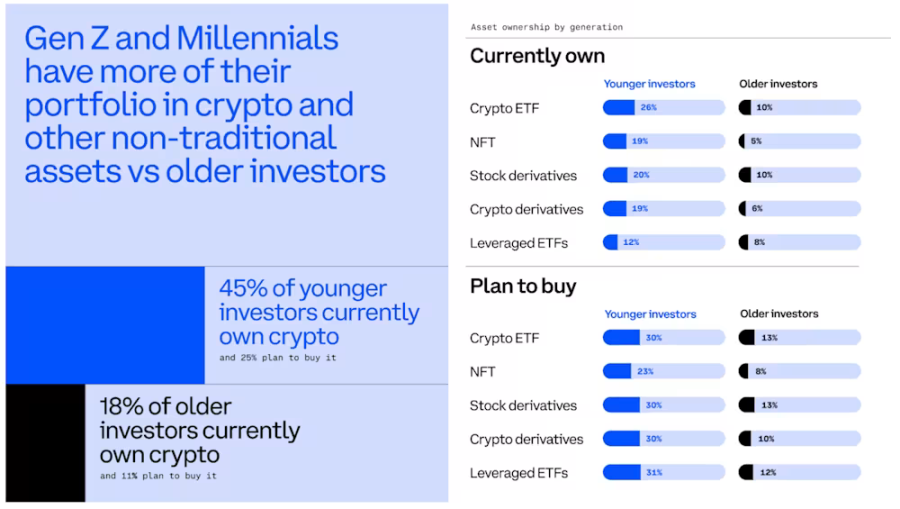
This anxiety is directly reflected in their asset allocation strategies. The survey reveals that younger investors allocate 25% of their investment portfolios to non-traditional asset classes such as cryptocurrencies, financial derivatives, non-fungible tokens (NFTs), and other emerging products. This proportion is three times higher than that of older investors, who allocate only 8% to non-traditional assets.

The proportion of stock holdings is roughly similar across generations, but the key difference lies in the diversification of younger investors' portfolios beyond stocks. They are more actively seeking opportunities for returns beyond traditional stock dividends and are more willing to experiment with new investment tools and emerging markets to narrow the wealth gap.

Cryptocurrency Is Not a Side Hustle but a Core Allocation

This generational shift in investment philosophy is most evident in the acceptance of cryptocurrency. The report shows that 45% of younger investors already hold cryptocurrencies, compared to only 18% of older investors. Additionally, nearly half (47%) of younger investors want to gain early access to new crypto assets before they become mainstream. In contrast, only 16% of older investors express this desire.

For the younger generation, cryptocurrency is not merely a speculative trade but a crucial tool to help them catch up in wealth accumulation. Eighty percent of young people believe that cryptocurrency provides their generation with more financial opportunities outside the traditional financial system. At the same time, another 80% are convinced that cryptocurrency will play a significantly larger role in the future financial system. Among older investors, only about 60% share this view.

The younger generation's enthusiasm for exploring emerging markets extends beyond spot cryptocurrencies; they are also eager to engage with more non-traditional assets. Data shows that 80% of young investors are willing to try new investment opportunities ahead of others, while less than half of older generations share this attitude. Younger investors consistently show strong interest in emerging non-traditional products such as cryptocurrency derivatives, prediction markets, 24/7 stock trading, early token offerings, altcoins, and decentralized finance (DeFi) lending.

Implications of This Trend for Future Markets

The younger generation of investors has already demonstrated distinct characteristics: they trade more frequently, are willing to take greater risks for higher returns, and are shifting a significant portion of their investment portfolios to non-traditional assets, with cryptocurrency at the core. At the same time, they are driving the entire financial industry toward a transformation that better meets the needs of the internet-native generation, creating platforms that operate around the clock and support diverse asset trading.


Twitter: https://twitter.com/BitpushNewsCN

BitPush Telegram Group: https://t.me/BitPushCommunity

BitPush Telegram Subscription: https://t.me/bitpush

Original Link: https://www.bitpush.news/articles/7596437

Preguntas relacionadas

QWhat is the main finding of the Coinbase and Ipsos research regarding younger investors?

AThe research found that younger investors, such as Gen Z and Millennials, are more likely to actively manage their investments, embrace non-traditional assets, and view cryptocurrency as a core component of their financial future.

QWhy do younger investors feel the traditional wealth-building path is not for them?

AThey believe it is harder to build wealth through traditional means due to rising housing costs, high student debt, and slow wage growth, making alternative paths like cryptocurrency more appealing.

QHow much of their portfolio do younger investors allocate to non-traditional assets compared to older investors?

AYounger investors allocate 25% of their portfolio to non-traditional assets, which is three times the 8% allocated by older investors.

QWhat percentage of younger investors hold cryptocurrency, and how does this compare to older investors?

A45% of younger investors hold cryptocurrency, compared to only 18% of older investors.

QWhat do younger investors believe about the role of cryptocurrency in the future financial system?

A80% of younger investors believe cryptocurrency provides financial opportunities outside the traditional system and that it will play a significantly larger role in the future financial system.

Lecturas Relacionadas

Unlocking $100 Million in Liquidity? Pump.fun's New Policy Tests the 5-Minute Pump Technique

Pump.fun, a popular meme coin launchpad, has introduced a new standard mechanism called BOOST. It aims to address a significant capital efficiency issue: when a newly launched token graduates from its initial bonding curve to a liquidity pool (LP), roughly 20% of its liquidity becomes permanently locked as "dead liquidity," estimated to waste over $100 million annually. Instead of locking these funds permanently, BOOST repurposes them. Upon a token's migration, approximately 20% of the settlement funds (e.g., 17.6 SOL or ~$2516 USDC) are used to buy back the token on the open market over a 5-minute period via a Time-Weighted Average Price (TWAP) mechanism. All purchased tokens are immediately burned. This creates a brief, systematic buy pressure immediately after migration, potentially generating a short-term price surge ("pump") while permanently reducing the token's circulating supply. The goal is to enhance the immediate post-launch trading experience, potentially increasing trader retention and sustainable protocol revenue, which funds ongoing token buybacks. However, concerns exist that this artificial 5-minute boost could lower the barrier for launching low-quality tokens and lead to steeper price crashes once the buy pressure stops, if followed by large sell-offs. The feature automatically applies to tokens migrating after July 21, 2024, but not to previously migrated tokens or those launched via the Mayhem AI Agent lab.

marsbitHace 4 min(s)

Unlocking $100 Million in Liquidity? Pump.fun's New Policy Tests the 5-Minute Pump Technique

marsbitHace 4 min(s)

Podcast Notes | Conversation with GSR Asset Management Head: To Determine if This Crypto Rally is Real, Just Watch the Lending Rates on Aave

Podcast Summary: Dialogue with GSR's Head of Asset Management: To Determine if This Crypto Rally is Real, Just Check Lending Rates on Aave Andy Baehr, Managing Director of Asset Management at GSR, discusses the current crypto market, characterizing it as stuck in a state of "ambivalence" with short-lived, unsustainable rallies. He outlines a simple framework: the market moves between "ambivalence" and "conviction" (sustained upward momentum). Currently, every rally resembles a single-stage rocket booster that quickly fizzles out. Baehr identifies three key signals to watch: 1) DeFi lending rates, 2) the potential passage of the CLARITY Act, and 3) the market forming a consensus on the "Fed hawkish peak." He emphasizes that the most immediate indicator for the sustainability of the recent CPI-triggered rally is the USDC borrowing rate on Aave, currently around 3.75%—close to U.S. Treasury yields. The absence of a credit spread indicates low leverage demand and a lack of market energy. He explains that a healthy, sustained rally requires layered buying pressure. Last year's rally progressed from an ETH short squeeze to crypto-native trader influx and finally to ETF inflows. Currently, this structure is missing. Other potential structural buyers like Digital Asset Treasury (DAT) companies are absent, and ETF flows have proven transient. Baehr notes that while small-cap crypto tokens outperformed large caps in Q2—a potential sign of capitation in major assets—capital is also flowing to more exciting opportunities like AI stocks and tech IPOs, leaving crypto sidelined. Regarding DeFi, he highlights that platforms like Aave provide a clear, real-time signal of leverage demand through their supply/demand-driven interest rates. A significant, sustained rate increase would signal genuine market conviction. He also observes the quiet emergence of fixed-income-like products and vaults in DeFi. On regulation, the probability of the CLARITY Act passing before the August 7th deadline has dropped linearly from 75% to below 40% on Polymarket. Baehr suggests its passage would be treated as a bullish surprise, a potent driver for price movement. However, political hurdles, including ethical clause debates and disclosures about the First Family's crypto profits, remain significant obstacles. Ultimately, the market awaits clarity on the Fed's terminal rate under Chair Warsh. Until the "Fed Solstice"—the point where the market collectively understands the peak of hawkish policy—sustained conviction will be difficult to achieve.

marsbitHace 35 min(s)

Podcast Notes | Conversation with GSR Asset Management Head: To Determine if This Crypto Rally is Real, Just Watch the Lending Rates on Aave

marsbitHace 35 min(s)

Trading

Spot
活动图片





