Bitcoin is About to Choose a Direction, How to Respond Flexibly | Invited Analysis

marsbitPublicado a 2025-12-29Actualizado a 2025-12-29

Resumen

Bitcoin is approaching a critical directional decision after an extended period of consolidation. Since reaching its all-time high of $126,200 in October, BTC has been in a confirmed medium-term downtrend, with a maximum drawdown of approximately 36% over 82 days. Technical indicators suggest the market is in an oversold area, and a directional breakout is imminent. Last week’s price action validated the analyst’s core view of wide-range oscillation between key levels. Two short-term trades were executed within the defined resistance zone of $89,500–$91,000, yielding a total return of 3.62%. The current analysis suggests that, in the absence of sudden news, a likely scenario involves a final downward move breaking the $80,000 psychological support to flush out remaining long positions before a potential reversal and technical rebound. This week (Dec 29–Jan 4), the market is expected to test the $86,000–$86,500 support region. A break below could lead to a decline toward $83,500–$84,500, while holding may extend the current consolidation. Two short-term trading plans are proposed based on whether this support holds or breaks, using 30% position sizing with strict stop-loss and trailing stop protocols. Key macro events this week include the release of the FOMC meeting minutes and US jobless claims data, which may influence medium-term interest rate expectations and market liquidity sentiment.

Odaily Invited Market Analyst Conaldo, Master of Financial Statistics from Columbia University, USA, focused on quantitative trading of US stocks during university and gradually expanded to digital assets such as Bitcoin, building a systematic quantitative trading model and risk control system through practical experience; possesses keen data insight into market fluctuations and is committed to continuous development in the professional trading field, pursuing stable returns; will delve into BTC technical, macro, and capital changes weekly, review and showcase practical strategies, and preview major upcoming events for reference.
Core Summary of Trading Weekly Report:

  • Strategy Execution (Short-term) Effectiveness Verification: Last week's trading strictly followed the established strategy, successfully completed two operations, achieving a cumulative return of 3.62%.
  • Core View (Short-term) Verification: Our core view proposed last week that "the market will show wide-range fluctuations" has been perfectly verified by the market movement. The defined core observation range of $89,500~$91,000 and the support area below of $86,500~$87,500 were repeatedly tested by the market. Particularly key is that last week's high of $90,598 was only $402 away from the upper edge of our core area ($91,000); the low during the week ($86,400) was only $100 away from the lower edge of the support area ($86,500), fully confirming the accuracy of our point prediction.
  • From a macro-technical perspective, Bitcoin has been in adjustment for 82 days since hitting its all-time high of $126,200 on October 6, with a maximum decline of about 36%, confirming a medium-term bearish trend. However, observing multiple technical indicators, it has now entered a low area, and the time and space of the adjustment are gradually approaching historical common oversold conditions. Since November 22, the price has continued to consolidate in a low range, showing a relative balance between bullish and bearish forces, with momentum for a directional breakthrough gathering. Although there are increasing calls for a rise in the market, we believe that, excluding interference from sudden news, there is still one key possibility for the subsequent trend: if the market is dominated by main funds, a better strategy for the bears might be to break down first, piercing the key psychological barrier of $80,000, using panic to clear the remaining long positions, thus completing the final bottoming. After that, funds can顺势 achieve a "short to long" shift, quickly pulling the price away from the cost area, and then start a relatively strong technical correction. It must be emphasized that the above trend is only a deduction based on market behavior logic, not an inevitable path. No matter how the market evolves, remember: "The market is always right." Before the choice of direction, maintaining observation and flexible response remains key at this stage.

1. Review of Last Week's Trading Results: (12.22~12.28)

1. Short-term Trading Review (No Leverage):

First Trade (Profit 2.27%): Based on the "rebound to core pressure area encounters resistance and goes short" pattern. When the price冲击 the $89,500~$91,000 area and encountered resistance,叠加 the spread trading model simultaneously发出 a top signal, a 30% short position was established, and finally closed for profit when the price fell near the support area.

Second Trade (Profit 1.35%): The logic of this trade is the same as above. When the price冲击 the $89,500~$91,000 area and encountered resistance,叠加 two models发出 resonance signals, successfully completing this trade.

2. Last Week's Trend Prediction and Operation Strategy Review:

Last week's前瞻 analysis clearly stated: It is expected that the market will mainly present a wide-range fluctuation pattern. The core observation range is $89,500~$91,000, and the outcome of the struggle in this area will determine the short-term direction. The following is the strategy review and analysis.

1. Market Trend Prediction Review:

• Core Pressure Level: First pressure looks at the $89,500~$91,000 area; second pressure looks at the $93,000~$94,500 area.

• Core Support Level: First support looks at the $86,500~$87,500 area; second support looks at the $83,500~$84,500 area.

2. Operation Strategy Review:

• Midline Strategy: Maintain about 65% midline position (short).

• Short-term Strategy: Last week we initially drafted A/B two sets of short-term operation plans. Combined with the actual market movement, we finally used Plan B as the core strategy and executed it.

(Plan B: Rebound verification, the $89,500~$91,000 core area has been effectively broken)

• Open Position: When encountering resistance signals during the rebound verification process, a 30% short position can be established.

• Risk Control: Stop loss set above $92,000.

• Close Position: When the price探 to the $83,500~$84,500 area shows resistance, consider partially or fully closing the position to take profit.

2. Technical Analysis: Bitcoin Medium-term Trend Judgment

Combining last week's market operation, the author will use multi-dimensional analysis models to conduct an in-depth analysis of the evolution of Bitcoin's internal structure and trend.

Bitcoin Weekly K-line Chart: (Momentum Quantitative Model + Sentiment Quantitative Model)
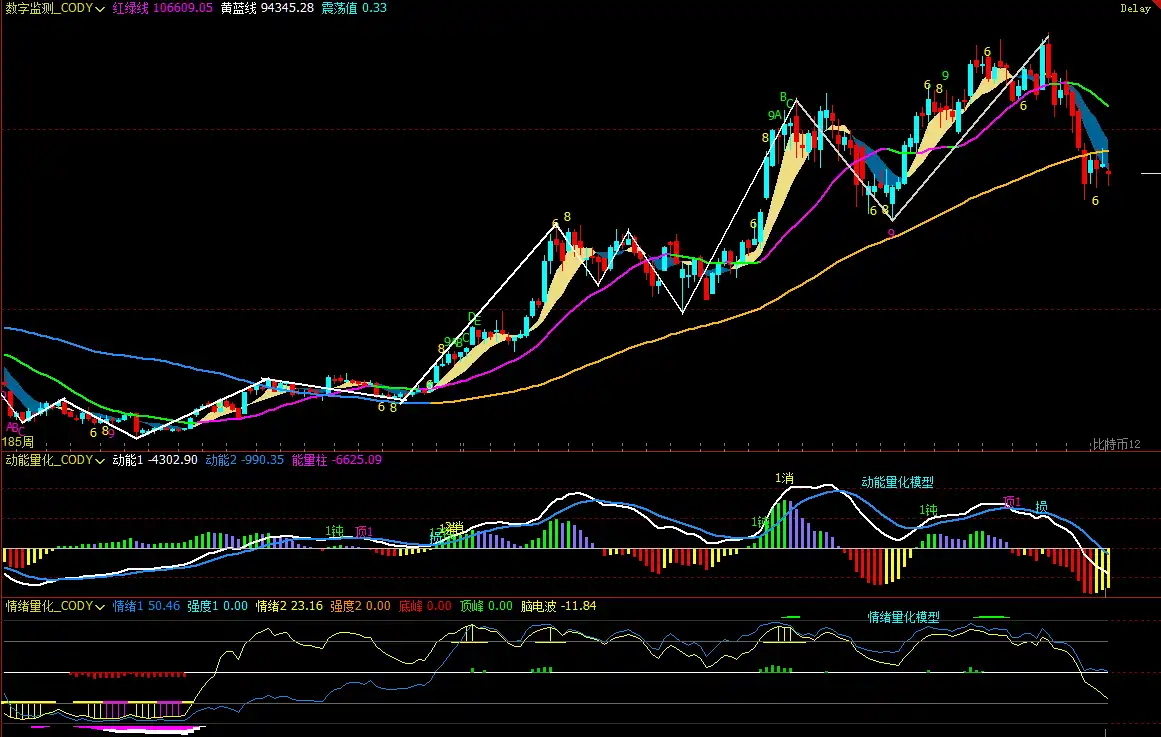
Figure 2

1. As shown in (Figure 2), analysis from the weekly chart:

Momentum Quantitative Model: After last week's adjustment, the two momentum indicator lines are still running below the zero axis, and the negative energy柱 is gradually shortening. This indicates that although the weekly line has entered a bear market, the bearish momentum has not been fully released.

Momentum Quantitative Model Predicts: Price decline index: High

Sentiment Quantitative Model: Blue sentiment line value 49.74, strength zero; yellow sentiment line value 19.99 (close to the low threshold), strength zero, peak value is 0.

Sentiment Quantitative Model Predicts: Price pressure and support index: Neutral

Digital Monitoring Model: The price has broken below the bull-bear (yellow-blue line)分界线 for 6 weeks; short-term bottom digital signal (above 9) has not yet appeared.

The above data预示: Bitcoin's weekly chart has established a bearish trend, be wary of subsequent release of bearish力量.

Bitcoin Daily K-line Chart:
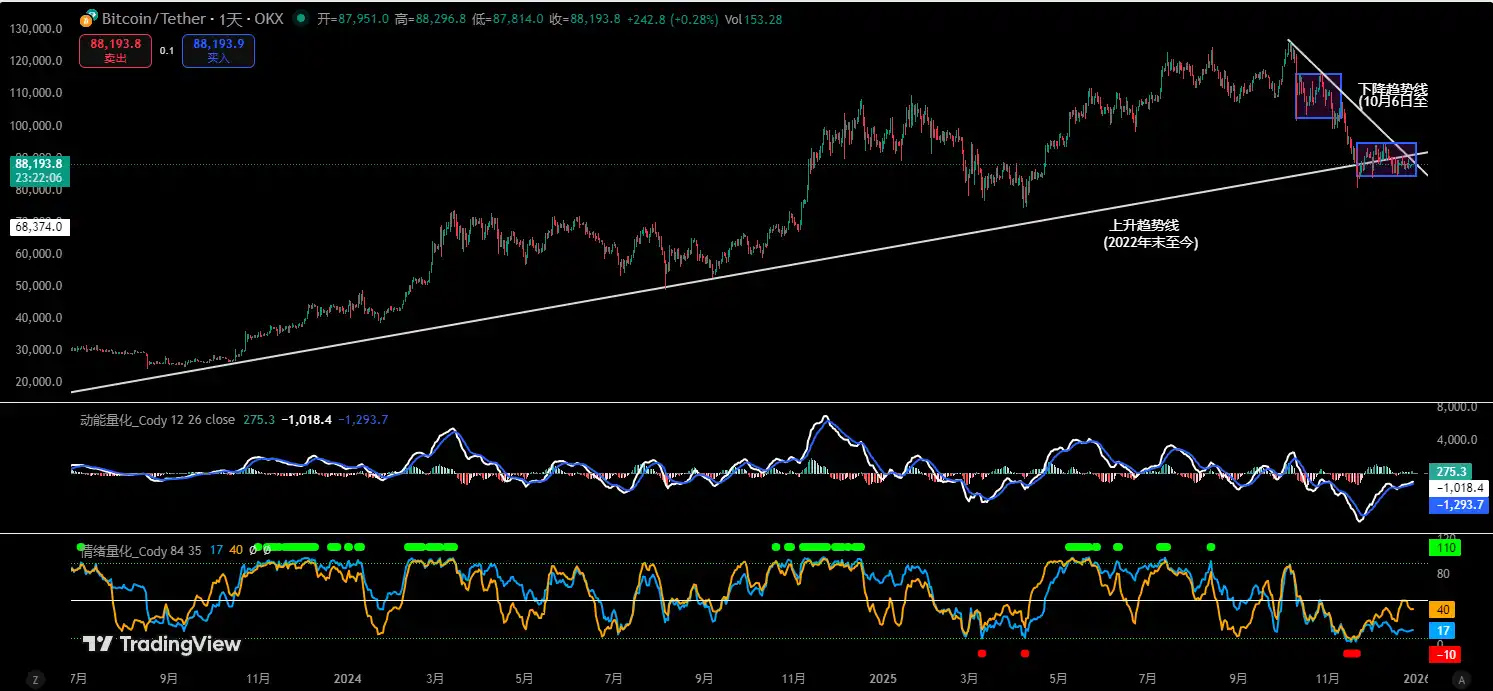
Figure 3

2. As shown in (Figure 3), analysis from the daily chart:

Momentum Quantitative Model: In last week's movement, the two momentum lines were almost粘合 together, slowly rising below the zero axis and gradually approaching the zero axis. Affected by the holiday, daily trading volume continued to萎缩, and the positive energy柱 change was not obvious.

Momentum Quantitative Model Predicts: Buying momentum is weak, the energy柱 has contracted to a "starlight" shape, indicating a temporary balance between bullish and bearish forces.

Sentiment Quantitative Model: After last week's daily close, the blue sentiment line value is 16 (close to the low threshold), strength zero; yellow sentiment line value is 40, strength zero.

Sentiment Quantitative Model Predicts: Pressure and support index: Neutral

The above data提示: The daily level is in a bear market, and the short-term market is about to choose a direction.

3. This Week's Bitcoin Market Prediction: (12.29~01.04)

1. It is highly likely that the market will mainly fluctuate and探底 this week, with the core observation range at $86,000~$86,500.

If effectively broken below: The price may continue to探, testing the support area below of $83,500~$84,500.

If effectively站稳: The market may延续 the current $86,500~$91,000 range fluctuation pattern.

2. Core Pressure Levels:

• First Pressure Area: $89,500~$91,000 area

• Second Pressure Area: $93,000~$94,500 area

• Important Pressure Area: Near $97,000

3. Core Support Levels:

• First Support Level: $86,000~$86,500 area

• Second Support Level: $83,500~$84,500 area

• Important Support Level: Near $80,000.

4. This Week's Bitcoin Operation Strategy (Excluding Sudden News Impact): (12.29~01.04)

1. Midline Strategy: Maintain about 65% midline position (short).

2. Short-term Strategy: Use 30% of the position, set stop loss points, and look for "spread" opportunities based on support and pressure levels. (Using 30 minutes as the operation cycle).

3. Focus on observing the struggle between bulls and bears over the $86,000~$86,500 area. To cope with market evolution, we have drafted A/B two sets of short-term operation plans:

Plan A: If effectively站稳 the $86,000~$86,500 area:

• Open Position: When the price rebounds to the $89,500~$91,000 area and shows resistance signals, a 30% short position can be established.

• Risk Control: Short stop loss set above $92,500.

• Close Position: When the price falls to the $86,000~$86,500 area and shows stabilization signals, close all short positions to take profit.

Plan B: If effectively跌破 the $86,000~$86,500 area:

• Open Position: If the price effectively breaks below, a 30% short position can be established.

• Risk Control: Stop loss set above $88,000.

• Close Position: When the price探 to the $83,500~$84,500 area shows stabilization signals, gradually close the position to take profit.

5. Special Tips:​​

1. When opening a position: Immediately set the initial stop loss level.

2. When profit reaches 1%: Move the stop loss to the opening cost price (break-even point) to ensure principal safety.

3. When profit reaches 2%​​: Move the stop loss to the position of 1% profit.

4. Continuous tracking: Thereafter, for every additional 1% profit, move the stop loss同步 by 1%, dynamically protecting and locking in existing profits.

(Note: The above 1% profit trigger threshold can be flexibly adjusted by investors according to their own risk preference and标的 volatility.)

6. This Week's Key Events前瞻: (12.29~01.04)

1. Fed Meeting Minutes Release "Real Divergence" Signal

Wednesday 03:00, the Fed will release the latest monetary policy meeting minutes. Compared to the interest rate decision itself, the minutes are more critical regarding the degree of divergence among internal members on the "timing, magnitude, and sustainability of rate cuts."

If the minutes show increased confidence among officials in the decline of inflation and discuss an earlier or faster easing path, it will strengthen the market's expectation of "declining real interest rates," constituting a medium-term positive for Bitcoin; conversely, if the minutes emphasize concerns about inflation recurring or financial conditions easing too quickly, it may阶段性 lift the US dollar and US bond yields, forming emotional suppression on BTC.

For Bitcoin, this is not a short-term directional signal but an important node affecting the mid-term capital pricing anchor.

2. Initial Jobless Claims: Thermometer of Liquidity Expectations

Wednesday 21:30, the US will announce the initial jobless claims for the week ending December 27.

The current market is more concerned with "whether the labor market is showing structural cooling" rather than fluctuations in a single data point.

If initial claims持续 above trend levels, it will further verify the economic cooling logic, strengthening the market's expectation of continued宽松 policy, which is beneficial for the valuation repair of non-yielding assets like Bitcoin; if the data falls again, it may strengthen the judgment that "the economy is still resilient," which is not conducive to the expansion of risk appetite for BTC in the short term.

The impact of this indicator on Bitcoin is mainly reflected in interest rate expectations rather than fundamentals itself.

3. Final Manufacturing PMI Verifies Real Economy Direction

Friday 22:45, the US December S&P Global Manufacturing PMI final value will be announced.

As a leading indicator, the PMI will help the market judge whether "soft landing" is still on track.

If the final value confirms that manufacturing is stabilizing or even improving, the overall sentiment of risk assets is expected to be maintained, with limited systemic pressure on BTC; if the PMI is revised down again, it may trigger repricing of economic downturn, short-term bearish for risk assets, but medium to long term may反而 strengthen expectations for monetary easing.

Financial markets are changing rapidly, all market analysis and trading strategies need to be dynamically adjusted. All views, analysis models, and operation strategies involved in this article are derived from personal technical analysis, for personal trading log use only, and do not constitute any investment advice or operation basis. The market has risks, investment needs caution, DYOR.


Preguntas relacionadas

QWhat is the analyst's short-term core view on the Bitcoin market as presented in the article, and how was it validated?

AThe analyst's short-term core view was that the market would present a wide-range interval oscillation. This was perfectly validated by the market movement, as the price repeatedly tested the defined core observation interval of $89,500~$91,000 and the support zone of $86,500~$87,500. The high of $90,598 was only $402 away from the upper bound, and the low of $86,400 was only $100 away from the support zone's lower bound.

QAccording to the technical analysis, what is the current state of Bitcoin's medium-term trend on the weekly chart?

AThe weekly chart analysis confirms an established bearish trend. The momentum量化 model shows both动能指标线 operating below the zero axis with negative energy柱 gradually shortening, indicating bearish momentum has not been fully released. The情绪量化 model shows neutral pressure and support indices. The digital monitoring model shows the price has been below the bull-bear line for 6 weeks, and a short-term bottom signal has not yet appeared.

QWhat are the two potential short-term operation plans (A and B) outlined for the week of December 29th to January 4th?

APlan A: If the price effectively holds above the $86,000~$86,500 area, open a 30% short position when the price rebounds to the $89,500~$91,000 area and shows a resistance signal. Stop loss is set above $92,500. Close the position for profit when the price falls to the $86,000~$86,500 area and shows a stabilization signal. Plan B: If the price effectively breaks below the $86,000~$86,500 area, open a 30% short position. Stop loss is set above $88,000. Close the position for profit when the price falls to the $83,500~$84,500 area and shows a stabilization signal.

QWhat key macroeconomic events are highlighted for the week, and how might they impact Bitcoin?

AThree key events are highlighted: 1) The release of the FOMC Meeting Minutes on Wednesday at 03:00, which could impact Bitcoin by influencing mid-term capital pricing anchors based on signals about internal Fed分歧 on rate cuts. 2) The Weekly Initial Jobless Claims data on Wednesday at 21:30, which acts as a thermometer for liquidity expectations and impacts Bitcoin through interest rate expectations. 3) The Final S&P Global Manufacturing PMI on Friday at 22:45, which validates the direction of the real economy and can affect overall risk asset sentiment for Bitcoin.

QWhat is the analyst's speculative scenario for a potential market move led by major funds, as mentioned in the core观点 section?

AThe analyst speculates that if the market is dominated by major funds, a potentially optimal strategy for the bears would be to break down first, piercing the key psychological barrier of $80,000. This would use panic sentiment to flush out remaining long positions, completing a final bottoming process. Afterwards, funds could then switch from short to long, rapidly pulling the price up away from the cost area to initiate a more forceful technical repair行情.

Lecturas Relacionadas

In-Depth Report on the On-Chain Lending Market: When Off-Chain Credit Meets On-Chain Liquidation

The on-chain lending market has evolved from a peripheral DeFi niche into core financial infrastructure. As of early 2026, total value locked (TVL) in on-chain lending protocols has reached $64.3 billion, accounting for 53.54% of total DeFi TVL, making it the largest and most mature vertical within decentralized finance. Aave dominates the sector with approximately $32.9 billion in TVL, commanding nearly half of the market—a leadership position that is unlikely to be challenged in the foreseeable future. However, the path of on-chain lending forward is not without risk. Liquidation cascades, credit defaults, and cross-chain vulnerabilities remain systemic threats hanging over the industry. At the same time, a deeper structural transformation is underway: on-chain lending is shifting from a “leverage tool for crypto-native users” to a “compliant gateway for institutional capital”. The scale of RWA (Real World Asset) lending has surpassed $18.5 billion, with U.S. Treasuries and government securities increasingly serving as core collateral. Institutional capital inflows are reshaping both the user base and risk appetite of the sector. This report systematically analyzes the evolution of on-chain lending definitions, competitive dynamics, core risks, and future trends, providing a comprehensive industry outlook for investors and trade practitioners. Key findings suggest that the “one dominant player with several strong challengers” structure will persist in the short term, while fixed-rate lending, compliant collateral, and institutional credit underwriting will define the next phase of competition. For investors focused on DeFi infrastructure, three key opportunity tracks stand out, namely, the Aave ecosystem (Morpho, Spark), RWA lending protocols (Ondo, Maple) and fixed-rate innovation (Notional, Pendle).

HTX LearnHace 1 hora(s)

In-Depth Report on the On-Chain Lending Market: When Off-Chain Credit Meets On-Chain Liquidation

HTX LearnHace 1 hora(s)

Fu Peng's First Public Speech in 2026: What Exactly Are Crypto Assets? Why Did I Join the Crypto Asset Industry?

Fu Peng, a renowned macroeconomist and now Chief Economist at New火 Group, delivered his first public speech of 2026 at the Hong Kong Web3 Festival. He explained his perspective on crypto assets and why he joined the industry, framing it within the context of macroeconomic trends and financial evolution. Fu emphasized that crypto assets are transitioning from an early, belief-driven phase to a mature, institutionally integrated asset class. He drew parallels to the 1970s-80s, when technological advances (like computing) revolutionized traditional finance, leading to the rise of FICC (Fixed Income, Currencies, and Commodities). Similarly, current advancements in AI, data, and blockchain are reshaping finance, with crypto assets becoming part of a new "FICC + C" (C for Crypto) framework. He noted that institutional capital, including traditional hedge funds, avoided early crypto due to its speculative nature but are now engaging as regulatory clarity emerges (e.g., stablecoin laws, CFTC classifying crypto as a commodity). Fu predicted that 2025-2026 marks a turning point where crypto becomes a standardized, financially viable asset for diversified portfolios, akin to commodities or derivatives in traditional finance. Fu defined Bitcoin not as "digital gold" in a simplistic sense but as a value-preserving, financially tradable asset. He highlighted that crypto's future lies in regulated, institutional adoption, moving away from retail-dominated trading. His entry into crypto signals this maturation, where traditional finance integrates crypto into mainstream asset management.

marsbitHace 2 hora(s)

Fu Peng's First Public Speech in 2026: What Exactly Are Crypto Assets? Why Did I Join the Crypto Asset Industry?

marsbitHace 2 hora(s)

Trading

Spot
Futuros

Artículos destacados

Cómo comprar CFG

¡Bienvenido a HTX.com! Hemos hecho que comprar Centrifuge (CFG) sea simple y conveniente. Sigue nuestra guía paso a paso para iniciar tu viaje de criptos.Paso 1: crea tu cuenta HTXUtiliza tu correo electrónico o número de teléfono para registrarte y obtener una cuenta gratuita en HTX. Experimenta un proceso de registro sin complicaciones y desbloquea todas las funciones.Obtener mi cuentaPaso 2: ve a Comprar cripto y elige tu método de pagoTarjeta de crédito/débito: usa tu Visa o Mastercard para comprar Centrifuge (CFG) al instante.Saldo: utiliza fondos del saldo de tu cuenta HTX para tradear sin problemas.Terceros: hemos agregado métodos de pago populares como Google Pay y Apple Pay para mejorar la comodidad.P2P: tradear directamente con otros usuarios en HTX.Over-the-Counter (OTC): ofrecemos servicios personalizados y tipos de cambio competitivos para los traders.Paso 3: guarda tu Centrifuge (CFG)Después de comprar tu Centrifuge (CFG), guárdalo en tu cuenta HTX. Alternativamente, puedes enviarlo a otro lugar mediante transferencia blockchain o utilizarlo para tradear otras criptomonedas.Paso 4: tradear Centrifuge (CFG)Tradear fácilmente con Centrifuge (CFG) en HTX's mercado spot. Simplemente accede a tu cuenta, selecciona tu par de trading, ejecuta tus trades y monitorea en tiempo real. Ofrecemos una experiencia fácil de usar tanto para principiantes como para traders experimentados.

257 Vistas totalesPublicado en 2026.03.19Actualizado en 2026.03.19

Cómo comprar CFG

Qué es WL

I. Introducción al ProyectoWorldLand es una L2 o cadena lateral de Ethereum, diseñada como una solución de abajo hacia arriba para mejorar el ecosistema de Ethereum.II. Información del Token1) Información BásicaNombre del token: WL (WorldLand)III. Enlaces RelacionadosSitio web:https://worldland.foundation/Exploradores:https://bscscan.com/address/0x8aaB31fbc69C92fa53f600910Cf0f215531F8239Redes Sociales:https://x.com/WorldLand_space Nota: La introducción del proyecto proviene de los materiales publicados o proporcionados por el equipo oficial del proyecto, que es solo para referencia y no constituye asesoramiento de inversión. HTX no se hace responsable de ninguna pérdida directa o indirecta resultante.

134 Vistas totalesPublicado en 2026.03.28Actualizado en 2026.03.28

Qué es WL

Cómo comprar WL

¡Bienvenido a HTX.com! Hemos hecho que comprar WorldLand (WL) sea simple y conveniente. Sigue nuestra guía paso a paso para iniciar tu viaje de criptos.Paso 1: crea tu cuenta HTXUtiliza tu correo electrónico o número de teléfono para registrarte y obtener una cuenta gratuita en HTX. Experimenta un proceso de registro sin complicaciones y desbloquea todas las funciones.Obtener mi cuentaPaso 2: ve a Comprar cripto y elige tu método de pagoTarjeta de crédito/débito: usa tu Visa o Mastercard para comprar WorldLand (WL) al instante.Saldo: utiliza fondos del saldo de tu cuenta HTX para tradear sin problemas.Terceros: hemos agregado métodos de pago populares como Google Pay y Apple Pay para mejorar la comodidad.P2P: tradear directamente con otros usuarios en HTX.Over-the-Counter (OTC): ofrecemos servicios personalizados y tipos de cambio competitivos para los traders.Paso 3: guarda tu WorldLand (WL)Después de comprar tu WorldLand (WL), guárdalo en tu cuenta HTX. Alternativamente, puedes enviarlo a otro lugar mediante transferencia blockchain o utilizarlo para tradear otras criptomonedas.Paso 4: tradear WorldLand (WL)Tradear fácilmente con WorldLand (WL) en HTX's mercado spot. Simplemente accede a tu cuenta, selecciona tu par de trading, ejecuta tus trades y monitorea en tiempo real. Ofrecemos una experiencia fácil de usar tanto para principiantes como para traders experimentados.

223 Vistas totalesPublicado en 2026.03.28Actualizado en 2026.03.28

Cómo comprar WL

Discusiones

Bienvenido a la comunidad de HTX. Aquí puedes mantenerte informado sobre los últimos desarrollos de la plataforma y acceder a análisis profesionales del mercado. A continuación se presentan las opiniones de los usuarios sobre el precio de A (A).

活动图片