Unicorn Report: Within an Hour's Drive of the Bay Area, 90% of the World's AI Market Value is Concentrated

marsbitPublicado a 2026-04-23Actualizado a 2026-04-23

Resumen

The 2025 Unicorn Report by Elad Gil reveals a dramatic concentration of AI unicorn value in the San Francisco Bay Area, which now holds 91% of the global generative AI unicorn market capitalization within a one-hour drive radius. The U.S. dominates globally with 65% of all unicorn value, a significant increase from previous years. While the rate of new unicorn creation has slowed post-2022, the average valuation of existing unicorns has reached a six-year high, driven overwhelmingly by AI companies. Generative AI unicorns saw an average valuation increase of $2.2 billion, far outpacing non-AI unicorns. The data indicates a powerful clustering effect, with the Bay Area solidifying its position as the world's premier AI hub, while other U.S. cities like New York and Los Angeles specialize in fintech/crypto and aerospace/defense, respectively.

Author: Elad Gil (Data Analysis: Shreyan Jain)

Compiled by: Deep Tide TechFlow

Deep Tide Guide: Elad Gil's team has been tracking the distribution of global unicorn market value for six consecutive years. The 2025 data points to a clear conclusion: the San Francisco Bay Area is becoming a supercluster for generative AI, with 91% of the world's AI unicorn market value concentrated within a one-hour drive. Meanwhile, the birth rate of new unicorns is slowing, but the average valuation of existing unicorns has hit a six-year high. This report uses hard data to reveal that the global startup ecosystem's center of power is accelerating its tilt towards the United States and the Bay Area.

All data is as of December 31 of the respective year. "2025" below refers to the market value as of December 31, 2025 / January 1, 2026.

Over the past two years, we have experienced a market correction in the post-zero interest rate era, the explosive rise of frontier AI labs like OpenAI and Anthropic, and ongoing debates about the "AI bubble." The data shows that the San Francisco Bay Area has evolved into an AI supercluster, with 91% of the world's private AI market value concentrated within a one-hour drive radius.

Previous analyses can be referenced: 2019, 2020, 2021, 2023.

Key Findings

  1. Generative AI has turned the Bay Area into a supercluster. The Bay Area now accounts for about 39% of global unicorn market value, more than 4 times that of the second-ranked city. A year ago, this figure was only 29%. Looking solely at generative AI unicorns, the Bay Area's share is as high as 91%.
  2. Absolute dominance of US unicorns. The US added nearly $1.2 trillion in unicorn market value over the past year, accounting for about 65% of the global total. Europe has surpassed China in market value share but still only holds around 10%.
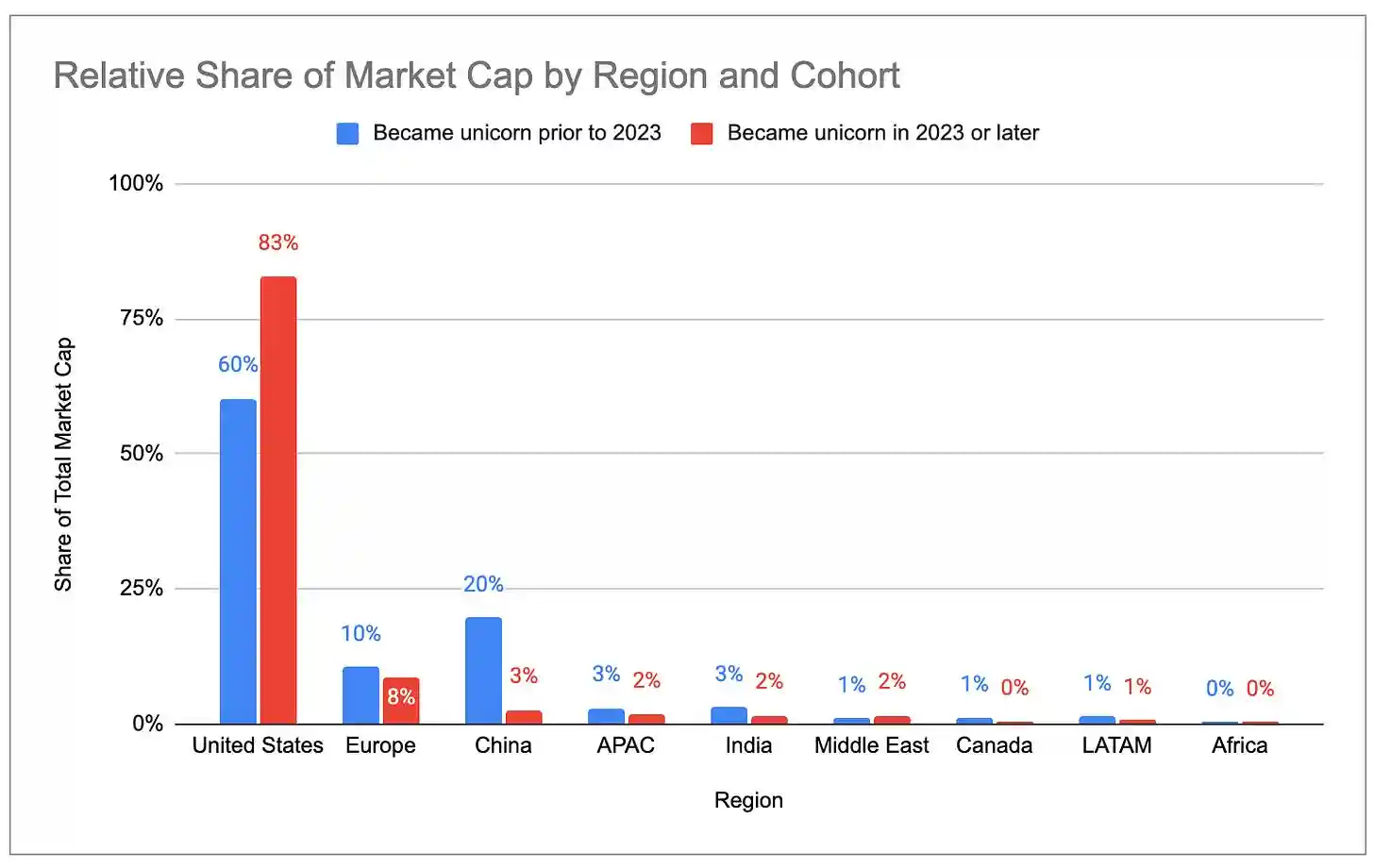
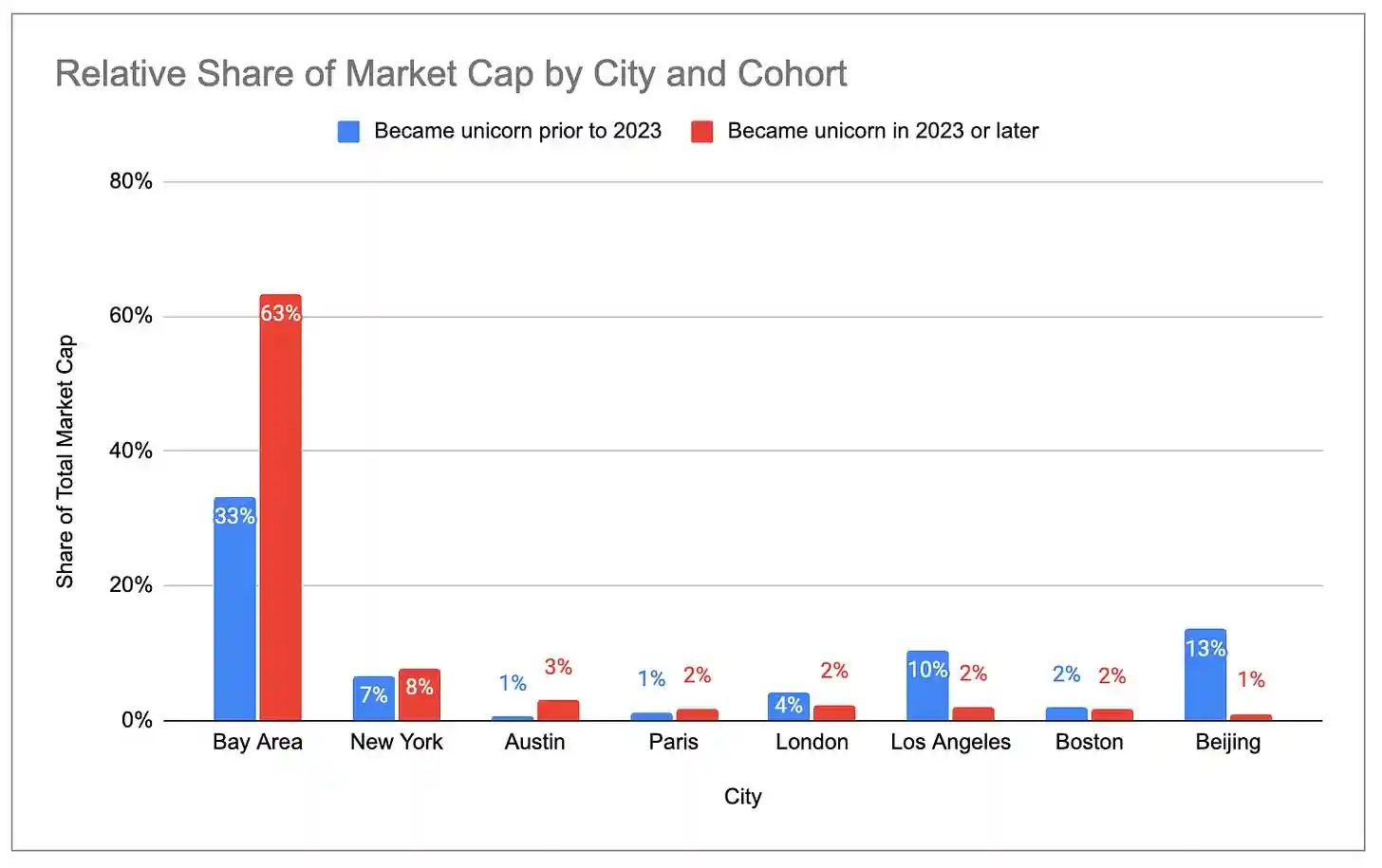
  3. Newer unicorns are more concentrated in the US and the Bay Area. Among unicorns born in 2023 and later, the US accounts for 83% of the total market value, compared to only 60% for those born in 2022 and earlier. The Bay Area's share is even more dramatic: 63% for the new generation vs. 33% for the old generation.
  4. The birth rate of new unicorns is slowing down. Only about 300 new unicorns were added between 2022 and 2025, compared to over 900 in the previous three years.
  5. But existing unicorns are more valuable than ever. The total number of unicorns increased by only 6% year-on-year, but the total market value grew by 33%. The average market value per unicorn reached its highest level in six years.
  6. Valuation growth is primarily driven by AI companies. In 2025, the valuation of generative AI unicorns grew by an average of about $2.2 billion year-on-year, compared to only about $400 million for non-AI unicorns. The share of generative AI in the global unicorn market value surged from 2% in 2024 to 22%. The concentration in the Bay Area will only continue to increase.
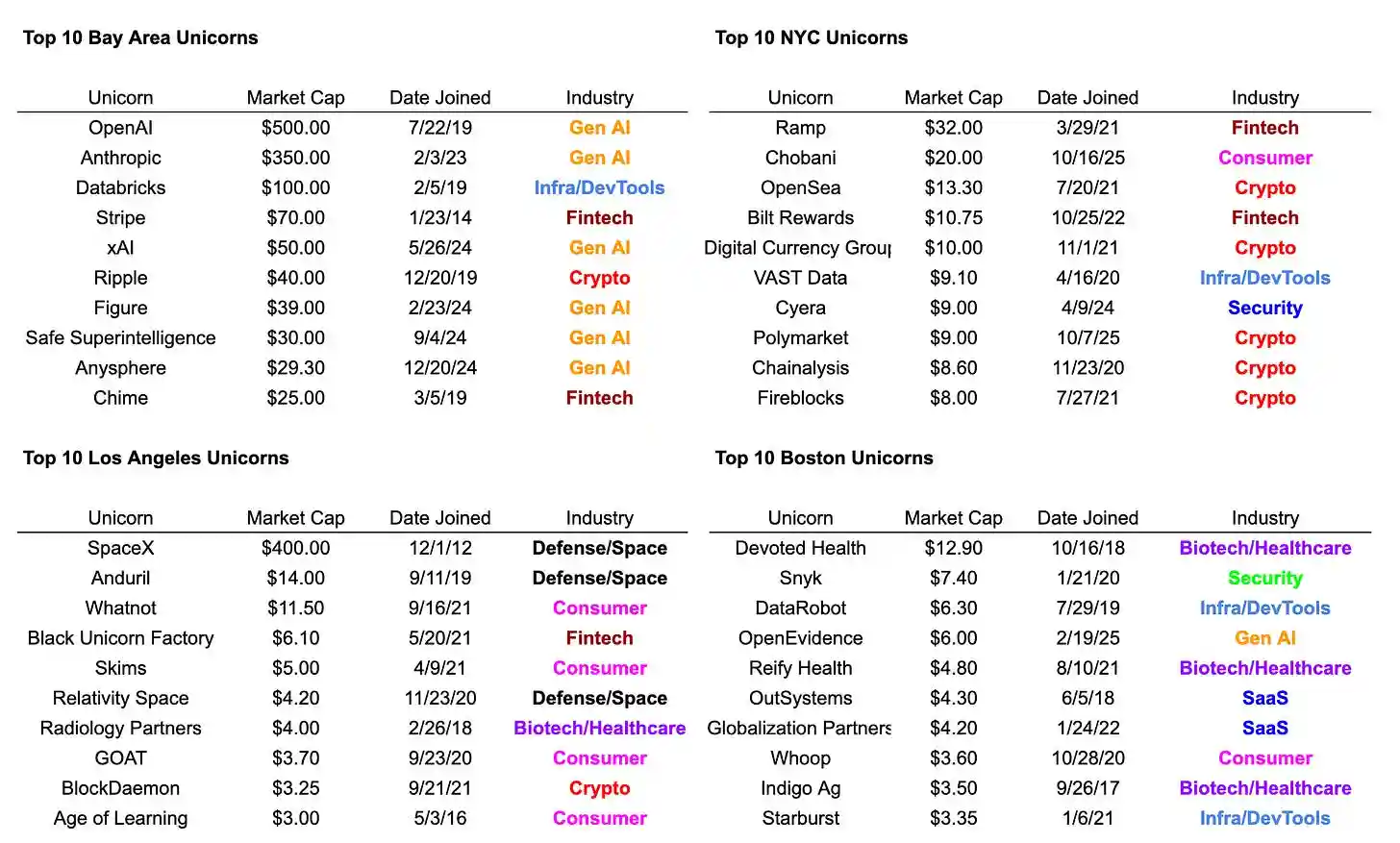
  7. Unicorn hubs cluster around specific industries. 6 of the Bay Area's top 10 unicorns are AI companies; 7 of New York's top 10 are fintech/crypto companies; 3 of Los Angeles' top 5 are defense/space companies (SpaceX, Anduril, Relativity, accounting for 83% of LA's total market value), and its top 10 includes 4 consumer companies.

Data Notes

All raw data comes from CB Insights, viewable here. A few points to note:

There is a lag in updating private financing rounds in public datasets; some unicorn valuations may not be the latest. For example, the latest funding rounds for Anduril, Stripe, and SpaceX are not reflected in the data.

Unicorn market value is, at best, a rough, lagging proxy indicator of startup ecosystem activity, and there are inevitable errors in mapping companies to valuations, cities, and industries. But we believe the data is accurate in its broad direction.

Unicorn Concentration

The geographical concentration of global unicorn market value is at an all-time high. The US accounts for 65% of all unicorn market value, up from 58% a year ago and 44% in 2020. The US share is about 4 times that of China, the second-ranked country.
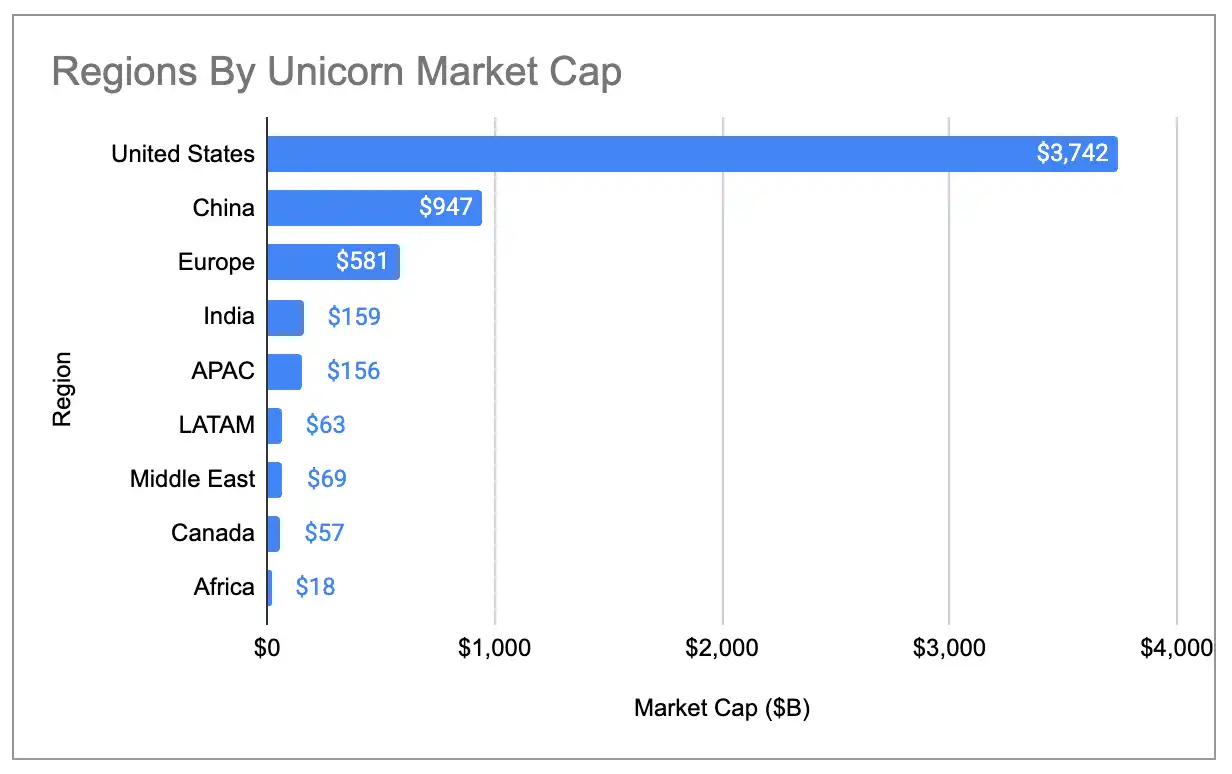
Caption: Global share of unicorn market value by country (including three outliers)

The Bay Area's unicorn market value is more than 4 times that of the second-ranked city, with its global share growing from 29% in 2024 to 39%:
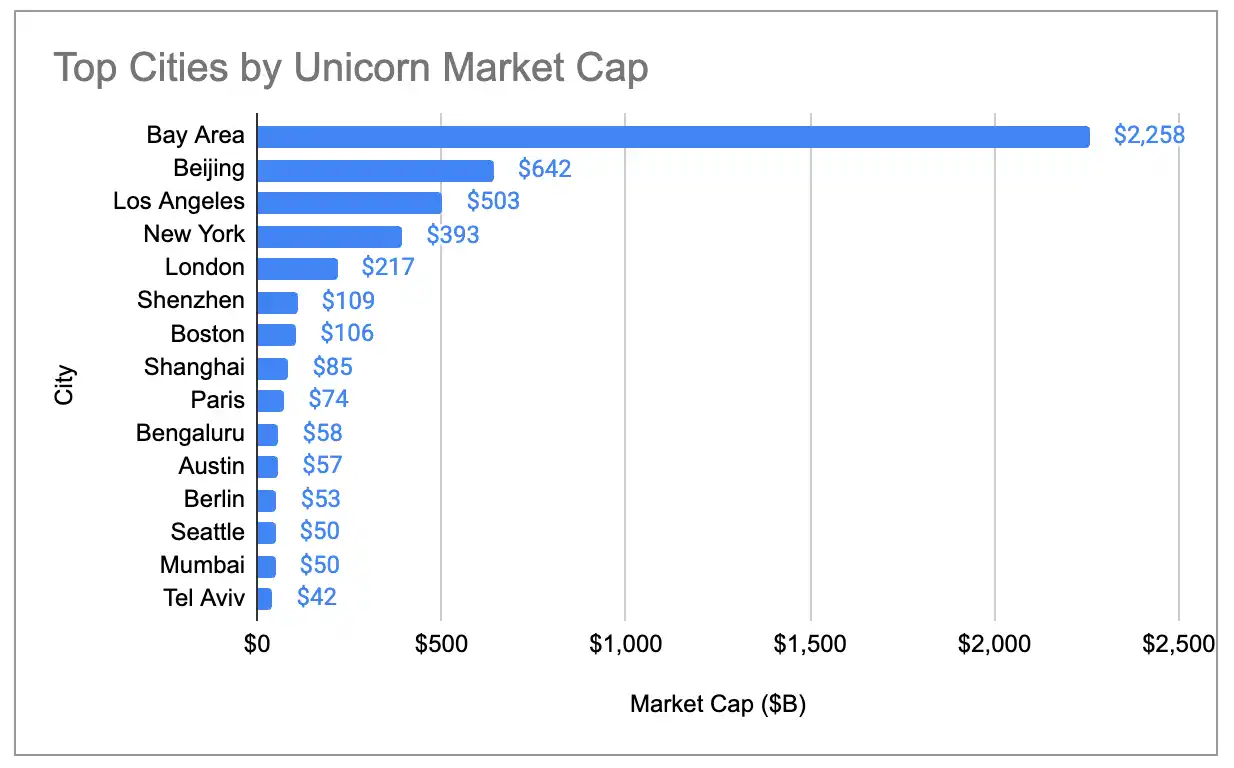
Caption: Global share of unicorn market value by city (including three outliers)

Even after removing the three largest outliers—OpenAI ($500B), SpaceX ($400B), and ByteDance ($300B)—the major ecosystems have continued to concentrate since 2019. The US share has steadily risen, while China's has steadily declined. Europe's total unicorn market value surpassed China's in 2024, and New York and London have also overtaken Beijing.
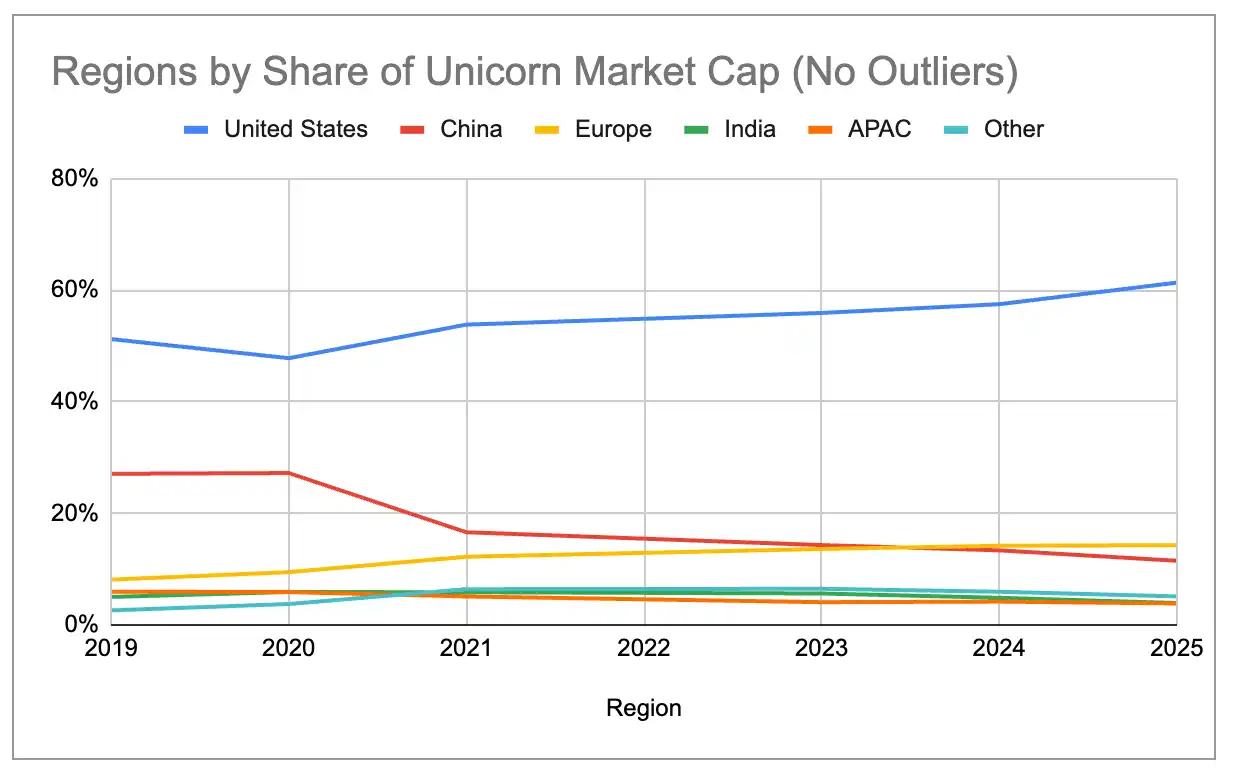
Caption: Global share of unicorn market value by country (excluding three outliers)
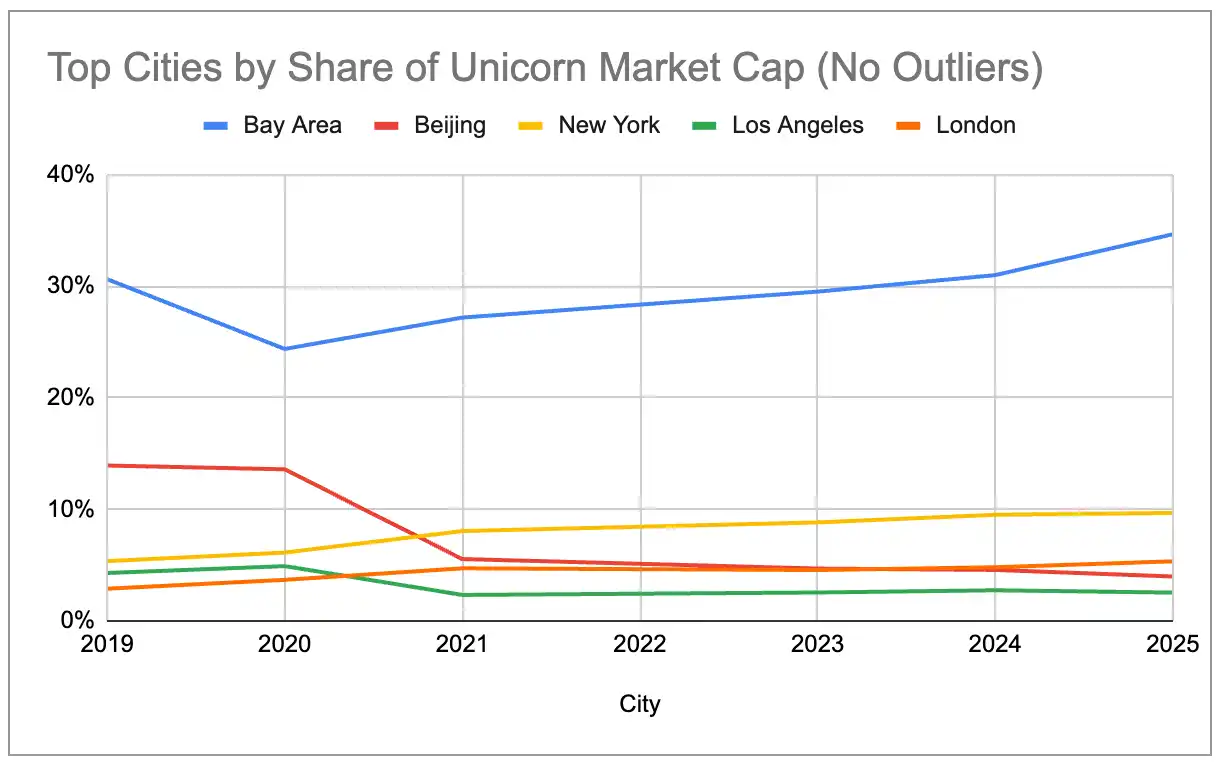
Caption: Global share of unicorn market value by city (excluding three outliers)

Super Concentration of Generative AI

Looking solely at the 97 unicorns whose core revenue comes from generative AI products/services, the cluster effect in the Bay Area is even more extreme. The Bay Area holds 91% of the global AI unicorn market value, with no other city exceeding 2%.
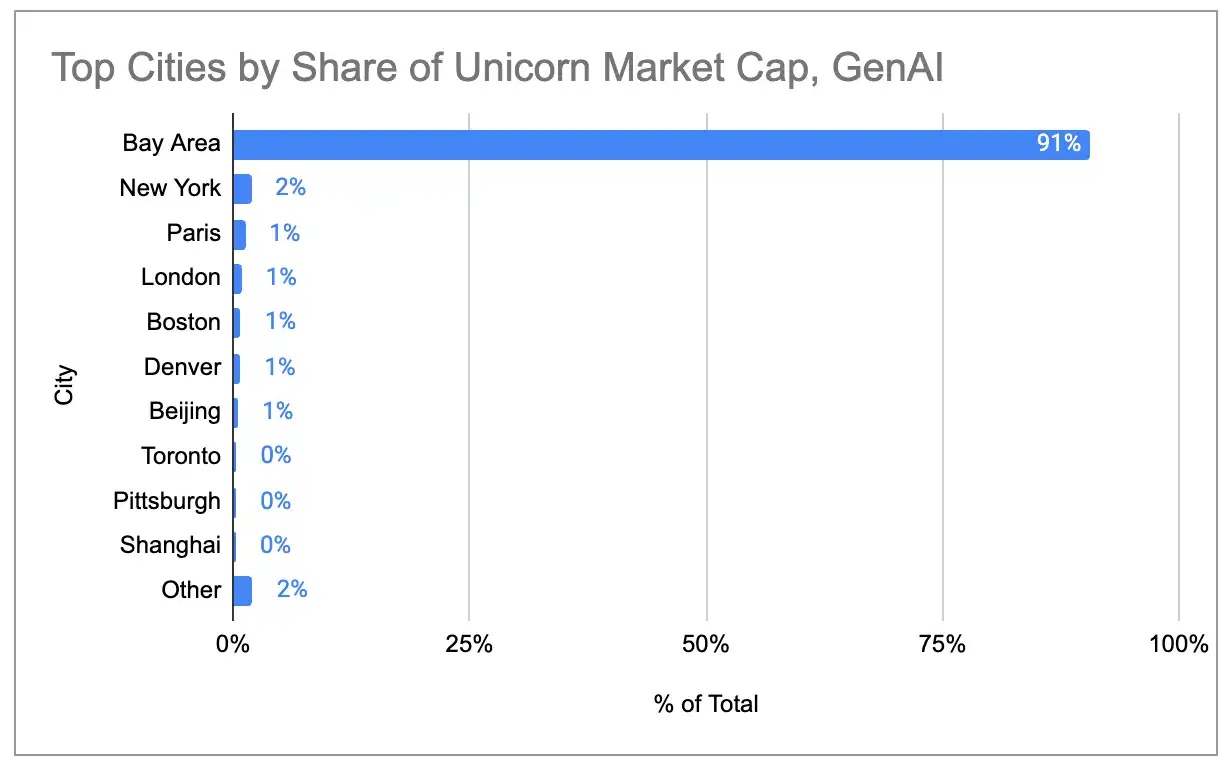
Caption: City distribution of generative AI unicorn market value

The total market value of generative AI unicorns has grown exponentially, with almost all the增量 coming from the US, especially the Bay Area.
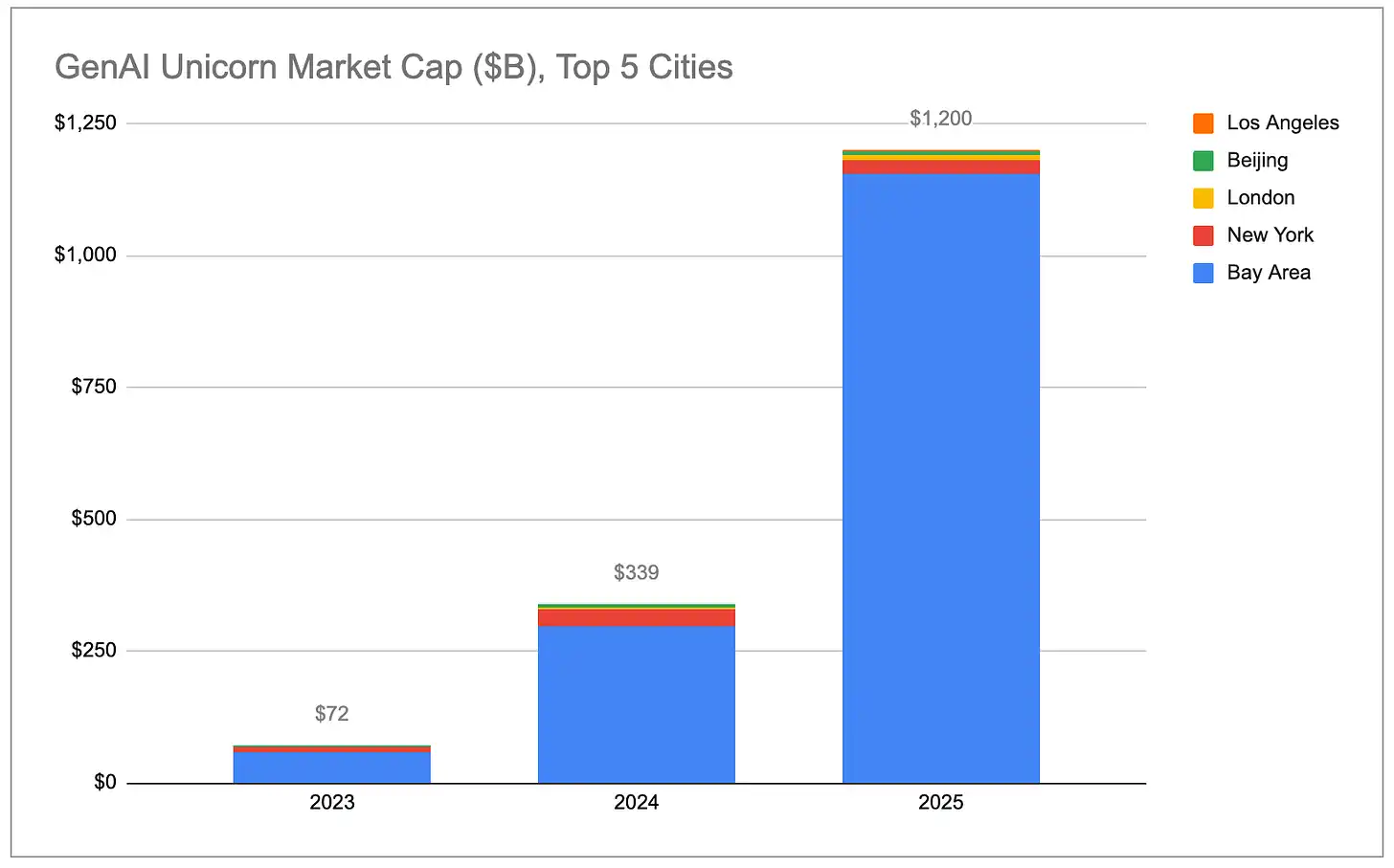
Caption: Total market value of generative AI unicorns (by country)

Caption: Total market value of generative AI unicorns (by city)

AI unicorn valuation growth far outpaces non-AI unicorns. The 48 AI companies that were unicorns throughout 2025 saw their total market value grow by $778 billion during the year. This figure exceeds the combined market value increase of the remaining 1100+ non-AI unicorns. Even excluding OpenAI (~$343B increase) and Anthropic (~$334B increase), the average year-on-year valuation growth for generative AI unicorns was about $2.2 billion, 5 times the average growth of non-AI unicorns (~$440 million).

Caption: Market value growth comparison: AI unicorns vs. non-AI unicorns

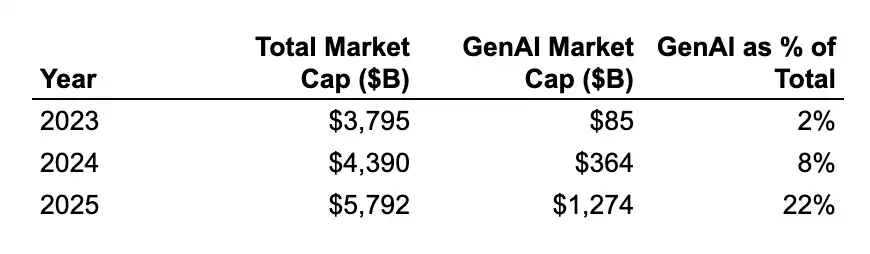
In relative terms, generative AI companies grew from 2% of the global unicorn market value in 2023 to 22%. If this trend continues, the Bay Area's share of the global unicorn market value will continue to expand, thanks to its de facto monopoly on top AI companies and talent.
<极div>

Caption: Change in the proportion of generative AI in total unicorn market value

(Note: We only classify companies whose primary revenue comes directly from generative AI as "generative AI." A full list of companies can be viewed here. We included chip/hardware companies like Cerebras and TensTorrent, and infrastructure companies like CoreWeave and Crusoe, but did not include data infrastructure companies like Databricks that more broadly support AI/ML workloads, nor robotics/defense companies like Anduril that use AI/ML for autonomous systems.)

New Unicorns

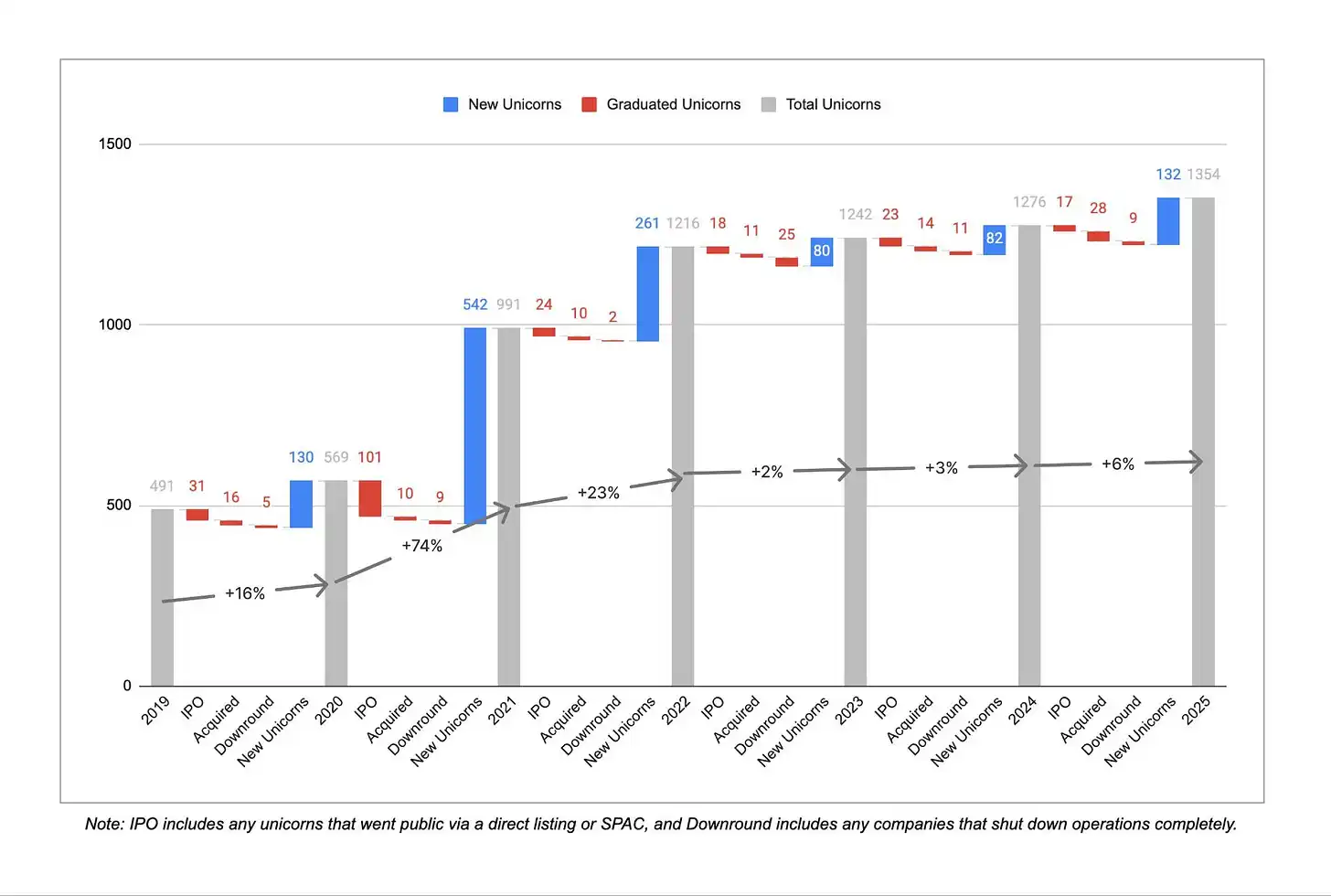
Caption: Number of new unicorns per year

After three years of high growth, the birth rate of new unicorns has slowed significantly over the past three years. Between December 2019 and December 2022, an average of over 300 companies became unicorns for the first time each year. From December 2022 to December 2025, this number dropped to about 100 per year, although 2025 saw a rebound compared to the previous two years.同时, over the past three years, 45 companies lost their unicorn status due to valuation markdowns or shutdowns, compared to only 16 in the previous three years, indicating that the correction of inflated valuations from the 2021/2022 zero-interest rate era is ongoing.

Caption: Trend of unicorn count vs. total market value

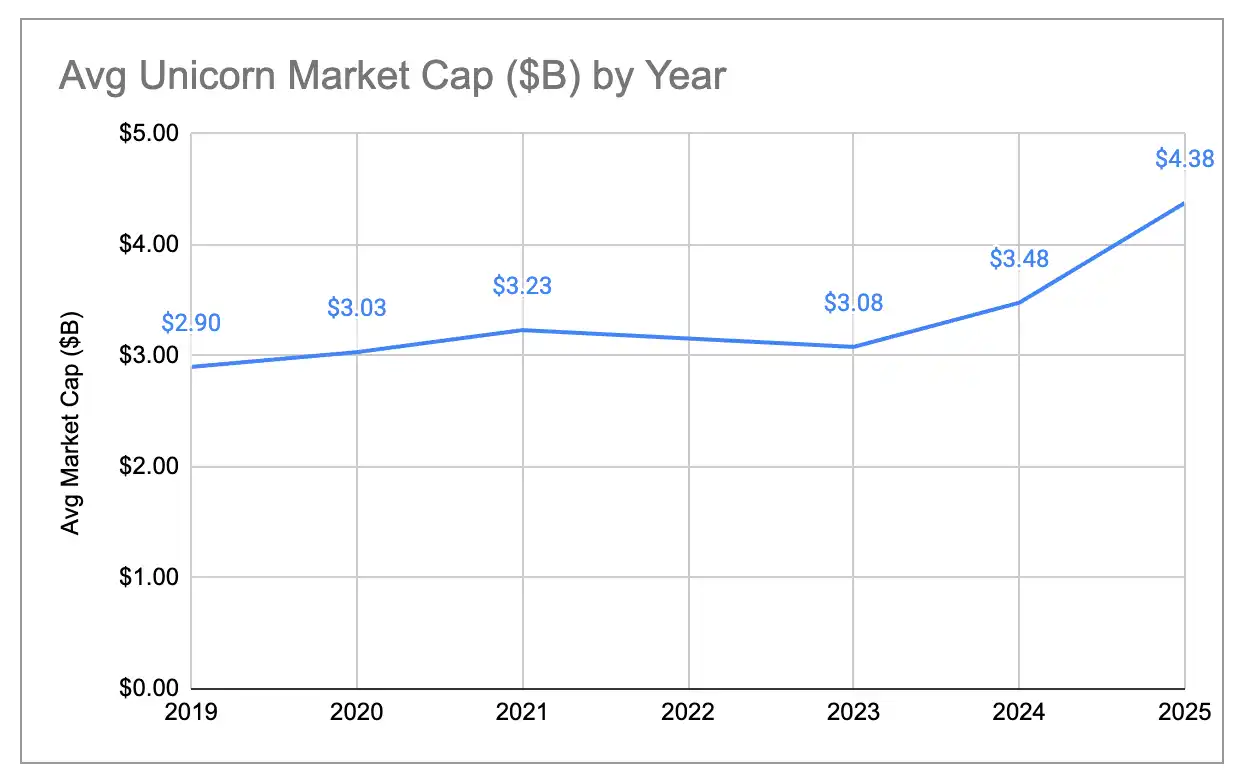
Although the number of unicorns has remained largely flat, the total market value has grown significantly. Over the past year, the global unicorn total market value grew from about $4.4 trillion to about $5.8 trillion, an increase of 33%. This is a strong rebound, especially relative to 2023 when the total market value actually shrank year-on-year. Historically, market value growth was driven more by new companies becoming unicorns, but in 2025, about 80% of the market value growth came from valuation increases of existing unicorns. The result is that the average market value per unicorn rose from about $3 billion to about $4.4 billion, the highest value in the six years we have been doing this analysis. It has become harder to become a unicorn, but once past the $1 billion threshold, these companies are, on average, more valuable and growing faster.

Caption: Trend in average unicorn market value

New Generation vs. Old Generation Unicorns

One way to剔除 the influence of inflated valuations from the zero-interest rate era is to look only at unicorns born after 2023. Here is a comparison of the market value distribution between the two batches of unicorns before and after 2023:

Caption: Market value distribution of unicorns born before 2023 (by country/city)

Caption: Market value distribution of unicorns born in 2023 and later (by country/city)

New generation unicorns are more concentrated in the US, with shares declining for Europe and China. Among unicorns added since 2023, the Bay Area accounts for 63% of the market value, compared to only 33% for the older batch of unicorns.

"Zombie" Unicorns

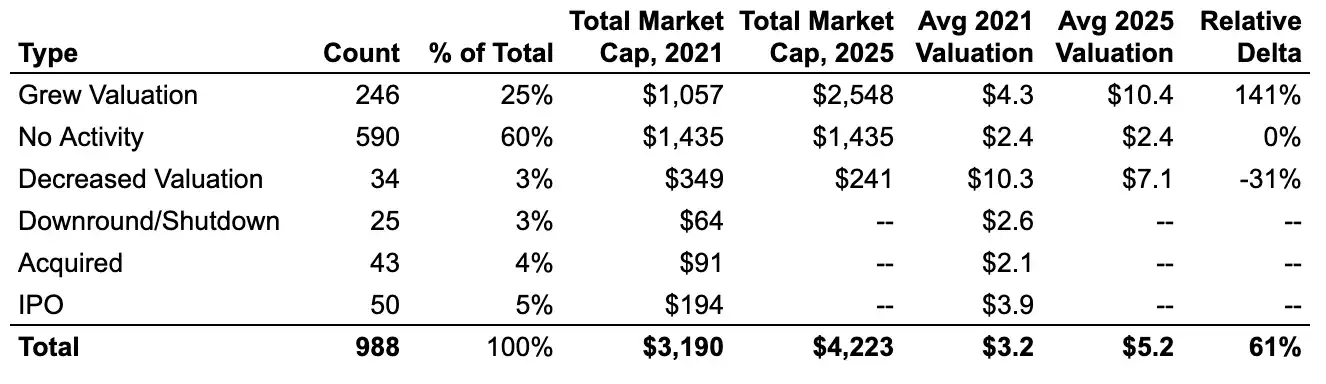
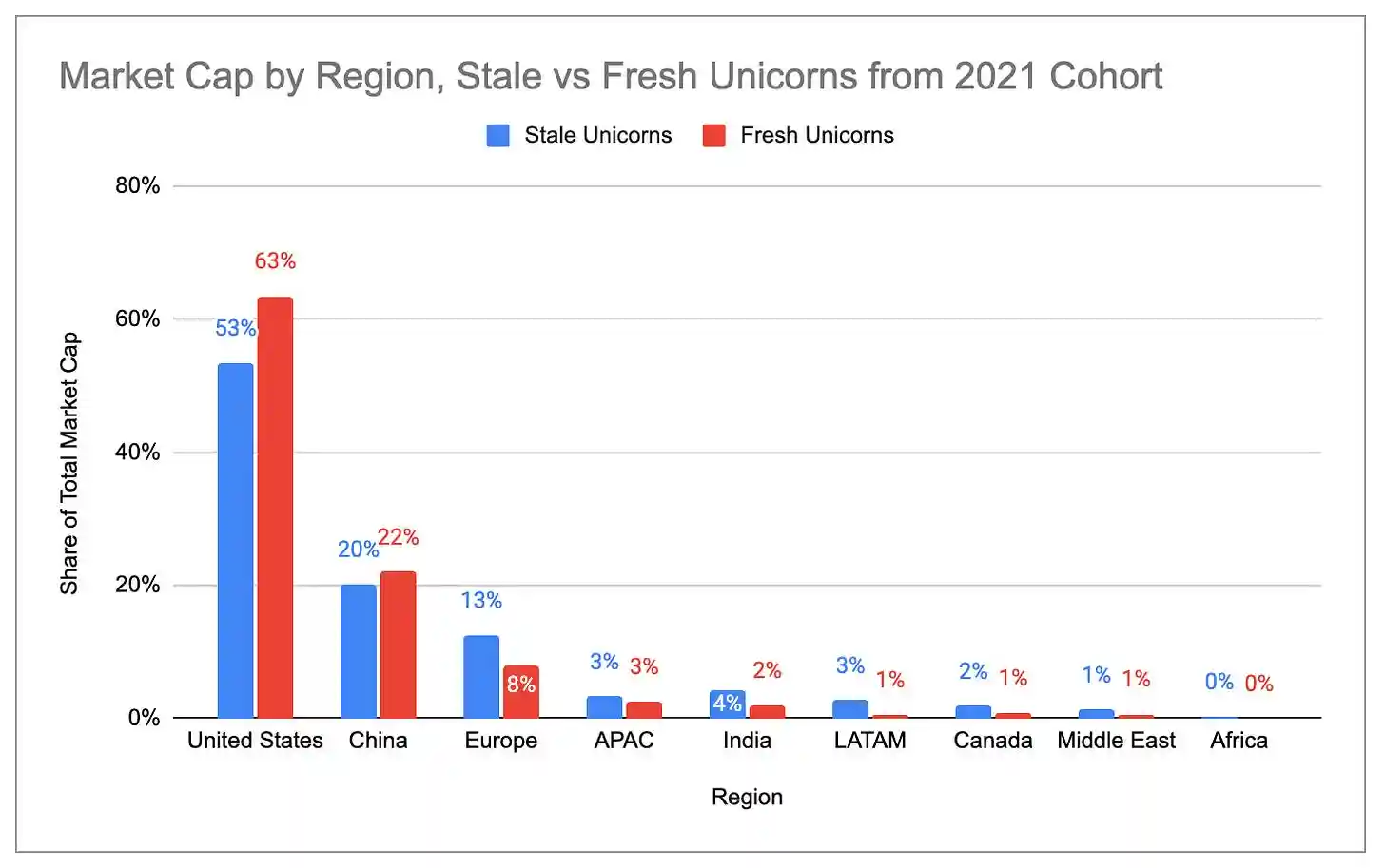
Of the nearly 1000 unicorns in December 2021, about 60% have maintained their unicorn status but have not completed any new funding rounds. These "zombie" unicorns raised enough money during the zero-interest rate era to survive至今 but have been unable to surpass their previous valuations. They collectively account for about $1.4 trillion of the current global unicorn market value, nearly 25% of the global total.

Caption: Proportion of "Zombie" vs. "Active" among 2021 Unicorns

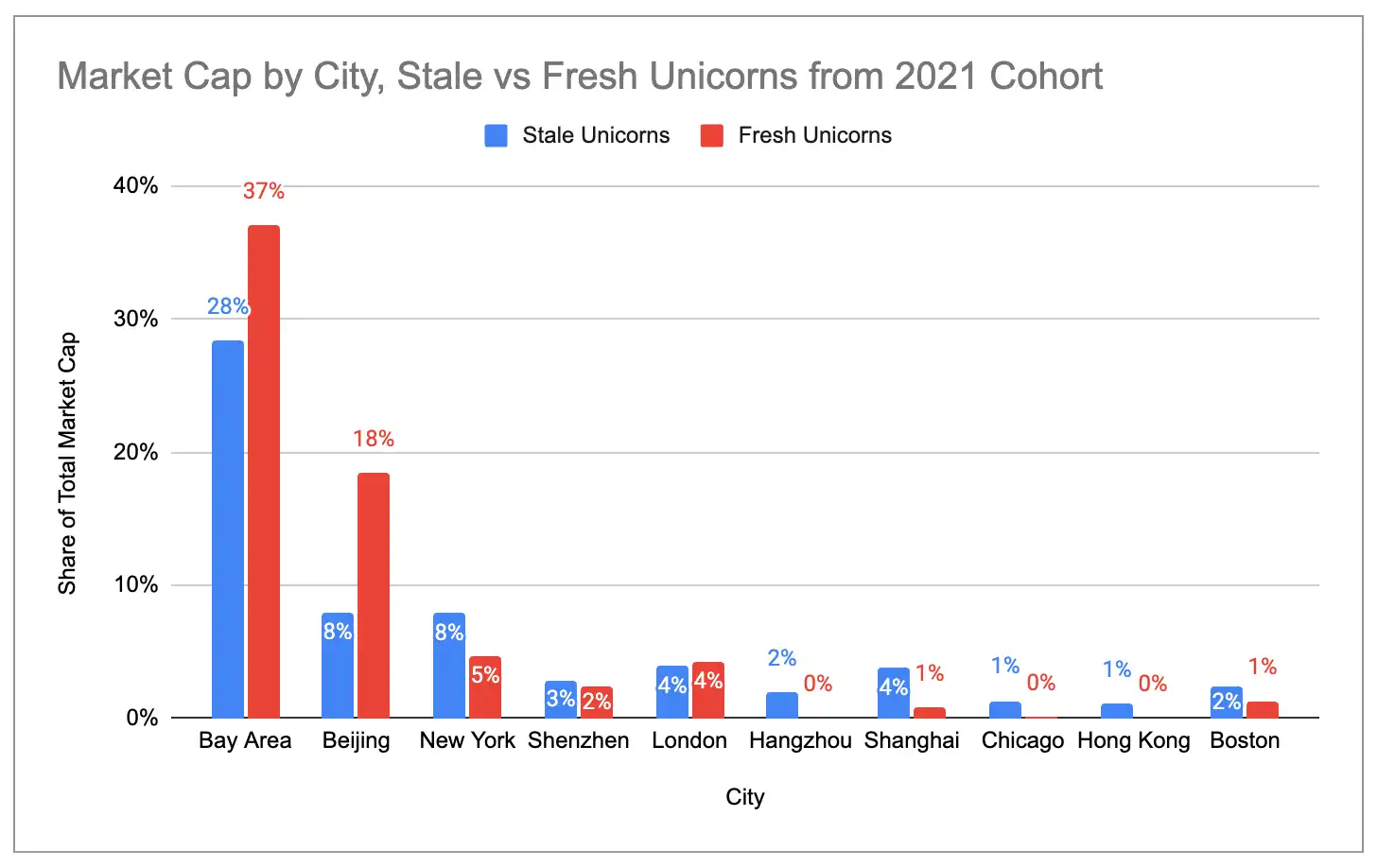
The proportion of "active" unicorns (those that have completed new funding rounds since 2021) in the US and the Bay Area is much higher than that of "zombie" unicorns. In contrast, Europe, India, Latin America, and New York have a higher concentration of "zombie" unicorns.

Caption: Market value distribution of "Zombie" vs. "Active" unicorns by country

Caption: Market value distribution of "Zombie" vs. "Active" unicorns by city

Four Major US Unicorn Clusters

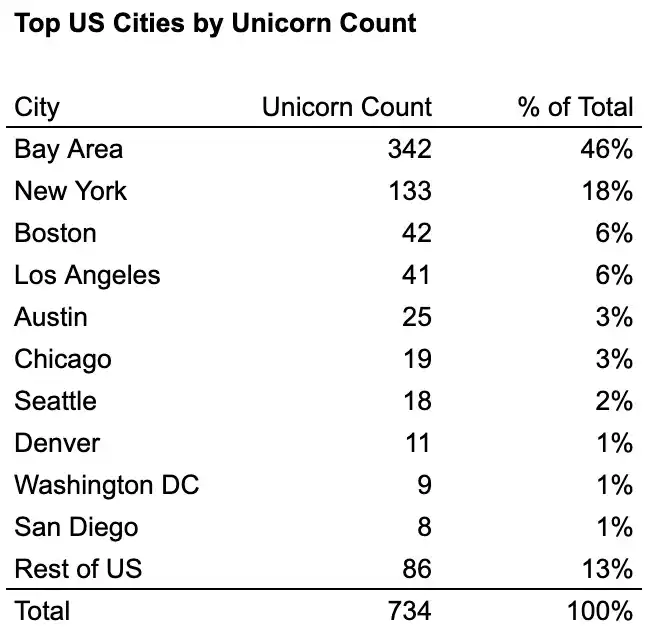
Within the US, four "industry cities" account for about 76% of the unicorn count and about 87% of the unicorn market value: the Bay Area, New York, Los Angeles, and Boston. The Bay Area is the absolute leader, with more than twice the number of unicorns of the second-ranked city and more than four times the market value.

Caption: Number of unicorns in major US cities

Caption: Unicorn market value in major US cities

Looking at the industry distribution of the top 10 unicorns in each city, the clustering effect of industry cities is clear:

  • Bay Area = AI Cluster (6 of the top 10 are generative AI)
  • New York = Fintech/Crypto Cluster (7 of the top 10)
  • Los Angeles = Defense/Space + Consumer Cluster (3 of the top 6 are defense/space, 4 of the top 10 are consumer)
  • Boston = Relatively balanced, but偏向 biotech/healthcare (3 of the top 10)

Caption: Industry distribution of Top 10 unicorns in four major US cities

Criptos en tendencia

ctr
CitreaCTR
wstusdt
wrapped stUSDTWSTUSDT
apr
aPrioriAPR
ctx
Cryptex FinanceCTX
audio
AudiusAUDIO
comp
CompoundCOMP
mantra
MantraMANTRA
xvs
VenusXVS
waxl
AxelarWAXL
bill
Billions NetworkBILL
pyth
PYTH (Pyth)PYTH
rune
THORChainRUNE
velodrome
Velodrome FinanceVELODROME
brev
BrevisBREV
zrx
ZRX(0X)ZRX

Preguntas relacionadas

QAccording to the report, what percentage of the world's generative AI unicorn market value is concentrated within an hour's drive of the San Francisco Bay Area?

A91% of the world's generative AI unicorn market value is concentrated within an hour's drive of the San Francisco Bay Area.

QWhat is the United States' share of the global unicorn market value as of the end of 2025, and how does this compare to the previous year?

AThe United States' share of the global unicorn market value is about 65% as of the end of 2025, which is an increase from 58% the previous year.

QHow has the average valuation of a unicorn company changed, reaching what is described as a six-year high?

AThe average valuation of a unicorn company has risen to approximately $4.4 billion, which is the highest level in the six years the analysis has been conducted.

QWhat major trend is identified regarding the birth rate of new unicorns between 2022-2025 compared to the preceding three-year period?

AThe birth rate of new unicorns has slowed significantly. Only about 300 new unicorns were added between 2022 and 2025, compared to over 900 in the previous three-year period (2019-2022).

QWhich specific industry clusters are identified for the top unicorns in New York and Los Angeles?

AIn New York, the top unicorns form a FinTech/Crypto cluster (7 out of the top 10). In Los Angeles, the top unicorns form a Defense/Aerospace cluster (3 of the top 5) and a Consumer cluster (4 of the top 10).

Lecturas Relacionadas

Ethereum Q1 2026 Report: Fees Decline, Users and Transaction Volume Hit New Highs

Ethereum Q1 2026 Report: Fees Down, Users & Transactions Hit New Highs Token Terminal's Q1 2026 report on Ethereum presents a pivotal development: the network achieved record highs in monthly active users (13.2M, +85.9% YoY), total transactions (200.4M, +81.5% YoY), and throughput (25.78 TPS), while transaction fees on the mainnet plummeted by 47.9% quarter-over-quarter. This shift is attributed to the network's strategic move into a "low fees for scale" phase, exemplified by the Fusaka upgrade which increased data capacity and lowered block space costs, releasing pent-up demand (a manifestation of Jevons's Paradox). The report highlights a core narrative shift for Ethereum: from a DeFi-centric blockchain to a global financial settlement layer. It maintains a dominant position in tokenized assets, holding majority market shares among top chains in stablecoins (61.8%), tokenized funds (73.0%), and tokenized commodities (84.0%). Growth in tokenized funds (+73.1% YoY) and commodities (+325.9% YoY) was particularly strong, driven by institutions like BlackRock and JPMorgan entering the space. Contrasting these usage gains, several USD-denominated value metrics declined in Q1: fully diluted market cap fell 30.3% QoQ, total value locked (TVL) dropped 11.0%, and ecosystem transaction volume decreased 24.0%. The report interprets this as Ethereum prioritizing long-term network expansion and cementing its role as the default settlement layer for finance over short-term fee capture. The commentary from Etherealize argues that, much like the early internet, Ethereum's open, permissionless model is poised to win over closed alternatives as institutional tokenization accelerates.

marsbitHace 1 hora(s)

Ethereum Q1 2026 Report: Fees Decline, Users and Transaction Volume Hit New Highs

marsbitHace 1 hora(s)

He Just Raised 2.7 Billion, and Li Fei-Fei Also Invested

Pete Florence, a former senior research scientist at Google DeepMind and a key contributor to the Vision-Language-Action (VLA) model architecture, is deliberately distancing his startup, Generalist AI, from the trendy "world model" label. He argues that the industry should prioritize concrete goals over buzzwords. His goal is to create robots that can perform a vast range of unseen tasks with high speed and success rates, without needing task-specific training data. Recently, his company raised $400 million (¥2.7 billion) at a $2 billion valuation. Notable investors include NVIDIA's NVentures, Bezos Expeditions, NFDG, as well as Xiaomi co-founder Lin Bin, Zoom founder Eric Yuan, and renowned AI scientist Fei-Fei Li. Florence's approach stems from his academic background at MIT under Professor Russ Tedrake, focusing on understanding the physical world. After joining DeepMind, he developed models like Transporter Network and co-created the VLA framework. He left in 2025 to found Generalist AI. The company has launched two models: GEN-0, which demonstrated that scaling laws apply to physical motion, and GEN-1. GEN-1 was trained on over 500,000 hours of physical interaction data collected via a specialized wearable device. It achieves a 99% success rate on precise mechanical tasks like folding boxes and maintains performance three times faster than its predecessor. Florence believes GEN-1 is reaching a commercial utility threshold similar to the GPT-3 inflection point. The substantial funding round, following GEN-1's release, signifies strong investor confidence in Generalist AI's practical, goal-driven path to creating versatile, useful robots, regardless of the "world model" terminology.

marsbitHace 1 hora(s)

He Just Raised 2.7 Billion, and Li Fei-Fei Also Invested

marsbitHace 1 hora(s)

Two Legends Lost in Three Days: Is Google's AI Talent Dam Cracking?

In three days, Google lost two AI legends. On June 18, Noam Shazeer, co-author of the seminal "Attention is All You Need" paper and Gemini co-lead, left for OpenAI. Just 48 hours later, John Jumper, 2024 Nobel laureate and AlphaFold lead, departed DeepMind for Anthropic. This follows Andrej Karpathy joining Anthropic in May. These moves highlight a structural trend: top AI talent is concentrating at mission-driven, pre-IPO firms like OpenAI and Anthropic, while Google becomes a primary source. The exodus stems from a core mission mismatch. Google's ad-centric model often subordinates AI research to product and revenue goals, creating friction for pioneers like Shazeer, who returned in 2024 only to leave again. In contrast, OpenAI and Anthropic offer singular focus on pushing AI boundaries, whether towards AGI or safety-aligned models, which deeply appeals to top researchers like Jumper. Financial incentives amplify the pull. With both OpenAI and Anthropic nearing IPO, employees stand to gain immensely from equity, an upside Google's mature stock cannot match. Furthermore, the 2023 merger of Google Brain and DeepMind, intended to consolidate strength, has instead created cultural tension and slowed the path from research to product, as evidenced by Gemini's pace. This talent redistribution is reshaping the AI landscape. While Google retains vast data and compute resources, its true crisis is the quiet, continuous loss of the people who define the field's future. The real moat in AI is not infrastructure, but the concentration of brilliant minds—a battle Google is currently losing.

marsbitHace 3 hora(s)

Two Legends Lost in Three Days: Is Google's AI Talent Dam Cracking?

marsbitHace 3 hora(s)

Behind the AI Report Card, Lies a Chinese 'Exam Setter'

Beyond the familiar performance charts like MMLU-Pro and MMMU, which major AI models strive to ace, stands a key "examiner": Chinese-Canadian researcher Wenhu Chen. An assistant professor at the University of Waterloo and founder of TIGERLab, Chen addresses the crucial need for more rigorous AI evaluation. As models like GPT-4 began scoring near-perfect results on older benchmarks like MMLU, it became difficult to distinguish their true capabilities. In response, Chen introduced MMLU-Pro in 2024, featuring harder, more reasoning-focused questions with more answer choices, successfully reintroducing meaningful performance gaps. His work extends to multi-modal evaluation with MMMU and its enhanced version, MMMU-Pro. These benchmarks test a model's ability to understand and reason with complex information from images, charts, and text across diverse academic subjects, exposing the significant challenges even top models face in genuine comprehension. Chen's background in complex QA, table reasoning, and his experience at Google DeepMind on projects like Gemini inform his approach. He understands that effective benchmarks must anticipate how models might "cheat" by memorizing data or avoiding visual analysis. His lab also actively researches video understanding and generation models (e.g., UniVideo, Vamba), ensuring his evaluation work is grounded in practical model-building challenges. Now at Meta's Super Intelligence Lab, Chen continues his focus on multi-modal data and evaluation, representing the deep yet often unseen contributions of Chinese talent in shaping the fundamental tools of the AI industry.

marsbitHace 3 hora(s)

Behind the AI Report Card, Lies a Chinese 'Exam Setter'

marsbitHace 3 hora(s)

Trading

Spot
Futuros

Artículos destacados

Qué es $S$

Entendiendo SPERO: Una Visión General Completa Introducción a SPERO A medida que el panorama de la innovación continúa evolucionando, la aparición de tecnologías web3 y proyectos de criptomonedas juega un papel fundamental en la configuración del futuro digital. Un proyecto que ha atraído la atención en este campo dinámico es SPERO, denotado como SPERO,$$s$. Este artículo tiene como objetivo reunir y presentar información detallada sobre SPERO, para ayudar a entusiastas e inversores a comprender sus fundamentos, objetivos e innovaciones dentro de los dominios web3 y cripto. ¿Qué es SPERO,$$s$? SPERO,$$s$ es un proyecto único dentro del espacio cripto que busca aprovechar los principios de descentralización y tecnología blockchain para crear un ecosistema que promueva la participación, la utilidad y la inclusión financiera. El proyecto está diseñado para facilitar interacciones de igual a igual de nuevas maneras, proporcionando a los usuarios soluciones y servicios financieros innovadores. En su esencia, SPERO,$$s$ tiene como objetivo empoderar a los individuos al proporcionar herramientas y plataformas que mejoren la experiencia del usuario en el espacio de las criptomonedas. Esto incluye habilitar métodos de transacción más flexibles, fomentar iniciativas impulsadas por la comunidad y crear caminos para oportunidades financieras a través de aplicaciones descentralizadas (dApps). La visión subyacente de SPERO,$$s$ gira en torno a la inclusividad, buscando cerrar brechas dentro de las finanzas tradicionales mientras aprovecha los beneficios de la tecnología blockchain. ¿Quién es el Creador de SPERO,$$s$? La identidad del creador de SPERO,$$s$ sigue siendo algo oscura, ya que hay recursos públicos limitados que proporcionan información de fondo detallada sobre su(s) fundador(es). Esta falta de transparencia puede derivarse del compromiso del proyecto con la descentralización, una ética que muchos proyectos web3 comparten, priorizando las contribuciones colectivas sobre el reconocimiento individual. Al centrar las discusiones en torno a la comunidad y sus objetivos colectivos, SPERO,$$s$ encarna la esencia del empoderamiento sin señalar a individuos específicos. Como tal, comprender la ética y la misión de SPERO sigue siendo más importante que identificar a un creador singular. ¿Quiénes son los Inversores de SPERO,$$s$? SPERO,$$s$ cuenta con el apoyo de una diversa gama de inversores que van desde capitalistas de riesgo hasta inversores ángeles dedicados a fomentar la innovación en el sector cripto. El enfoque de estos inversores generalmente se alinea con la misión de SPERO, priorizando proyectos que prometen avances tecnológicos sociales, inclusión financiera y gobernanza descentralizada. Estas fundaciones de inversores suelen estar interesadas en proyectos que no solo ofrecen productos innovadores, sino que también contribuyen positivamente a la comunidad blockchain y sus ecosistemas. El respaldo de estos inversores refuerza a SPERO,$$s$ como un contendiente notable en el dominio de proyectos cripto que evoluciona rápidamente. ¿Cómo Funciona SPERO,$$s$? SPERO,$$s$ emplea un marco multifacético que lo distingue de los proyectos de criptomonedas convencionales. Aquí hay algunas de las características clave que subrayan su singularidad e innovación: Gobernanza Descentralizada: SPERO,$$s$ integra modelos de gobernanza descentralizada, empoderando a los usuarios para participar activamente en los procesos de toma de decisiones sobre el futuro del proyecto. Este enfoque fomenta un sentido de propiedad y responsabilidad entre los miembros de la comunidad. Utilidad del Token: SPERO,$$s$ utiliza su propio token de criptomoneda, diseñado para servir diversas funciones dentro del ecosistema. Estos tokens permiten transacciones, recompensas y la facilitación de servicios ofrecidos en la plataforma, mejorando la participación y la utilidad general. Arquitectura en Capas: La arquitectura técnica de SPERO,$$s$ apoya la modularidad y escalabilidad, permitiendo la integración fluida de características y aplicaciones adicionales a medida que el proyecto evoluciona. Esta adaptabilidad es fundamental para mantener la relevancia en el cambiante paisaje cripto. Participación de la Comunidad: El proyecto enfatiza iniciativas impulsadas por la comunidad, empleando mecanismos que incentivan la colaboración y la retroalimentación. Al nutrir una comunidad sólida, SPERO,$$s$ puede abordar mejor las necesidades de los usuarios y adaptarse a las tendencias del mercado. Enfoque en la Inclusión: Al ofrecer tarifas de transacción bajas e interfaces amigables para el usuario, SPERO,$$s$ busca atraer a una base de usuarios diversa, incluyendo a individuos que anteriormente pueden no haber participado en el espacio cripto. Este compromiso con la inclusión se alinea con su misión general de empoderamiento a través de la accesibilidad. Cronología de SPERO,$$s$ Entender la historia de un proyecto proporciona información crucial sobre su trayectoria de desarrollo y hitos. A continuación se presenta una cronología sugerida que mapea eventos significativos en la evolución de SPERO,$$s$: Fase de Conceptualización e Ideación: Las ideas iniciales que forman la base de SPERO,$$s$ fueron concebidas, alineándose estrechamente con los principios de descentralización y enfoque comunitario dentro de la industria blockchain. Lanzamiento del Whitepaper del Proyecto: Tras la fase conceptual, se lanzó un whitepaper completo que detalla la visión, los objetivos y la infraestructura tecnológica de SPERO,$$s$ para generar interés y retroalimentación de la comunidad. Construcción de Comunidad y Primeras Interacciones: Se realizaron esfuerzos de divulgación activa para construir una comunidad de primeros adoptantes y posibles inversores, facilitando discusiones en torno a los objetivos del proyecto y obteniendo apoyo. Evento de Generación de Tokens: SPERO,$$s$ llevó a cabo un evento de generación de tokens (TGE) para distribuir sus tokens nativos a los primeros seguidores y establecer liquidez inicial dentro del ecosistema. Lanzamiento de la dApp Inicial: La primera aplicación descentralizada (dApp) asociada con SPERO,$$s$ se puso en marcha, permitiendo a los usuarios interactuar con las funcionalidades centrales de la plataforma. Desarrollo Continuo y Alianzas: Actualizaciones y mejoras continuas a las ofertas del proyecto, incluyendo alianzas estratégicas con otros actores en el espacio blockchain, han moldeado a SPERO,$$s$ en un jugador competitivo y en evolución en el mercado cripto. Conclusión SPERO,$$s$ se erige como un testimonio del potencial de web3 y las criptomonedas para revolucionar los sistemas financieros y empoderar a los individuos. Con un compromiso con la gobernanza descentralizada, la participación comunitaria y funcionalidades diseñadas de manera innovadora, allana el camino hacia un paisaje financiero más inclusivo. Como con cualquier inversión en el espacio cripto que evoluciona rápidamente, se anima a los posibles inversores y usuarios a investigar a fondo y participar de manera reflexiva con los desarrollos en curso dentro de SPERO,$$s$. El proyecto muestra el espíritu innovador de la industria cripto, invitando a una mayor exploración de sus innumerables posibilidades. Mientras el viaje de SPERO,$$s$ aún se desarrolla, sus principios fundamentales pueden, de hecho, influir en el futuro de cómo interactuamos con la tecnología, las finanzas y entre nosotros en ecosistemas digitales interconectados.

85 Vistas totalesPublicado en 2024.12.17Actualizado en 2024.12.17

Qué es $S$

Qué es AGENT S

Agent S: El Futuro de la Interacción Autónoma en Web3 Introducción En el paisaje en constante evolución de Web3 y las criptomonedas, las innovaciones están redefiniendo constantemente cómo los individuos interactúan con las plataformas digitales. Uno de estos proyectos pioneros, Agent S, promete revolucionar la interacción humano-computadora a través de su marco agente abierto. Al allanar el camino para interacciones autónomas, Agent S busca simplificar tareas complejas, ofreciendo aplicaciones transformadoras en inteligencia artificial (IA). Esta exploración detallada profundizará en las complejidades del proyecto, sus características únicas y las implicaciones para el dominio de las criptomonedas. ¿Qué es Agent S? Agent S se presenta como un marco agente abierto innovador, diseñado específicamente para abordar tres desafíos fundamentales en la automatización de tareas informáticas: Adquisición de Conocimiento Específico del Dominio: El marco aprende inteligentemente de diversas fuentes de conocimiento externas y experiencias internas. Este enfoque dual le permite construir un rico repositorio de conocimiento específico del dominio, mejorando su rendimiento en la ejecución de tareas. Planificación a Largo Plazo de Tareas: Agent S emplea planificación jerárquica aumentada por la experiencia, un enfoque estratégico que facilita la descomposición y ejecución eficiente de tareas complejas. Esta característica mejora significativamente su capacidad para gestionar múltiples subtareas de manera eficiente y efectiva. Manejo de Interfaces Dinámicas y No Uniformes: El proyecto introduce la Interfaz Agente-Computadora (ACI), una solución innovadora que mejora la interacción entre agentes y usuarios. Utilizando Modelos de Lenguaje Multimodal de Gran Escala (MLLMs), Agent S puede navegar y manipular diversas interfaces gráficas de usuario sin problemas. A través de estas características pioneras, Agent S proporciona un marco robusto que aborda las complejidades involucradas en la automatización de la interacción humana con las máquinas, preparando el terreno para una multitud de aplicaciones en IA y más allá. ¿Quién es el Creador de Agent S? Si bien el concepto de Agent S es fundamentalmente innovador, la información específica sobre su creador sigue siendo elusiva. El creador es actualmente desconocido, lo que resalta ya sea la etapa incipiente del proyecto o la elección estratégica de mantener a los miembros fundadores en el anonimato. Independientemente de la anonimidad, el enfoque sigue siendo en las capacidades y el potencial del marco. ¿Quiénes son los Inversores de Agent S? Dado que Agent S es relativamente nuevo en el ecosistema criptográfico, la información detallada sobre sus inversores y patrocinadores financieros no está documentada explícitamente. La falta de información disponible públicamente sobre las bases de inversión u organizaciones que apoyan el proyecto plantea preguntas sobre su estructura de financiamiento y hoja de ruta de desarrollo. Comprender el respaldo es crucial para evaluar la sostenibilidad del proyecto y su posible impacto en el mercado. ¿Cómo Funciona Agent S? En el núcleo de Agent S se encuentra una tecnología de vanguardia que le permite funcionar de manera efectiva en diversos entornos. Su modelo operativo se basa en varias características clave: Interacción Humano-Computadora Similar a la Humana: El marco ofrece planificación avanzada de IA, esforzándose por hacer que las interacciones con las computadoras sean más intuitivas. Al imitar el comportamiento humano en la ejecución de tareas, promete elevar las experiencias de los usuarios. Memoria Narrativa: Empleada para aprovechar experiencias de alto nivel, Agent S utiliza memoria narrativa para hacer un seguimiento de las historias de tareas, mejorando así sus procesos de toma de decisiones. Memoria Episódica: Esta característica proporciona a los usuarios una guía paso a paso, permitiendo que el marco ofrezca apoyo contextual a medida que se desarrollan las tareas. Soporte para OpenACI: Con la capacidad de ejecutarse localmente, Agent S permite a los usuarios mantener el control sobre sus interacciones y flujos de trabajo, alineándose con la ética descentralizada de Web3. Fácil Integración con APIs Externas: Su versatilidad y compatibilidad con varias plataformas de IA aseguran que Agent S pueda encajar sin problemas en ecosistemas tecnológicos existentes, convirtiéndolo en una opción atractiva para desarrolladores y organizaciones. Estas funcionalidades contribuyen colectivamente a la posición única de Agent S dentro del espacio cripto, ya que automatiza tareas complejas y de múltiples pasos con una intervención humana mínima. A medida que el proyecto evoluciona, sus posibles aplicaciones en Web3 podrían redefinir cómo se desarrollan las interacciones digitales. Cronología de Agent S El desarrollo y los hitos de Agent S pueden encapsularse en una cronología que resalta sus eventos significativos: 27 de septiembre de 2024: El concepto de Agent S fue lanzado en un documento de investigación integral titulado “Un Marco Agente Abierto que Usa Computadoras Como un Humano”, mostrando las bases del proyecto. 10 de octubre de 2024: El documento de investigación fue puesto a disposición del público en arXiv, ofreciendo una exploración profunda del marco y su evaluación de rendimiento basada en el benchmark OSWorld. 12 de octubre de 2024: Se lanzó una presentación en video, proporcionando una visión visual de las capacidades y características de Agent S, involucrando aún más a posibles usuarios e inversores. Estos marcadores en la cronología no solo ilustran el progreso de Agent S, sino que también indican su compromiso con la transparencia y la participación comunitaria. Puntos Clave Sobre Agent S A medida que el marco Agent S continúa evolucionando, varios atributos clave destacan, subrayando su naturaleza innovadora y potencial: Marco Innovador: Diseñado para proporcionar un uso intuitivo de las computadoras similar a la interacción humana, Agent S aporta un enfoque novedoso a la automatización de tareas. Interacción Autónoma: La capacidad de interactuar de manera autónoma con las computadoras a través de GUI significa un salto hacia soluciones informáticas más inteligentes y eficientes. Automatización de Tareas Complejas: Con su metodología robusta, puede automatizar tareas complejas y de múltiples pasos, haciendo que los procesos sean más rápidos y menos propensos a errores. Mejora Continua: Los mecanismos de aprendizaje permiten a Agent S mejorar a partir de experiencias pasadas, mejorando continuamente su rendimiento y eficacia. Versatilidad: Su adaptabilidad en diferentes entornos operativos como OSWorld y WindowsAgentArena asegura que pueda servir a una amplia gama de aplicaciones. A medida que Agent S se posiciona en el paisaje de Web3 y criptomonedas, su potencial para mejorar las capacidades de interacción y automatizar procesos significa un avance significativo en las tecnologías de IA. A través de su marco innovador, Agent S ejemplifica el futuro de las interacciones digitales, prometiendo una experiencia más fluida y eficiente para los usuarios en diversas industrias. Conclusión Agent S representa un audaz avance en la unión de la IA y Web3, con la capacidad de redefinir cómo interactuamos con la tecnología. Aunque aún se encuentra en sus primeras etapas, las posibilidades para su aplicación son vastas y atractivas. A través de su marco integral que aborda desafíos críticos, Agent S busca llevar las interacciones autónomas al primer plano de la experiencia digital. A medida que nos adentramos más en los reinos de las criptomonedas y la descentralización, proyectos como Agent S sin duda desempeñarán un papel crucial en la configuración del futuro de la tecnología y la colaboración humano-computadora.

492 Vistas totalesPublicado en 2025.01.14Actualizado en 2025.01.14

Qué es AGENT S

Cómo comprar S

¡Bienvenido a HTX.com! Hemos hecho que comprar Sonic (S) sea simple y conveniente. Sigue nuestra guía paso a paso para iniciar tu viaje de criptos.Paso 1: crea tu cuenta HTXUtiliza tu correo electrónico o número de teléfono para registrarte y obtener una cuenta gratuita en HTX. Experimenta un proceso de registro sin complicaciones y desbloquea todas las funciones.Obtener mi cuentaPaso 2: ve a Comprar cripto y elige tu método de pagoTarjeta de crédito/débito: usa tu Visa o Mastercard para comprar Sonic (S) al instante.Saldo: utiliza fondos del saldo de tu cuenta HTX para tradear sin problemas.Terceros: hemos agregado métodos de pago populares como Google Pay y Apple Pay para mejorar la comodidad.P2P: tradear directamente con otros usuarios en HTX.Over-the-Counter (OTC): ofrecemos servicios personalizados y tipos de cambio competitivos para los traders.Paso 3: guarda tu Sonic (S)Después de comprar tu Sonic (S), guárdalo en tu cuenta HTX. Alternativamente, puedes enviarlo a otro lugar mediante transferencia blockchain o utilizarlo para tradear otras criptomonedas.Paso 4: tradear Sonic (S)Tradear fácilmente con Sonic (S) en HTX's mercado spot. Simplemente accede a tu cuenta, selecciona tu par de trading, ejecuta tus trades y monitorea en tiempo real. Ofrecemos una experiencia fácil de usar tanto para principiantes como para traders experimentados.

1.0k Vistas totalesPublicado en 2025.01.15Actualizado en 2026.06.02

Cómo comprar S

Discusiones

Bienvenido a la comunidad de HTX. Aquí puedes mantenerte informado sobre los últimos desarrollos de la plataforma y acceder a análisis profesionales del mercado. A continuación se presentan las opiniones de los usuarios sobre el precio de S (S).

活动图片