Are Dogecoin ETFs Dead On Arrival? Dwindling Volume Suggests Investors Are Not Interest – Details

bitcoinistPublicado a 2025-12-11Actualizado a 2025-12-11

Resumen

Dogecoin ETFs have experienced consistently low demand and dwindling trading volumes since their launch in late November, indicating a lack of institutional interest. Data from SoSoValue shows daily volumes have declined significantly, with only three days reaching seven-figure trades out of twelve. Total net assets for these funds stand at just $6.01 million, far below Grayscale’s Chainlink ETF, which has $77.71 million in assets. Analysts had predicted lower interest for meme coins like DOGE compared to major cryptos, and this is reflected as even newer Solana and XRP ETFs are performing better. DOGE’s status as a meme coin with limited utility is seen as a key reason for its poor ETF uptake. The token’s price also fell over 6% to $0.138 at the time of writing.

The Dogecoin ETFs have continued to record low demand since they launched last month, indicating the lack of interest from institutional investors in the meme coin. Notably, DOGE has also seen the lowest demand through these ETFs among the top coins by market cap.

Dogecoin ETFs Record Dwindling Volume And Inflows

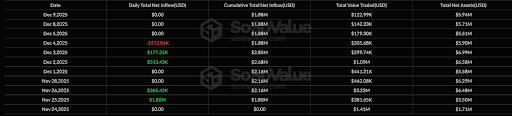
SoSoValue data shows that the Dogecoin ETFs have continued to see their daily volume and inflows decline since they launched last month. On December 10, the Grayscale and Bitwise DOGE ETFs recorded a trading volume of $125,100. Meanwhile, these funds as a group saw a total net inflow of $171,920 on the day.

Further data from SoSo Value shows that the Dogecoin ETFs trading volume has been on a decline since December 2, when they recorded a daily trading volume of $1.09 million. These funds have recorded only three 7-figure trading volume days out of 12 trading days since November 24, when Grayscale’s Dogecoin fund launched.
Source: Chart from SoSoValue on X

This is relatively low and signifies little demand for the DOGE ETFs among institutional investors. For context, Grayscale’s Chainlink ETF, the only LINK fund at the moment, has outperformed the Dogecoin ETFs despite launching at the start of this month. Grayscale’s LINK ETF has a total net asset of $77.71 million, while the DOGE ETFs have total net assets of $6.01 million.

The net flows also highlight the underperformance of these Dogecoin ETFs. Since launching, Bitwise’s DOGE fund has recorded a net outflow of $972,840. Meanwhile, Grayscale’s fund has taken in just over $3 million. The funds, as a group, have recorded net inflows on five of 12 trading days.

Possible Reason For The Underperformance

Bloomberg analyst Eric Balchunas had warned before now that crypto ETFs like the Dogecoin ETFs would record fewer assets given their distance from Bitcoin in terms of market cap. “’The further away you get from BTC, the less asset there will be,’ he said. Notably, DOGE funds have the lowest net assets among the top 10 cryptos by market cap with ETF wrappers.

The Solana and XRP ETFs, which also just launched last month, have outperformed the Dogecoin ETFs, although there are more funds offering SOL and XRP. Meanwhile, Balachunas’ theory hasn’t applied to the LINK ETF, as it has outperformed DOGE funds despite Chainlink having a lower market cap than Dogecoin.

Furthermore, the Hedera and Litecoin ETFs also boast larger net assets than the Dogecoin ETFs, indicating that institutional investors are simply not bullish on DOGE, possibly due to its meme coin status and lack of utility. DOGE is, so far, the only meme coin with an ETF wrapper.

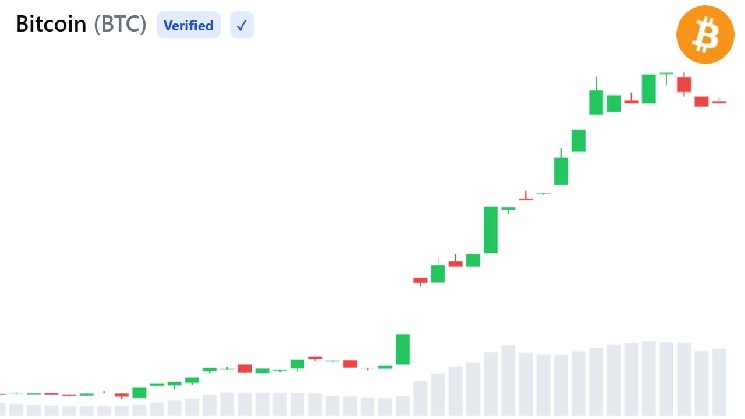
At the time of writing, the DOGE price is trading at around $0.138, down over 6% in the last 24 hours, according to data from CoinMarketCap.

DOGE trading at $0.13 on the 1D chart | Source: DOGEUSDT on Tradingview.com

Lecturas Relacionadas

Cook's Curtain Call and Ternus Takes the Helm: The Disruption and Reboot of Apple's 4 Trillion Dollar Empire

Tim Cook has officially announced he will step down as CEO of Apple in September, transitioning to executive chairman after a 15-year tenure during which he grew the company’s market value from around $350 billion to nearly $4 trillion. He will be succeeded by John Ternus, a 50-year-old hardware engineering veteran who has been groomed for the role through increasing public visibility and internal responsibility. Ternus’s appointment signals a strategic shift toward hardware and engineering leadership, with Johny Srouji—head of Apple Silicon—taking on an expanded role as Chief Hardware Officer. This consolidation aims to strengthen Apple’s core technological capabilities. However, Cook’s departure highlights a significant unresolved issue: Apple’s delayed and fragmented approach to artificial intelligence. Despite early efforts, such as hiring John Giannandrea from Google in 2018, Apple’s AI initiatives—particularly around Siri—have struggled with internal restructuring and reliance on external partnerships, including with Google. The transition comes at a critical moment as Apple faces paradigm shifts with the rise of artificial general intelligence (ASI). The company’s closed ecosystem of hardware, software, and services—once a major advantage—now presents challenges in adapting to an AI-centric world where intelligence may matter more than the device itself. Ternus must quickly articulate a clear AI strategy, possibly starting at WWDC, to reassure markets and redefine Apple’s role in a new technological era. His task is not only to maintain Apple’s operational excellence but also to reinvigorate its capacity to innovate and lead in the age of AI.

marsbitHace 2 hora(s)

Cook's Curtain Call and Ternus Takes the Helm: The Disruption and Reboot of Apple's 4 Trillion Dollar Empire

marsbitHace 2 hora(s)

Trading

Spot
Futuros
活动图片