Airdrops Won't Make You Rich, edgeX Doesn't Need a Community

marsbitPublicado a 2026-03-31Actualizado a 2026-03-31

Resumen

The decentralized perpetual contract protocol edgeX, incubated by Amber Group and backed by Circle Ventures, faced massive community backlash following its token airdrop distribution. Despite earlier promises not to screen out Sybil accounts and to distribute tokens based on points earned through trading, users discovered significant inconsistencies in token allocation. Many users reported receiving vastly different token amounts for the same number of points—some obtained 11 tokens per point, while others received as few as 0.5. Further allegations emerged, including insider trading, with reports that low-point affiliated addresses received a quarter of the total airdrop. The project worsened the situation by disabling comments on its social media channels to suppress criticism. Influential figures like Bingwa accused edgeX of being a "setup" rather than a legitimate project, designed to manipulate and exploit users. The incident has eroded trust in airdrop mechanisms, highlighting the risks of "rule changes after the fact" and the lack of transparency. As a result, user activity on edgeX plummeted, with daily new deposits dropping from over 2,000 to under 50 shortly after the airdrop snapshot. The event raises broader concerns about the sustainability of airdrop-driven engagement in DeFi, suggesting that the era of "airdrop致富" (getting rich from airdrops) may be over.

Author: Gu Yu, ChainCatcher

Last week, the severe backlash from BackPack was still vivid in everyone's minds, and today, another decentralized perpetual contract trading protocol, edgeX, is facing a tidal wave of criticism.

This morning, edgeX officially announced the website to check and claim the token airdrop, with plans to list on exchanges tonight. As a project incubated by Amber Group and strategically invested in by Circle Ventures this year, edgeX was once highly anticipated by airdrop hunters.

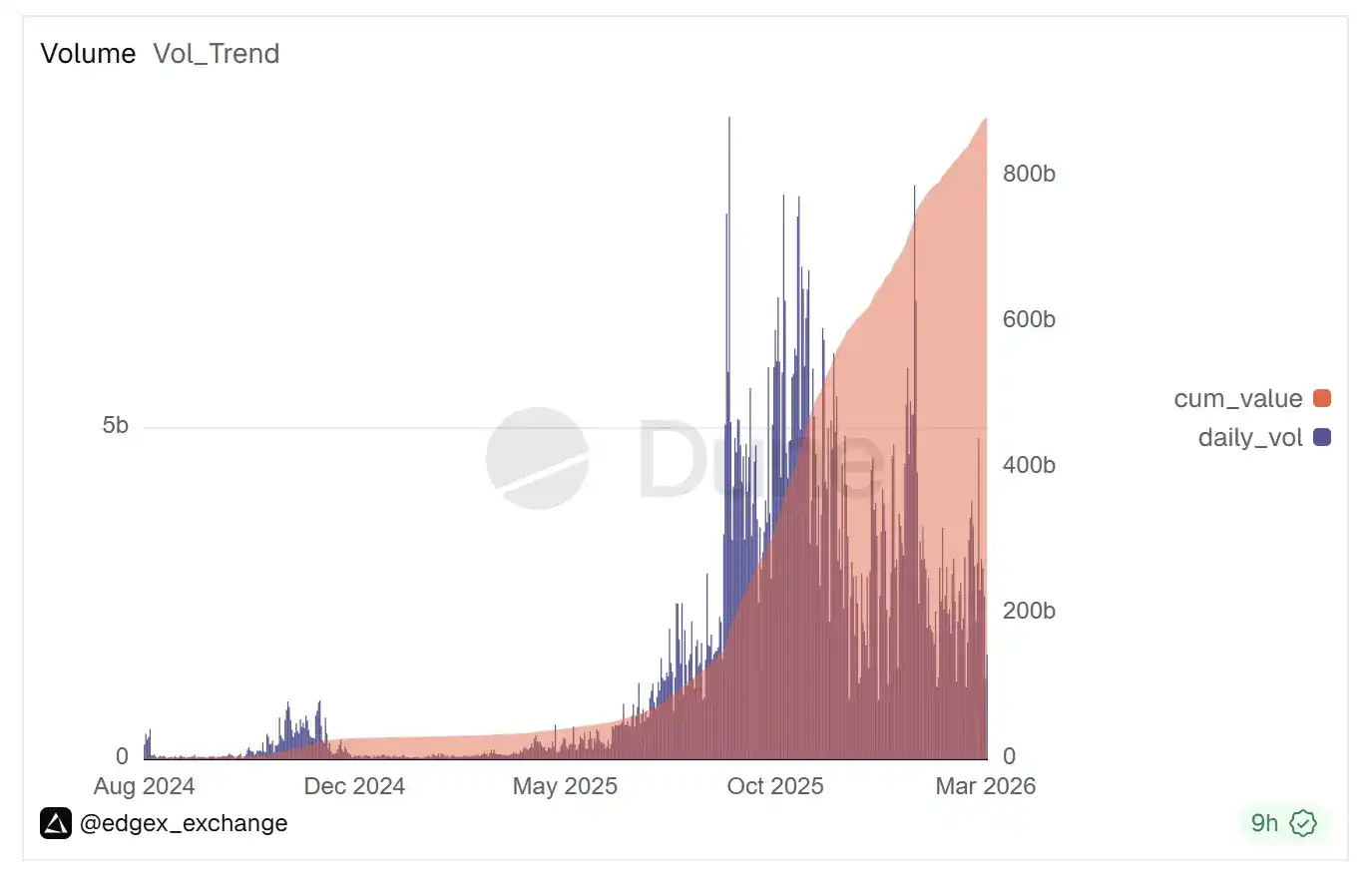
Since August 2025, edgeX's trading volume has entered a period of rapid growth. To date, it has accumulated over 470,000 user addresses, a total trading volume exceeding $87.7 billion, and a current Total Value Locked (TVL) of over $360 million. Furthermore, edgeX has generated over $180 million in fee revenue from these trades.
The edgeX team had previously promised the community that they would absolutely not screen for Sybil attacks—'if you have points, you get tokens'—which was a source of confidence for many edgeX users. However, what no one anticipated was that while edgeX indeed did not remove Sybil accounts this time, they manipulated the "points weighting" instead.

Based on community feedback, many users earned the same number of points through trading but received different amounts of airdropped tokens. Some users received 4 tokens per point on average, some only received 0.5 tokens per point, while others received 11 tokens per point. In response, the project team merely stated that points from different sources indeed had different weights.

Even calculating at the rate of 11 tokens per point, their current value is only about $5.5. In contrast, the secondary market price for edgeX points last year was $30-40, resulting in significant losses for secondary market buyers of these points.

What's worse, several KOLs, including He Bi, exposed that the edgeX project team engaged in a 'rat warehouse' situation (insider trading/preferential allocation), where multiple linked addresses with low points collectively received a quarter of the total airdropped tokens.

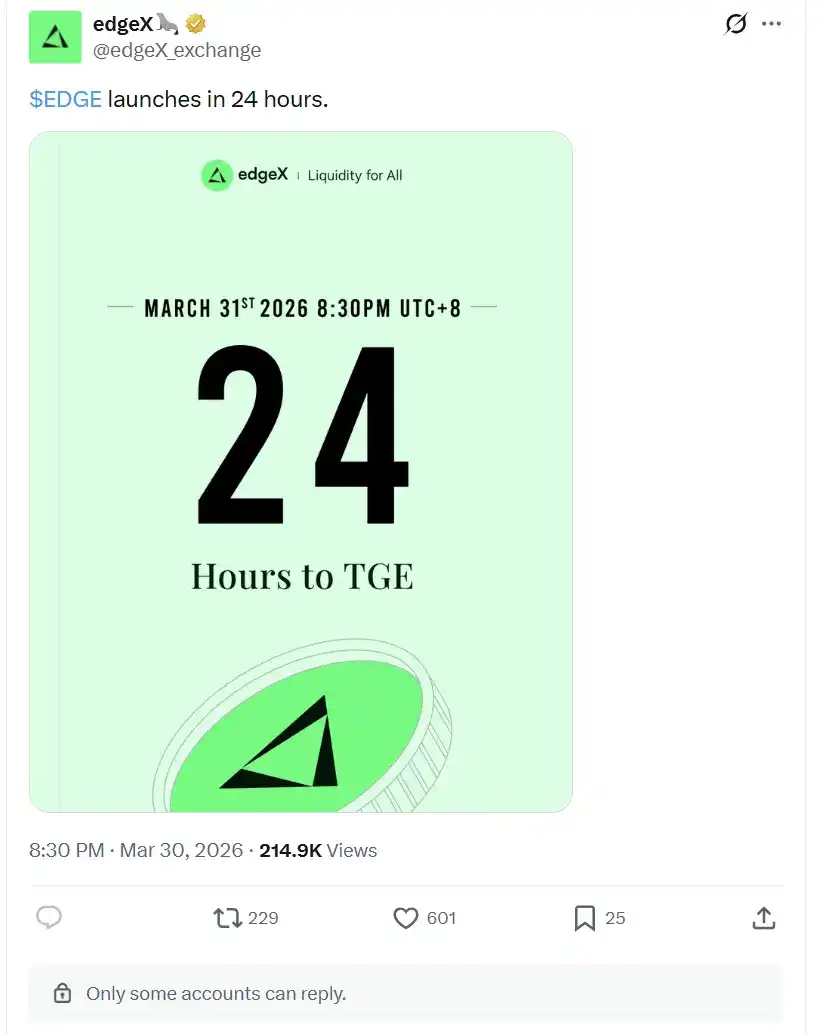
As community质疑声四起质疑 (questioning) grew louder, edgeX directly disabled comments on its X (formerly Twitter) account, attempting to suppress the spread of negative comments, but it was already too late.
"Why did they change rules arbitrarily, resulting in different rights for the same points? Why delete posts, kick people out, and suppress discussion? Because a project that from the very start intended to rely on wash trading to inflate data, hype valuations with stories, and coordinate with market maker groups for利益输送 (benefit transfer/insider profiteering) fundamentally cannot respect users, nor can it respect the community," said well-known KOL Ice Frog in an X post.

Ice Frog also stated that the most egregious aspect of edgeX is that it wasn't aimed at building a project from the beginning, but rather at setting up a scheme (a scam/plot), attempting to use manipulation and收割 (harvesting/exploitation) to destroy this industry.

Undoubtedly, this "post-rules" handling directly shatters the core premise of user trust in airdrop mechanisms—predictability. Once users cannot evaluate returns based on公开规则 (public rules), the so-called "points farming strategy" loses its博弈基础 (gaming foundation). One after another, large-scale "反向撸毛" (reverse airdrop/being rugged) and "作恶" (malicious acts) events continue to impact user confidence.

In fact, a significant portion of the trading volume and user activity on many yet-to-launch-token DeFi protocols comes from airdrop expectations. The seemingly massive community size and trading volume are built on this foundation. Once such projects complete their token launches and lose the appeal of potential收益 (returns/yields) for users, the false prosperity will quickly crumble. Once the expected returns from trading for airdrops are no longer certain or even become negative, the overall activity of the entire DeFi market could significantly decline.

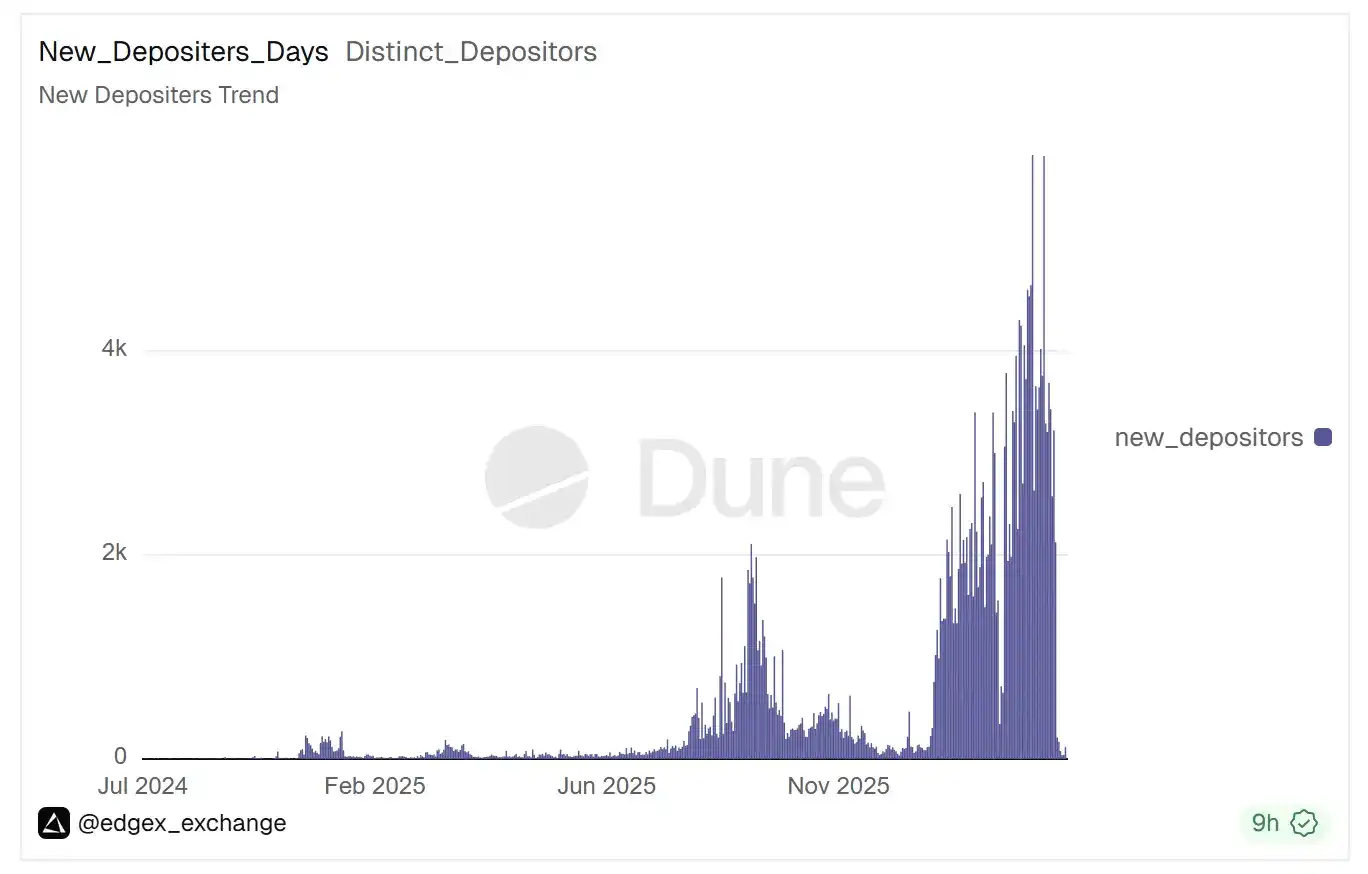
Taking edgeX as an example, in the days following the conclusion of the airdrop snapshot for this project, the number of new depositing users per day plummeted from over 2,000 to fewer than 50.
After the edgeX反向撸毛 (rug pull), what remains for the market is a series of question marks: How many people will continue to believe in "getting rich through airdrops"? As反向撸毛 (getting rugged) becomes the new normal and large numbers of airdrop hunters leave, will DeFi's trading activity and user stickiness continue to decrease?

When "反向撸毛" (reverse airdrops/rug pulls) evolve from isolated incidents into an industry consensus, the myth of getting rich through airdrops may have come to an end. For participants in the post-airdrop era, protecting the cash flow in hand might be more important than chasing those hard-to-verify "airdrop expectations."


Preguntas relacionadas

QWhat is the main controversy surrounding the edgeX airdrop distribution?

AThe main controversy is that edgeX applied different weights to user points without clear prior disclosure, resulting in unequal token distributions for users with the same number of points. Some users received 11 tokens per point while others received as low as 0.5, breaching expectations of fairness and transparency.

QHow did edgeX respond to the community's criticism regarding the airdrop?

AedgeX closed the comments section on its X (Twitter) account to suppress negative feedback and did not provide a transparent explanation for the unequal point weighting, only acknowledging that points from different sources had different weights.

QWhat allegations did KOLs like He Bi and Bing Wa make against edgeX?

AKOLs alleged that edgeX engaged in 'rat trading' (insider manipulation), where low-point affiliated addresses received a quarter of the total airdropped tokens, suggesting the project was designed to benefit insiders rather than the community.

QWhat impact did the airdrop snapshot have on edgeX's user activity?

AAfter the airdrop snapshot was completed, daily new depositing users on edgeX plummeted from over 2,000 to fewer than 50, indicating a collapse in user engagement once the airdrop incentive was removed.

QWhy does the article suggest that the edgeX incident could harm the broader DeFi ecosystem?

AThe incident undermines trust in airdrop predictability, which drives much of DeFi's trading volume and user activity. If users can no longer rely on fair rewards, engagement may decline, and the 'airdrop farming' economy could collapse.

Lecturas Relacionadas

Breaking: Google Earth Urgently Pulls Back Nano Banana 2 Image Generation Feature!

Google Earth's newly launched "Create image" feature, powered by the Nano Banana 2 AI image generation model, was abruptly withdrawn shortly after its release due to being "played" by users. The feature allowed users to generate and overlay AI-created visuals directly onto real-world satellite and 3D maps in Google Earth. The tool enabled creative applications like historical recreations (e.g., visualizing ancient Pompeii), generating informational graphics for landmarks, and envisioning architectural projects or futuristic cityscapes on real terrain. It operated under "geospatial grounding," meaning the AI respected the underlying geography, topography, and perspective of the chosen map view. The model also integrated with Gemini to retrieve relevant factual information. However, upon release, users quickly tested its limits. A prominent example involved reimagining Philadelphia's historic Independence Hall as a post-apocalyptic ruin overrun by "happy" zombies, evil clowns, and giant alien mechs. This highlighted both the feature's playful potential and its risks regarding the generation of inappropriate or misleading content on realistic maps, leading to its swift temporary removal. Google stated it would re-release the feature after implementing "enhanced guardrails." Analysts note this move strategically leverages Google's vast proprietary geospatial data, positioning its AI not just for artistic generation but for spatially accurate world visualization—a unique advantage in the competitive AI image generation landscape.

marsbitHace 14 min(s)

Breaking: Google Earth Urgently Pulls Back Nano Banana 2 Image Generation Feature!

marsbitHace 14 min(s)

Altman Admits: Overestimated AI Snatching Jobs! Huang Renxun: The Unemployment Narrative Is Completely Backwards

Sam Altman has revised his earlier predictions about AI rapidly replacing jobs, admitting he overestimated the speed at which AI would eliminate entry-level white-collar roles. Speaking on the "Invest Like the Best" podcast, he stated that people do not truly want an AI CEO, as accountability and human connection remain critical. He found that individuals prefer interacting with people who can be held responsible for decisions. Similarly, NVIDIA's Jensen Huang argued that the narrative of AI destroying jobs is misguided. He distinguishes between tasks and jobs, noting that while AI can automate specific tasks, entire jobs—encompassing communication, judgment, coordination, and accountability—are not eliminated. He cited examples like radiologists and software engineers, where demand for these roles has increased as AI handles repetitive tasks, allowing for business expansion and the creation of more positions. Data from a University of Maryland and LinkUp study supports this, showing that U.S. job postings for new graduates have actually risen, countering the fear of vanishing entry-level roles. However, a significant shift is occurring: the traditional entry-level tasks that help newcomers gain experience are being automated, making initial career access more challenging. The key insight is that as AI takes over standardized tasks, the enduring value of human work shifts toward areas of responsibility, trust-building, and final decision-making—aspects that AI cannot replicate. The real "moat" for professionals lies in these irreplaceable human elements.

marsbitHace 19 min(s)

Altman Admits: Overestimated AI Snatching Jobs! Huang Renxun: The Unemployment Narrative Is Completely Backwards

marsbitHace 19 min(s)

Weekly Editor's Picks (0725-0731)

Weekly Editor's Picks (0725-0731) provides a curated selection of deep analysis, filtering out market noise. Key themes from this week include: **Macro & Policy:** The Federal Reserve's upcoming meeting is marked by high uncertainty, balancing cooling inflation data against persistent price pressures. Meanwhile, the U.S. crypto regulatory Clarity Act faces critical political hurdles, with its 2026 passage probability seen as low. **Investing & Crypto:** Analysis suggests long-term crypto success depends on conviction through volatile cycles, focusing on assets like Bitcoin and core smart contract platforms. A trend noted is the increasing similarity between global equity markets (especially tech) and crypto, driven by narrative and leverage. Several major crypto protocols show strong revenue growth, but this isn't always translating to token price appreciation due to sell pressure and structural factors. **AI & Semiconductors:** Nvidia's rising credit default swap rates signal market concern over AI infrastructure financing risks. The storage sector experienced volatility as markets began pricing in potential 2027 oversupply. Despite a record profitable quarter, SK Hynix's results were deemed "below expectations," reflecting heightened investor demands for future growth visibility. **Markets & DeFi:** TradeXYZ demonstrated remarkable accuracy in pre-market pricing for a major A股 listing. The token ONDO saw gains, linked to its growing role in the on-chain tokenized stock ecosystem. **Ethereum:** Post-Pectra upgrade, a major structural shift is underway as Lido begins migrating millions of ETH to new validator architectures designed for capital efficiency. **Also Highlighted:** Butian's bullish stock market move; OpenAI's Altman promising major advances; Samsung and SK Hynix securing large AI chip deals; Apple reaching a $5T market cap; and ongoing discussions around exchange security following Poolin's bankruptcy case.

marsbitHace 54 min(s)

Weekly Editor's Picks (0725-0731)

marsbitHace 54 min(s)

Low Investment Isn't Apple's Immunity Pass

While Meta and Google face investor scrutiny over ballooning AI capital expenditures, Apple's minimal AI investment has paradoxically become a strength. Its market cap recently reclaimed the global top spot, surpassing $5 trillion. The irony is deep: Apple's own AI efforts have lagged, with "Apple Intelligence" delayed and core talent lost, forcing reliance on partners like Google Gemini and Alibaba's Qianwen. Its Q3 FY2026 (Q2 CY) earnings initially seemed stellar. Revenue hit $109.4B (up 16% YoY), with iPhone and Mac sales, growing 22% and 29% respectively, driving most of the growth. However, the stock fell over 8% post-earnings. The primary concern was a weaker Q4 revenue growth forecast of 9-11%, below expectations, due to looming supply chain constraints. Apple is feeling the indirect cost of the AI boom. Soaring memory and chip prices, fueled by massive data center investments from Microsoft, Amazon, and others, are forcing Apple to raise Mac and iPad prices significantly. The upcoming iPhone launch is also expected to see substantial price hikes. Despite avoiding heavy AI infrastructure spending—its capital expenditures are actually down 28%—Apple cannot escape the industry-wide supply and cost pressures. While Apple's operating cash flow remains robust, its substantial R&D spending (up 32% YoY) has yet to yield major AI breakthroughs. As Tim Cook prepares to step down as CEO, Apple faces a challenging transition: balancing its premium hardware success against the strategic and cost pressures of the AI era it has so far cautiously navigated.

marsbitHace 1 hora(s)

Low Investment Isn't Apple's Immunity Pass

marsbitHace 1 hora(s)

Trading

Spot
活动图片




