Failed BEAT push toward $4 threatens a correction below $2

ambcryptoPublicado a 2026-07-01Actualizado a 2026-07-01

Resumen

Audiera (BEAT) experienced a 12.4% price drop in 24 hours, with Open Interest falling 19.85%. Despite a 50% surge a week prior, the token failed to break past the $3.70 resistance and reach $4. The funding rate turned negative, indicating bearish sentiment. While the long-term structure remains bullish with a key low at $0.94 intact, technical indicators signal short-term weakness. The Chaikin Money Flow (CMF) is negative, showing capital outflows, and the MACD is bearish. Price action was rejected from a key supply zone (Fair Value Gap) between $3.04 and $3.68. Analysis of the 4-hour chart and liquidation heatmaps suggests a likely correction toward the $1.50 support level. The immediate trader recommendation is to wait. The bullish long-term trend conflicts with the current bearish momentum, leaving the market to determine if buyers can defend the $1.50 zone or if prices will fall further.

Audiera [BEAT] witnessed a 12.4% price correction in the past 24 hours. The Open Interest also slumped by 19.85% in the same time period. A week ago, the token gained 50% in a day and appeared to be recovering from a deep correction.

The funding rate was starting to turn negative, Coinalyze data warned. This meant that speculative traders were willing to pay funding to keep their positions open, signaling bearish market sentiment and aggressive short selling.

AMBCrypto had warned that sustained buying pressure is needed to keep BEAT’s bullish recovery going. Though the $2.64 local resistance was breached, the altcoin did not manage to clear the $3.70 hurdle and bound past $4.

The bullish long-term structure is at odds with BEAT expectations
Source: BEAT on TradingView

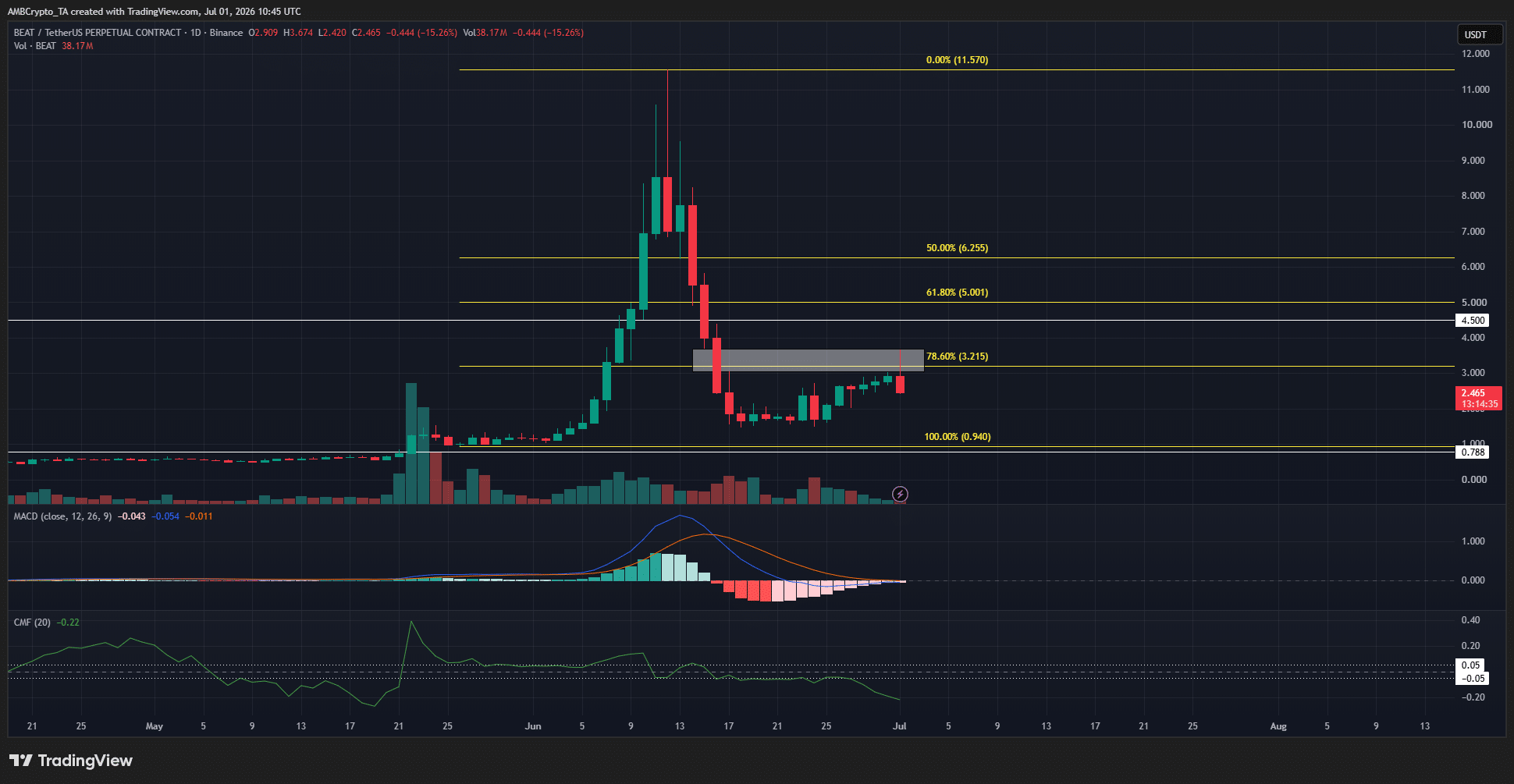
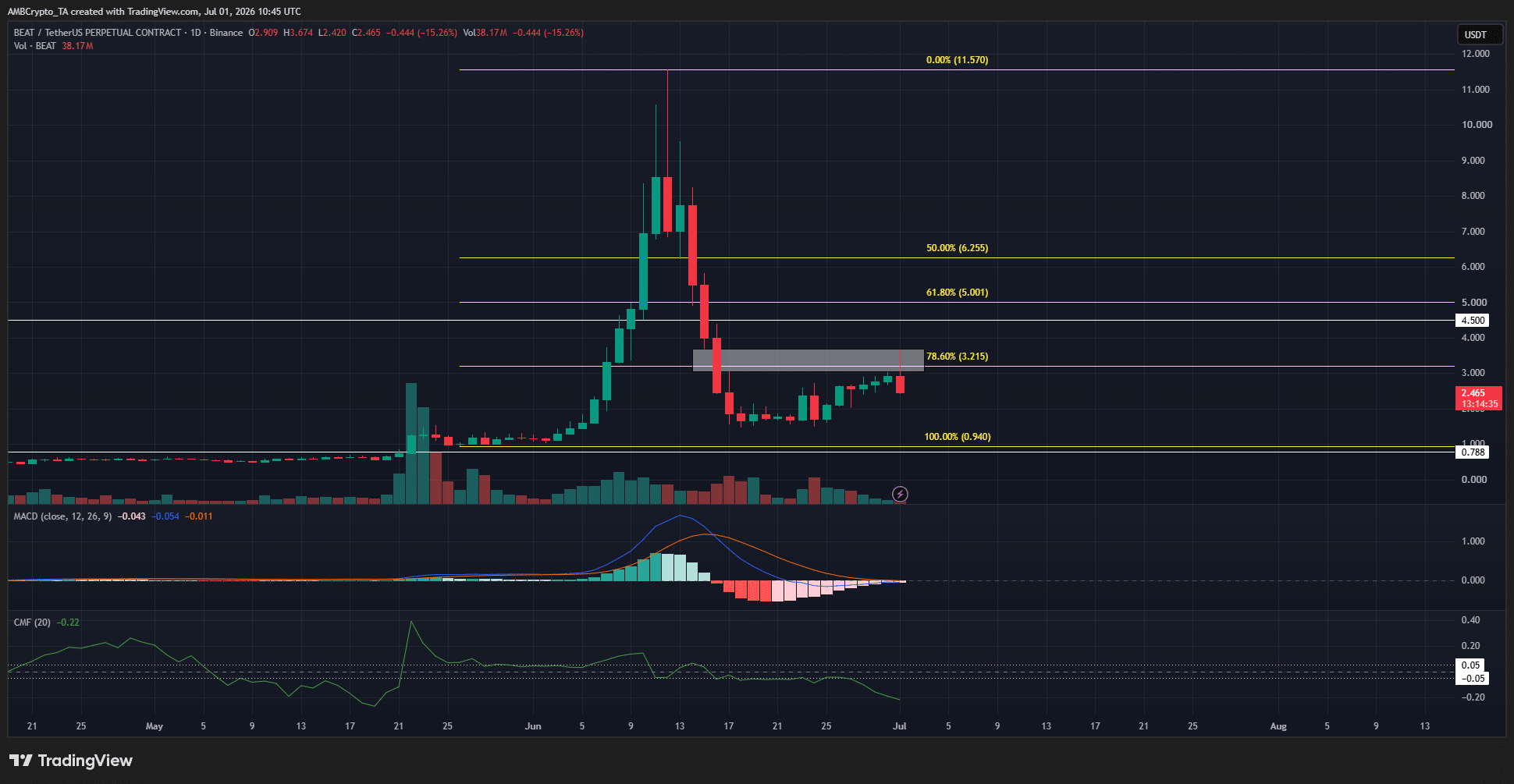
On the 1-day chart, the bullish swing structure remained intact. The swing low at $0.94 remained unbroken, keeping this upward bias alive. Yet, the technical indicators were flashing insistent warning signs.

The CMF was at -0.22, showing heavy capital outflows and selling pressure. The MACD was also moving below the zero line and has not undone the bearish crossover it made in mid-June.

Together, they capture the downward pressure on BEAT.

The price action also revealed a crucial clue. The fair value gap [white box] from $3.04-$3.68 was a key local supply zone. In recent hours of trading, Audiera token prices swept this area and have faced nearly 35% losses within 10 hours.

The failure to reclaim this FVG, which also coincided with the 78.6% Fibonacci retracement level, was a sign of bearish strength.

Traders’ call to action- Wait
Source: BEAT on TradingView

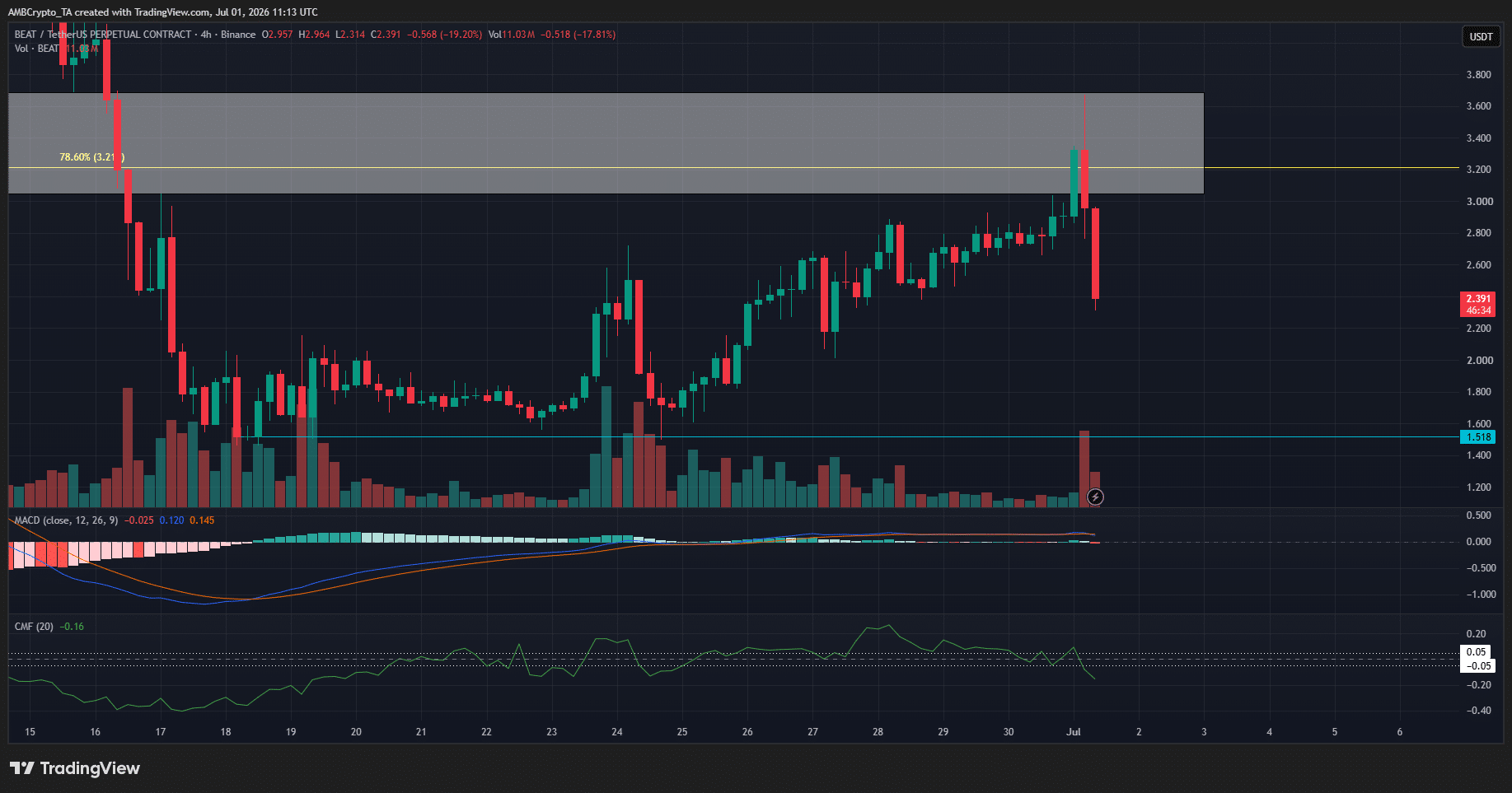
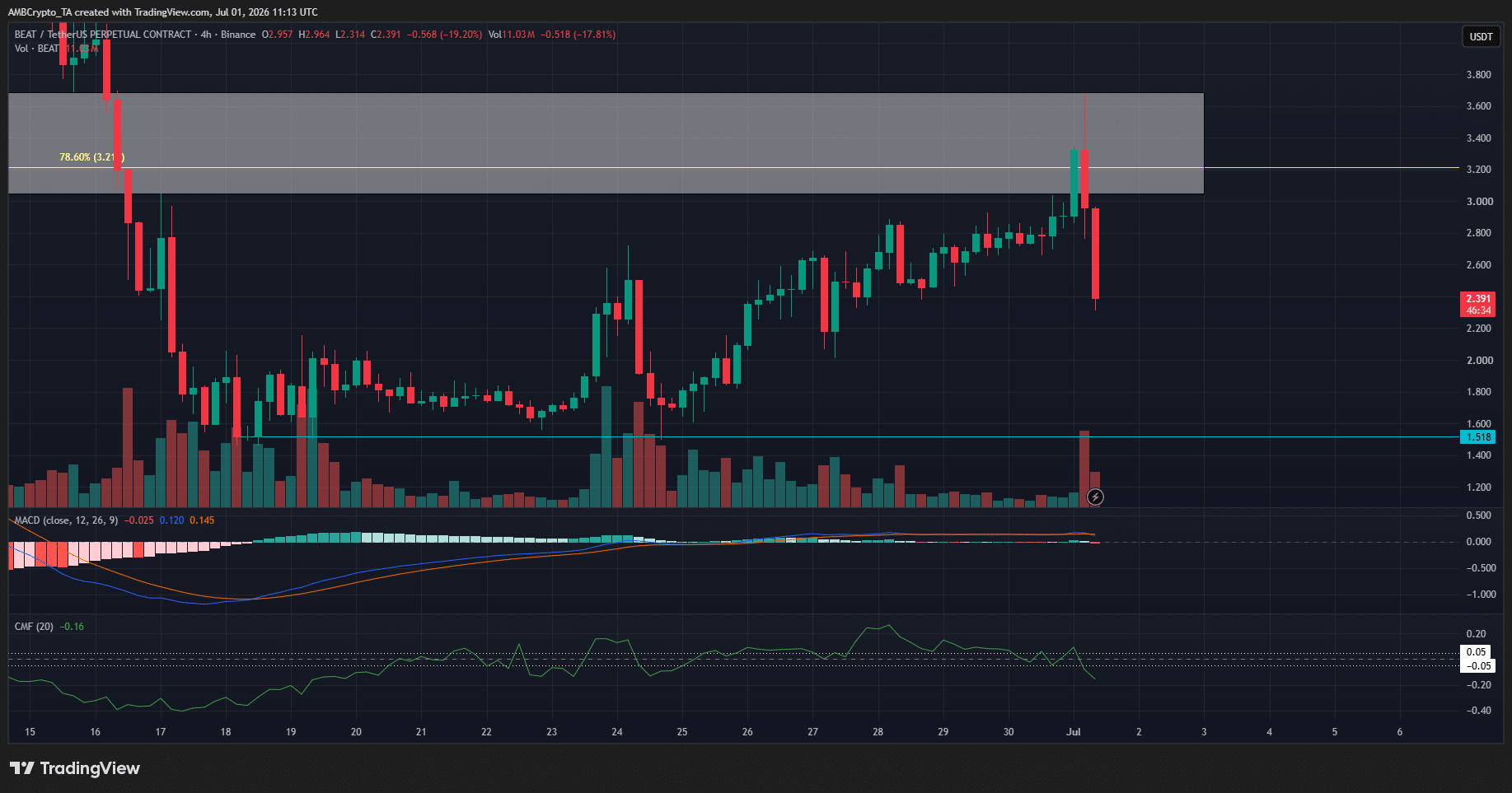
The 4-hour chart showcased the rejection from $3.68 better. Though the short-term structure is bullish, the CMF has flipped negative, and the MACD made a bearish crossover.

It appeared that a price drop was likely. The $1.51 local support zone needs to be breached to give traders a clear sell signal.
Source: CoinGlass

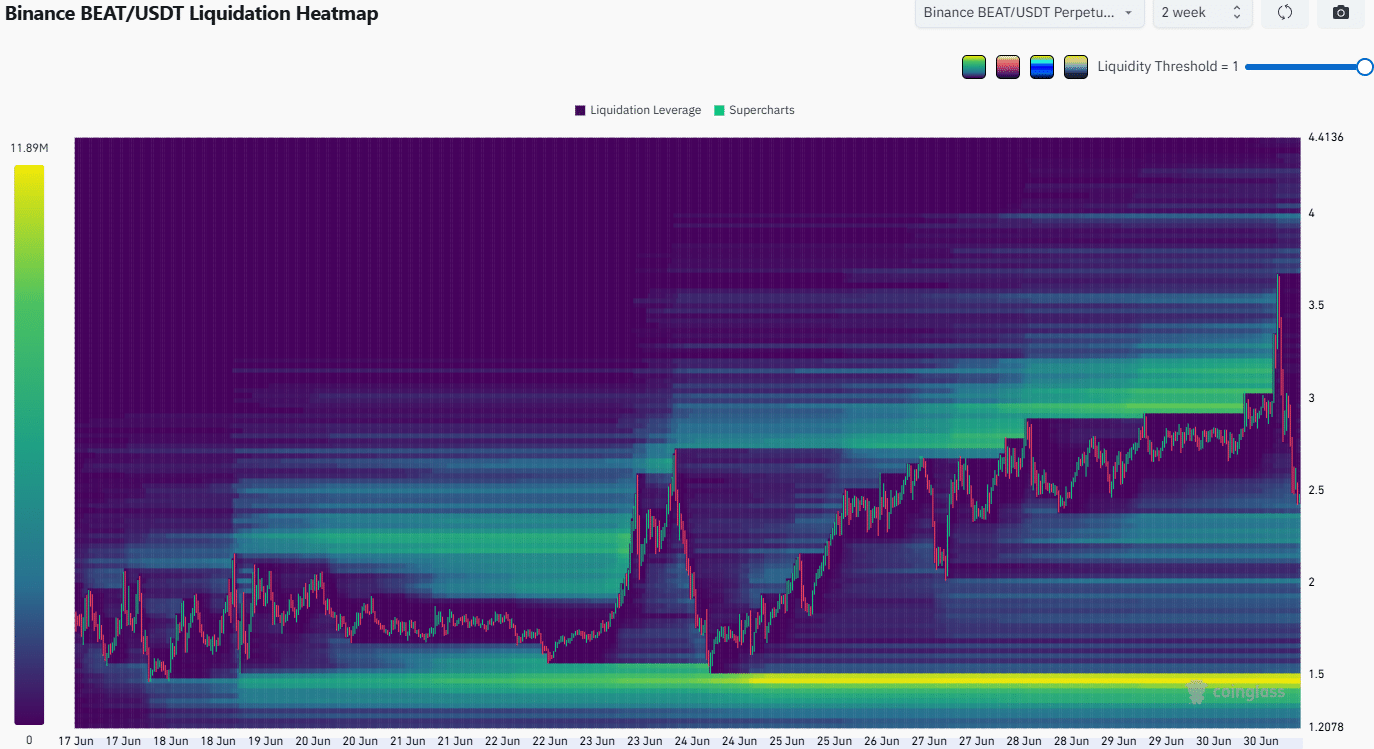
The liquidity around $3 has been swept, and the $1.5 area is the next magnetic zone of interest, the liquidation heatmap concurred.

This is the short-term expectation for BEAT- a potential correction toward $1.5. It remains to be seen if the buyers are strong enough to defend this local support, or if the market-wide malaise would beat down BEAT prices.


Final Summary

  • The BEAT long-term price structure remained bullish.
  • The rejection from above the $3 supply zone indicated bears have the upper hand in the short-term and could force a correction towards $1.50.


Criptos en tendencia

Preguntas relacionadas

QAccording to the article, what were the key percentage changes for BEAT's price and Open Interest in the past 24 hours?

AIn the past 24 hours, BEAT's price corrected by 12.4% and its Open Interest slumped by 19.85%.

QWhat specific technical indicators and price levels does the article cite as evidence of the current downward pressure on BEAT?

AThe article cites the CMF at -0.22 (showing capital outflows), the MACD below the zero line with a persistent bearish crossover, and the failure to reclaim the fair value gap/Fibonacci level at $3.04-$3.68 as key evidence of downward pressure.

QWhat is identified as the crucial local support level that, if breached, would give a clear sell signal for BEAT?

AThe $1.51 local support zone is identified as the crucial level. A breach of this support would give traders a clear sell signal.

QWhat contradictory signals does the article highlight between BEAT's long-term and short-term outlook?

AThe article highlights that while the long-term bullish swing structure (with a swing low at $0.94 unbroken) remains intact, the short-term indicators like negative CMF, bearish MACD crossover, and rejection from key resistance levels suggest a potential correction is likely.

QBased on the liquidity heatmap and price action analysis, what is the next key 'magnetic zone' or price target for a potential BEAT correction?

ABased on the liquidation heatmap and price action, the $1.5 area is identified as the next key magnetic zone or target for a potential BEAT correction.

Lecturas Relacionadas

Predicting World Cup Knockout Matches: Why Are Different AI Models So Far Apart?

AI performance in predicting the 2026 FIFA World Cup knockout matches varied significantly, according to an analysis of models including ChatGPT, Grok, DeepSeek, Gemini, and Claude. The standout predictions came from DeepSeek and Gemini for the Netherlands vs. Morocco match. Gemini precisely forecasted a 1-1 draw and a penalty shootout win for Morocco, while DeepSeek correctly identified the high probability of a draw and Morocco's potential to advance via a defensive and counter-attacking strategy. Grok and Tongyi Qianwen (千问) demonstrated strength in predicting accurate scores for matches with clearer favorites. They correctly called the narrow 1-0 win for Canada over South Africa and Brazil's 2-1 victory over Japan, as well as Norway's 2-1 win over Ivory Coast. ChatGPT and Claude excelled more in match process analysis than in predicting exact scores or upsets. They frequently identified potential challenges for favorites, such as Japan's pressing against Brazil or DR Congo's defensive tactics against England, even when predicting the favorite's ultimate victory. A notable failure was the unanimous misjudgment of Germany vs. Paraguay. All models incorrectly favored Germany, underestimating Paraguay's ability to force a penalty shootout and cause an upset. In summary, Gemini and DeepSeek showed the most insight for high-stakes, unpredictable matches. Grok and Qianwen were reliable "score predictors" for less volatile games. ChatGPT and Claude were strong "analytical models," adept at outlining match dynamics but often hesitant to predict upsets.

Odaily星球日报Hace 11 min(s)

Predicting World Cup Knockout Matches: Why Are Different AI Models So Far Apart?

Odaily星球日报Hace 11 min(s)

Will There Be a Next Wave of Web3 Games? Veteran Player's Review: At the Peak of Hype, You Should at Least Sell Half

**Title: Is There Another Wave for Web3 Gaming? A Veteran Player's Review: When Hype Peaks, You Must Exit at Least Half** **Summary:** In an interview, veteran player "Earn Money Chicken" shares his journey and reflections on Web3 gaming. He transitioned from being a traditional in-game trader to a Web3 gamer, having profited from games like Mobox, StepN, and Seraph, but also experiencing significant losses. He defines himself primarily as a player, not an investor, attracted to Web3 games for the blend of earning potential, engaging gameplay, and the satisfaction of researching game mechanics. While he enjoys strategic "gambling" within games, he emphasizes it's not about zero-sum competition with other players. The interview explores the complex, often adversarial relationship between players, projects, and major investors (whales). The player's experience as a traditional game merchant helped develop his analytical mindset for spotting opportunities, but wasn't directly transferable. He identifies the core sources of profit in early Web3 gaming as **"era红利" (era-specific红利)** and strategic foresight, not just simple calculations. He warns that the biggest mistake ordinary players make is calculating their return-on-investment (ROI) period at peak hype, as asset and yield depreciation can trap them. Reflecting on his wins and losses, he now advocates for managing expectations. His most successful exit was from Seraph, where he sold at a relatively good time. The key problem with current Web3 games, he argues, is that most are not mature games first. A successful Web3 game must primarily be a **good, fun game** with a genuine player base willing to spend money for enjoyment, not just participants seeking profit. The blockchain element should solve problems within that context, not be the primary driver. While he believes the sector might see another speculative boom (possibly another strong "Ponzi" model attracting hype), a truly mature and sustainable Web3 game likely needs to come from a traditional major game studio. It would leverage a proven IP, mature content, a functional NFT trading system, and attract both traditional and crypto-native players, offering more normalized returns rather than extreme暴利. His final advice: Newcomers without prior experience should avoid the space now, as it's like searching for a diamond in the rough. For those remaining, the rule is: be brave when assets are low and overlooked, but **when everyone is talking about it (at peak hype), you must sell at least half your holdings.**

marsbitHace 56 min(s)

Will There Be a Next Wave of Web3 Games? Veteran Player's Review: At the Peak of Hype, You Should at Least Sell Half

marsbitHace 56 min(s)

The Most Hidden AI Winners

"The Most Under-the-Radar AI Winners" While core AI giants and their direct suppliers have dominated headlines, a group of seemingly unrelated, decades-old manufacturing companies have emerged as major beneficiaries. A key example is Japan's TOTO, famous for bathroom fixtures. Its stock soared 145% in a year, driven not by its mainstay toilet business but by its nearly 40-year-old semiconductor ceramic component unit. Specifically, TOTO manufactures electrostatic chucks—critical, hard-to-replace parts for advanced chip manufacturing processes like etching and EUV lithography. This segment, though only 9% of revenue, contributed over 54% of operating profit in FY2025 with a 43% margin. High barriers to entry, including deep know-how in high-purity ceramic sintering and long supplier certification cycles (5+ years), secure its position. This pattern repeats across industries. Nitto Boseki, a 128-year-old glass fiber maker, saw its stock rise 325% due to near-monopoly supply of T-glass, an essential low-expansion material for AI chip substrates. Similarly, Ajinomoto, the global MSG leader, commands 80-95% of the market for ABF film, a vital insulating layer in chip packaging. These "hidden" segments, often born from deep materials science expertise, are now bottleneck supplies in the AI hardware chain, enjoying pricing power and high margins. In China's A-share market, the theme combines this AI-driven demand with domestic substitution. Companies like Zhongci Electronic (advancing in electrostatic chucks) and Honghe Technology & Feilihua (in high-end electronic glass fabrics) are gaining traction. The investment thesis hinges on whether these domestic players can rapidly scale qualified capacity to capture the supply gap within the critical time window. Ultimately, these cases show that in the AI supply chain, high-profit concentrations exist not only at the cutting-edge tech frontier but also in indispensable, difficult-to-replicate materials and components. Market recognition often lags behind fundamental profit shifts, creating potential for significant re-ratings as traditional industrial firms are re-evaluated as key enablers of advanced semiconductor manufacturing.

marsbitHace 1 hora(s)

The Most Hidden AI Winners

marsbitHace 1 hora(s)

Trading

Spot

Artículos destacados

Cómo comprar 4

¡Bienvenido a HTX.com! Hemos hecho que comprar 4 (4) sea simple y conveniente. Sigue nuestra guía paso a paso para iniciar tu viaje de criptos.Paso 1: crea tu cuenta HTXUtiliza tu correo electrónico o número de teléfono para registrarte y obtener una cuenta gratuita en HTX. Experimenta un proceso de registro sin complicaciones y desbloquea todas las funciones.Obtener mi cuentaPaso 2: ve a Comprar cripto y elige tu método de pagoTarjeta de crédito/débito: usa tu Visa o Mastercard para comprar 4 (4) al instante.Saldo: utiliza fondos del saldo de tu cuenta HTX para tradear sin problemas.Terceros: hemos agregado métodos de pago populares como Google Pay y Apple Pay para mejorar la comodidad.P2P: tradear directamente con otros usuarios en HTX.Over-the-Counter (OTC): ofrecemos servicios personalizados y tipos de cambio competitivos para los traders.Paso 3: guarda tu 4 (4)Después de comprar tu 4 (4), guárdalo en tu cuenta HTX. Alternativamente, puedes enviarlo a otro lugar mediante transferencia blockchain o utilizarlo para tradear otras criptomonedas.Paso 4: tradear 4 (4)Tradear fácilmente con 4 (4) en HTX's mercado spot. Simplemente accede a tu cuenta, selecciona tu par de trading, ejecuta tus trades y monitorea en tiempo real. Ofrecemos una experiencia fácil de usar tanto para principiantes como para traders experimentados.

780 Vistas totalesPublicado en 2025.10.20Actualizado en 2026.06.02

Cómo comprar 4

Discusiones

Bienvenido a la comunidad de HTX. Aquí puedes mantenerte informado sobre los últimos desarrollos de la plataforma y acceder a análisis profesionales del mercado. A continuación se presentan las opiniones de los usuarios sobre el precio de 4 (4).

活动图片