Predicting World Cup Knockout Matches: Why Are Different AI Models So Far Apart?

Odaily星球日报Publicado a 2026-07-02Actualizado a 2026-07-02

Resumen

AI performance in predicting the 2026 FIFA World Cup knockout matches varied significantly, according to an analysis of models including ChatGPT, Grok, DeepSeek, Gemini, and Claude. The standout predictions came from DeepSeek and Gemini for the Netherlands vs. Morocco match. Gemini precisely forecasted a 1-1 draw and a penalty shootout win for Morocco, while DeepSeek correctly identified the high probability of a draw and Morocco's potential to advance via a defensive and counter-attacking strategy. Grok and Tongyi Qianwen (千问) demonstrated strength in predicting accurate scores for matches with clearer favorites. They correctly called the narrow 1-0 win for Canada over South Africa and Brazil's 2-1 victory over Japan, as well as Norway's 2-1 win over Ivory Coast. ChatGPT and Claude excelled more in match process analysis than in predicting exact scores or upsets. They frequently identified potential challenges for favorites, such as Japan's pressing against Brazil or DR Congo's defensive tactics against England, even when predicting the favorite's ultimate victory. A notable failure was the unanimous misjudgment of Germany vs. Paraguay. All models incorrectly favored Germany, underestimating Paraguay's ability to force a penalty shootout and cause an upset. In summary, Gemini and DeepSeek showed the most insight for high-stakes, unpredictable matches. Grok and Qianwen were reliable "score predictors" for less volatile games. ChatGPT and Claude were strong "analytical mo...

Original | Odaily Planet Daily(@OdailyChina)

Author | Asher(@Asher_ 0210)
Before each World Cup match, I always have AI models make predictions. Almost every model makes logical and detailed arguments.

Some discuss team value, some break down group stage data, some analyze injuries and tactics, and others directly give scripts for scorelines, extra time, and penalty shootouts. At first glance, ChatGPT, Grok, Qwen, DeepSeek, Gemini, and Claude all seem to know football well.

But as a user of prediction markets, what I really care about is not which model provides the most complete analysis, but which one is more worthy of reference.

As the World Cup entered the knockout stage, Odaily Planet Daily began asking different AI models the same questions before each match from the first game, and then checked back against the real results afterwards—which models just sounded plausible, and which ones truly foresaw the match outcome in advance.

So far, in the concluded World Cup knockout matches: Canada narrowly defeated South Africa 1-0, Brazil edged Japan 2-1, Germany was eliminated by Paraguay after being dragged into a penalty shootout, and the Netherlands also fell to Morocco on penalties. The Belgium vs. Senegal match was even more dramatic, ending 2-2 in regulation before an extra-time turnaround, fully highlighting the unpredictability of knockout football.

DeepSeek and Gemini: Gained Fame by Predicting the Morocco Match

The most memorable predictions so far are from DeepSeek and Gemini for the Netherlands vs. Morocco match. It was easy to pick the wrong side before this game—the Netherlands appeared stronger on paper and had a more complete squad. Many models acknowledged Morocco would be tough, but ultimately trusted the Netherlands to advance.

The brilliance of DeepSeek and Gemini lies in not stopping at "this will be a tight match." They wrote the subsequent script. Gemini predicted a 1-1 draw in regulation time and a penalty shootout win for Morocco before the match. The match indeed ended 1-1, with Morocco winning 3-2 on penalties. They didn't just guess the direction correctly; they basically predicted how the match would reach penalties and who would prevail.
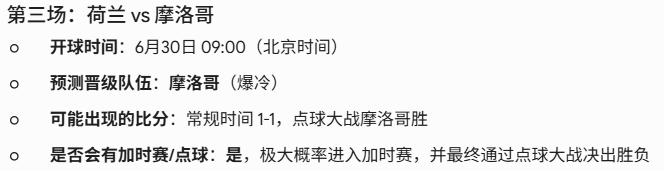
Gemini's prediction for the Netherlands vs. Morocco match

DeepSeek was also very close. It judged that the match was most likely to end 1-1 or 0-0 in regulation, could go to extra time or even penalties, and leaned towards Morocco causing an upset with defense and counter-attacks.
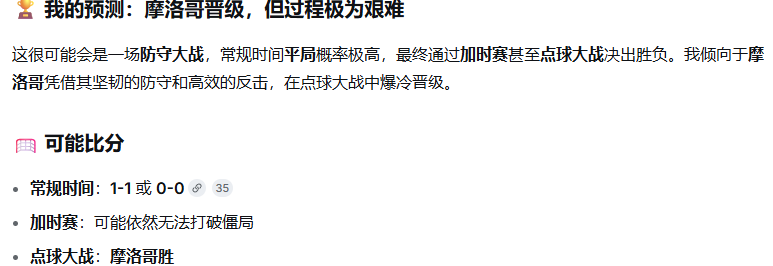
DeepSeek's prediction for the Netherlands vs. Morocco match

After this match, DeepSeek and Gemini's presence skyrocketed. Especially Gemini, this time it didn't seem like making a pre-match prediction, but more like having read the match script in advance.

Grok and Qwen Consistently Nailed Exact Scores, More Stable Than Expected

Besides DeepSeek and Gemini's highlight in the Morocco match, Grok and Qwen also made their presence felt. Their most impressive aspect is that in matches with relatively clear favorite outcomes, they not only correctly predicted the advancing team but also forecasted scores quite close to the final results.

South Africa vs. Canada is an example. Most AI models favored Canada before the match, but the分歧 was whether Canada would win comfortably. Grok predicted a 1-0 win for Canada, and Qwen also predicted a narrow one-goal victory. In the end, Canada advanced with just one goal, not the imagined big win.

Qwen's prediction for the South Africa vs. Canada match

Brazil vs. Japan was similar. Most AI models thought Brazil was stronger, but whether Japan could keep the match tight was the key. Both Grok and Qwen predicted a 2-1 scoreline, and the match indeed ended with Brazil narrowly winning 2-1. They correctly foresaw not just "Brazil will win," but that Japan could cause enough trouble.

They were also quite accurate for Ivory Coast vs. Norway. Norway, with Haaland, was an understandable favorite, but Ivory Coast's physicality and wing attacks wouldn't make it one-sided. Both Grok and Qwen predicted a 2-1 win for Norway, which matched the final "script."
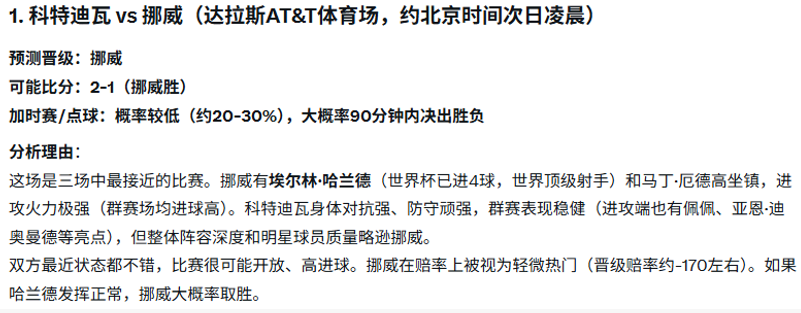
Grok's prediction for the Ivory Coast vs. Norway match

The advantage of Grok and Qwen is their detailed analysis of favored matches. They didn't write the grand script of Morocco eliminating the Netherlands in advance, but in matches involving Canada, Brazil, Norway, France, etc., they gave predictions for the outcome direction and score that were quite accurate. In other words, they might not be the best at spotting upsets, but they are skilled at judging whether a favorite will cruise through or struggle to a narrow win.

ChatGPT Didn't Have Many Miraculous Scores, But Its Match Process Analysis Was Quite Accurate

ChatGPT didn't pull off a prediction like Gemini's for Morocco eliminating the Netherlands on penalties, nor did it consecutively hit exact scores like Grok and Qwen. But its strength—in many matches where the favorite seemed clear before the game, ChatGPT would more noticeably remind that the match might not be that easy.

Brazil vs. Japan is an example. ChatGPT predicted Brazil would advance but didn't portray it as a comfortable rout. It mentioned Japan's pressing, running, and discipline would make Brazil uncomfortable, even having a chance to score first or equalize. Ivory Coast vs. Norway was similar; ChatGPT predicted Norway's advancement but warned it wouldn't be an easy game, highlighting Ivory Coast's physicality, wing attacks, and transition ability would cause problems.

Additionally, for the England vs. DR Congo knockout match, ChatGPT didn't simply predict an England rout. It suggested the match might be cagey, with DR Congo using low-block defense to slow the tempo. England eventually advanced but didn't win comfortably.
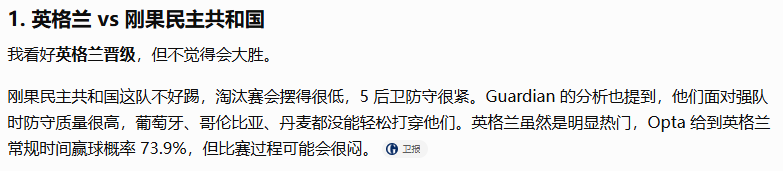
ChatGPT's prediction for the England vs. DR Congo match

ChatGPT's strength lies not in always predicting scores accurately, but often in identifying where the resistance in a match will come from in advance. It's well-suited for understanding the dynamics of a match, but less so if one only wants a final score prediction. It can describe the process accurately, but when it comes to calling a major upset, it often lacks decisive conviction.

Germany's Exit Became a Collective AI Model Wreck

If previous matches showed the highlights of different models, then Germany vs. Paraguay was a collective failure.

Before the match, all AI models sided with Germany. ChatGPT, Grok, Qwen, Gemini, Claude all favored Germany, with score predictions mostly集中在 2-0, 3-0, or 3-1. The reasoning was consistent: all believed Germany was stronger on paper, had better squad depth, and more firepower.

But this was the match where things went wrong. The AI models underestimated Paraguay's ability to drag the match into a quagmire. Germany failed to settle it in regulation, couldn't break the deadlock in extra time, and was eventually dragged into a penalty shootout and eliminated by Paraguay.

Who's Most Accurate So Far?

Judging from the concluded knockout matches, different models are starting to show their characteristics.

DeepSeek and Gemini have the most highlights. They not only predict advancements for favorites like Brazil and France but also provide valuable answers in harder-to-call upset matches. For the Netherlands vs. Morocco match, their key advantage was daring to write the script for a Morocco upset and penalty shootout in advance. Especially Gemini, directly predicting Morocco's penalty victory was truly brilliant for this match.

Grok and Qwen are more like "score-type predictors." They hit many exact scores, performing well especially in matches involving Canada, Brazil, Norway, and France. The problem is, when facing traditional powerhouses like Germany or the Netherlands, they ultimately leaned towards the favorite.

ChatGPT and Claude are more like "analysis-type predictors." Their reasoning is well-written, their direction is mostly on point, and they can warn about risks like extra time. The issue is, they often see that a match will be tough but are reluctant to conclude with an upset. The Netherlands vs. Morocco was a case in point; they saw the risks of extra time and penalties but still trusted the Netherlands more.

So, rather than hastily asking which model knows football best, it's better to see which scenarios they are respectively suited for.


Preguntas relacionadas

QWhich AI models stood out for their prediction of the Netherlands vs. Morocco match, and what made them remarkable?

ADeepSeek and Gemini stood out. Gemini correctly predicted a 1:1 draw in regular time and a penalty shootout victory for Morocco, while DeepSeek accurately foresaw a tight, low-scoring match likely going to extra time or penalties, with Morocco having a chance to advance.

QWhat was a key strength of Grok and Qianwen in the context of these World Cup knockout predictions?

AGrok and Qianwen excelled at predicting specific, accurate final scores in matches where the favored team was expected to win. They correctly called close scorelines like Canada's 1:0 win over South Africa and Brazil's 2:1 win over Japan, demonstrating precision in judging how difficult a win would be for the favorite.

QHow did ChatGPT generally perform compared to other models, according to the article?

AChatGPT was described as an 'analytical model.' Its strength was not necessarily predicting exact scores or major upsets, but in accurately identifying potential difficulties and key tactical battles within a match, such as warning that a favored team might not have an easy game.

QWhich match was a collective failure for all the AI models mentioned?

AThe Germany vs. Paraguay match was a collective failure. All models (ChatGPT, Grok, Qianwen, Gemini, Claude) predicted a German victory with comfortable scorelines like 2:0 or 3:0. They underestimated Paraguay's ability to drag the game into a stalemate, which ultimately led to a penalty shootout and Germany's elimination.

QWhat is the article's main conclusion about comparing the different AI models for predictions?

AThe article concludes that instead of declaring one model as definitively 'the best,' it's more useful to understand their different strengths and suitable scenarios: DeepSeek and Gemini for capturing potential upsets, Grok and Qianwen for precise score predictions in favored-team matches, and ChatGPT/Claude for detailed match process and difficulty analysis.

Lecturas Relacionadas

Ray Dalio's Latest Macro Analysis Full Text: Buy More Gold, Add Some Bitcoin

In his latest macro analysis, Ray Dalio applies his framework from "How Countries Go Broke: The Big Cycle" to the current global debt environment. He highlights recent events like Japan selling U.S. Treasuries and rising U.S. long-term yields as signs of an unsustainable debt dynamic. Dalio explains that excessive government debt leads to either unacceptably high interest rates, severe economic downturns, or significant currency debasement through central bank money printing. He summarizes the U.S. fiscal situation: with $5.5 trillion in revenue, $7.5 trillion in spending, a $2 trillion deficit, and total debt at six times annual revenue, debt servicing costs are immense. Without correction, U.S. debt could reach $55-$60 trillion in a decade. Dalio proposes a "3% Three-Way" solution: reducing the budget deficit to 3% of GDP through balanced spending cuts, tax increases, and interest rate reductions to avoid a traumatic adjustment. In response to FAQs, he argues that the risk of a U.S. debt crisis is high and could materialize within a few years if the current path continues. He dismisses the notion that the dollar's reserve status makes the U.S. immune, citing historical precedents of reserve currency declines. He is also unconvinced by Japan's high-debt stability, noting poor returns for yen-denominated assets. For investors, Dalio recommends diversifying globally, underweighting bonds, and overweighting assets like gold and a small allocation to Bitcoin (around 10-15% to gold) to hedge against currency debasement and poor debt returns.

marsbitHace 45 min(s)

Ray Dalio's Latest Macro Analysis Full Text: Buy More Gold, Add Some Bitcoin

marsbitHace 45 min(s)

Stripe’s 16-Year Chronicle: From 7 Lines of Code to a $100 Billion Valuation

Stripe's 16-year journey began with a simple promise: "7 lines of code to accept payments." Founded by Patrick and John Collison, the company started by hiding the complexity of bank integrations and merchant accounts behind a clean API, initially targeting developers at startups. This early focus on user experience and technical simplicity fueled rapid adoption. A key early milestone was establishing vital bank partnerships, a challenge overcome by hiring Billy Alvarado, who brought crucial institutional relationship skills. From this foundation, Stripe systematically expanded its product boundaries. It launched Connect for platform payments, Atlas for company formation, Radar for fraud prevention, and Billing for subscriptions. This transformed Stripe from a payment processor into a broader financial infrastructure suite for internet businesses. The COVID-19 pandemic accelerated growth but also led to over-hiring. A 14% layoff in 2022 marked a period of organizational correction. Subsequently, Stripe shifted its growth strategy towards strategic acquisitions to enter new domains quickly. It acquired Bridge (stablecoin infrastructure), Privy (wallet infrastructure), Metronome (usage-based billing), and agreed to buy OpenRouter (AI model routing). These moves signal Stripe's ambition to build a "programmable money system" for the emerging AI and agent-based economy, managing not just currency flows but also the measurement and pricing of computational resources like AI tokens. Internally, Stripe leverages AI agents (like "Minions") to boost engineering productivity. Despite scaling to nearly 8,000 employees and processing $1.9 trillion in payment volume annually, the company remains private. A recent employee tender offer valued it at $159 billion. The core question for Stripe's future is whether it can successfully integrate its expanding product matrix—spanning payments, crypto, and AI infrastructure—into a cohesive platform, positioning itself as the foundational economic layer for autonomous software agents.

marsbitHace 1 hora(s)

Stripe’s 16-Year Chronicle: From 7 Lines of Code to a $100 Billion Valuation

marsbitHace 1 hora(s)

Treasury Secretary's Move to Suppress Treasury Yields Ignites 'Currency Debasement Trade'! Gold Hits Three-Month High, Bitcoin Surges Over 25% in a Single Week

US Treasury Secretary Besant's efforts to lower long-term Treasury yields by announcing expanded buybacks had only a brief market impact. However, this move fueled a "currency devaluation trade," weakening the US dollar while boosting both gold (to a three-month high) and Bitcoin (up over 25% for the week). Analysts attribute this reaction to deepening market concerns over the massive US fiscal deficit and structural pressures keeping long-term rates elevated, including fierce competition for capital from global government borrowing and massive AI sector financing. Despite the Treasury's actions, fundamental forces like growth, inflation, and capital demand are seen as limiting its ability to sustainably suppress yields. Bitcoin's strong positive correlation with gold has reinforced its narrative as a hedge against devaluation. While equity markets have shown resilience, some strategists warn that Treasury yields nearing 5% increase pressure on the dollar and high-leverage assets. Figures like Ray Dalio have advised reducing bond exposure in favor of gold and some Bitcoin, citing US debt risks. Market opinions are divided on the sustainability of the devaluation trade, with some noting the lack of a near-term catalyst for its next leg higher. The underlying tension between the Treasury's desire for lower borrowing costs and the Federal Reserve's focus on inflation and reducing market intervention remains a key theme. Upcoming events like Nvidia's earnings and the Jackson Hole symposium will test whether AI profits can continue supporting stocks and if the Fed aligns more with Washington's preference for easier financial conditions.

华尔街日报Hace 3 hora(s)

Treasury Secretary's Move to Suppress Treasury Yields Ignites 'Currency Debasement Trade'! Gold Hits Three-Month High, Bitcoin Surges Over 25% in a Single Week

华尔街日报Hace 3 hora(s)

Alexander Shokhin: Business Needs an Interest Rate Below 10% and the Dollar at 90-95 Rubles

Alexander Shokhin, head of the Russian Union of Industrialists and Entrepreneurs (RSPP), has advocated for potentially using "non-market" tools to keep the ruble within a target exchange rate corridor. This, he argues on August 21, would help avoid excessive volatility, though he called the topic a separate discussion. Shokhin had previously raised the idea of a currency corridor in late May, noting the ruble's current exchange rate is not fully market-driven due to a limited currency segment and reduced foreign currency demand. He stated that many business community colleagues propose fixing a corridor, even through non-market methods, to ensure predictability. The business community's key targets, as outlined by Shokhin in late December 2025, are a Central Bank key rate of 12%, inflation of 4–5%, and a US dollar exchange rate of 90–95 rubles by the end of 2026. A turning point for investment, he said, would be lowering the rate to 12% with 6% inflation, though truly comfortable business conditions would require a rate below 10%. He stressed the critical importance of currency predictability for corporate investment decisions. From a data analysis perspective, the idea of a ruble corridor is not new. A similar mechanism was used in Russia from 1995 to 1998, where the central bank held the dollar within fixed boundaries through regular interventions. This regime lasted three years before ending abruptly during the 1998 default, illustrating the fragility of rigid targets under external shocks. The macro-economic link is clear: stricter corridors require more reserves to defend against currency pressure. The key unresolved technical aspect is the specific sources and volume of such interventions given the current market's limited liquidity. Whether this discussion remains theoretical or leads to concrete corridor parameters will be seen in the coming months.

cryptonews.ruHace 4 hora(s)

Alexander Shokhin: Business Needs an Interest Rate Below 10% and the Dollar at 90-95 Rubles

cryptonews.ruHace 4 hora(s)

Trading

Spot
活动图片