ETH Rises 29% Weekly, Whales Both Shorting and Buying the Dip: What Signal Does This Send?

Publicado a 2026-08-25Actualizado a 2026-08-25

Resumen

Ethereum is currently under significant pressure, but the trend is leaning bullish and may continue, with the next target price being $2,800.

As of press time, Ethereum (ETH) is trading around $2,452, up 2.69% on the daily chart, extending its weekly gain of 29%. After a surge to $2,546 at one point, the Ethereum price has retraced and now appears to be in a consolidation phase. The price of the altcoin has been fluctuating between $2,400 and $2,500.

Amidst these market changes, some individuals and institutions have positioned themselves strategically, while others have opted to cash out.

Abraxas Capital increases its Ethereum holdings by $173 million.

Abraxas Capital has been actively shorting the market. Despite the recent price surge, the firm seems to anticipate another round of correction.

Consequently, the firm has established a short position of $783 million on the Hyperliquid platform. However, given the risks associated with such high leverage, the firm has turned to the spot market for hedging.

According to Lookonchain data, Abraxas Capital purchased 73,872 ETH worth $173.17 million from Binance over the past four days.

This move indicates a complex risk management strategy, hoping one side can absorb the risk from the other. Typically, such a large spot purchase would increase demand, thereby alleviating market pressure.

Why is Ethereum still under pressure?

Interestingly, as the market rebounded, investors who were previously at a loss significantly increased their selling.

For example, Binance's net flow has remained positive for five consecutive days. The net flow for all exchanges has also remained positive for two consecutive days, currently standing at around 2300.
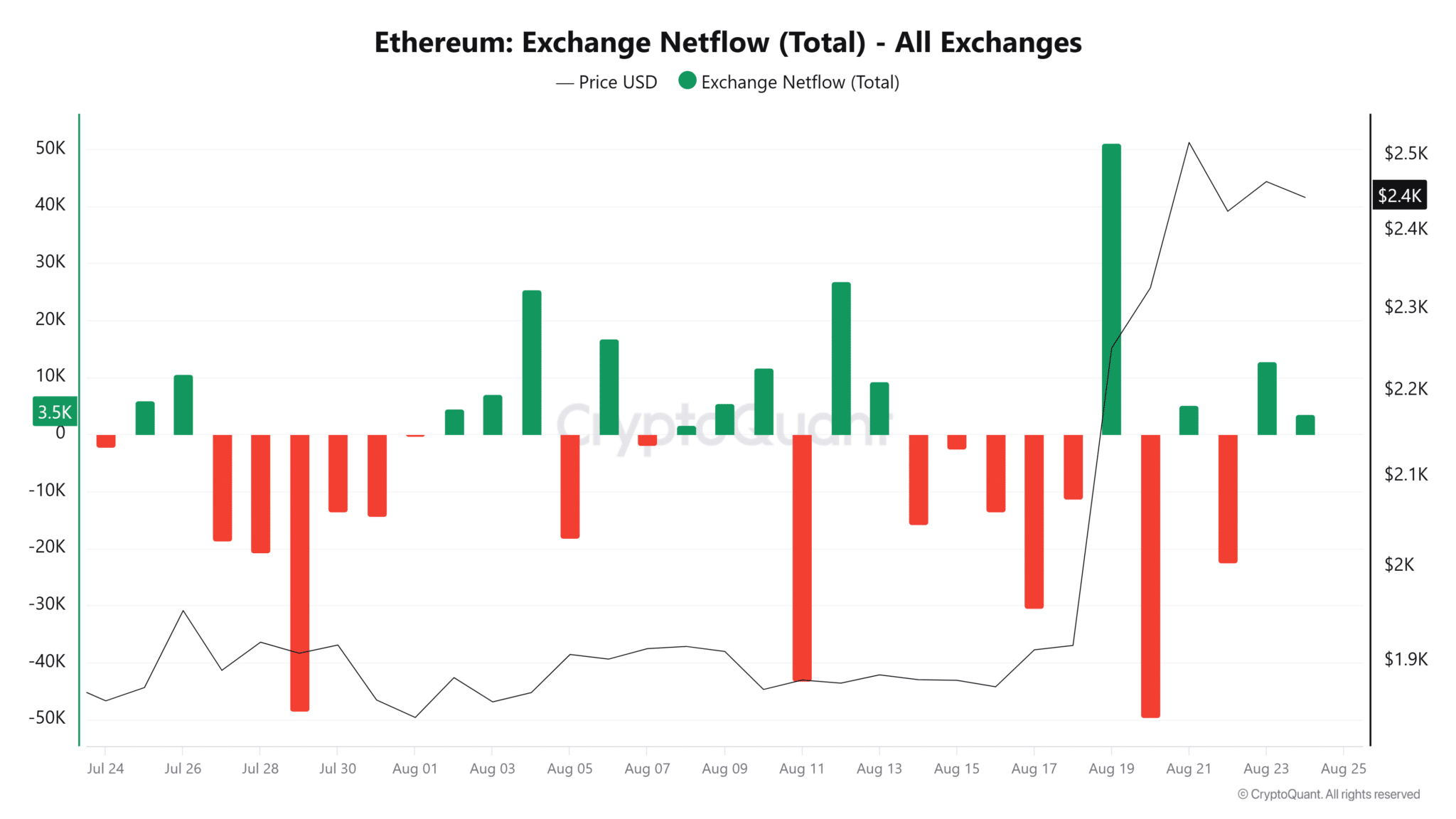
Sustained positive net flow suggests traders are predominantly selling. This market behavior typically weakens market structure and leads to unfavorable price action.

The continuous inflow of funds to exchanges has significantly increased the supply available for immediate sale. In fact, the Exchange Supply Ratio (ESR) for Binance has climbed to a monthly high of 0.0328.
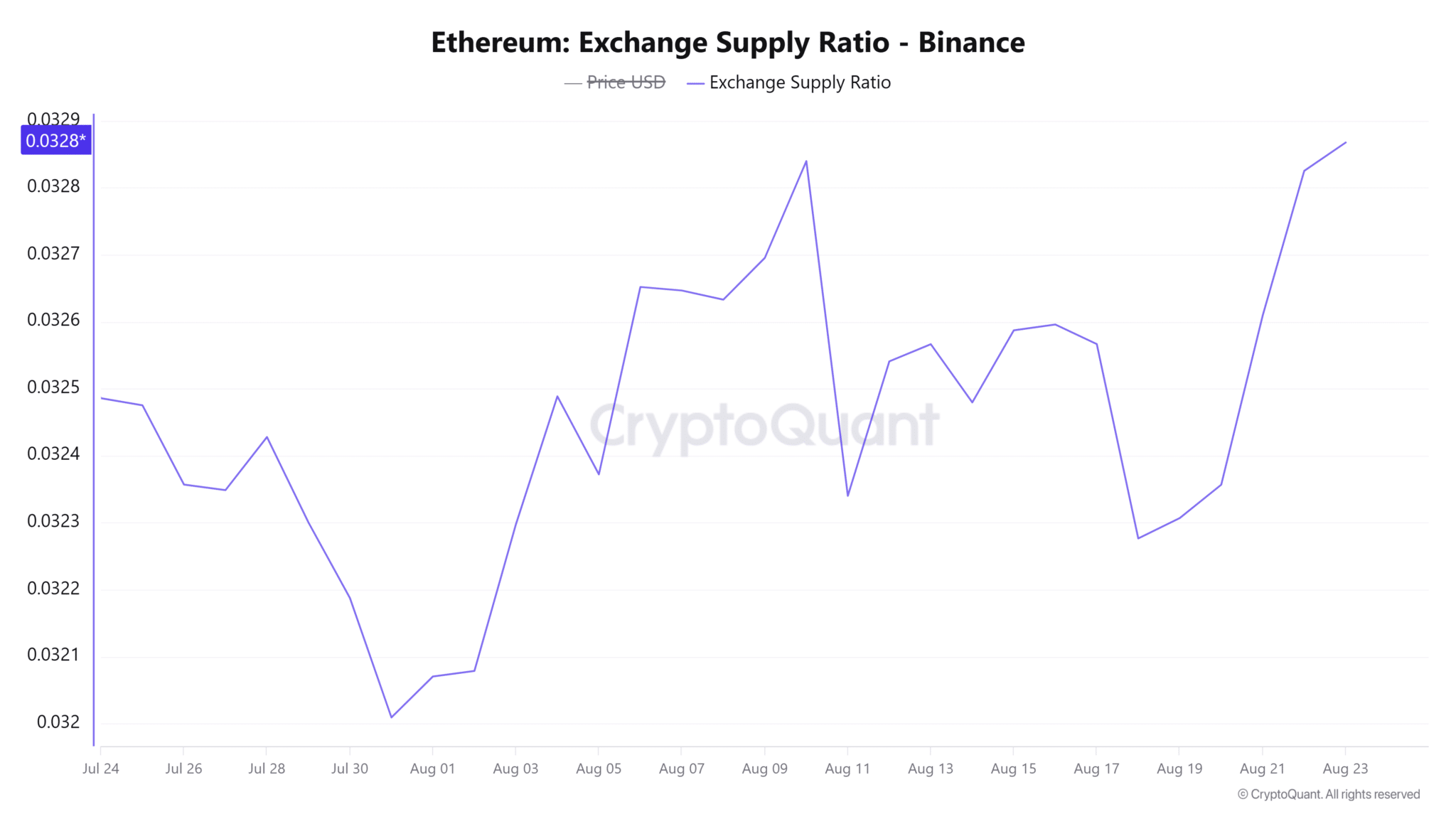
The rise in ESR confirms that the number of traders currently selling ETH exceeds the number of buyers. In this context, Ethereum's supply remains tight.

What's next for Ethereum?

Although sellers remain active on exchanges, their pressure does not seem overwhelming. Demand from large buyers like Abraxas Capital is absorbing the pressure, keeping the market in a state of equilibrium.

The tension between Ethereum bulls and bears explains the recent sideways movement. Beyond that, the market structure leans bullish, with the uptrend remaining strong.
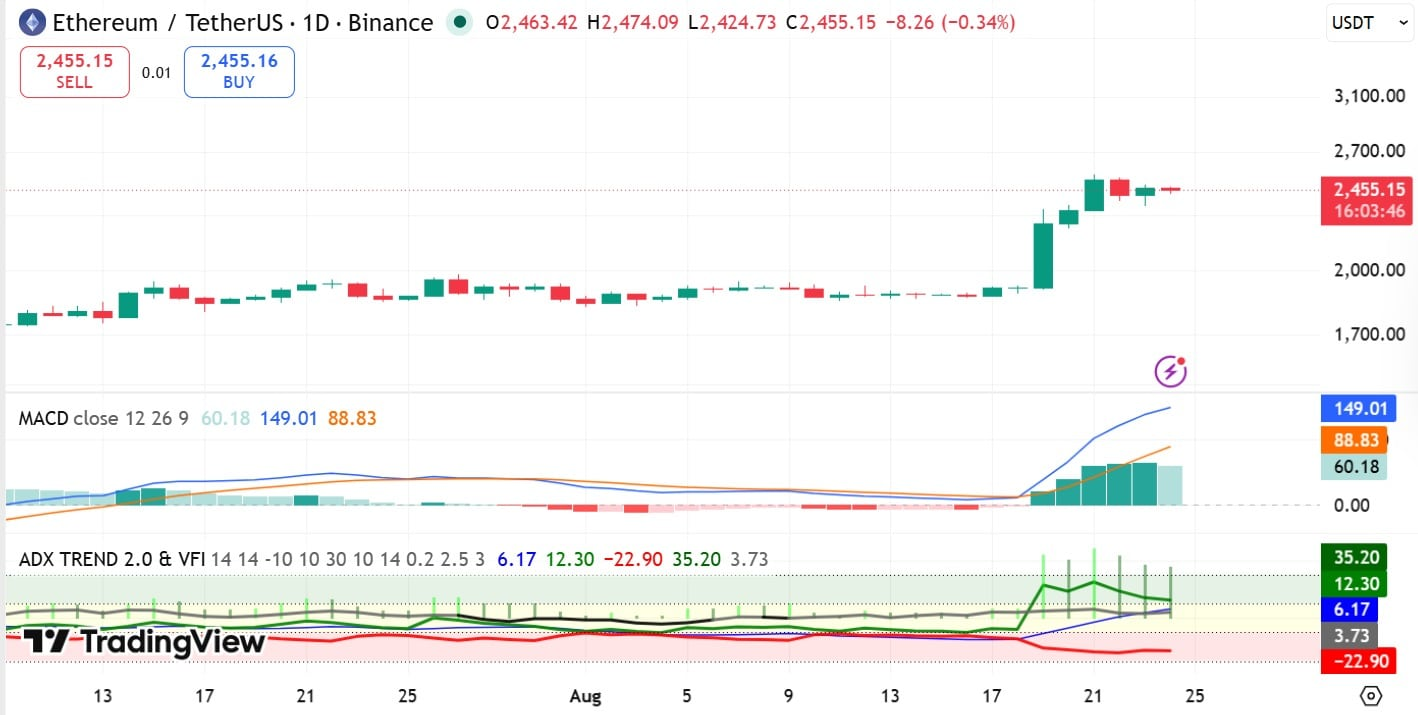
The MACD indicator maintains its upward trend, reaching the highest level since August 2025. With the MACD value at 149, it indicates strong upward momentum.

The ADX trend indicator confirms this momentum, with the +DI around 12, while the D- is at -22, and the contraction/expansion is at 35.

These indicators suggest that Ethereum is likely to break out of its current range, with a target price of $2,800. However, if selling persists, Ethereum might fail to hold the $2,400 level and could potentially drop to $2,200.

Final Summary

Over the past 4 days, Abraxas Capital purchased 73,872 ETH worth $173.17 million from Binance.

Ethereum currently faces significant pressure, but the trend is bullish and likely to continue, with the next target price at $2,800.


Lecturas Relacionadas

The End of Old Cryptography: How Ethereum is Preparing for the Era of Quantum Computing

Ethereum developers have proposed a new system for handling staking deposits, aiming to future-proof the network against the potential threat of quantum computers. Currently, Ethereum's security relies on elliptic curve cryptography, which could be broken by sufficiently powerful quantum machines capable of deriving private keys from public ones. While estimates of the timeline for this threat vary, with Google research in March 2026 suggesting it could be closer than previously thought, major blockchains are proactively preparing. The new proposal introduces a more flexible deposit contract capable of accepting keys of various types and lengths, identified by a scheme label. It also changes how deposit data is communicated within the network's layers. Crucially, the transition plan involves a three-phase process to ensure a controlled and predictable shift, initially disabling new deposits, then re-enabling the current format, and finally permanently switching to new post-quantum cryptography in a future update. The proposal is currently a draft with no set implementation date. It represents a strategic move to build infrastructure in advance, rather than a direct solution for existing accounts. Analysis notes that Ethereum is structurally vulnerable to a "store now, decrypt later" attack, as public keys revealed in past transactions remain permanently on-chain. This proposal prepares for a signature algorithm change but does not address the risk to keys already exposed.

cryptonews.ruHace 6 min(s)

The End of Old Cryptography: How Ethereum is Preparing for the Era of Quantum Computing

cryptonews.ruHace 6 min(s)

Meta Faces a $1.4 Trillion Penalty: Algorithmic Recommendation in the Dock. Will the Rules Change in the Second Half of the Internet Era?

A landmark federal trial in Oakland, California, has begun against Meta, with 29 states accusing the company of harming children and teens through its social media platform designs. The states seek a potential maximum penalty of $1.4 trillion, calculated from alleged repeated violations of consumer protection laws and the Children's Online Privacy Protection Act (COPPA) involving millions of underage users. The core legal strategy bypasses the traditional shield of Section 230 by targeting Meta's own platform features—like its recommendation algorithms, infinite scroll, and "like" buttons—rather than user-generated content. The plaintiffs argue these designs are addictive and deceptive. Meta denies the claims, calling the penalty "unprecedented" and disputing the methodology. While the astronomical $1.4 trillion figure is seen as a starting point for negotiations, even a significantly reduced penalty in the hundreds of billions could establish a critical precedent. The case focuses on holding platforms legally responsible for their algorithmic designs. A ruling against Meta could force product changes, such as removing "likes" or imposing usage limits, and provide a legal template for similar suits against other tech giants like TikTok and YouTube. The trial's outcome may redefine accountability for algorithm-driven business models across the internet.

marsbitHace 16 min(s)

Meta Faces a $1.4 Trillion Penalty: Algorithmic Recommendation in the Dock. Will the Rules Change in the Second Half of the Internet Era?

marsbitHace 16 min(s)

A Precedent for the Prediction Markets: CFTC Aims to Prove Authority Over Polymarket via Criminal Case

A U.S. Army soldier, Gannon Ken Van Dyke, who earned $400,000 using non-public information on the crypto event-prediction platform Polymarket, is contesting the U.S. Commodity Futures Trading Commission's (CFTC) attempt to intervene in his criminal case. The CFTC, which initiated a separate civil suit against Van Dyke but has not pursued it to trial, seeks to submit arguments in the ongoing criminal proceeding. Van Dyke's lawyers filed a motion opposing this, arguing the CFTC is improperly trying to influence the criminal case as an outside expert rather than through its own lawsuit. They contend that event contracts traded on platforms like Polymarket are not swaps and thus fall outside the CFTC's jurisdiction, calling the regulator's tactics a procedural maneuver. Van Dyke faces criminal fraud charges for allegedly trading based on confidential information about potential regime change in Venezuela. His civil case with the CFTC is stayed pending the criminal trial, expected in late 2026 or early 2027. The court's decision on whether to allow the CFTC's intervention could set a precedent for how such event contracts are regulated. An AI analysis notes inconsistency in the CFTC's approach compared to a similar case involving a Google employee, raising questions about the legal strategy for the prediction market industry, which includes platforms like Kalshi. The outcome may define future regulatory standards for the entire market.

cryptonews.ruHace 20 min(s)

A Precedent for the Prediction Markets: CFTC Aims to Prove Authority Over Polymarket via Criminal Case

cryptonews.ruHace 20 min(s)

Trading

Spot
活动图片