Mantra CEO tells OM holders to withdraw from OKX over ‘inaccurate’ migration plan

cointelegraphPublished on 2025-12-08Last updated on 2025-12-08

Abstract

Mantra CEO John Patrick Mullin has urged users to withdraw their OM tokens from the OKX exchange, accusing the platform of posting an "inaccurate" migration plan. Mullin claims OKX provided incorrect dates and details about the upcoming token migration from an Ethereum-based ERC-20 token to a native Mantra Chain token. He stated that OKX has not communicated with Mantra since April 13, when the OM token crashed over 90%, an event Mantra attributed to aggressive exchange leverage policies. Mullin advised users to avoid relying on OKX and complete the migration independently. The official migration is set to occur after January 15, contrary to OKX’s announced December timeline.

Tensions between blockchain platform Mantra and crypto exchange OKX are rising after Mantra accused the exchange of posting incorrect information about its token migration.

In a Monday X post, Mantra CEO John Patrick Mullin urged users of centralized cryptocurrency exchange (CEX) OKX to withdraw their Mantra (OM) tokens and cut their “dependency” on the platform.

“Users should consider withdrawing their OM tokens from OKX[...]. Avoid OKX Exchange Dependency: Complete migration without relying on potentially negligent or malicious intermediaries,” said Mullin.

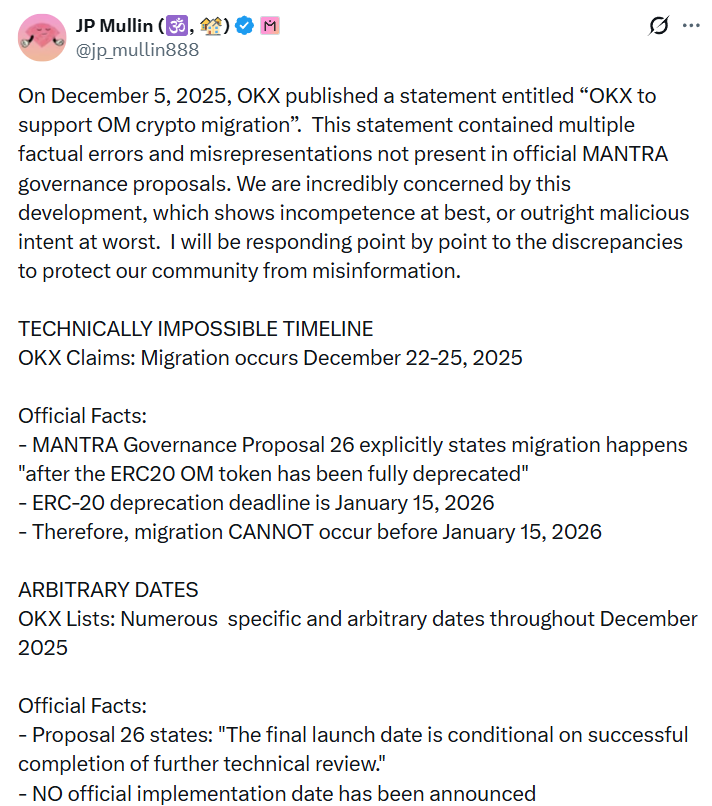
His warning came in response to a Friday announcement from OKX about supporting the incoming OM token migration.
Source: JP Mullin

Related: BitMine buys $199M in Ether as smart money traders bet on ETH decline

According to Mullin, the OKX post contained multiple inaccuracies, including false migration and implementation dates.

OKX said the migration would occur between Dec. 22 and Dec. 25. Mantra’s governance proposal, by contrast, states that the migration will only take place after the Jan. 15 deprecation of the Ethereum-based ERC-20 OM token.

Mullin also said OKX’s post referenced “arbitrary dates throughout December 2025,” while Mantra has not yet announced an official implementation date.

He claimed OKX has not communicated with Mantra since “the events” of April 13, while Mantra has “helpfully [been] communicating with all other major exchanges regarding our migration.”
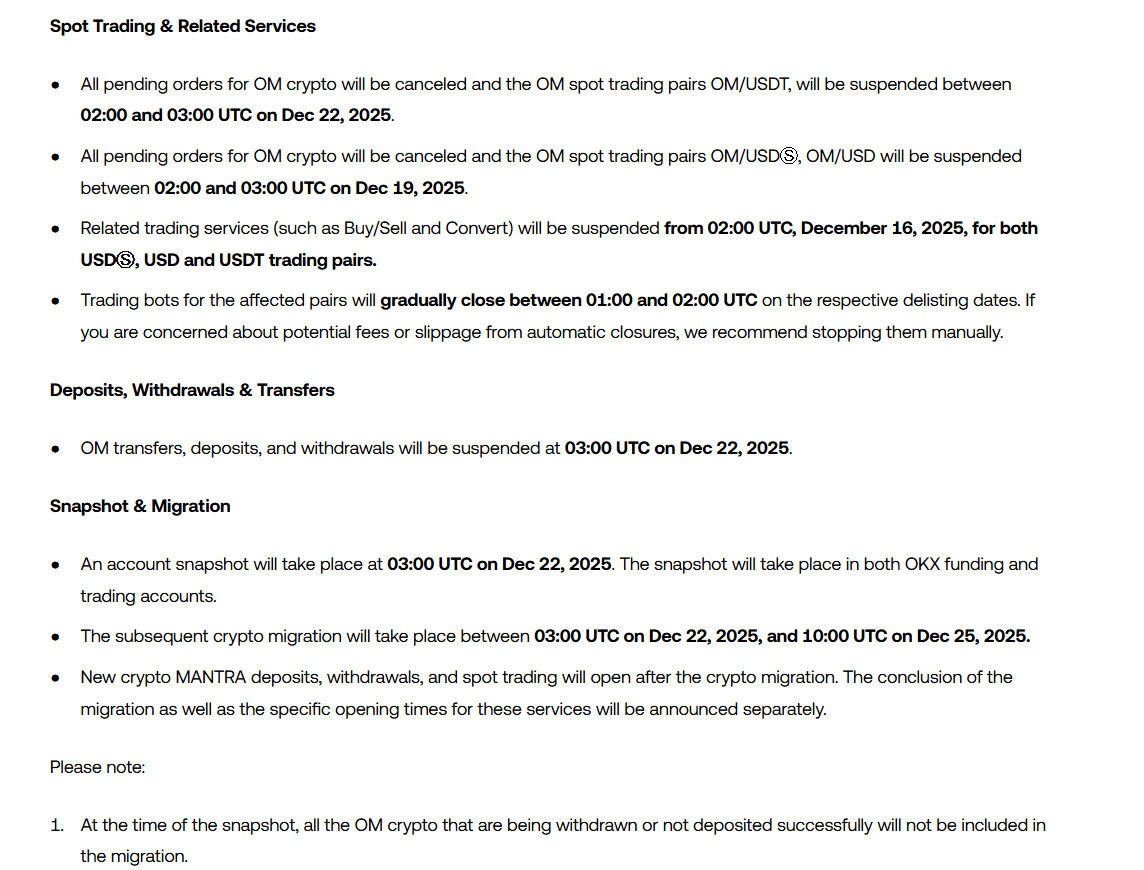
OKX’s OM Crypto Migration post. Source: okx.com

During the incoming migration, the OM token will migrate from an Ethereum-native ERC-20 token to a Mantra Chain-native token.

Cointelegraph has contacted OKX for comment but had not received a response by publication time.

Related: Prediction markets emerge as speculative ‘arbitrage arena’ for crypto traders

April crash still casting a shadow

On April 13, the Mantra’s OM token price fell by over 90% from around $6.30 to below $0.50.
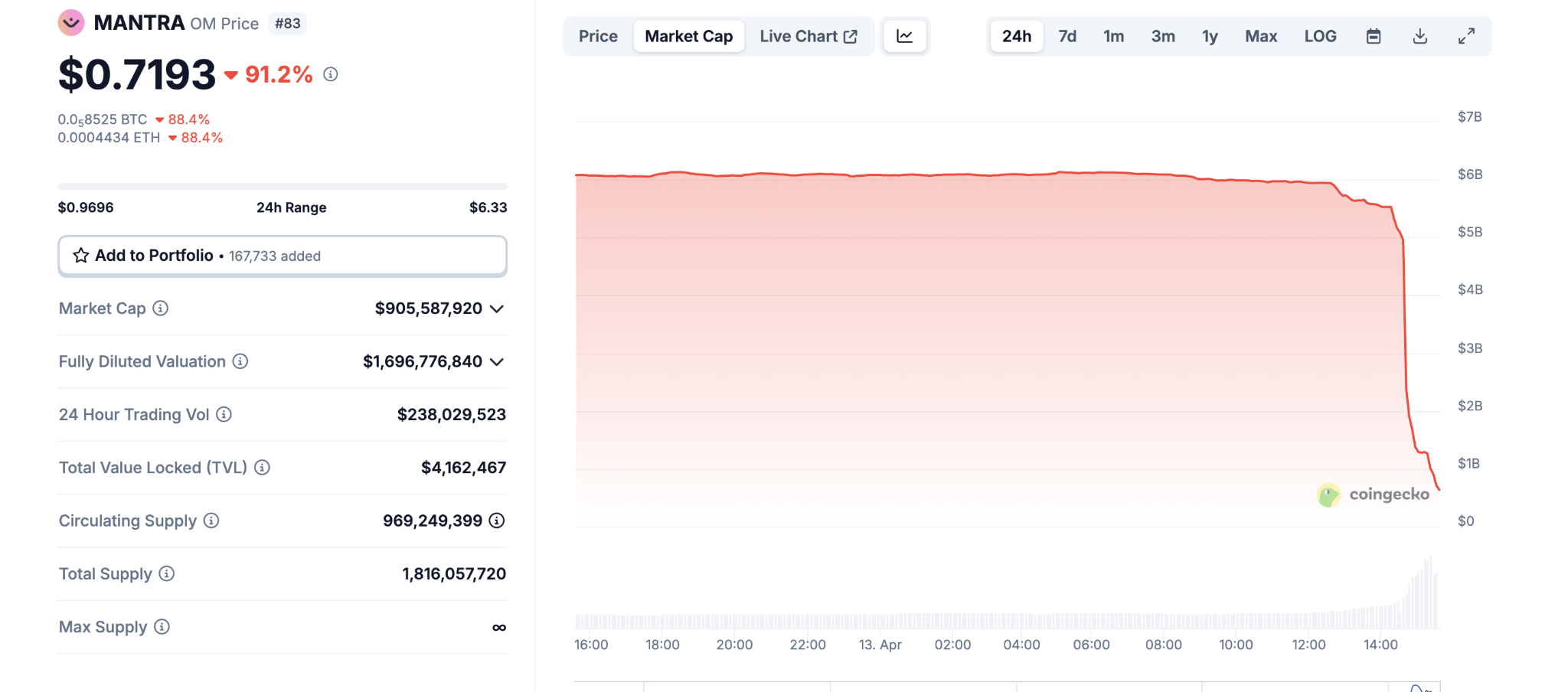
OM/USD, 1-day chart. Source: Coingecko.com

On April 30, Mantra published a post-mortem report that blamed the aggressive trading policies and high leverage on cryptocurrency exchanges for the token crash.

“Liquidation cascades could happen to any project in the crypto industry,” Mullin said in the post, pointing to the role of “aggressive leverage positions” on exchanges as a broader threat to investor safety.

Mullin also urged exchanges to review their leverage policies while implementing a transparency dashboard for OM tokenomics, along with announcing the burning of 150 million staked OM tokens, permanently removing them from circulation in a bid to tighten the token’s supply.

Magazine: If the crypto bull run is ending... it’s time to buy a Ferrari — Crypto Kid

Related Reads

The Stronger the Consensus, the Greater the Risk: The Market Is 'Eerily Quiet' Amid Rate Cut Expectations

In the context of the upcoming Fed rate decision, market consensus strongly expects a 25 basis point cut, with over 85% probability priced in. However, this high level of agreement means the actual rate cut may not significantly move markets, as it has already been anticipated. The real focus is on the Fed’s forward guidance, particularly the "dot plot" showing policymakers' interest rate projections for 2026. The Fed faces unusual uncertainty due to a recent government shutdown, which delayed key inflation data (CPI) for October and November. This lack of recent data may lead to more ambiguous signals from the Fed, increasing potential market volatility. Three scenarios are outlined: 1. **Baseline (most likely)**: The Fed cuts rates as expected and maintains previous guidance, resulting in minimal market reaction. 2. **Dovish**: The Fed signals more rate cuts in 2026 than previously indicated, potentially boosting risk assets like Bitcoin and equities. 3. **Hawkish**: The Fed emphasizes persistent inflation and limited future cuts, which could strengthen the dollar and pressure crypto and other risk assets. The article’s key argument is that high consensus often implies higher risk, as markets are driven by surprises relative to expectations. Investors are advised to focus on managing position risks amid elevated uncertainty rather than betting on specific outcomes.

比推Hace 13 min(s)

The Stronger the Consensus, the Greater the Risk: The Market Is 'Eerily Quiet' Amid Rate Cut Expectations

比推Hace 13 min(s)

Trading

Spot
Futures
活动图片