In an unexpected twist, Michael Saylor is in the news today after he revealed a sweeping financial overhaul in the Middle East. This may be a sign of the vast geopolitical advantage he believes lies in wait for whichever nation adopts his strategy first.
His target is not individual retail investors. Instead, he is aiming at the estimated $20 to $50 trillion currently trapped in low-yield sovereign and corporate bonds across major developed economies.
At the Bitcoin MENA conference, he specifically named Japan, Europe, and Switzerland as examples. These regions hold huge pools of capital, while earning very little.
In these regions, institutional investors and banks are struggling to generate meaningful returns in ultra-low-rate environments.
Saylor’s new Bitcoin idea
By offering a high-yield, zero-volatility product backed by the world’s most robust digital asset, Saylor argued that the adopting country could instantly become the “digital banking capital of the world.”
According to the exec, this nation would serve as a 21st-century equivalent of Switzerland, attracting massive, immediate inflows of global digital capital and reshaping global financial power dynamics.
For Saylor, the ambition is not to capture a fraction of the existing crypto market. Instead, he aims to fundamentally restructure the world’s largest pools of capital.
He starkly contrasted his proposed 8% yield account against the stagnant $200 trillion global credit market. Saylor contended that investors only tolerate high-risk assets, such as the massive corporate bond market, out of “disgust” and desperation for yield.
He also argued that traditional bank accounts fail to provide meaningful returns, pushing them into riskier options.
What is his main goal?
Thus, his ultimate vision places Bitcoin [BTC] not as a competitor to existing assets, but as the foundational, high-integrity digital capital that underwrites a new, high-yield financial system.
He said,
“The only reason you buy a corporate bond or a junk bond or private credit or mortgage-backed security is that your bank account doesn’t pay you 6% or 8%. And so the biggest idea is to create high-powered digital money. You might have heard that phrase, high-powered digital money.”
Saylor solidified his pitch by linking his proposed financial structure directly to the original vision of Bitcoin’s creator.
“Satoshi said the future is corporations holding Bitcoin to create high-powered digital money.”
He detailed the exact blueprint for execution, demanding that the product be backed by a regulated bank and endorsed by the bank regulator of the adopting nation.
The structure relies on taking digital credit (like his company’s strategy) to create a fund of 80% credit and 20% currency, protected by a 10% reserve buffer to eliminate volatility. This would allow the bank to safely offer a prospective 8% dividend.
What impact will this have?
Finally, Saylor argued that a country offering this regulated, zero-volatility account, be it the Bank of Dubai, Abu Dhabi, or Bahrain, would instantly become the world’s digital banking capital. This would draw in potentially $20 to $50 trillion from yield-starved regions by simply offering 100 to 300 basis points more than competitors.
Crucially, he stressed that a nation could adjust the risk, yield, and liquidity by simply manipulating the currency allocation or the reserve buffer. This would give regulators immediate control over the new financial primitive.
“The perfect product is a bank account with zero volatility that pays you 400 basis points more than the risk-free rate in your favorite currency.”
The ultimate financial product is a digital bank account where the volatility factor goes to zero, causing the Sharpe ratio to trend towards infinity.
Saylor called this the “lightsaber of money,” the inevitable outcome of combining digital capital, digital credit, and a digital fund, all blessed by a regulator.
What’s more?
This commitment to the theoretical can be immediately mirrored by Strategy’s actions.
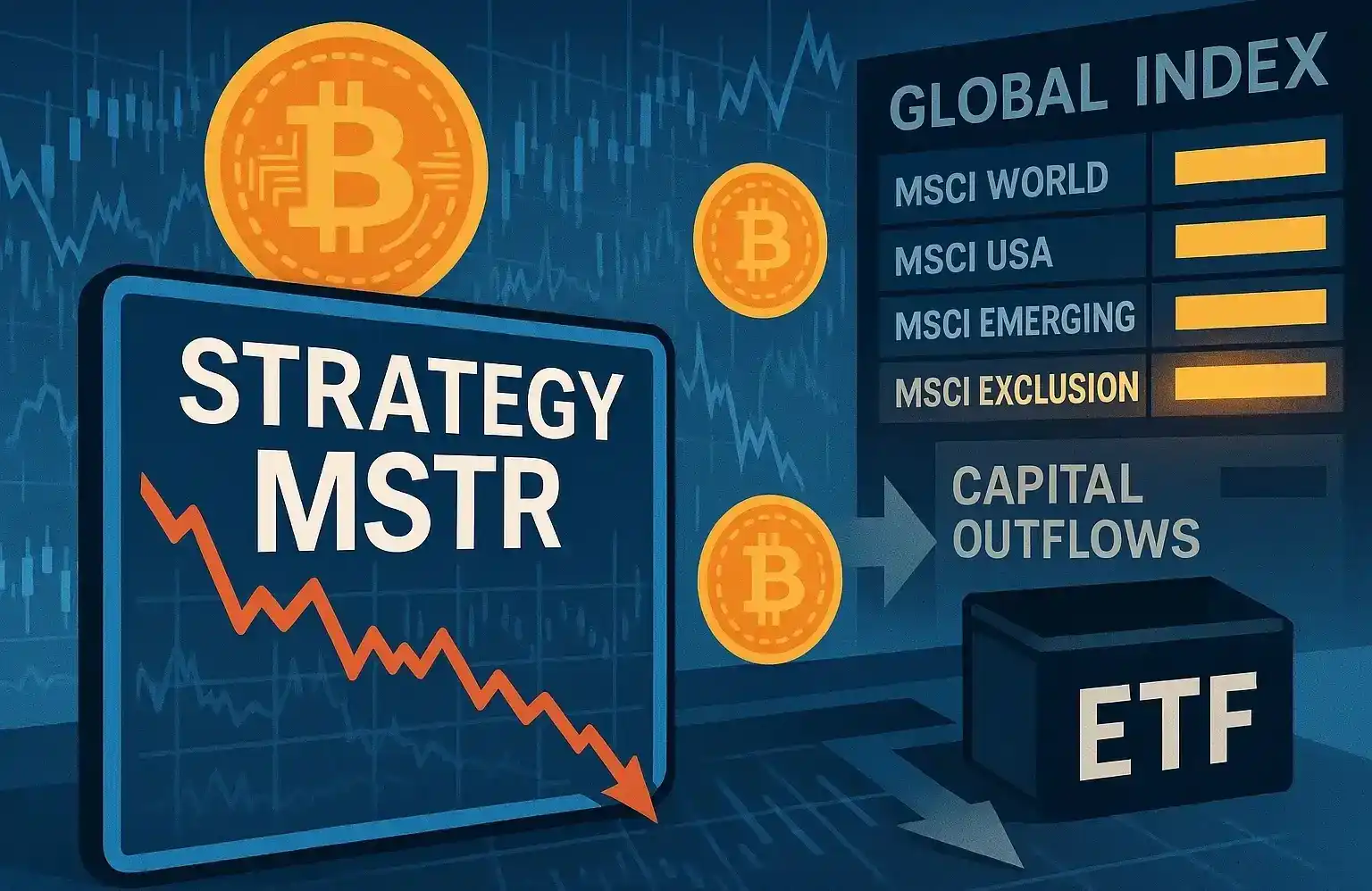
Despite looming index exclusion reviews, the firm surprised markets by immediately deploying capital raised through its “at-the-market” (ATM) program as per its 8-K filing.
In fact, it acquired a massive 10,624 BTC worth nearly $1 billion at an average price of $90.6k.
This acquisition, the second-largest of H2 2025, simply reinforced Saylor’s unwavering conviction. It also proved that the company’s financial structure is fully committed to using equity markets to endlessly scale its Bitcoin position.
Final Thoughts
- Saylor revealed his plan in the Middle East to court the first nation willing to adopt his Bitcoin-backed banking system.
- His real target is not retail investors but the $20–$50 trillion locked in low-yield sovereign and corporate bonds across Japan, Europe, and Switzerland.