Original Title:A Data-Driven Look at Upbit's Recent Stablecoin Market Expansion Strategy
Original Author:c4lvin
Original Compilation:Chopper,Foresight News
Upbit launched a promotional campaign from July 26th to August 9th, waiving the 0.05% transaction fee for stablecoin trades in the Korean Won (KRW) trading market. Within the same week, it rapidly listed USD stablecoins like RLUSD and USDG. This series of moves aims to boost stablecoin trading volume.
This is not Upbit's first time listing stablecoins, but it is the platform's first time to roll out multiple stablecoin-related initiatives intensively within a very short timeframe. This article will analyze the logic behind Upbit's current push into the stablecoin track from three dimensions: the competitive landscape of the Korean exchange stablecoin market, the trends of cross-border stablecoin capital inflows and outflows, and the current regulatory environment.
Reshaping of the Korean Exchange Stablecoin Market Landscape
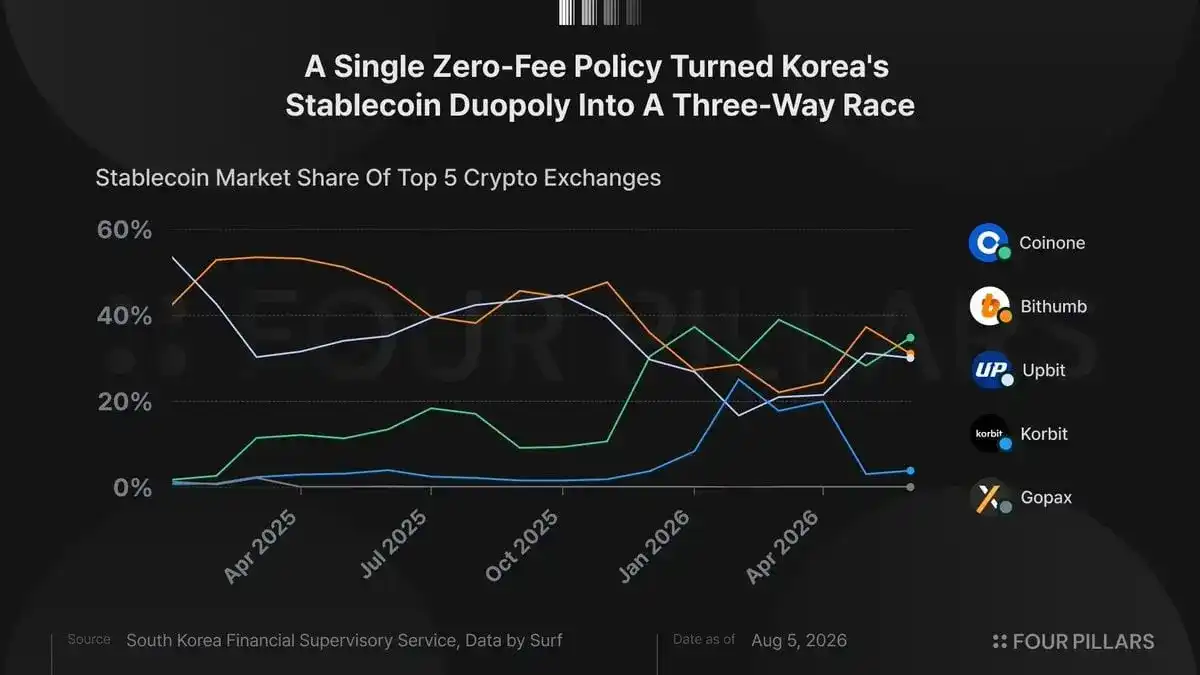
In January 2025, the Korean stablecoin trading market was a two-horse race: Upbit held a 53.5% share, Bithumb 42.5%, with the two combined accounting for over 95% of the market. Just 18 months later, the industry landscape has been completely rewritten. As of June 2026, Coinone ranked first with a daily average stablecoin trading volume of 84.58 billion KRW (34.8%); Bithumb followed closely with 75.57 billion KRW (31.1%); Upbit held 73.02 billion KRW (30.1%), evolving the market into a three-way contest.
The catalyst for this change was Coinone's comprehensive elimination of USDC transaction fees starting in October 2025. At that time, other competitors maintained fees in the 0.04%–0.20% range, while Coinone persisted with a zero-fee strategy. Influenced by this, its market share climbed to 11.5% in March 2025 and reached 30.5% in December, surpassing Upbit's 29.7% for the first time. Price-sensitive trading demands, primarily consisting of two types, flowed heavily to Coinone: demand for funds exiting to participate in overseas derivatives trading and demand for earning USD exchange rate arbitrage.
This fully demonstrates that stablecoin trading demand has extremely high price elasticity. Regardless of where it is purchased, the stablecoin itself is a homogeneous asset, and a large number of users withdraw their purchased coins to external wallets. Therefore, the core factors differentiating exchange competitiveness are essentially limited to transaction fees and liquidity. In fact, a mere 0.05 percentage point difference in fees was enough to rewrite the industry rankings.
Notably, this market reshuffling occurred only in the stablecoin track. In June 2026, in the overall cryptocurrency trading market across all categories, Upbit held a 60.0% share, Bithumb 32.0%, with the two combined exceeding 90%, while Coinone only held 6.2%. That is to say, even in a market where Upbit holds an absolute overall advantage, stablecoins represent its most prominent weak point.
Simultaneously, the overall market size is contracting rapidly. In July 2026, the total daily average stablecoin trading volume of the five major Korean exchanges was $466.69 million, a staggering 80.3% decline compared to the $23.7 billion in January. Dunamu (Upbit's parent company) reported Q1 2026 revenue of 234.6 billion KRW, down 55% year-over-year; operating profit of 88 billion KRW, plummeting 78% year-over-year. In just six months, the market size has shrunk to one-fifth of its previous level. In such a macro environment, tracks like stablecoins, which are not affected by bull/bear cycles and have resilient demand, hold far greater strategic value than during market boom periods.
Stablecoins: The Core Vehicle for Cross-Border Capital Flow in Korea
To understand the essence of stablecoin demand in Korea, one must track where the funds go after users purchase stablecoins.
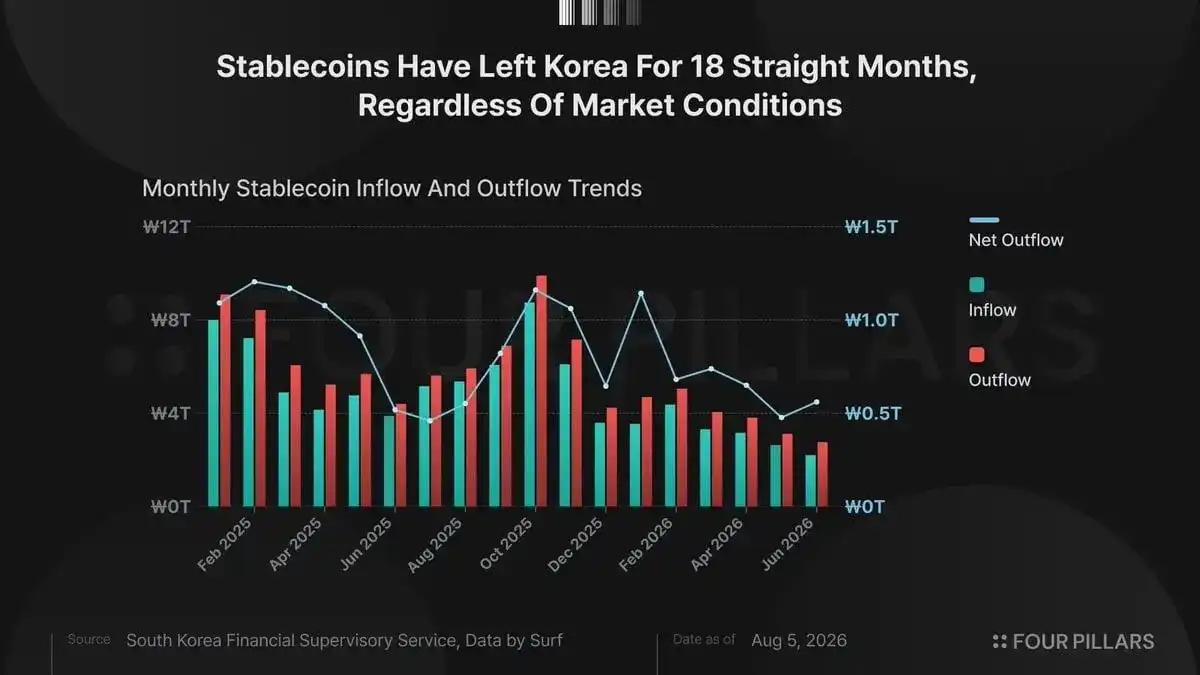
In June 2026 alone, stablecoin withdrawals from the five major Korean exchanges to overseas exchanges amounted to 2.7625 trillion KRW, while stablecoin inflows from overseas were 2.2022 trillion KRW, resulting in a net outflow of 560.3 billion KRW. Since this data began to be tracked in January 2025, every single month for 18 consecutive months has seen a net outflow, with the cumulative net outflow reaching approximately 14.9 trillion KRW.
This persistent net outflow stands in stark contrast to the stock market. In Q2 2026, Korea experienced net selling of 1.6185 trillion KRW in overseas stock investments, while stablecoin net outflows reached 1.6872 trillion KRW. Overseas stock fund flows can reverse and return to the domestic market with changing market conditions; yet, even during market downturns, stablecoins continue to maintain a net capital outflow, highlighting their unique positioning in the Korean market.
The role of stablecoins as a channel for transferring capital to overseas exchanges and DeFi was not inherent, making this phenomenon even more worthy of study. The launch of stablecoin trading pairs against KRW in Korea happened very late. Among the five major exchanges, Upbit was the last to launch USDT/KRW trading pairs, officially doing so only in 2024. Before this, users wanting to transfer funds to overseas exchanges could only buy volatile assets like Bitcoin or XRP for transfer, bearing the price fluctuation risk during the transaction.
After the KRW trading pairs were launched, this cross-border function was rapidly taken over by stablecoins. The fact that the Korean Financial Supervisory Service began specifically tracking cross-border stablecoin transfer data in January 2025 itself indicates that regulators already view stablecoins as a primary tool for cross-border capital movement. Globally, USDT trading volume had already surpassed Bitcoin's back in 2019; Korea, due to the delayed launch of KRW trading pairs, essentially went through a compressed version of this development process after 2024.
The Actual Effect of the Stablecoin Trading Expansion Strategy
Returning to Upbit's decision, this fee waiver is a time-limited promotion, ending on August 9th; whereas Coinone, which captured a significant market share, has maintained a permanent zero-fee policy since October 2025.
The effect of time-limited promotions has precedents for reference. Korbit once ran a USDC zero-fee and rewards campaign from January 1st to April 13th, 2026. During the campaign period, its stablecoin market share reached 3.48%, but after it ended, trading volume flowed back to Upbit and Bithumb. Following this historical case, it's likely that the stimulated trading volume from Upbit's promotion will also recede after the campaign concludes. The following analysis combines data from the promotional period and normal periods to assess the subsequent trend.
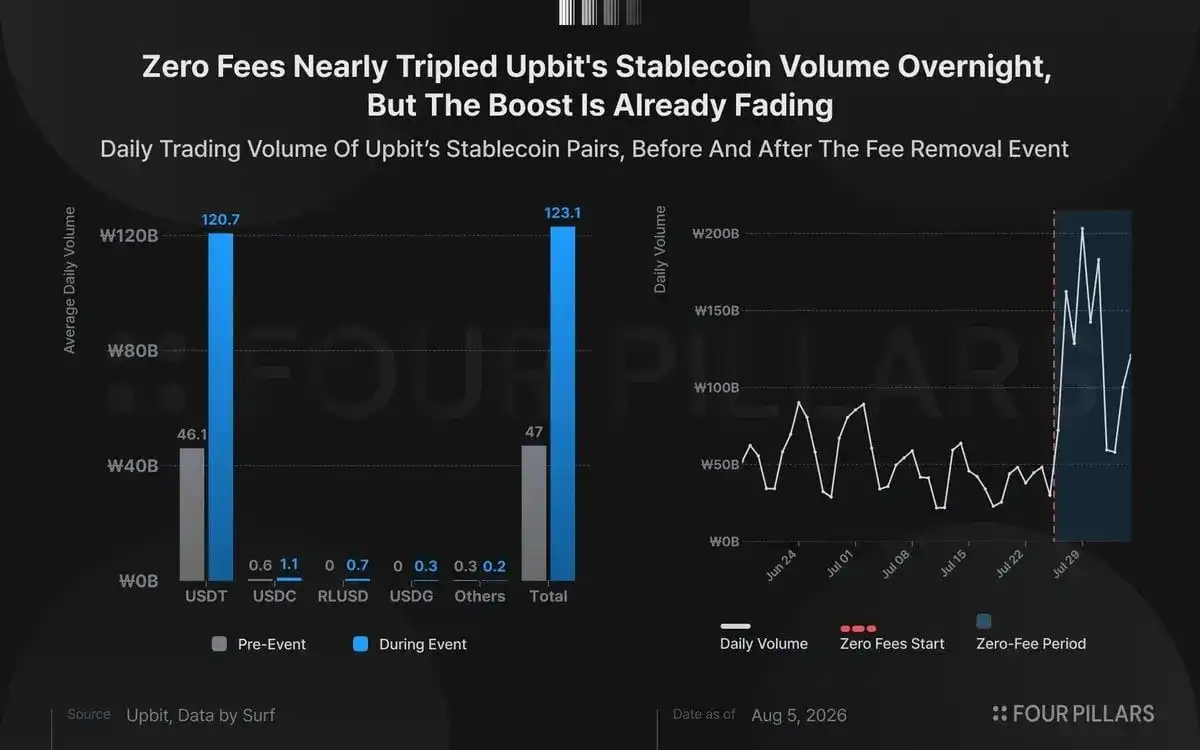
The following is a comparison of Upbit's daily average stablecoin trading volume during the promotional period versus the month before the promotion: Daily average trading volume 30 days before the promotion: 46.96 billion KRW. After the campaign started, the daily average volume increased by 162.0% to 123.06 billion KRW. Excluding weekend factors and counting only weekdays, the increase was 170%, rising from 55.03 billion KRW to 148.69 billion KRW.
The policy took effect very quickly. On July 25th, the day before the campaign, trading volume was 29.95 billion KRW. On the launch day (a Sunday), it reached 72.19 billion KRW, doubling compared to the previous weekend. On the first weekday, July 27th, it surged to 162.27 billion KRW, peaking at 203.29 billion KRW on July 29th.
Three key phenomena are revealed in the data:
- Almost all the new trading volume came from USDT. USDT's daily average trading volume rose from 46.06 billion KRW to 120.71 billion KRW, maintaining a 98.1% share of Upbit's total stablecoin trading volume, showing almost no change before and after the campaign. In contrast, newly listed stablecoins accompanying the campaign, RLUSD (daily average 0.71 billion KRW) and USDG (daily average 0.34 billion KRW), contributed only about 1% to the overall increase, with their popularity being fleeting. RLUSD's volume on its listing day was 5.6 billion KRW, then quickly fell to around 0.1 billion KRW daily; USDG started with 2.24 billion KRW on its listing day and similarly rapidly declined. The heat from new coin listings lasted only a day. Meanwhile, long-tail stablecoins like USD1, USDS, USDE, and even gold-pegged assets like XAUT, despite also enjoying full fee waivers, saw trading volumes stagnate or even decline. Conclusion: Upbit's current round of stablecoin expansion strategy did not divert USDT's trading flow to other stablecoins.
- Even before the campaign ended, the stimulus effect has already begun to fade. The daily average trading volume for the first week was 148.65 billion KRW, dropping to 84.68 billion KRW in the second week. Excluding weekends and looking only at weekdays, the volume decreased by 33%, from 163.944 billion KRW to 110.58 billion KRW. This is a typical pattern of rapid initial campaign enthusiasm cooling off.
- Exchange rate fluctuations introduced an interfering variable. The Korean Won strengthened in July. The price of USDT on Upbit's platform dropped from 1517 KRW on June 26th to 1423 KRW on August 4th. Late July was right in the middle of this decline, coinciding with the promotion period. Exchange rate fluctuations themselves can generate arbitrage and bottom-fishing demand. Therefore, a portion of the trading volume growth came from the exchange rate dynamics, not solely the effect of the fee waiver.
In summary, once the promotion ends and fees are reinstated, Upbit will find it difficult to retain the market share temporarily gained during the campaign period. As long as Coinone's permanent zero-fee policy remains in effect, Upbit faces a dilemma in the future: either follow suit and permanently waive stablecoin transaction fees, or sacrifice market share to preserve fee income.
Institutionalization of Regulation: Becoming a Key Variable
I believe Upbit itself is well aware that the trading volume boost from fee waivers is only a short-term effect, and that listing multiple new stablecoins cannot truly divert USDT trading flow.
Estimates show that over the past 15 days, Upbit has foregone approximately 1 billion KRW in fee revenue. Why invest resources and actively give up fees in a low-margin sector? The evolving regulatory environment in Korea provides important clues.
First, the launch of KRW-pegged stablecoins is imminent. In its 2026 economic growth strategy, the Korean government formally plans to advance the legislation of the "Digital Asset Basic Act" in the latter half of the year. The bill is expected to include provisions such as a licensing system for KRW stablecoin issuance, reserve asset requirements, and user redemption rights. The US GENIUS Act is expected to be fully enacted by late 2026 to early 2027, at which point USD stablecoins will usher in a new wave of global adoption.
Second, changes in Dunamu's ownership structure. In November 2025, Naver Financial resolved to make Dunamu a wholly-owned subsidiary through a share swap agreement. Both parties proposed building a payment ecosystem centered on stablecoins and digital wallets as a key synergy direction. From this perspective, Upbit's stablecoin trading volume, liquidity, and user base are not just sources of fee revenue but also distribution channels for future payment services. Therefore, expanding the business foundation as much as possible at present holds strategic significance.
Third, the contradiction lies in the fact that regulatory laws might prevent Dunamu from fully benefiting from KRW stablecoin opportunities. Current laws like the "Act on Reporting and Using Specified Financial Transaction Information" and the "Virtual Asset User Protection Act" stipulate that virtual asset service providers cannot trade assets issued by related parties. Once Dunamu becomes part of the Naver Group, if Naver leads a consortium to issue a KRW stablecoin, there is a regulatory interpretation: Upbit might be restricted from listing that coin. Given the uncertainty about whether it can list a domestic KRW stablecoin in the future, the opportunity it can firmly grasp now is to become the distribution hub for USD stablecoins in Korea.