Cardano Founder Hoskinson Accused Of Selling 1.5 Billion ADA In 2021 Rally

bitcoinistPublicado a 2026-06-10Actualizado a 2026-06-10

Resumen

Cardano founder Charles Hoskinson faces new allegations from NFT creator Masato Alexander, who claims on-chain tracing reveals large ADA transactions linked to Hoskinson during the 2021 rally. Alexander's analysis suggests a 925 million ADA transaction and nine 20 million ADA payments had a closer common ancestor to IOG's funds than previously known, reducing intermediary hops. He published transaction graphs but noted this traces funding paths, not proving control or sales. This follows prior claims Hoskinson used "genesis keys" to move ~318 million unclaimed ADA into reserves. Hoskinson and a Cardano report denied this, stating most vouchers were redeemed. Separately, Thomas Braziel raised governance questions using Isle of Man filings, inquiring about foundation control and fund allocation during Cardano's early ICO period. Both sets of claims revisit debates over Cardano's early allocation and governance transparency.

Cardano founder Charles Hoskinson is facing a new round of allegations after NFT creator Masato Alexander published additional on-chain tracing work tied to large ADA movements during the 2021 market rally. The claims add another layer to an already contentious debate over Cardano’s early allocation history, governance structure, and voucher redemption process.

Large Cardano Flows To IOG-Linked Pool Pledges

Alexander, who previously became a central figure in the Cardano ADA voucher controversy, said on X that IOG’s on-chain footprint extended beyond its original Genesis UTxO and included several stake pools operated over the years. According to him, those pools required owners and pledged ADA, creating additional paths for tracing funds through Cardano’s UTxO model.

“However, IOG had a larger onchain footprint than just their Genesis UTxO, they operated a number of stake pools over the years,” Alexander wrote. “Each pool requires an owner and pledge ADA to be put up.”

The latest allegation is framed around large ADA transactions that critics claim were linked to Hoskinson and occurred during the 2021 rally. Alexander said his updated tracing work shows that both a 925 million ADA transaction and nine 20 million ADA payments had a closer common ancestor than IOG’s original genesis ADA. In his telling, that reduces the number of intermediary hops between IOG and the transactions from roughly 40 to between one and seven transactions.

“Turns out both the 925m AND the x9 20m payments have a closer common ancestor than IOG’s genesis ADA, which cuts the # of intermediary hops between IOG and these Txs from ~40 to ~1 to 7 Txs,” Alexander wrote. “They gather up ~21 of the 64m ADA pledge’s from IOG’s private pools.”

Alexander also published a dedicated transaction graph and a broader report containing what he described as a hop-by-hop trace, an interactive flow graph, and raw identifiers linked to Cardanoscan. He presented the work cautiously, saying it was not a final adjudication of intent or legal responsibility.

“This is best effort attempt at looking into what transpired on chain, draw your own conclusions,” he wrote. “If you find any errors in the data or methodology, please feel free to reach out and i’ll update it.”

The distinction matters. The material cited by Alexander focuses on tracing transaction ancestry and common funding paths. It does not, on its own, prove who controlled every wallet, whether funds were sold on exchanges, or what contractual obligations may have applied. It does, however, revive questions about Cardano’s early distribution and the transparency of large ADA movements during one of the asset’s most significant bull-market periods.

Isle Of Man Filings Add Another Governance Question

Alexander’s renewed claims follow his earlier allegation that Hoskinson used Cardano “genesis keys” during the 2021 Allegra hard fork to alter or sweep old ICO and voucher-related UTxOs, moving roughly 318 million ADA into Cardano reserves or treasury rather than leaving them directly claimable by original voucher holders.

Hoskinson denied that allegation, saying IOG did not give itself hundreds of millions of unclaimed ADA and that most vouchers were eventually redeemed.

A later Cardano redemption transparency report said the allegations had “no basis.” According to the report, 99.2% of vouchers representing 99.7% of ADA sold through the voucher program were redeemed. It also stated that after Byron-era on-chain redemption ended, 390 vouchers representing 318 million ADA remained unredeemed and were swept into the reserve while a post-sweep redemption process continued.

The scrutiny is not limited to Alexander’s on-chain work. Thomas Braziel of 117 Partners separately said he had collected original Isle of Man filings related to Cardano’s earliest foundation structure. Braziel said the documents appeared to show an early foundation involving Hoskinson, Jeremy Wood, Ken Kodama, and a corporate services provider, while later filings showed Hoskinson serving as the foundation’s “Enforcer.”

Under Isle of Man foundation law, Braziel argued, an Enforcer is not simply a passive observer but a key oversight role meant to ensure that the council follows the foundation’s purposes and governing documents. He linked that question to the timing of Cardano’s ICO, which began in September 2015, before the Swiss Cardano Foundation was established in September 2016.

“The question is not whether development companies should be compensated,” Braziel wrote. “The question is: who negotiated those arrangements on behalf of ICO participants and the Isle of Man Foundation?”

Braziel said he was “not alleging wrongdoing” but asking for documentation on who controlled the Isle of Man Foundation, what happened to roughly 1,090 BTC historical materials indicate were allocated to it, how development agreements were negotiated, and what governance protections existed for ADA purchasers.

At press time, ADA traded at $0.16.
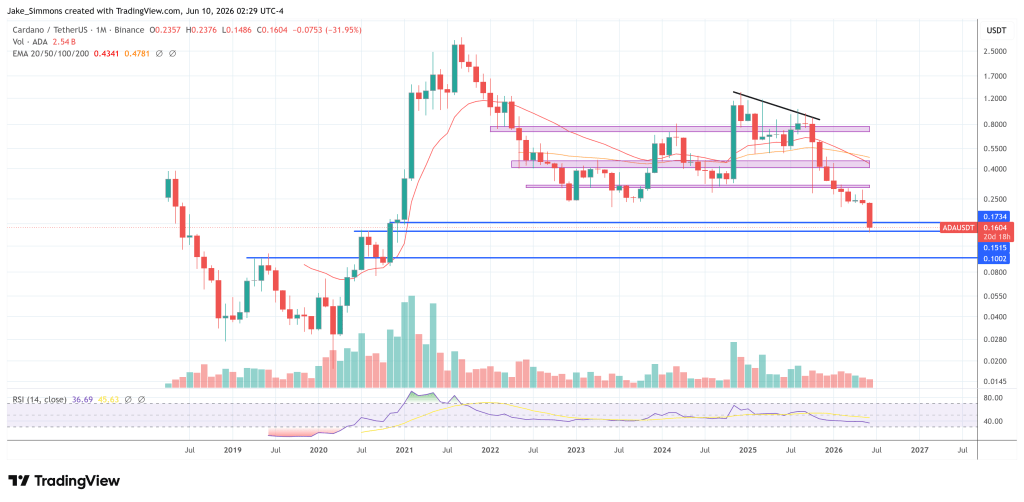
ADA hovers above key support, 1-month chart | Source: ADAUSDT on TradingView.com

Preguntas relacionadas

QWho published the on-chain tracing work that forms the basis of the new allegations against Charles Hoskinson?

AThe on-chain tracing work was published by NFT creator Masato Alexander.

QAccording to the article, what was the approximate total amount of ADA transactions that Alexander's tracing work focused on from the 2021 rally?

AThe tracing work focused on a 925 million ADA transaction and nine separate 20 million ADA payments, for an approximate total of 1.105 billion ADA.

QWhat does the article state was the outcome of the 318 million ADA in unredeemed vouchers after the Byron-era redemption ended?

AAccording to a later Cardano redemption transparency report cited in the article, the 318 million ADA from 390 unredeemed vouchers was swept into the Cardano reserve, while a post-sweep redemption process continued.

QWhat role in the early Isle of Man Foundation does Thomas Braziel claim Charles Hoskinson served, according to the filings he collected?

AThomas Braziel claims that later filings show Charles Hoskinson served as the "Enforcer" of the early Isle of Man Foundation.

QWhat is the core governance question Thomas Braziel raises based on the Isle of Man foundation documents and the timing of the ICO?

AThe core governance question he raises is: "who negotiated those arrangements [development agreements] on behalf of ICO participants and the Isle of Man Foundation?" given that the ICO began before the Swiss Cardano Foundation was established.

Lecturas Relacionadas

AI Investors' 2026 Anxiety: When Models Devour Everything, What Moat Is Left for Startups?

In 2026, a wave of investor anxiety questions the defensibility of AI startups as models improve, fearing that most companies are just "thin wrappers" destined to be absorbed by foundation models or chipmakers. The author argues against this despair, positing that true moats lie not in benchmark performance but in areas models cannot easily reach. The logic of despair is that if models excel at all measurable tasks, only compute and cutting-edge model weights hold lasting value. However, the essay contends that the most valuable work is inherently "untrainable." Benchmarks measure what can be measured and thus optimized for, but real-world correctness often resides in private, complex systems. Examples include legacy codebases, intricate legal transactions, or hospital workflows. This kind of correctness is proprietary, costly to establish, and cannot be validated quickly—it requires time and trust within an organization. As models commodify visible, measurable tasks from both above (labs absorbing scaffolding) and below (saturation by cheaper models), value shifts to "untrainable ground." This encompasses work where correctness is a private truth, locked behind integration barriers, licenses, liability frameworks, and entrenched user habits. Trust and adoption are slow, human-centric processes that smarter models cannot accelerate. Successful companies defend their position by embedding deeply into client operations, owning the definition of "good" within a specific domain (e.g., Harvey in law, OpenEvidence in medicine), and pricing on outcomes rather than tokens. While labs compete fiercely, they are incentivized to keep the application layer vibrant. The future belongs not to those competing on generic benchmarks but to those navigating unscoreable terrain, doing the "unsexy work" of translation between models and messy human realities. The most cited benchmark scores are thus maps of territory about to become worthless, signaling who will lose the right to define what counts as good.

marsbitHace 12 min(s)

AI Investors' 2026 Anxiety: When Models Devour Everything, What Moat Is Left for Startups?

marsbitHace 12 min(s)

Trump's Crypto Empire: A $2.3 Billion Wealth Transfer Experiment

In June 2026, Reuters investigations revealed that since Donald Trump's return to the White House, his family has accumulated roughly $2.3 billion in profits from four core crypto ventures: World Liberty Financial (WLFI), the $TRUMP meme coin, American Bitcoin, and ALT5 Sigma (later renamed AI Financial). Coincidentally, overall investor losses in these projects were estimated to be a similar amount. The businesses, spanning DeFi, stablecoins, meme coins, Bitcoin mining, and digital payments, largely relied not on technological innovation but on converting the political influence and notoriety of the Trump brand into financial assets sold to the market. This marks a dramatic shift from Trump's earlier skepticism of cryptocurrencies. The ventures operated on a similar logic: leveraging the Trump name to generate market hype and trust, attracting investment through token sales or public listings, and enabling the family to capture profits upfront through equity, token allocations, and fees, while later entrants often bore the brunt of the risk as markets cooled. WLFI, the most profitable venture, generated an estimated $1.6 billion for the family, primarily through sales of its locked, illiquid governance token and its USD1 stablecoin. The $TRUMP meme coin, a direct monetization of the presidential IP, brought in over $600 million for Trump-linked entities before its price crashed nearly 97% from its peak. American Bitcoin gained a "Trump stock" premium for its mining operations, and ALT5 Sigma/AI Financial combined Trump, AI, and crypto themes for a temporary valuation surge. The episode underscores how political influence can be packaged into financial assets, creating substantial wealth for promoters while highlighting the risks for investors who base decisions on hype and brand allegiance over fundamental business models and cash flows.

marsbitHace 52 min(s)

Trump's Crypto Empire: A $2.3 Billion Wealth Transfer Experiment

marsbitHace 52 min(s)

CFTC Proposes New Rules for Prediction Markets, Redefining Which Events Can Be Listed and Who Can Participate

The U.S. Commodity Futures Trading Commission (CFTC) has proposed new rules to establish a clearer regulatory framework for prediction markets. The proposal aims to modify how "event contracts" are reviewed, creating a structured process to determine if contracts involving terrorism, assassination, war, or illegal activities violate the public interest. This moves away from a blanket ban toward a case-by-case assessment of whether a contract's subject matter is acceptable for financial trading. A key focus is distinguishing between predicting the impact of risks and predicting the occurrence of harm. The proposal suggests that many sports-based prediction markets—such as those on game outcomes, scores, or season standings—may be permissible as they can provide price discovery and meaningful information. However, markets on easily manipulated events like specific player injuries, referee calls, or outcomes of youth sports would face stricter scrutiny. The rules directly target insider trading and manipulation risks, highlighting cases where individuals with non-public information or the ability to influence an event's outcome could unfairly profit. This underscores a shift toward ensuring market fairness. The proposal does not end the regulatory debate, particularly with state gambling regulators who argue that sports prediction markets are essentially sports betting and should fall under state jurisdiction. Nonetheless, the CFTC's action signals a move toward formalizing prediction markets, pushing the industry from a phase of rapid, often unregulated expansion into a more institutionalized, rule-based environment that more closely resembles traditional financial markets.

marsbitHace 1 hora(s)

CFTC Proposes New Rules for Prediction Markets, Redefining Which Events Can Be Listed and Who Can Participate

marsbitHace 1 hora(s)

Trading

Spot
Futuros

Artículos destacados

Cómo comprar ADA

¡Bienvenido a HTX.com! Hemos hecho que comprar Cardano (ADA) sea simple y conveniente. Sigue nuestra guía paso a paso para iniciar tu viaje de criptos.Paso 1: crea tu cuenta HTXUtiliza tu correo electrónico o número de teléfono para registrarte y obtener una cuenta gratuita en HTX. Experimenta un proceso de registro sin complicaciones y desbloquea todas las funciones.Obtener mi cuentaPaso 2: ve a Comprar cripto y elige tu método de pagoTarjeta de crédito/débito: usa tu Visa o Mastercard para comprar Cardano (ADA) al instante.Saldo: utiliza fondos del saldo de tu cuenta HTX para tradear sin problemas.Terceros: hemos agregado métodos de pago populares como Google Pay y Apple Pay para mejorar la comodidad.P2P: tradear directamente con otros usuarios en HTX.Over-the-Counter (OTC): ofrecemos servicios personalizados y tipos de cambio competitivos para los traders.Paso 3: guarda tu Cardano (ADA)Después de comprar tu Cardano (ADA), guárdalo en tu cuenta HTX. Alternativamente, puedes enviarlo a otro lugar mediante transferencia blockchain o utilizarlo para tradear otras criptomonedas.Paso 4: tradear Cardano (ADA)Tradear fácilmente con Cardano (ADA) en HTX's mercado spot. Simplemente accede a tu cuenta, selecciona tu par de trading, ejecuta tus trades y monitorea en tiempo real. Ofrecemos una experiencia fácil de usar tanto para principiantes como para traders experimentados.

1.5k Vistas totalesPublicado en 2024.12.10Actualizado en 2026.06.02

Cómo comprar ADA

Discusiones

Bienvenido a la comunidad de HTX. Aquí puedes mantenerte informado sobre los últimos desarrollos de la plataforma y acceder a análisis profesionales del mercado. A continuación se presentan las opiniones de los usuarios sobre el precio de ADA (ADA).

活动图片