Ethereum's Last Major Buyer: How Much Longer Can It Hold On?

marsbitPublicado a 2026-06-11Actualizado a 2026-06-11

Resumen

The article examines the precarious situation of Bitmine, a major and aggressive institutional buyer of Ethereum (ETH), which is nearing its goal of accumulating 5% of the total ETH supply. Despite holding significant unrealized losses exceeding $10.5 billion due to a high average purchase price, Bitmine continues to buy ETH, recently financing its purchases through a $274 million perpetual preferred stock offering with a 9.5% annual dividend. The analysis highlights several critical pressures on this model. Bitmine relies heavily on ETH staking yields (3-4%) to potentially cover its high dividend obligations. However, if ETH's price remains low or falls further, these yields, paid in ETH, lose dollar value, creating a sustainability gap. The article questions what will support ETH's price once Bitmine completes its 5% target and potentially slows or stops its purchases, as other institutional buyers like ETFs have shown net outflows. The conclusion outlines three scenarios: a pessimistic view where financing dries up and ETH could fall sharply; a base case of continued buying and range-bound prices; and an optimistic outlook driven by new institutional demand and favorable regulation. Ultimately, the piece questions who will become the next major marginal buyer to support ETH's price if Bitmine's "flywheel" of buying slows down.

As the crypto market continues its decline, with BTC and ETH once falling near $60,000 and $1,500 respectively, both Strategy and Bitmine are facing floating losses exceeding tens of billions of dollars. At the end of May, Strategy sold 32 BTC, breaking its long-held narrative of not selling coins, putting the 'raise funds to buy coins' model into a stress test phase.

Against this backdrop, Bitmine has high-profile announced the issuance of Series A Perpetual Preferred Stock with a 9.5% annual yield, raising approximately $274 million net proceeds. As of press time, Bitmine purchased 127,000 ETH last week and accumulated a purchase of 125,000 ETH over the past 3 days. Its total holdings currently stand at about 5.66 million ETH, less than 400,000 ETH away from its 5% target.

As the most persistent and aggressive marginal buyer of ETH in the current market, Bitmine continues to add to its positions despite floating losses in the tens of billions. Now, even it needs to rely on preferred stock to replenish its funding flywheel. Once changes occur in the financing market, forcing this hoarding machine to slow down, who will be left to support Ethereum's price?

Buying 5% Before Year-End, Then What?

Bitmine began accumulating ETH in the second half of last year, planning to complete its "5% Alchemy" within 5 years. Data shows that between July 2025 and June 2026, Bitmine raised $19.2 billion through 50 equity offerings, with all funds used to purchase ETH.

As of press time, Bitmine's Ethereum holdings have reached approximately 5.66 million, less than 400,000 away from the 5% target, achieving over 90% of the planned progress in about a year.
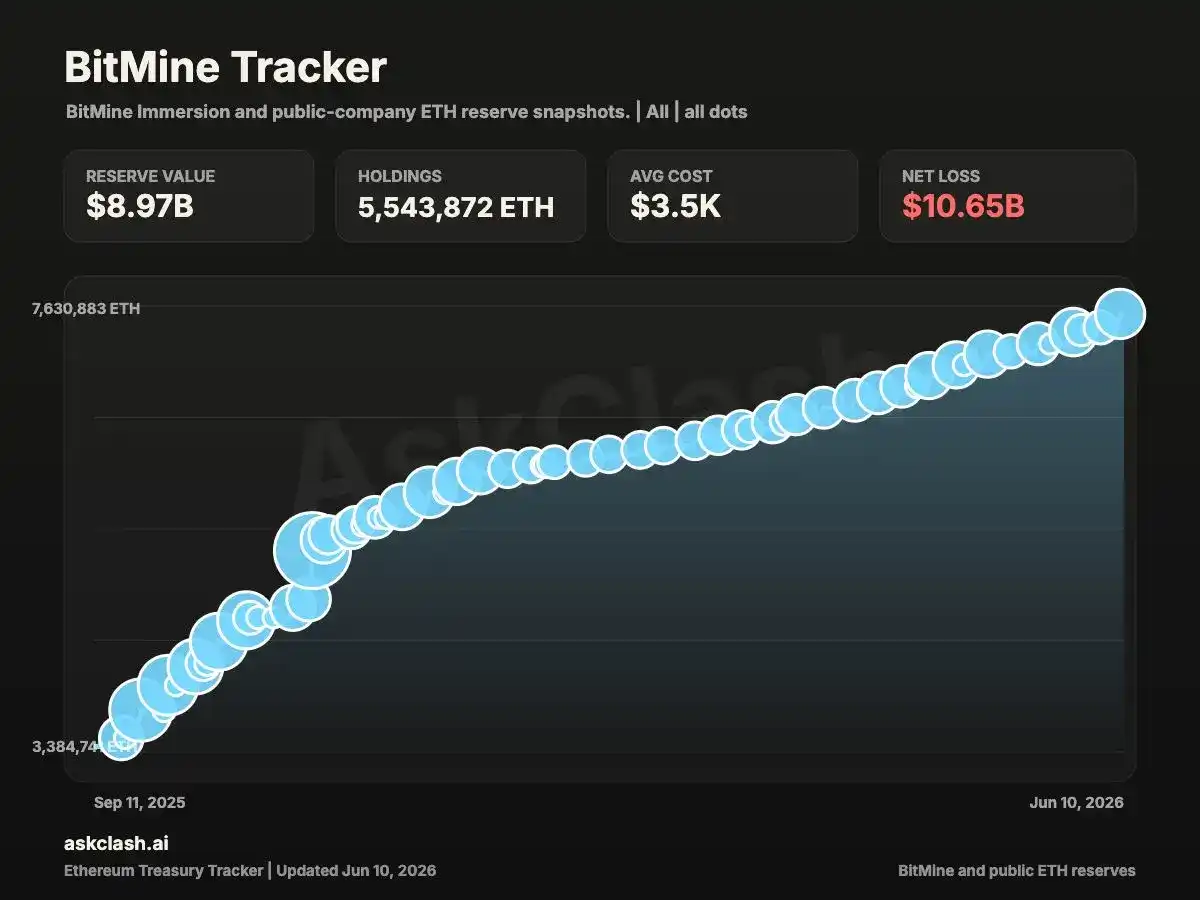
Among these, about 4.719 million ETH have been staked, accounting for over 85% of total holdings, with expected annual staking returns of approximately $230 million to $296 million. This staking system is supported by the company's self-built MAVAN validator node network, considered the key structural design that distinguishes Bitmine from Strategy.

However, the price of aggressive accumulation is also evident. With ETH currently around $1,650, the company's average cost is about $3,500. Its ETH treasury value is only about $9.3 billion, resulting in an overall company loss of $10.5 billion, a drawdown of over 50%. The company's stock price has fallen nearly 90% from its peak.
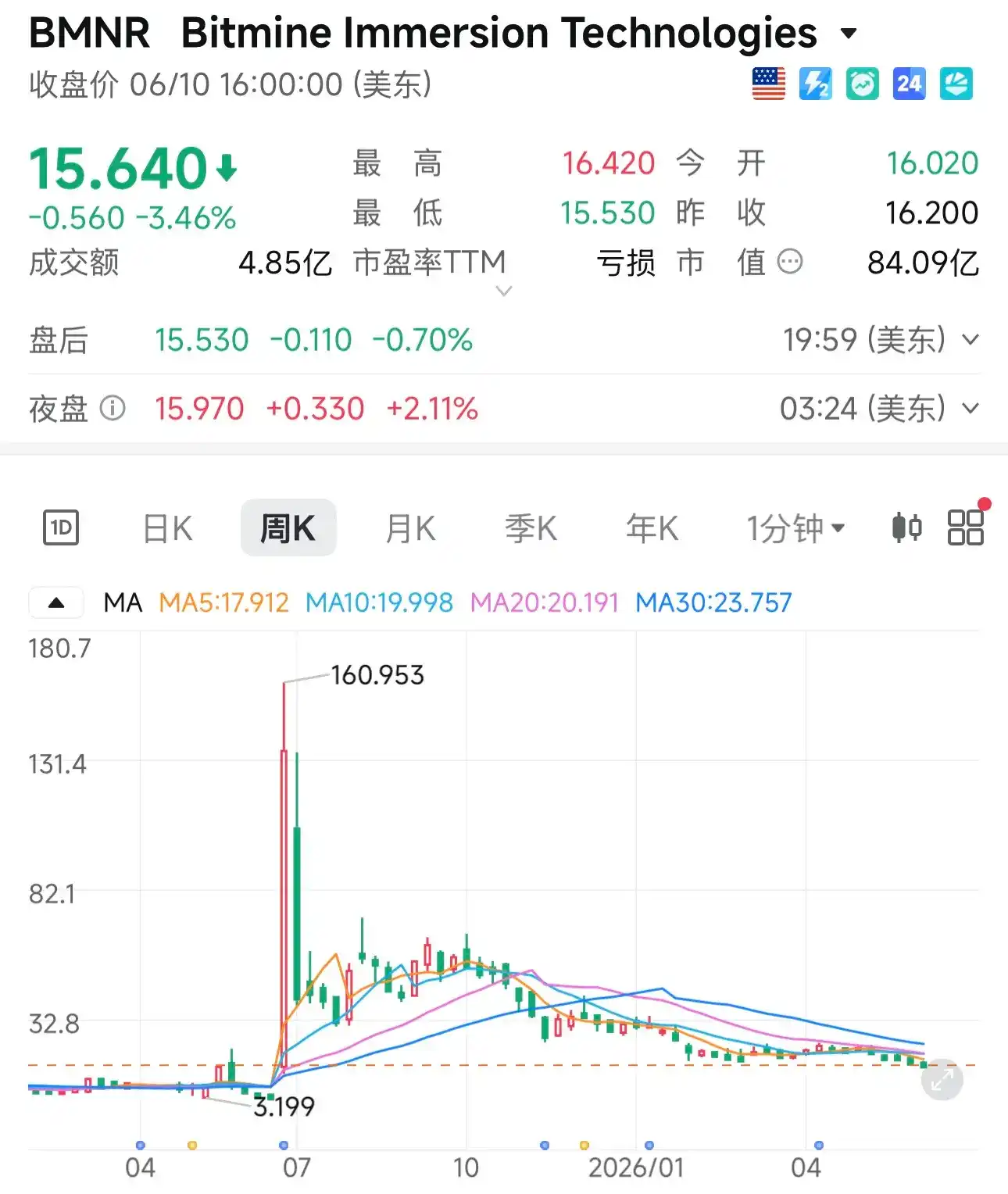
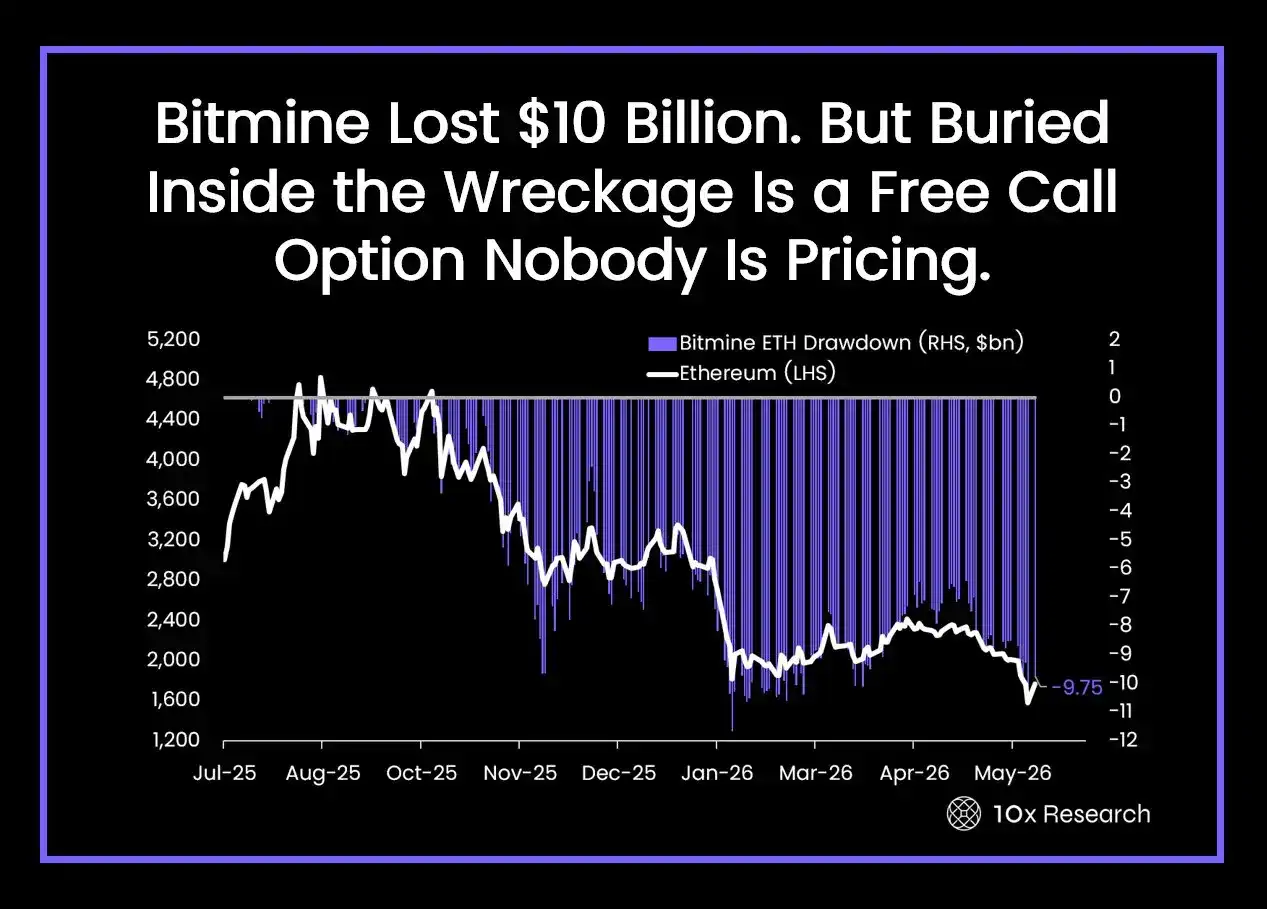
10x Research points out that Bitmine's investors face two layers of losses: the floating loss from ETH's decline is the first layer. Investors paid a premium of about $4.6 billion over the underlying ETH net asset value when purchasing BMNR stock, constituting the second layer. These two layers combined amplify the actual loss magnitude for shareholders.
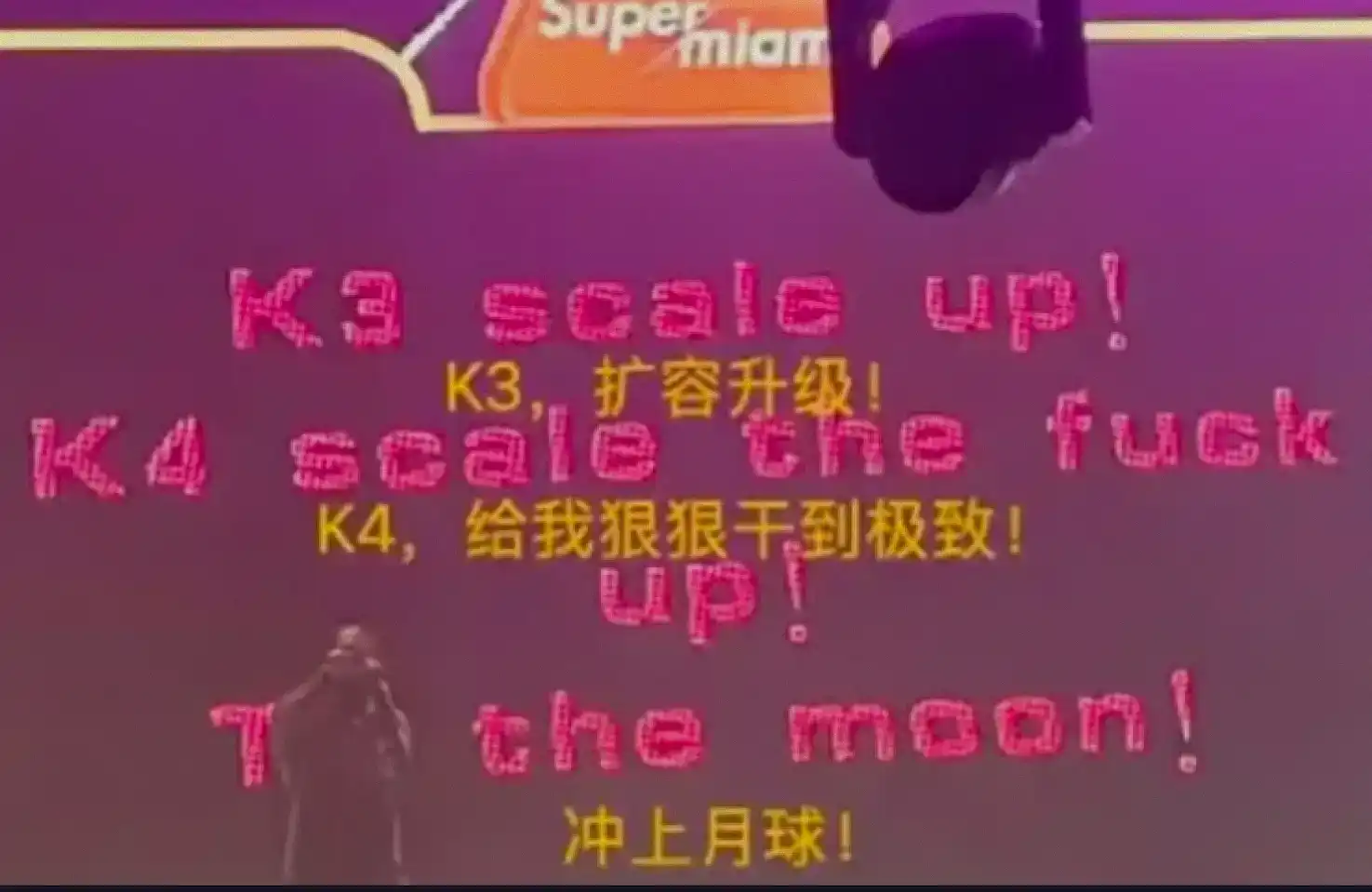
Facing massive floating losses, Tom Lee has characterized this decline as superficial. He believes the existing financial system harbors a large amount of fraudulent trading, whereas Ethereum has never experienced fraudulent transactions, operates at lower costs, and both on-chain transaction volume and daily active addresses have hit record highs. The price correction is driven by macro factors and leverage unwinding, with fundamentals unharmed. The longer-term bet is that AI agent systems will rely on blockchains to operate, ETH supply continues to contract, and Ethereum is the most direct beneficiary.

Tom Lee recently revealed that Bitmine expects to complete the 5% target by the end of 2026, at which point it may no longer need to continue accumulating. He also mentioned the company is likely to be formally included in the Russell 1000 Index by the end of June. Based on market cap calculations at that time, this could bring at least $2.15 billion in passive fund inflows for BMNR.

How Can 3% Staking Yield Support a 9.5% Dividend?

On June 5th, Bitmine completed pricing for its Series A Perpetual Preferred Stock: 3.5 million shares, issue price $80 per share, par value $100, net proceeds about $274 million. The dividend yield is 9.5%, paid weekly in cash, and continues to accrue even if the board does not declare a dividend. The annualized dividend obligation is approximately $33.25 million based on par value.

Bitmine holds an early redemption right: it can redeem at 110% of par within 18 months of issuance, at 105% of par between 18 months and 3 years, and at 100% of par after 3 years, with any accumulated unpaid dividends also paid upon redemption.

At first glance, the math seems manageable. By the end of May, Bitmine had cumulatively staked 4.7 million ETH, with expected annual staking returns of $230 million to $296 million, 8 to 9 times the annualized dividend obligation.

However, the prediction exceeding $200 million is based on the assumption that the recent 4.7 million ETH are fully staked. According to the prospectus, for the six months ended February 28, 2026, the company's staking revenue was $11.18 million, annualizing to about $22 million.

It's worth noting that staking rewards are denominated in ETH, not USD. If ETH continues to fall, the company's staking income will shrink proportionally.

Here lies a fundamental difference between Bitmine and Strategy. BTC has no native yield. For STRC to pay dividends, Strategy can only rely on BTC price appreciation or selling coins, as detailed by ChainCatcher in 'Strategy Cashes Out $2.5 Million, Bitcoin Market Cap Evaporates $80 Billion'.

ETH's staking mechanism offers Tom Lee a different path: even if the price remains stagnant, staking rewards still generate income without touching the underlying holdings. This is the real stress-resistance advantage of the Bitmine model in the current bear market.

But this path doesn't seem sustainable for long. Crypto KOL chenmo points out that in the early stages with limited issuance, covering dividends with staking revenue might not be a problem. However, as the preferred stock issuance scale continues to expand, a 3-4% staking yield is destined to be unable to cover a 9.5% annual interest rate. At that point, only a rise in ETH price can sustain this logic.

Analyst Yuyue also noted that Strategy's STRC model is already under pressure in the current market. Following up with preferred stock issuance at this time, even if a short-term positive, could be interpreted by the market as a worse signal.

According to CointelegraphMT research, two details in the prospectus warrant attention. The auditor was changed to KPMG on April 27th, with simultaneous disclosure of material weaknesses in internal controls. The audit is not yet complete, and financial data may be subject to restatement.

Additionally, the board has complete discretionary power over dividend payments. The sole enforcement mechanism for preferred shareholders is the right to nominate two directors after 18 consecutive months of not receiving dividends.

If Bitmine Stops Buying After Reaching 5%, Where Will ETH's Price Go?

On-chain analyst Yu Jin stated that at the current buying pace, the target could likely be reached next month. So, will they continue buying after reaching it? If they stop, with the market's last steadfast bull disappearing, what will support ETH?

Bitmine has been the most persistent and aggressive marginal buyer in the ETH market over the past year. Other potential buying forces are scattered and weak. ETH spot ETFs saw a net outflow of $173 million overall last week. Although turning briefly positive on June 8th after 17 consecutive days of outflows, the inflow strength was far less than the previous outflow scale.

Meanwhile, Goldman Sachs reduced its ETH ETF holdings by about 70% in Q1 2026. Harvard University's endowment fund completely liquidated its approximately $87 million ETHA holdings, selling all after holding for just one quarter. Details on institutional fund movements can be found in 'Harvard and Other Institutions Liquidate, Six Core Talents Depart in One Month: What's Wrong with Ethereum?'.

Furthermore, stablecoin legislation and institutional incremental demand brought by RWA tokenization are slow-moving variables, difficult to fill a gap of Bitmine's scale in the short term.

Without an overall reversal in the crypto market, it's foreseeable that the treasury flywheel will be difficult to sustain. The transmission effect would be: ETH price continues to fall, BMNR stock price faces pressure, the premium over net assets narrows, the window for additional fundraising shrinks, the buying pace slows, and ETH further loses marginal support. This cycle doesn't even require Bitmine to actively sell a single ETH; the mere disappearance of buying power is sufficient.
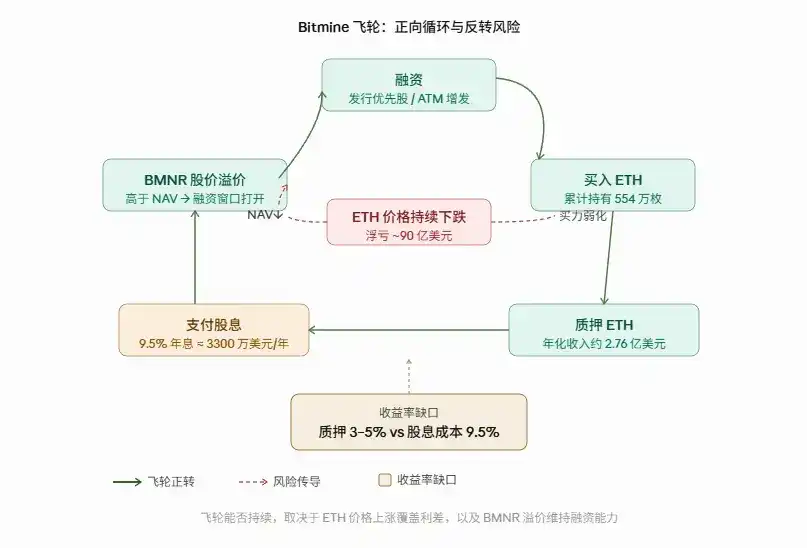
Image Source: AI Generated

In a pessimistic scenario, if the financing market's acceptance of preferred stock weakens, BMNR keeps hitting new lows, buying significantly slows, ETH could potentially test the next key consensus level (around $1,000). DWF Labs co-founder Andrei Grachev believes Strategy and Bitmine have a significant chance to create the largest market crash in cryptocurrency history. This is a tail risk judgment, not a baseline expectation.

In the baseline scenario, Bitmine maintains buying, staking returns provide a buffer, preferred stock is digested smoothly, and ETH consolidates at a bottom in the $1,500 to $2,000 range. Although Bitmine is severely battered and ETH's short-term recovery is difficult, the 10x Research report mentions that when a stock falls deep enough, the underlying asset becomes almost irrelevant. What investors are buying is essentially a pure option—a free call option on ETH's future rebound, which is not yet fully priced by the market.

In an optimistic scenario, formal inclusion in the Russell 1000 brings passive funds, and the enactment of legislation like the GENIUS Act removes barriers for institutional entry. Standard Chartered maintains its year-end 2026 ETH target price of $4,000, believing the recent price drop does not reflect the continued improvement in Ethereum's network fundamentals. It compares the current situation to Amazon's phase after the 2001 bubble burst—where price temporarily disconnected from network value, but infrastructure building never stopped. The bank expects the ETH/BTC exchange rate to recover to about 0.08 by the end of this decade, with a target price of $40,000 by the end of 2030.

Conclusion

Ultimately, how long this financing can extend the life of Bitmine's flywheel comes down to ETH's price. However, Bitmine's buying itself is an important part of supporting that price.

So the core question is: after Bitmine completes its 5% target and gradually steps back, who will pick up the baton? Traditional institutions are pulling back, ETF funds flow in and out, and real incremental demand from stablecoins and RWA has yet to manifest on a large scale.

Perhaps Ethereum lacks no narratives, but when will the liquidity inflection point appear, and where will the new marginal buyers come from? These are the key questions that will determine ETH's price trajectory going forward.


Lecturas Relacionadas

Raising Interest Rates Is Not a Tech Killer, EPS Is: A Strategy for Discarding the Weak and Retaining the Strong After the AI Theme's Sharp Decline

**Summary: Rising Interest Rates Are Not the Killer of Tech; EPS Is: The "Keep the Strong, Ditch the Weak" Strategy After the AI Theme Plunge** The author argues that the sharp sell-off in tech and AI-related stocks, triggered by a strong US jobs report that heightened Fed rate hike fears, represents a "pullback to pick up passengers" rather than a "car crash." The true end of a tech bull market is not determined by an extra 25 basis point hike, but by industry overcapacity and the disproval of earnings per share (EPS) expectations. Historical analysis shows that during past rate hike cycles, the Nasdaq-100 often outperformed, provided EPS growth remained strong. The current phase is seen as a shift from a "broad narrative-driven rally" to a "focused verification stage" for AI. The investment strategy should be to "keep the strong, ditch the weak." * **Retain exposure** to high-conviction AI infrastructure leaders with clear order visibility, stable margins, strong cash flow, and upward EPS revisions (e.g., AI servers, advanced packaging, optical modules, key cloud suppliers). * **Reduce exposure** to high-beta, narrative-driven stocks with unclear profit paths (e.g., some quantum computing, space, or speculative chip stocks), especially on rebounds. Valuation concerns should focus on whether earnings can catch up to high multiples, not on high P/E alone. Crowded positioning signals a concentration into quality assets, not necessarily a market top. The upcoming Q2 earnings season will be a key validation point. The core principle is to hold stocks with proven EPS, while using macro events (CPI data, central bank meetings) to manage timing and risk.

marsbitHace 3 hora(s)

Raising Interest Rates Is Not a Tech Killer, EPS Is: A Strategy for Discarding the Weak and Retaining the Strong After the AI Theme's Sharp Decline

marsbitHace 3 hora(s)

The Largest IPO in History Ignites Heated Debate: Is SpaceX Worth $1.77 Trillion?

SpaceX's potential IPO is priced at $135 per share, aiming to raise $75 billion and valuing the company at approximately $1.77 trillion, which would make it the largest IPO in history. This valuation has sparked intense debate among investors. Bullish analysts, including major underwriters Goldman Sachs and Morgan Stanley, argue the valuation is justified by SpaceX's long-term potential. They see it not just as a rocket company but as a future leader in space infrastructure, with key growth drivers being Starlink satellite internet, low-cost rocket launches, and future AI-related ventures. They project revenues reaching hundreds of billions to trillions of dollars by 2030-2040. ARK Invest's model suggests a 2030 enterprise value could reach $2.5 trillion. Bearish analysts from independent research firms like Morningstar, PitchBook, and New Constructs contend the IPO price is excessively high, already pricing in unrealistic future growth. Using DCF and sum-of-the-parts models, they estimate fair value between $780 billion and $1.7 trillion, significantly below the IPO target. They highlight risks such as the speculative nature of AI projections, over-dependence on Elon Musk, high growth expectations, and corporate governance concerns. Trefis set a target price of just $79 per share. While both sides acknowledge SpaceX's unique position in commercial space, the core disagreement centers on whether the $135 share price offers a reasonable margin of safety or is overly optimistic. Despite the valuation controversy, reported strong demand for the IPO indicates significant market interest.

marsbitHace 5 hora(s)

The Largest IPO in History Ignites Heated Debate: Is SpaceX Worth $1.77 Trillion?

marsbitHace 5 hora(s)

Trading

Spot
Futuros

Artículos destacados

Qué es $S$

Entendiendo SPERO: Una Visión General Completa Introducción a SPERO A medida que el panorama de la innovación continúa evolucionando, la aparición de tecnologías web3 y proyectos de criptomonedas juega un papel fundamental en la configuración del futuro digital. Un proyecto que ha atraído la atención en este campo dinámico es SPERO, denotado como SPERO,$$s$. Este artículo tiene como objetivo reunir y presentar información detallada sobre SPERO, para ayudar a entusiastas e inversores a comprender sus fundamentos, objetivos e innovaciones dentro de los dominios web3 y cripto. ¿Qué es SPERO,$$s$? SPERO,$$s$ es un proyecto único dentro del espacio cripto que busca aprovechar los principios de descentralización y tecnología blockchain para crear un ecosistema que promueva la participación, la utilidad y la inclusión financiera. El proyecto está diseñado para facilitar interacciones de igual a igual de nuevas maneras, proporcionando a los usuarios soluciones y servicios financieros innovadores. En su esencia, SPERO,$$s$ tiene como objetivo empoderar a los individuos al proporcionar herramientas y plataformas que mejoren la experiencia del usuario en el espacio de las criptomonedas. Esto incluye habilitar métodos de transacción más flexibles, fomentar iniciativas impulsadas por la comunidad y crear caminos para oportunidades financieras a través de aplicaciones descentralizadas (dApps). La visión subyacente de SPERO,$$s$ gira en torno a la inclusividad, buscando cerrar brechas dentro de las finanzas tradicionales mientras aprovecha los beneficios de la tecnología blockchain. ¿Quién es el Creador de SPERO,$$s$? La identidad del creador de SPERO,$$s$ sigue siendo algo oscura, ya que hay recursos públicos limitados que proporcionan información de fondo detallada sobre su(s) fundador(es). Esta falta de transparencia puede derivarse del compromiso del proyecto con la descentralización, una ética que muchos proyectos web3 comparten, priorizando las contribuciones colectivas sobre el reconocimiento individual. Al centrar las discusiones en torno a la comunidad y sus objetivos colectivos, SPERO,$$s$ encarna la esencia del empoderamiento sin señalar a individuos específicos. Como tal, comprender la ética y la misión de SPERO sigue siendo más importante que identificar a un creador singular. ¿Quiénes son los Inversores de SPERO,$$s$? SPERO,$$s$ cuenta con el apoyo de una diversa gama de inversores que van desde capitalistas de riesgo hasta inversores ángeles dedicados a fomentar la innovación en el sector cripto. El enfoque de estos inversores generalmente se alinea con la misión de SPERO, priorizando proyectos que prometen avances tecnológicos sociales, inclusión financiera y gobernanza descentralizada. Estas fundaciones de inversores suelen estar interesadas en proyectos que no solo ofrecen productos innovadores, sino que también contribuyen positivamente a la comunidad blockchain y sus ecosistemas. El respaldo de estos inversores refuerza a SPERO,$$s$ como un contendiente notable en el dominio de proyectos cripto que evoluciona rápidamente. ¿Cómo Funciona SPERO,$$s$? SPERO,$$s$ emplea un marco multifacético que lo distingue de los proyectos de criptomonedas convencionales. Aquí hay algunas de las características clave que subrayan su singularidad e innovación: Gobernanza Descentralizada: SPERO,$$s$ integra modelos de gobernanza descentralizada, empoderando a los usuarios para participar activamente en los procesos de toma de decisiones sobre el futuro del proyecto. Este enfoque fomenta un sentido de propiedad y responsabilidad entre los miembros de la comunidad. Utilidad del Token: SPERO,$$s$ utiliza su propio token de criptomoneda, diseñado para servir diversas funciones dentro del ecosistema. Estos tokens permiten transacciones, recompensas y la facilitación de servicios ofrecidos en la plataforma, mejorando la participación y la utilidad general. Arquitectura en Capas: La arquitectura técnica de SPERO,$$s$ apoya la modularidad y escalabilidad, permitiendo la integración fluida de características y aplicaciones adicionales a medida que el proyecto evoluciona. Esta adaptabilidad es fundamental para mantener la relevancia en el cambiante paisaje cripto. Participación de la Comunidad: El proyecto enfatiza iniciativas impulsadas por la comunidad, empleando mecanismos que incentivan la colaboración y la retroalimentación. Al nutrir una comunidad sólida, SPERO,$$s$ puede abordar mejor las necesidades de los usuarios y adaptarse a las tendencias del mercado. Enfoque en la Inclusión: Al ofrecer tarifas de transacción bajas e interfaces amigables para el usuario, SPERO,$$s$ busca atraer a una base de usuarios diversa, incluyendo a individuos que anteriormente pueden no haber participado en el espacio cripto. Este compromiso con la inclusión se alinea con su misión general de empoderamiento a través de la accesibilidad. Cronología de SPERO,$$s$ Entender la historia de un proyecto proporciona información crucial sobre su trayectoria de desarrollo y hitos. A continuación se presenta una cronología sugerida que mapea eventos significativos en la evolución de SPERO,$$s$: Fase de Conceptualización e Ideación: Las ideas iniciales que forman la base de SPERO,$$s$ fueron concebidas, alineándose estrechamente con los principios de descentralización y enfoque comunitario dentro de la industria blockchain. Lanzamiento del Whitepaper del Proyecto: Tras la fase conceptual, se lanzó un whitepaper completo que detalla la visión, los objetivos y la infraestructura tecnológica de SPERO,$$s$ para generar interés y retroalimentación de la comunidad. Construcción de Comunidad y Primeras Interacciones: Se realizaron esfuerzos de divulgación activa para construir una comunidad de primeros adoptantes y posibles inversores, facilitando discusiones en torno a los objetivos del proyecto y obteniendo apoyo. Evento de Generación de Tokens: SPERO,$$s$ llevó a cabo un evento de generación de tokens (TGE) para distribuir sus tokens nativos a los primeros seguidores y establecer liquidez inicial dentro del ecosistema. Lanzamiento de la dApp Inicial: La primera aplicación descentralizada (dApp) asociada con SPERO,$$s$ se puso en marcha, permitiendo a los usuarios interactuar con las funcionalidades centrales de la plataforma. Desarrollo Continuo y Alianzas: Actualizaciones y mejoras continuas a las ofertas del proyecto, incluyendo alianzas estratégicas con otros actores en el espacio blockchain, han moldeado a SPERO,$$s$ en un jugador competitivo y en evolución en el mercado cripto. Conclusión SPERO,$$s$ se erige como un testimonio del potencial de web3 y las criptomonedas para revolucionar los sistemas financieros y empoderar a los individuos. Con un compromiso con la gobernanza descentralizada, la participación comunitaria y funcionalidades diseñadas de manera innovadora, allana el camino hacia un paisaje financiero más inclusivo. Como con cualquier inversión en el espacio cripto que evoluciona rápidamente, se anima a los posibles inversores y usuarios a investigar a fondo y participar de manera reflexiva con los desarrollos en curso dentro de SPERO,$$s$. El proyecto muestra el espíritu innovador de la industria cripto, invitando a una mayor exploración de sus innumerables posibilidades. Mientras el viaje de SPERO,$$s$ aún se desarrolla, sus principios fundamentales pueden, de hecho, influir en el futuro de cómo interactuamos con la tecnología, las finanzas y entre nosotros en ecosistemas digitales interconectados.

72 Vistas totalesPublicado en 2024.12.17Actualizado en 2024.12.17

Qué es $S$

Qué es AGENT S

Agent S: El Futuro de la Interacción Autónoma en Web3 Introducción En el paisaje en constante evolución de Web3 y las criptomonedas, las innovaciones están redefiniendo constantemente cómo los individuos interactúan con las plataformas digitales. Uno de estos proyectos pioneros, Agent S, promete revolucionar la interacción humano-computadora a través de su marco agente abierto. Al allanar el camino para interacciones autónomas, Agent S busca simplificar tareas complejas, ofreciendo aplicaciones transformadoras en inteligencia artificial (IA). Esta exploración detallada profundizará en las complejidades del proyecto, sus características únicas y las implicaciones para el dominio de las criptomonedas. ¿Qué es Agent S? Agent S se presenta como un marco agente abierto innovador, diseñado específicamente para abordar tres desafíos fundamentales en la automatización de tareas informáticas: Adquisición de Conocimiento Específico del Dominio: El marco aprende inteligentemente de diversas fuentes de conocimiento externas y experiencias internas. Este enfoque dual le permite construir un rico repositorio de conocimiento específico del dominio, mejorando su rendimiento en la ejecución de tareas. Planificación a Largo Plazo de Tareas: Agent S emplea planificación jerárquica aumentada por la experiencia, un enfoque estratégico que facilita la descomposición y ejecución eficiente de tareas complejas. Esta característica mejora significativamente su capacidad para gestionar múltiples subtareas de manera eficiente y efectiva. Manejo de Interfaces Dinámicas y No Uniformes: El proyecto introduce la Interfaz Agente-Computadora (ACI), una solución innovadora que mejora la interacción entre agentes y usuarios. Utilizando Modelos de Lenguaje Multimodal de Gran Escala (MLLMs), Agent S puede navegar y manipular diversas interfaces gráficas de usuario sin problemas. A través de estas características pioneras, Agent S proporciona un marco robusto que aborda las complejidades involucradas en la automatización de la interacción humana con las máquinas, preparando el terreno para una multitud de aplicaciones en IA y más allá. ¿Quién es el Creador de Agent S? Si bien el concepto de Agent S es fundamentalmente innovador, la información específica sobre su creador sigue siendo elusiva. El creador es actualmente desconocido, lo que resalta ya sea la etapa incipiente del proyecto o la elección estratégica de mantener a los miembros fundadores en el anonimato. Independientemente de la anonimidad, el enfoque sigue siendo en las capacidades y el potencial del marco. ¿Quiénes son los Inversores de Agent S? Dado que Agent S es relativamente nuevo en el ecosistema criptográfico, la información detallada sobre sus inversores y patrocinadores financieros no está documentada explícitamente. La falta de información disponible públicamente sobre las bases de inversión u organizaciones que apoyan el proyecto plantea preguntas sobre su estructura de financiamiento y hoja de ruta de desarrollo. Comprender el respaldo es crucial para evaluar la sostenibilidad del proyecto y su posible impacto en el mercado. ¿Cómo Funciona Agent S? En el núcleo de Agent S se encuentra una tecnología de vanguardia que le permite funcionar de manera efectiva en diversos entornos. Su modelo operativo se basa en varias características clave: Interacción Humano-Computadora Similar a la Humana: El marco ofrece planificación avanzada de IA, esforzándose por hacer que las interacciones con las computadoras sean más intuitivas. Al imitar el comportamiento humano en la ejecución de tareas, promete elevar las experiencias de los usuarios. Memoria Narrativa: Empleada para aprovechar experiencias de alto nivel, Agent S utiliza memoria narrativa para hacer un seguimiento de las historias de tareas, mejorando así sus procesos de toma de decisiones. Memoria Episódica: Esta característica proporciona a los usuarios una guía paso a paso, permitiendo que el marco ofrezca apoyo contextual a medida que se desarrollan las tareas. Soporte para OpenACI: Con la capacidad de ejecutarse localmente, Agent S permite a los usuarios mantener el control sobre sus interacciones y flujos de trabajo, alineándose con la ética descentralizada de Web3. Fácil Integración con APIs Externas: Su versatilidad y compatibilidad con varias plataformas de IA aseguran que Agent S pueda encajar sin problemas en ecosistemas tecnológicos existentes, convirtiéndolo en una opción atractiva para desarrolladores y organizaciones. Estas funcionalidades contribuyen colectivamente a la posición única de Agent S dentro del espacio cripto, ya que automatiza tareas complejas y de múltiples pasos con una intervención humana mínima. A medida que el proyecto evoluciona, sus posibles aplicaciones en Web3 podrían redefinir cómo se desarrollan las interacciones digitales. Cronología de Agent S El desarrollo y los hitos de Agent S pueden encapsularse en una cronología que resalta sus eventos significativos: 27 de septiembre de 2024: El concepto de Agent S fue lanzado en un documento de investigación integral titulado “Un Marco Agente Abierto que Usa Computadoras Como un Humano”, mostrando las bases del proyecto. 10 de octubre de 2024: El documento de investigación fue puesto a disposición del público en arXiv, ofreciendo una exploración profunda del marco y su evaluación de rendimiento basada en el benchmark OSWorld. 12 de octubre de 2024: Se lanzó una presentación en video, proporcionando una visión visual de las capacidades y características de Agent S, involucrando aún más a posibles usuarios e inversores. Estos marcadores en la cronología no solo ilustran el progreso de Agent S, sino que también indican su compromiso con la transparencia y la participación comunitaria. Puntos Clave Sobre Agent S A medida que el marco Agent S continúa evolucionando, varios atributos clave destacan, subrayando su naturaleza innovadora y potencial: Marco Innovador: Diseñado para proporcionar un uso intuitivo de las computadoras similar a la interacción humana, Agent S aporta un enfoque novedoso a la automatización de tareas. Interacción Autónoma: La capacidad de interactuar de manera autónoma con las computadoras a través de GUI significa un salto hacia soluciones informáticas más inteligentes y eficientes. Automatización de Tareas Complejas: Con su metodología robusta, puede automatizar tareas complejas y de múltiples pasos, haciendo que los procesos sean más rápidos y menos propensos a errores. Mejora Continua: Los mecanismos de aprendizaje permiten a Agent S mejorar a partir de experiencias pasadas, mejorando continuamente su rendimiento y eficacia. Versatilidad: Su adaptabilidad en diferentes entornos operativos como OSWorld y WindowsAgentArena asegura que pueda servir a una amplia gama de aplicaciones. A medida que Agent S se posiciona en el paisaje de Web3 y criptomonedas, su potencial para mejorar las capacidades de interacción y automatizar procesos significa un avance significativo en las tecnologías de IA. A través de su marco innovador, Agent S ejemplifica el futuro de las interacciones digitales, prometiendo una experiencia más fluida y eficiente para los usuarios en diversas industrias. Conclusión Agent S representa un audaz avance en la unión de la IA y Web3, con la capacidad de redefinir cómo interactuamos con la tecnología. Aunque aún se encuentra en sus primeras etapas, las posibilidades para su aplicación son vastas y atractivas. A través de su marco integral que aborda desafíos críticos, Agent S busca llevar las interacciones autónomas al primer plano de la experiencia digital. A medida que nos adentramos más en los reinos de las criptomonedas y la descentralización, proyectos como Agent S sin duda desempeñarán un papel crucial en la configuración del futuro de la tecnología y la colaboración humano-computadora.

482 Vistas totalesPublicado en 2025.01.14Actualizado en 2025.01.14

Qué es AGENT S

Cómo comprar S

¡Bienvenido a HTX.com! Hemos hecho que comprar Sonic (S) sea simple y conveniente. Sigue nuestra guía paso a paso para iniciar tu viaje de criptos.Paso 1: crea tu cuenta HTXUtiliza tu correo electrónico o número de teléfono para registrarte y obtener una cuenta gratuita en HTX. Experimenta un proceso de registro sin complicaciones y desbloquea todas las funciones.Obtener mi cuentaPaso 2: ve a Comprar cripto y elige tu método de pagoTarjeta de crédito/débito: usa tu Visa o Mastercard para comprar Sonic (S) al instante.Saldo: utiliza fondos del saldo de tu cuenta HTX para tradear sin problemas.Terceros: hemos agregado métodos de pago populares como Google Pay y Apple Pay para mejorar la comodidad.P2P: tradear directamente con otros usuarios en HTX.Over-the-Counter (OTC): ofrecemos servicios personalizados y tipos de cambio competitivos para los traders.Paso 3: guarda tu Sonic (S)Después de comprar tu Sonic (S), guárdalo en tu cuenta HTX. Alternativamente, puedes enviarlo a otro lugar mediante transferencia blockchain o utilizarlo para tradear otras criptomonedas.Paso 4: tradear Sonic (S)Tradear fácilmente con Sonic (S) en HTX's mercado spot. Simplemente accede a tu cuenta, selecciona tu par de trading, ejecuta tus trades y monitorea en tiempo real. Ofrecemos una experiencia fácil de usar tanto para principiantes como para traders experimentados.

975 Vistas totalesPublicado en 2025.01.15Actualizado en 2026.06.02

Cómo comprar S

Discusiones

Bienvenido a la comunidad de HTX. Aquí puedes mantenerte informado sobre los últimos desarrollos de la plataforma y acceder a análisis profesionales del mercado. A continuación se presentan las opiniones de los usuarios sobre el precio de S (S).

活动图片