Tether Cooperates with U.S. Sanctions to Freeze $344 Million in USDT, Reigniting Debate Over Stablecoin 'One-Click Freeze Authority'

marsbitPublicado a 2026-04-24Actualizado a 2026-04-24

Resumen

Tether, the issuer of USDT, has frozen over $344 million worth of USDT across two Tron blockchain addresses in its largest-ever single compliance action. The freeze was carried out on April 23 in coordination with the U.S. Office of Foreign Assets Control (OFAC) and other law enforcement agencies. The funds are suspected to be linked to sanctions evasion, criminal networks, or other illicit activities, though specific details were not disclosed. This action comes amid increased U.S. regulatory scrutiny, including sanctions against entities tied to Iran and Mexican drug cartels. Tether’s CEO, Paolo Ardoino, emphasized the company’s commitment to preventing illegal use of USDT, contrasting it with slower responses from competitors like Circle. To date, Tether has frozen over $4.4 billion in assets and collaborates with more than 340 law enforcement agencies across 65 countries. The move has reignited debate within the crypto community over the centralized "freeze authority" held by stablecoin issuers, challenging the notion that "your stablecoins are your own." Critics point to the built-in blacklist function in USDT’s smart contracts, which allows Tether to immobilize funds in targeted wallets, while proponents argue it enhances regulatory compliance and anti-money laundering efforts.

Author: Claude, Deep Tide TechFlow

Deep Tide Introduction: On April 23, Tether cooperated with OFAC and U.S. law enforcement agencies to freeze a total of 344 million USDT in two wallets on the Tron chain, setting a historical record for the largest single freeze. This action, occurring against the backdrop of intensified enforcement of Iran sanctions and criticism of Circle's ineffective freezing after the Drift Protocol's $285 million hack, has once again pushed the 'one-click freeze authority' of stablecoin issuers into the spotlight of public opinion. Tether has cumulatively frozen over $4.4 billion in assets, but its approximately $189 billion in circulation has never undergone a comprehensive audit.
The largest single compliance freeze in stablecoin history has been implemented.

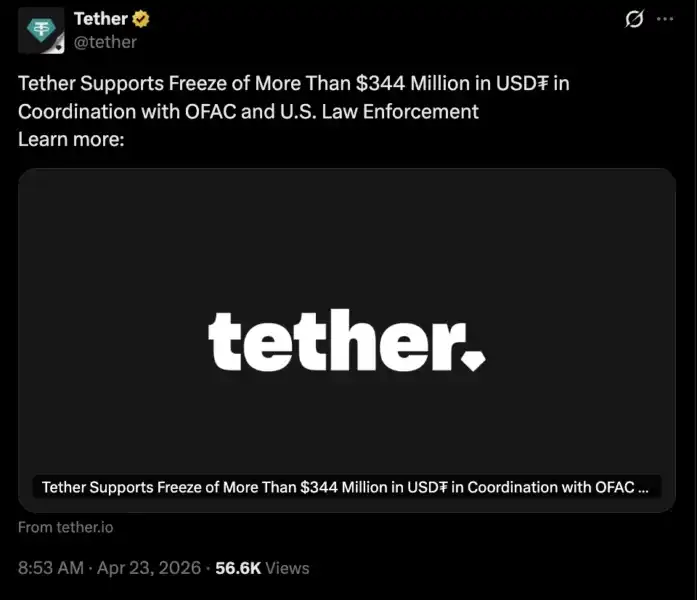
On April 23, Tether issued a statement confirming it had cooperated with the U.S. Department of the Treasury's Office of Foreign Assets Control (OFAC) and multiple law enforcement agencies to freeze USDT in two wallet addresses on the Tron chain, totaling over $344 million. Blockchain security company PeckShield first identified the two blacklisted addresses on-chain: TNiq9...QZH81 held approximately $212.9 million, and TTiDL...pjSr9 held approximately $131.3 million.

Tether stated that the freezing action was based on intelligence shared by U.S. authorities, involving sanctions evasion, criminal networks, or other illegal activities, but did not disclose the specific subjects of the investigation or the nature of the case. Blockchain analysis company AMLbot claimed these two addresses had appeared in documents related to scams, with one linked to a forged $75 billion contract and another involving a Bitcoin-for-USDT scam promising 10% instant returns.

Largest Single Freeze in History, Nearly Double the Previous Record

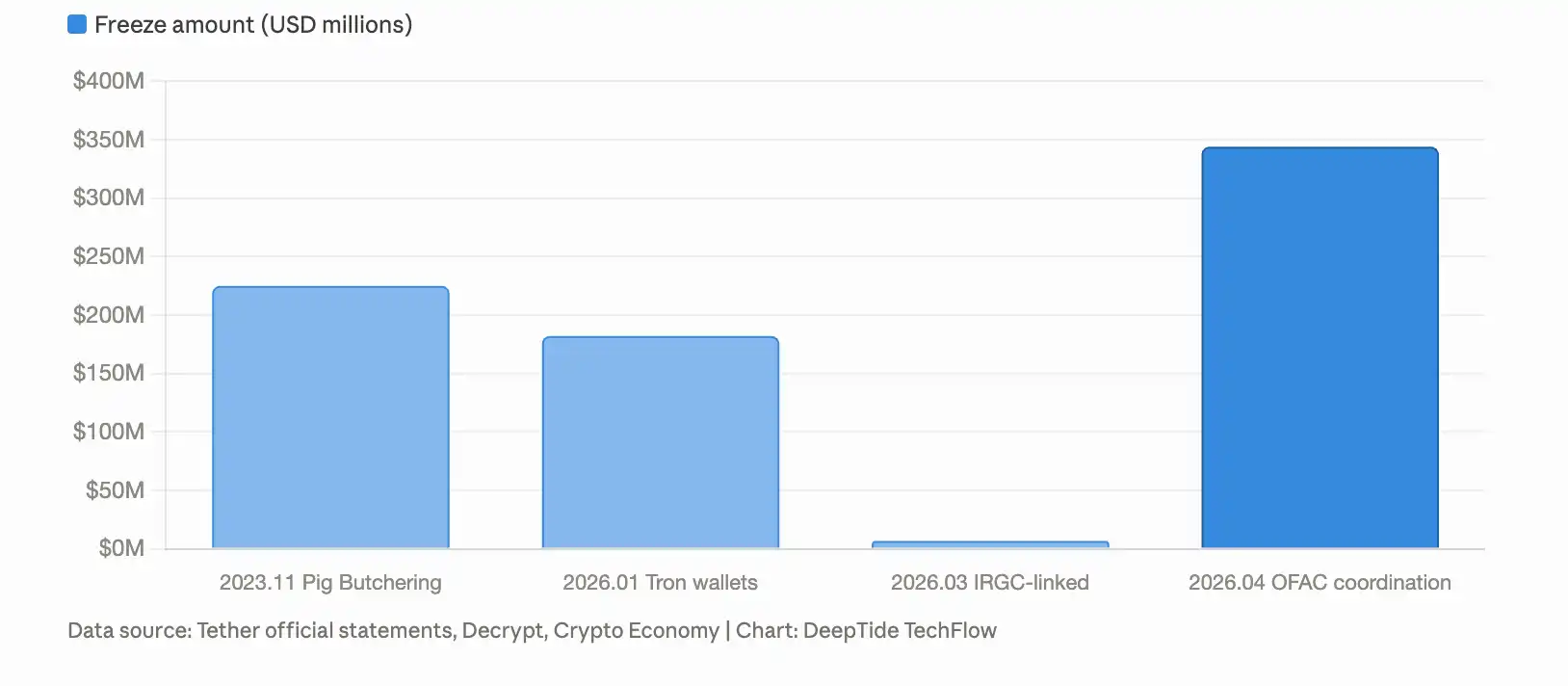
This is the largest single freeze action on record for Tether, nearly double the $182 million freeze in January of this year.

Tether CEO Paolo Ardoino stated in the declaration that USDT is not a safe haven for illegal activities, and when credible links to sanctioned entities or criminal networks are found, the company takes immediate action. He also subtly referenced competitor Circle's slow response in the Drift Protocol incident, saying, 'Recent events have shown that when platforms fail to act swiftly, law enforcement breaks down, users are exposed, and trust is lost.'

According to data disclosed by Tether, the company currently cooperates with over 340 law enforcement agencies in 65 countries, has assisted in over 2,300 cases, and has cumulatively frozen assets exceeding $4.4 billion, of which $2.1 billion is directly related to U.S. law enforcement. Previous large-scale freezes include: approximately $225 million frozen in November 2023 (related to investigations into human trafficking and pig-butchering scams in Southeast Asia), and approximately $182 million frozen in January 2026 (five Tron wallets).
Sanctions Background: Iran, Drug Networks, and OFAC Enforcement Escalation

According to The CC Press, this freeze was executed under OFAC's Iran-related sanctions framework. This timing is significant.

On the same day (April 23), the U.S. Treasury Department announced sanctions against 23 individuals and entities linked to the Sinaloa drug cartel, involving a complex supply chain network procuring fentanyl and methamphetamine precursor chemicals from Asia. Although this sanctions action is not the same case as the Tether freeze, both point to the same policy direction: the U.S. is comprehensively escalating its enforcement of sanctions through cryptocurrency channels.

Regarding Iran, the scale of using USDT to evade sanctions has expanded dramatically in recent years. According to a TRM Labs investigative report cited by The Block in January this year, two UK-registered exchanges, Zedcex and Zedxion, actually provided financial channels for the IRGC (Islamic Revolutionary Guard Corps), processing approximately $1 billion in transactions between 2023 and 2025, 56% of which were IRGC-related transactions, almost all settled using USDT on the Tron chain. IRGC-related transaction volume surged from $24 million in 2023 to $619 million in 2024.

U.S. Senator Richard Blumenthal has publicly called Tether a 'key money laundering tool' for the IRGC, sanctioned Iranian banks, and Iranian weapons manufacturers. In March of this year, Tether also froze $6.76 million USDT linked to networks associated with the IRGC and the Houthis.

Community Questions 'Your Coins Were Never Yours'

However, there is still controversy surrounding the specific attribution of this $344 million freeze.

According to on-chain analysis published by @asvanevik (Nansen CEO Alex Svanevik) on platform X, the network involved with the frozen addresses has been operating since 2021, had fund interactions with the Turkish exchange Paribu, but had only about $1.5 million in transaction records with known IRGC wallets, accounting for 0.4% of the total frozen amount. Svanevik assessed the credibility of attributing this network to the IRGC at 40%-50%.

Meanwhile, the crypto community's reaction is clearly divided.

Crypto media TFTC directly wrote: 'Tether one-click froze $344 million. Your stablecoin was never your stablecoin.' The media used this event as a counterexample to Bitcoin's uncensorable nature, emphasizing that Bitcoin has no issuer, no compliance desk, and no intermediary that can freeze balances.

On-chain data supports the realistic basis for this concern. The USDT smart contract has a built-in blacklist function on every supported chain. Once an address is blacklisted, the related tokens, even if visible on-chain, cannot be transferred, exchanged, or redeemed. To date, Tether has frozen over $3.3 billion USDT across more than 7,000 wallets.

On the other hand, the regulatory faction believes this precisely proves that stablecoins can become effective compliance infrastructure. Unlike cash, every transaction on a public chain is traceable, and the issuer's freezing capability provides law enforcement with speed and precision unattainable by traditional finance.

Between regulatory compliance and the ideal of decentralization, stablecoins are moving towards an increasingly clear hybrid model:

Centralized control rights operating on decentralized infrastructure.

Preguntas relacionadas

QWhat was the record amount of USDT frozen by Tether in a single action on April 23rd, and on which blockchain did it occur?

ATether froze a record 344 million USDT in a single action on the Tron blockchain on April 23rd.

QWhich U.S. government office did Tether cooperate with to execute the freezing of the 344 million USDT?

ATether cooperated with the U.S. Treasury's Office of Foreign Assets Control (OFAC) to execute the freezing.

QWhat is the main criticism from the crypto community regarding Tether's ability to freeze funds, as highlighted in the article?

AThe main criticism is that it demonstrates the principle 'your stablecoin is never your stablecoin,' highlighting the centralized control and lack of user sovereignty over their assets, in contrast to the censorship-resistant nature of assets like Bitcoin.

QAccording to the article, what was one of the alleged illicit activities connected to the frozen addresses, as identified by blockchain analysis firm AMLbot?

AAMLbot identified that one of the addresses was associated with a fake $75 billion contract, and another was involved in a Bitcoin-for-USDT scam promising 10% instant returns.

QHow does the article describe the evolving model of stablecoins in terms of infrastructure and control?

AThe article describes stablecoins as moving toward a clear hybrid model: decentralized infrastructure running with centralized control.

Lecturas Relacionadas

Kicked Out of PayPal, Musk Aims for a Comeback in the Crypto Market

Elon Musk's X (formerly Twitter) has launched its "Smart Cashtags" feature, generating approximately $1 billion in trading volume within days of its April 2026 pilot launch. The feature allows users to click on stock or crypto tickers (or even full Solana token contract addresses) in posts to view real-time price charts and discussions without leaving the app. Initially available to iPhone users in the US and Canada, with a partnership in Canada enabling direct trading via the Wealthsimple app. This move is part of Musk's broader "Everything App" vision, spearheaded by the upcoming X Money platform. Analysts, such as Mizuho's Dan Dolev, see this as a potential disruptor to the US payments market, even prompting a downgrade of PayPal's stock. X Money's beta offers services like 6% APY on deposits, cashback, and P2P transfers, with speculation it may later incorporate crypto trading and stablecoin settlements for faster transactions. However, the ambitious plan faces significant regulatory scrutiny. Senator Elizabeth Warren has questioned the sustainability of the high 6% yield and raised concerns over X's banking partner, Cross River Bank, which has a history of regulatory violations. Additional risks involve the "GENIUS Act," which may create loopholes for stablecoin issuance without full FDIC insurance coverage, potentially leaving users unprotected. The integration of social trading on a platform with over 500 million users could inject new liquidity and retail interest into the crypto market. Yet, it also amplifies risks like herd mentality and the blurring of lines between entertainment and financial speculation. Musk's return to finance, after his ouster from PayPal, hinges on balancing innovation with regulatory compliance.

marsbitHace 1 hora(s)

Kicked Out of PayPal, Musk Aims for a Comeback in the Crypto Market

marsbitHace 1 hora(s)

Trading

Spot
Futuros

Artículos destacados

Cómo comprar ONE

¡Bienvenido a HTX.com! Hemos hecho que comprar Harmony (ONE) sea simple y conveniente. Sigue nuestra guía paso a paso para iniciar tu viaje de criptos.Paso 1: crea tu cuenta HTXUtiliza tu correo electrónico o número de teléfono para registrarte y obtener una cuenta gratuita en HTX. Experimenta un proceso de registro sin complicaciones y desbloquea todas las funciones.Obtener mi cuentaPaso 2: ve a Comprar cripto y elige tu método de pagoTarjeta de crédito/débito: usa tu Visa o Mastercard para comprar Harmony (ONE) al instante.Saldo: utiliza fondos del saldo de tu cuenta HTX para tradear sin problemas.Terceros: hemos agregado métodos de pago populares como Google Pay y Apple Pay para mejorar la comodidad.P2P: tradear directamente con otros usuarios en HTX.Over-the-Counter (OTC): ofrecemos servicios personalizados y tipos de cambio competitivos para los traders.Paso 3: guarda tu Harmony (ONE)Después de comprar tu Harmony (ONE), guárdalo en tu cuenta HTX. Alternativamente, puedes enviarlo a otro lugar mediante transferencia blockchain o utilizarlo para tradear otras criptomonedas.Paso 4: tradear Harmony (ONE)Tradear fácilmente con Harmony (ONE) en HTX's mercado spot. Simplemente accede a tu cuenta, selecciona tu par de trading, ejecuta tus trades y monitorea en tiempo real. Ofrecemos una experiencia fácil de usar tanto para principiantes como para traders experimentados.

225 Vistas totalesPublicado en 2024.12.12Actualizado en 2025.03.21

Cómo comprar ONE

Discusiones

Bienvenido a la comunidad de HTX. Aquí puedes mantenerte informado sobre los últimos desarrollos de la plataforma y acceder a análisis profesionales del mercado. A continuación se presentan las opiniones de los usuarios sobre el precio de ONE (ONE).

活动图片