Tiger Research: Zuckerberg Begins Betting on Prediction Markets, While Asian Nations Still View Them as Gambling

marsbitPublicado a 2026-07-11Actualizado a 2026-07-11

Resumen

This article examines the rise of prediction markets, contrasting their growing institutional acceptance in the West with their restrictive regulation in Asia. It details how prediction markets, which originated from informal political betting and academic experiments like the Iowa Electronic Market, aggregate crowd wisdom into probabilistic prices through binary contracts. Their growth accelerated around 2020, reaching over $14 billion in monthly volume. A key driver is the "skin in the game" principle, where users risk their own capital, leading to high accuracy in predicting events like Fed rate decisions and elections, as demonstrated by platforms like Polymarket. Meta's entry, with Mark Zuckerberg reportedly leading the development of the Arena app, signals the market's maturation. In the U.S., court rulings have distinguished prediction markets from gambling, facilitating entry by traditional financial institutions. However, most Asian jurisdictions still classify them as gambling, focusing on social control rather than financial innovation. The article argues this stance creates three problems for Asia: 1) regulatory arbitrage pushes users to riskier offshore platforms, 2) loss of sovereign information infrastructure as valuable social sentiment data accumulates abroad, and 3) abandonment of user protection. It concludes that Asia needs a policy shift from prohibition to constructive regulation, integrating these markets into the formal system to harness their data a...

Prediction markets have largely remained conceptual for years. Circa 2020, the situation began to change. A few small-scale projects started accumulating significant trading volume and broke through regulatory hurdles one by one, marking the formal formation of prediction markets as an industry.
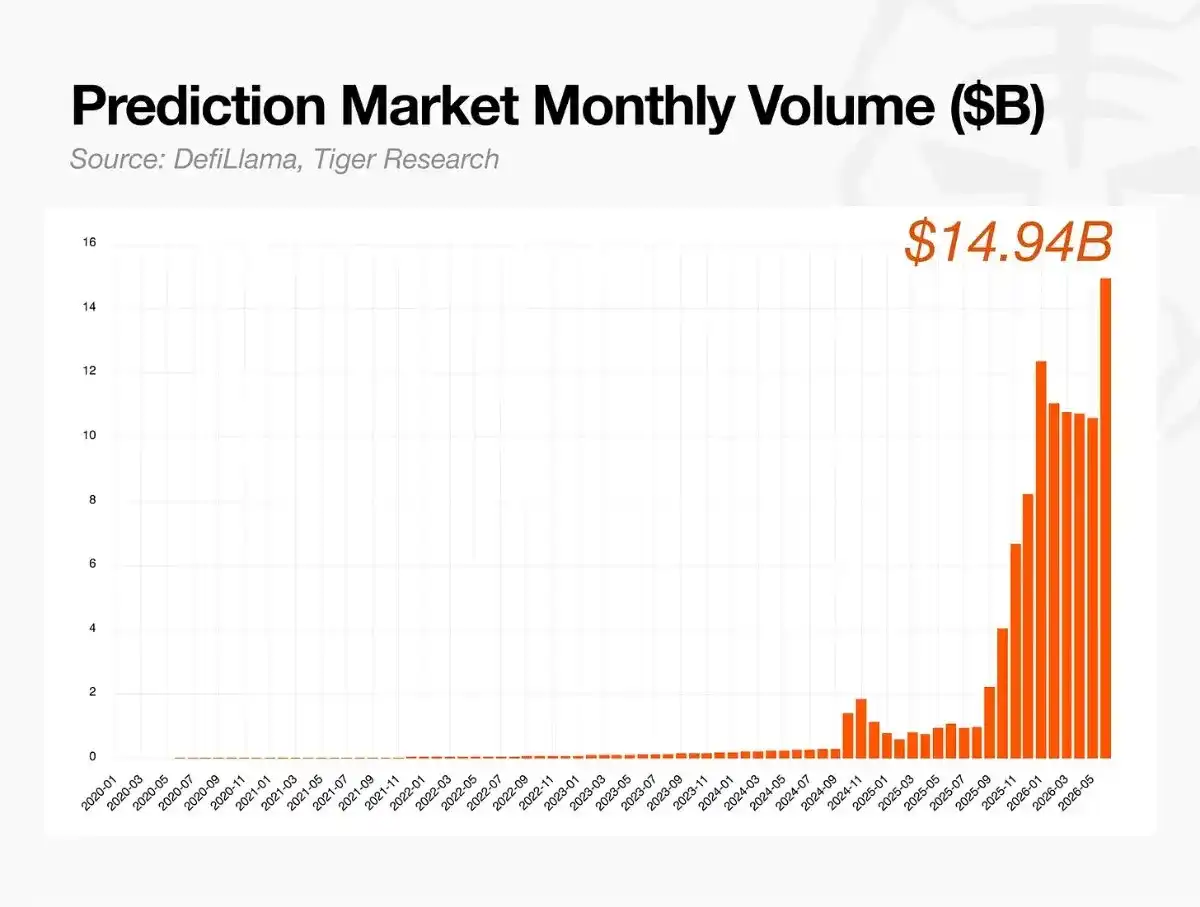
Since then, growth has accelerated. Current monthly trading volume exceeds $14 billion, and the combined valuation of major platforms is approximately $40 billion.

Meta's entry further proves it has moved beyond the early stage. A recent report by The New York Times revealed that Mark Zuckerberg personally leads a team developing a prediction market application called Arena. The dedication of such resources by a major tech company indicates this industry has left the experimental phase and established a proven business model.

Where Did Prediction Markets Originate?

Prediction markets are not a new phenomenon. They have been used informally in academia and finance for decades before blockchain technology brought them to the masses and helped them form an industry.

Informal Use

The term "prediction markets" itself emerged later than its history. By the 1980s, this concept went by various names such as information markets, decision markets, until a 2004 economics paper solidified it as "prediction markets."

However, the underlying practice predates the name. The earliest form was political betting on election outcomes. In 18th-century London coffee houses, people placed bets on parliamentary scandals and prime ministerial changes, with the resulting odds sometimes appearing in newspapers. In 19th-century New York, informal futures markets predicting presidential election outcomes were active in over-the-counter markets near Wall Street.

Academic Use
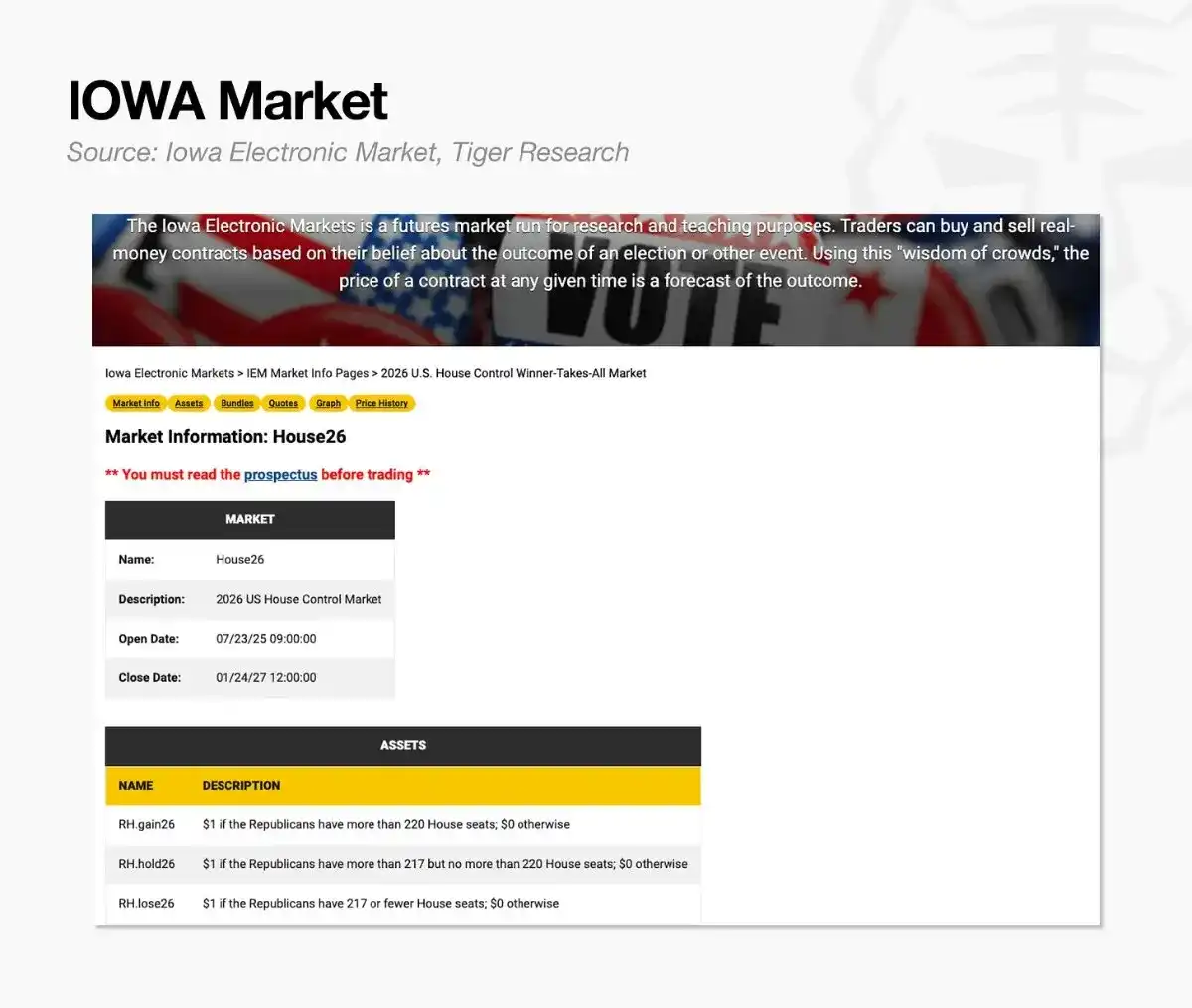
The academic starting point was three economists at the University of Iowa in 1988. Puzzled by polls failing to predict Jesse Jackson's win in the Michigan primary, they designed a market where people could directly trade election outcomes. This later became the Iowa Electronic Market (IEM).

In 1992 and 1993, the IEM received approval from the Commodity Futures Trading Commission (CFTC) for research purposes. Anyone could participate with $5. From 1988 to 2004, the IEM outperformed traditional polls about three-quarters of the time, serving as a laboratory for aggregating collective judgment into prices. Nonetheless, there was no regulatory framework at the time to allow its operation as a public market.

Binary Options

These early prediction markets closely resembled binary options in financial markets: contracts that are yes-or-no bets on whether a price would breach a certain threshold within a specified time. Their structure—settling at 1 if the event occurs, otherwise 0—is completely consistent with the logic of prediction markets.

Binary options also entered regulated exchanges. Examples include the Fixed Return Options by the American Stock Exchange in 2007 and S&P 500-based binary options by the Chicago Board Options Exchange in 2008. However, frequent fraud by offshore platforms led to bans on selling such products to retail investors in several major jurisdictions between 2017 and 2021. Despite this, this basic yes-or-no binary betting structure remains the logical foundation for how prediction markets operate today.

How Are Prediction Markets Traded Today?

Today, prediction markets cover topics encompassing almost any imaginable event.

Sports events account for the largest trading volume, benefiting from continuous schedules of leagues and global tournaments. The ongoing World Cup has further heightened the heat. Politics, geopolitics, and macroeconomics have expanded from indicators like inflation data to predictions on private company valuations, turning information itself into a tradable asset. Cryptocurrency and stock prices, along with some gossip-driven events, collectively form a complete spectrum from mass interest to professional information demand.
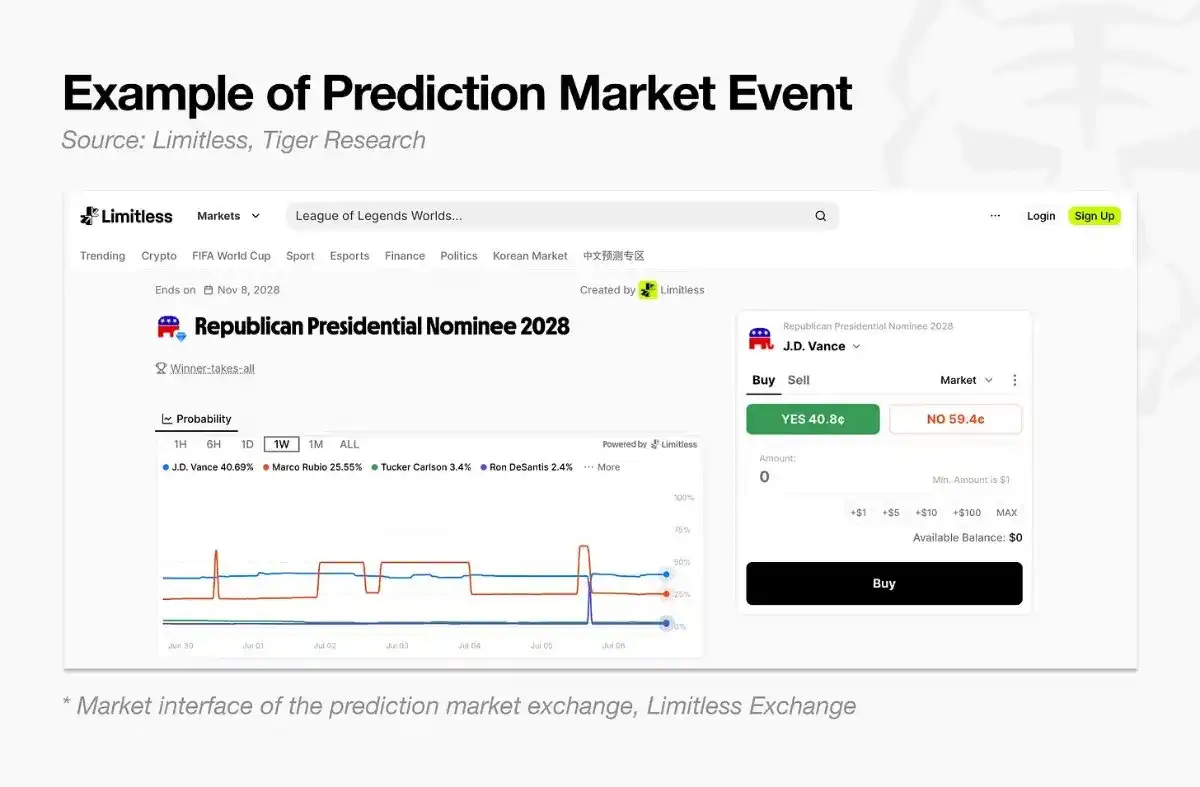
Each contract settles in a binary yes-or-no manner. Taking "Will J.D. Vance be the Republican presidential nominee in 2028?" as an example: If Vance is confirmed as the nominee, contracts betting "Yes" pay $1; otherwise, contracts betting "No" pay $1.

The simplest way to understand this structure is to think of $1 as 100%. A contract pays $1 (100%) if the event occurs, otherwise $0, so the intermediate trading price naturally reflects probability. A contract at 40 cents represents 40% of that dollar, meaning the market perceives a 40% probability of the event occurring. The cent value can be directly read as a percentage (ignoring bid-ask spreads and transaction costs).

Prices are formed through order books, not determined by any central party. Buy orders (e.g., buy at 39 cents) and sell orders (e.g., sell at 40 cents) accumulate at various price levels, with trades executed where both sides match. The price (and thus the implied probability) is generated in real-time by the interplay of funds from numerous participants. Traders can also sell their positions before expiration to lock in profits or cut losses, essentially exchanging their view on an event for cash.

Outcomes are recorded by oracles. No matter how precise a contract's price, someone still needs to determine "Yes" or "No" after the event concludes. Oracles are the mechanisms responsible for this judgment.
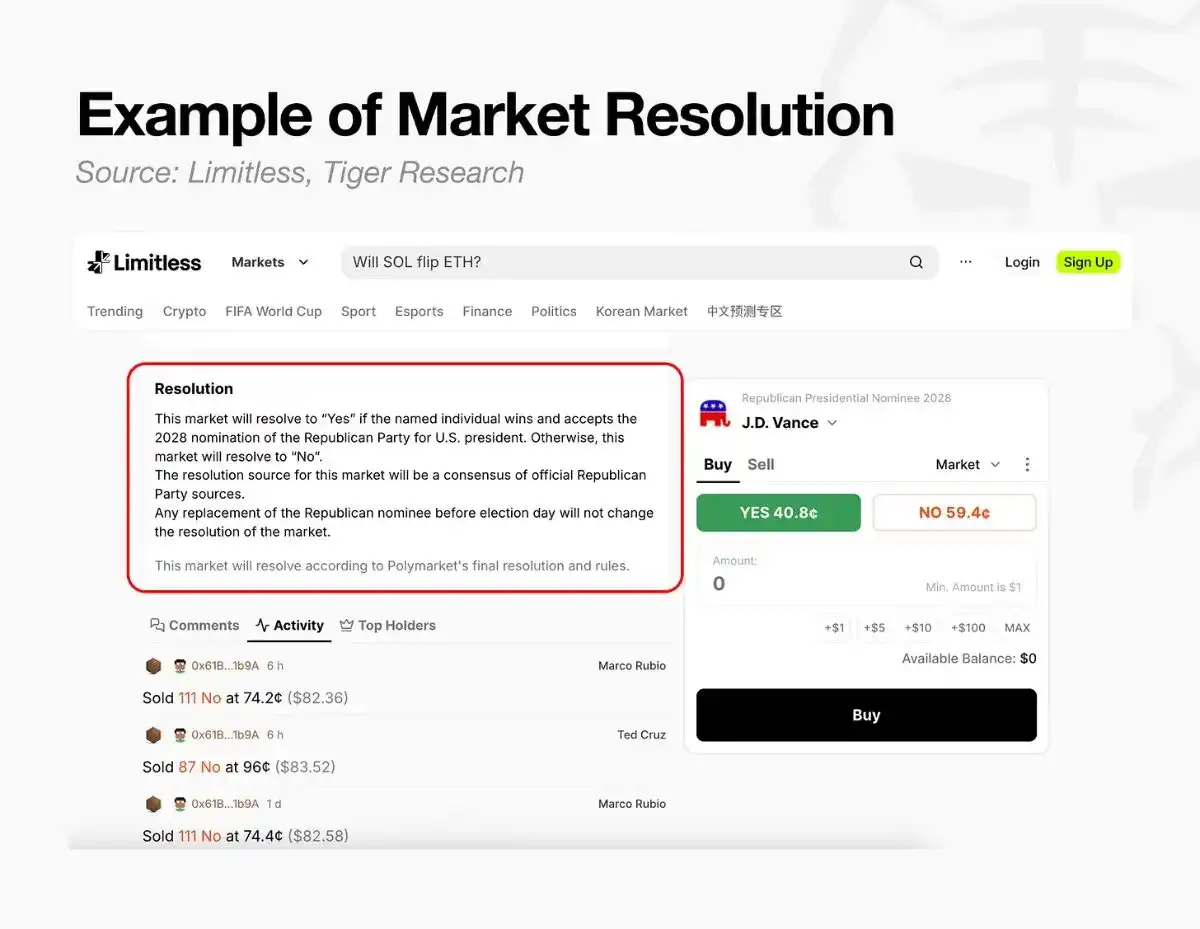
Oracles operate in two main ways:

  • Decentralized Oracles: Proposers stake collateral and submit a proposed outcome. If unchallenged within a set period, it becomes the final result. If challenged, a re-proposal process begins, and only after further challenges does it proceed to voting.
  • Centralized: Judgment criteria are set in advance. After the event concludes, the exchange directly applies the official result and immediately settles the market. This approach vests judgment authority entirely in a single exchange.

For example, on the Limitless platform, once a deadline passes, results are finalized according to preset rules. Reporting of real-world outcomes to the blockchain is completed by oracle services: most markets tracking crypto or stock prices report automatically via the Pyth Network, while custom markets for sports or politics are judged manually by an operations team within 24 to 72 hours.

At its core, a prediction market is an information system. It compresses the views of a large number of participants into a single number reflected in the price and, after the event, judges whether the prediction was correct based on preset rules.

The Evolution from Game to Information Finance

Prediction markets have evolved beyond simple betting platforms to become core infrastructure for information finance—turning future uncertainties into real-time price information. Their fundamental difference from traditional polls or expert forecasts lies in the "skin in the game" mechanism, where participants back their positions with their own capital.

In traditional methods, experts face little reputational cost for being wrong, and polls cannot filter out respondents' indifference or strategic misrepresentation. Prediction market prices carry a real cost for error—mistaken positions lose money—forcing participants to verify their beliefs with the most objective, up-to-date information. This willingness to bear a cost translates directly into market reliability.

This mechanism's performance is evident in multiple areas of real-world data:

Accuracy in Financial & Monetary Policy Predictions: Research by a Federal Reserve economist in February 2026 explains why. Since 2022, prediction market expectations for interest rates ahead of FOMC meetings have shown a statistically high degree of consistency with actual outcomes, outperforming federal funds futures and Bloomberg consensus. The reason is that participants immediately lose money if they are wrong, prompting stricter analysis of available information and pricing accordingly.

Transparent Probability Estimates for Politics & Elections: In South Korea's local elections in June 2026, Polymarket correctly predicted the winners in 14 out of 16 major cities and provinces. Where exit polls could only say "too close to call," prediction markets offered real-time probabilities backed by participants' real money, representing the aggregated judgment of numerous participants synthesizing multiple variables, not a simple forecast.

Responsiveness to Market Events & Company Valuations: When the issue of a stablecoin interest income cap emerged in March 2026, prediction markets immediately priced the probability of a Coinbase stock drop at 97.6%, serving as a real-time risk indicator rather than post-hoc analysis, demonstrating participants' sensitive response when their own capital is at risk. Academic research has reached similar conclusions: a 2015 study on internal prediction markets at companies like Google and Ford found prediction errors reduced by up to 25% compared to official forecast models, indicating prediction accuracy improves when insider knowledge is combined with capital at risk.

Information asymmetry remains a limitation. The Venezuela case in January 2026, where someone used confidential information for insider trading, exposed a real weakness. However, this attempt to distort prices was identified and prosecuted as a crime, also proving that markets aim to operate with transparency and accountability.

In areas where information is widely distributed, prediction markets are precision analytical tools; in areas where information is concentrated in few hands, they are monitoring mechanisms capable of identifying that concentration. Because participants' capital is genuinely at risk, the prices generated by these markets constitute objective information for assessing the value of financial assets.

The Absence of Prediction Markets in Asian Policy Discussions

The nature and trajectory of prediction markets vary greatly depending on national regulatory frameworks. The United States incorporated them into the regulated financial system through judicial rulings, while major jurisdictions in Asia still largely categorize them as traditional gambling.

In the U.S., litigation resolved much of the regulatory uncertainty. The CFTC attempted to classify Kalshi's election prediction contracts as gambling and sanction the platform, but courts ruled election prediction is not a game of chance, and regulators lacked the authority to ban it. This ruling shifted the regulatory stance, serving as a decisive catalyst for the entry of traditional financial institutions including ICE, Robinhood, and CME.

In contrast, in major Asian jurisdictions, the mainstream view still equates the binary settlement structure of prediction markets with traditional gambling. The dominant regulatory perspective is gambling control and public order, not financial policy. While approaches differ by country, prediction markets largely remain outside formal policy discussions in the region, with India and Indonesia being exceptions.

This divergence in treatment ultimately boils down to whether regulators view the market as a financial innovation or a social control issue.

Prediction Markets at a Crossroads: Regulatory Dilemma and Institutionalization

Prediction markets have become a core part of global financial and information infrastructure. A significant gap has emerged between the global trend and the rigid stance of Asian regulators. In an era where technological and financial boundaries have largely dissolved, attempts to confine new markets within old regulatory frameworks have inherent limitations. The current regulatory approach in major Asian jurisdictions faces three major problems.

The first is the paradox of regulatory arbitrage.

Prediction markets operate on borderless digital networks. Blocking platforms or restricting users in one country does not eliminate underlying demand. Users migrate to unregulated offshore platforms, assuming greater risks. This leads to capital outflow from the jurisdiction, with regulators losing both market oversight and associated tax revenue, weakening regional financial competitiveness in the long run.

The second is the loss of national information infrastructure sovereignty.

Prediction markets are advanced information infrastructure that translates complex social questions into precise numerical estimates, not merely betting venues. Recent elections in Asia have shown prediction markets reading public sentiment faster and more accurately than traditional polls. When excluded under the guise of regulation, the data that best reflects a society's mood accumulates on foreign servers. The result is that foreign media and institutions gain clearer insights into local societies than domestic analysts.

The third is the abandonment of user protection.

Users are in a blind spot, with no institutional safeguards. Policies that simply deny the market's existence without sufficient prior discussion only expose users to risk and push them outside the system.

The focus of discussion needs a fundamental shift.

The question is no longer how to block this market, but how to healthily utilize this data within the formal system. This shift in perspective requires dedicated study, yet related discussions remain limited.

In this field, Limitless Research is filling the gap, processing prediction data from Asian markets like South Korea and Japan into information assets. More participants are needed in the future to take on the role of building a healthy data ecosystem.

Regulation should not be a dam blocking the flow of water, but a channel to guide it correctly.

What Asia needs now is not stricter enforcement, but to initiate forward-looking discussions in response to this shift. Pushing transactions that are already happening into the shadows is the worst policy. It requires sustained effort to bring them into the formal system through constructive discussion, establish transparent oversight mechanisms, and return the data generated in the process as assets for the nation and society.


Criptos en tendencia

Preguntas relacionadas

QWhat is the key milestone that signals the prediction market industry has moved beyond its conceptual phase and is now a verified business model?

AThe entry of a major tech company like Meta, with Mark Zuckerberg personally leading the development of a prediction market app called Arena, serves as the key milestone indicating the industry has moved beyond experimentation and established a verified business model.

QHow is the probability of an event reflected in the trading price of a prediction market contract?

AThe trading price directly reflects the implied probability. A contract price of 40 cents, for example, represents 40% of the $1 maximum payout, meaning the market assesses a 40% probability of the event occurring. The cent value can be read directly as a percentage probability.

QWhat is the fundamental mechanism that distinguishes prediction markets from traditional polling or expert forecasts in terms of accuracy?

AThe fundamental mechanism is 'skin in the game,' where participants risk their own capital. This creates a real financial cost for being wrong, forcing participants to use the most objective and up-to-date information to validate their beliefs, which translates directly into market reliability and superior accuracy compared to methods without financial accountability.

QHow does the regulatory approach to prediction markets differ between the United States and most major Asian jurisdictions?

AIn the United States, legal rulings have integrated prediction markets into the regulated financial system (e.g., a court ruled election prediction is not gambling). In contrast, most major Asian jurisdictions still classify them as traditional gambling, focusing on gambling control and public order rather than financial policy innovation.

QWhat are the three main problems identified with the current restrictive regulatory stance of major Asian jurisdictions towards prediction markets?

AThe three main problems are: 1) The paradox of regulatory arbitrage, where users migrate to riskier offshore platforms, causing capital flight and loss of oversight. 2) The loss of national information infrastructure sovereignty, as valuable social sentiment data accumulates on foreign servers. 3) The abdication of user protection, as users are pushed into unregulated spaces without institutional safeguards.

Lecturas Relacionadas

Ethereum's Next Decade in the Eyes of Vitalik

"Lean Ethereum" Long-Term Roadmap Unveiled by Vitalik Buterin On July 5, 2026, Vitalik Buterin published the "Lean Ethereum" roadmap, positioning it as Ethereum's third major evolution following the Merge. This multi-year, multi-phase upgrade aims to fundamentally transform Ethereum's core protocol through staged network upgrades extending to 2029. Key goals include achieving 1 gigagas per second L1 throughput (a massive increase from the current ~32 TPS), near-instant finality, and quantum-resistant cryptography. The plan involves transitioning Ethereum's security model from full transaction re-execution by all nodes to native verification via recursive STARK proofs. A major proposed change is replacing the EVM with a proof-friendly architecture like RISC-V or leanISA, though this remains a point of contention, especially with L2s like Arbitrum favoring alternatives like WASM. Other planned upgrades include a restructured state model with a large, cheap "warehouse" storage layer to drastically reduce fees for migrated applications, multi-dimensional gas pricing, and a new focus on making privacy a first-class, native protocol feature. While the roadmap significantly raises Ethereum's long-term technical ceiling, analysts note it does not directly address ETH's mid-term token economics or value capture. The plan's multi-year timeline means near-term price impact will likely depend on observable progress milestones, such as the successful deployment of the upcoming Glamsterdam gas limit increase, growth in L2 activity and blob usage, and trends in L1 fee revenue and ETH burn.

链捕手Hace 3 hora(s)

Ethereum's Next Decade in the Eyes of Vitalik

链捕手Hace 3 hora(s)

In Just 11 Days, Claude Rewrote Millions of Lines of Code, an Epic AI Engineering Feat Sparks Fury

In just 11 days, Bun's founder Jarred Sumner used Anthropic's Claude AI models to rewrite its million lines of code from Zig to Rust. This move sparked significant controversy, particularly from Zig's creator, Andrew Kelley, who publicly criticized Sumner's engineering practices and the decision to use AI for such a massive rewrite. Bun, a high-performance JavaScript/TypeScript runtime and rival to Node.js, was originally written in Zig. After Anthropic acquired Bun, the team encountered persistent stability and memory safety bugs in the Zig codebase. These issues, combined with Zig's strict policy against LLM-generated code, led to the decision to rewrite in Rust. The rewrite was executed using Claude AI tools at an estimated API cost of $165,000, dramatically reducing the expected time and financial cost. Andrew Kelley's response was scathing. He blamed the original bugs on poor engineering habits, calling Bun's Zig code a collection of "hacks on top of hacks." He expressed relief that Bun was no longer associated with Zig, fearing it would misrepresent the language and attract low-quality, AI-generated contributions. The tech community is divided; some view Kelley's critique as unprofessional, while others see it as a defense of engineering integrity. A major concern about the AI-driven rewrite is the resulting code quality. The translation from Zig left approximately 27,000 lines of unsafe Rust code, raising fears about long-term maintainability and technical debt. The debate centers on whether this project is a milestone in AI-assisted development or a future maintenance nightmare.

marsbitHace 4 hora(s)

In Just 11 Days, Claude Rewrote Millions of Lines of Code, an Epic AI Engineering Feat Sparks Fury

marsbitHace 4 hora(s)

From Auto Finance to Bitcoin to AI Engines: An Analysis of Cango's 'What Not to Do' Strategy

From Auto Finance to Bitcoin and Now AI: Cango's "What Not to Do" Strategy Cango, a Chinese auto finance platform that went public on the NYSE in 2018, is undergoing its third major transformation. After selling its entire auto business in 2024, it pivoted to become a large-scale Bitcoin miner, acquiring 50 exahash of mining rigs from Bitmain. However, its true goal was never Bitcoin, but owning and controlling energy infrastructure. Now, Cango is pivoting again. While most listed Bitcoin miners are leasing power to giant hyperscalers for AI training clusters, Cango is taking the opposite path. It has launched an AI inference subsidiary called EcoHash, focusing not on training but on distributed inference. The company's strategy hinges on the insight that over 70% of mining industry power is controlled by small, independent sites (10-50 MW), which are too small for hyperscalers but ideal for low-latency AI inference. Cango aims to partner with these small operators, providing the AI technology, customers, and financing through its EcoLink software layer, which can distribute workloads across sites for reliability. Cango maintains a hybrid model, running roughly 31.7 EH/s of Bitcoin mining for cash flow while aggressively cleaning its balance sheet—slashing long-term debt by 94.5% to $30.6 million and raising $75 million for its AI venture. Its first AI deployment will be at a 50 MW site in Georgia. The strategy faces skepticism, given the high costs of converting mining sites and the potential for an AI bubble. However, Cango's leadership believes discipline around "what not to do"—avoiding direct competition with hyperscalers in training—positions it to capture the long-tail demand for distributed AI inference power.

Foresight NewsHace 5 hora(s)

From Auto Finance to Bitcoin to AI Engines: An Analysis of Cango's 'What Not to Do' Strategy

Foresight NewsHace 5 hora(s)

Trading

Spot

Artículos destacados

Qué es $S$

Entendiendo SPERO: Una Visión General Completa Introducción a SPERO A medida que el panorama de la innovación continúa evolucionando, la aparición de tecnologías web3 y proyectos de criptomonedas juega un papel fundamental en la configuración del futuro digital. Un proyecto que ha atraído la atención en este campo dinámico es SPERO, denotado como SPERO,$$s$. Este artículo tiene como objetivo reunir y presentar información detallada sobre SPERO, para ayudar a entusiastas e inversores a comprender sus fundamentos, objetivos e innovaciones dentro de los dominios web3 y cripto. ¿Qué es SPERO,$$s$? SPERO,$$s$ es un proyecto único dentro del espacio cripto que busca aprovechar los principios de descentralización y tecnología blockchain para crear un ecosistema que promueva la participación, la utilidad y la inclusión financiera. El proyecto está diseñado para facilitar interacciones de igual a igual de nuevas maneras, proporcionando a los usuarios soluciones y servicios financieros innovadores. En su esencia, SPERO,$$s$ tiene como objetivo empoderar a los individuos al proporcionar herramientas y plataformas que mejoren la experiencia del usuario en el espacio de las criptomonedas. Esto incluye habilitar métodos de transacción más flexibles, fomentar iniciativas impulsadas por la comunidad y crear caminos para oportunidades financieras a través de aplicaciones descentralizadas (dApps). La visión subyacente de SPERO,$$s$ gira en torno a la inclusividad, buscando cerrar brechas dentro de las finanzas tradicionales mientras aprovecha los beneficios de la tecnología blockchain. ¿Quién es el Creador de SPERO,$$s$? La identidad del creador de SPERO,$$s$ sigue siendo algo oscura, ya que hay recursos públicos limitados que proporcionan información de fondo detallada sobre su(s) fundador(es). Esta falta de transparencia puede derivarse del compromiso del proyecto con la descentralización, una ética que muchos proyectos web3 comparten, priorizando las contribuciones colectivas sobre el reconocimiento individual. Al centrar las discusiones en torno a la comunidad y sus objetivos colectivos, SPERO,$$s$ encarna la esencia del empoderamiento sin señalar a individuos específicos. Como tal, comprender la ética y la misión de SPERO sigue siendo más importante que identificar a un creador singular. ¿Quiénes son los Inversores de SPERO,$$s$? SPERO,$$s$ cuenta con el apoyo de una diversa gama de inversores que van desde capitalistas de riesgo hasta inversores ángeles dedicados a fomentar la innovación en el sector cripto. El enfoque de estos inversores generalmente se alinea con la misión de SPERO, priorizando proyectos que prometen avances tecnológicos sociales, inclusión financiera y gobernanza descentralizada. Estas fundaciones de inversores suelen estar interesadas en proyectos que no solo ofrecen productos innovadores, sino que también contribuyen positivamente a la comunidad blockchain y sus ecosistemas. El respaldo de estos inversores refuerza a SPERO,$$s$ como un contendiente notable en el dominio de proyectos cripto que evoluciona rápidamente. ¿Cómo Funciona SPERO,$$s$? SPERO,$$s$ emplea un marco multifacético que lo distingue de los proyectos de criptomonedas convencionales. Aquí hay algunas de las características clave que subrayan su singularidad e innovación: Gobernanza Descentralizada: SPERO,$$s$ integra modelos de gobernanza descentralizada, empoderando a los usuarios para participar activamente en los procesos de toma de decisiones sobre el futuro del proyecto. Este enfoque fomenta un sentido de propiedad y responsabilidad entre los miembros de la comunidad. Utilidad del Token: SPERO,$$s$ utiliza su propio token de criptomoneda, diseñado para servir diversas funciones dentro del ecosistema. Estos tokens permiten transacciones, recompensas y la facilitación de servicios ofrecidos en la plataforma, mejorando la participación y la utilidad general. Arquitectura en Capas: La arquitectura técnica de SPERO,$$s$ apoya la modularidad y escalabilidad, permitiendo la integración fluida de características y aplicaciones adicionales a medida que el proyecto evoluciona. Esta adaptabilidad es fundamental para mantener la relevancia en el cambiante paisaje cripto. Participación de la Comunidad: El proyecto enfatiza iniciativas impulsadas por la comunidad, empleando mecanismos que incentivan la colaboración y la retroalimentación. Al nutrir una comunidad sólida, SPERO,$$s$ puede abordar mejor las necesidades de los usuarios y adaptarse a las tendencias del mercado. Enfoque en la Inclusión: Al ofrecer tarifas de transacción bajas e interfaces amigables para el usuario, SPERO,$$s$ busca atraer a una base de usuarios diversa, incluyendo a individuos que anteriormente pueden no haber participado en el espacio cripto. Este compromiso con la inclusión se alinea con su misión general de empoderamiento a través de la accesibilidad. Cronología de SPERO,$$s$ Entender la historia de un proyecto proporciona información crucial sobre su trayectoria de desarrollo y hitos. A continuación se presenta una cronología sugerida que mapea eventos significativos en la evolución de SPERO,$$s$: Fase de Conceptualización e Ideación: Las ideas iniciales que forman la base de SPERO,$$s$ fueron concebidas, alineándose estrechamente con los principios de descentralización y enfoque comunitario dentro de la industria blockchain. Lanzamiento del Whitepaper del Proyecto: Tras la fase conceptual, se lanzó un whitepaper completo que detalla la visión, los objetivos y la infraestructura tecnológica de SPERO,$$s$ para generar interés y retroalimentación de la comunidad. Construcción de Comunidad y Primeras Interacciones: Se realizaron esfuerzos de divulgación activa para construir una comunidad de primeros adoptantes y posibles inversores, facilitando discusiones en torno a los objetivos del proyecto y obteniendo apoyo. Evento de Generación de Tokens: SPERO,$$s$ llevó a cabo un evento de generación de tokens (TGE) para distribuir sus tokens nativos a los primeros seguidores y establecer liquidez inicial dentro del ecosistema. Lanzamiento de la dApp Inicial: La primera aplicación descentralizada (dApp) asociada con SPERO,$$s$ se puso en marcha, permitiendo a los usuarios interactuar con las funcionalidades centrales de la plataforma. Desarrollo Continuo y Alianzas: Actualizaciones y mejoras continuas a las ofertas del proyecto, incluyendo alianzas estratégicas con otros actores en el espacio blockchain, han moldeado a SPERO,$$s$ en un jugador competitivo y en evolución en el mercado cripto. Conclusión SPERO,$$s$ se erige como un testimonio del potencial de web3 y las criptomonedas para revolucionar los sistemas financieros y empoderar a los individuos. Con un compromiso con la gobernanza descentralizada, la participación comunitaria y funcionalidades diseñadas de manera innovadora, allana el camino hacia un paisaje financiero más inclusivo. Como con cualquier inversión en el espacio cripto que evoluciona rápidamente, se anima a los posibles inversores y usuarios a investigar a fondo y participar de manera reflexiva con los desarrollos en curso dentro de SPERO,$$s$. El proyecto muestra el espíritu innovador de la industria cripto, invitando a una mayor exploración de sus innumerables posibilidades. Mientras el viaje de SPERO,$$s$ aún se desarrolla, sus principios fundamentales pueden, de hecho, influir en el futuro de cómo interactuamos con la tecnología, las finanzas y entre nosotros en ecosistemas digitales interconectados.

120 Vistas totalesPublicado en 2024.12.17Actualizado en 2024.12.17

Qué es $S$

Qué es AGENT S

Agent S: El Futuro de la Interacción Autónoma en Web3 Introducción En el paisaje en constante evolución de Web3 y las criptomonedas, las innovaciones están redefiniendo constantemente cómo los individuos interactúan con las plataformas digitales. Uno de estos proyectos pioneros, Agent S, promete revolucionar la interacción humano-computadora a través de su marco agente abierto. Al allanar el camino para interacciones autónomas, Agent S busca simplificar tareas complejas, ofreciendo aplicaciones transformadoras en inteligencia artificial (IA). Esta exploración detallada profundizará en las complejidades del proyecto, sus características únicas y las implicaciones para el dominio de las criptomonedas. ¿Qué es Agent S? Agent S se presenta como un marco agente abierto innovador, diseñado específicamente para abordar tres desafíos fundamentales en la automatización de tareas informáticas: Adquisición de Conocimiento Específico del Dominio: El marco aprende inteligentemente de diversas fuentes de conocimiento externas y experiencias internas. Este enfoque dual le permite construir un rico repositorio de conocimiento específico del dominio, mejorando su rendimiento en la ejecución de tareas. Planificación a Largo Plazo de Tareas: Agent S emplea planificación jerárquica aumentada por la experiencia, un enfoque estratégico que facilita la descomposición y ejecución eficiente de tareas complejas. Esta característica mejora significativamente su capacidad para gestionar múltiples subtareas de manera eficiente y efectiva. Manejo de Interfaces Dinámicas y No Uniformes: El proyecto introduce la Interfaz Agente-Computadora (ACI), una solución innovadora que mejora la interacción entre agentes y usuarios. Utilizando Modelos de Lenguaje Multimodal de Gran Escala (MLLMs), Agent S puede navegar y manipular diversas interfaces gráficas de usuario sin problemas. A través de estas características pioneras, Agent S proporciona un marco robusto que aborda las complejidades involucradas en la automatización de la interacción humana con las máquinas, preparando el terreno para una multitud de aplicaciones en IA y más allá. ¿Quién es el Creador de Agent S? Si bien el concepto de Agent S es fundamentalmente innovador, la información específica sobre su creador sigue siendo elusiva. El creador es actualmente desconocido, lo que resalta ya sea la etapa incipiente del proyecto o la elección estratégica de mantener a los miembros fundadores en el anonimato. Independientemente de la anonimidad, el enfoque sigue siendo en las capacidades y el potencial del marco. ¿Quiénes son los Inversores de Agent S? Dado que Agent S es relativamente nuevo en el ecosistema criptográfico, la información detallada sobre sus inversores y patrocinadores financieros no está documentada explícitamente. La falta de información disponible públicamente sobre las bases de inversión u organizaciones que apoyan el proyecto plantea preguntas sobre su estructura de financiamiento y hoja de ruta de desarrollo. Comprender el respaldo es crucial para evaluar la sostenibilidad del proyecto y su posible impacto en el mercado. ¿Cómo Funciona Agent S? En el núcleo de Agent S se encuentra una tecnología de vanguardia que le permite funcionar de manera efectiva en diversos entornos. Su modelo operativo se basa en varias características clave: Interacción Humano-Computadora Similar a la Humana: El marco ofrece planificación avanzada de IA, esforzándose por hacer que las interacciones con las computadoras sean más intuitivas. Al imitar el comportamiento humano en la ejecución de tareas, promete elevar las experiencias de los usuarios. Memoria Narrativa: Empleada para aprovechar experiencias de alto nivel, Agent S utiliza memoria narrativa para hacer un seguimiento de las historias de tareas, mejorando así sus procesos de toma de decisiones. Memoria Episódica: Esta característica proporciona a los usuarios una guía paso a paso, permitiendo que el marco ofrezca apoyo contextual a medida que se desarrollan las tareas. Soporte para OpenACI: Con la capacidad de ejecutarse localmente, Agent S permite a los usuarios mantener el control sobre sus interacciones y flujos de trabajo, alineándose con la ética descentralizada de Web3. Fácil Integración con APIs Externas: Su versatilidad y compatibilidad con varias plataformas de IA aseguran que Agent S pueda encajar sin problemas en ecosistemas tecnológicos existentes, convirtiéndolo en una opción atractiva para desarrolladores y organizaciones. Estas funcionalidades contribuyen colectivamente a la posición única de Agent S dentro del espacio cripto, ya que automatiza tareas complejas y de múltiples pasos con una intervención humana mínima. A medida que el proyecto evoluciona, sus posibles aplicaciones en Web3 podrían redefinir cómo se desarrollan las interacciones digitales. Cronología de Agent S El desarrollo y los hitos de Agent S pueden encapsularse en una cronología que resalta sus eventos significativos: 27 de septiembre de 2024: El concepto de Agent S fue lanzado en un documento de investigación integral titulado “Un Marco Agente Abierto que Usa Computadoras Como un Humano”, mostrando las bases del proyecto. 10 de octubre de 2024: El documento de investigación fue puesto a disposición del público en arXiv, ofreciendo una exploración profunda del marco y su evaluación de rendimiento basada en el benchmark OSWorld. 12 de octubre de 2024: Se lanzó una presentación en video, proporcionando una visión visual de las capacidades y características de Agent S, involucrando aún más a posibles usuarios e inversores. Estos marcadores en la cronología no solo ilustran el progreso de Agent S, sino que también indican su compromiso con la transparencia y la participación comunitaria. Puntos Clave Sobre Agent S A medida que el marco Agent S continúa evolucionando, varios atributos clave destacan, subrayando su naturaleza innovadora y potencial: Marco Innovador: Diseñado para proporcionar un uso intuitivo de las computadoras similar a la interacción humana, Agent S aporta un enfoque novedoso a la automatización de tareas. Interacción Autónoma: La capacidad de interactuar de manera autónoma con las computadoras a través de GUI significa un salto hacia soluciones informáticas más inteligentes y eficientes. Automatización de Tareas Complejas: Con su metodología robusta, puede automatizar tareas complejas y de múltiples pasos, haciendo que los procesos sean más rápidos y menos propensos a errores. Mejora Continua: Los mecanismos de aprendizaje permiten a Agent S mejorar a partir de experiencias pasadas, mejorando continuamente su rendimiento y eficacia. Versatilidad: Su adaptabilidad en diferentes entornos operativos como OSWorld y WindowsAgentArena asegura que pueda servir a una amplia gama de aplicaciones. A medida que Agent S se posiciona en el paisaje de Web3 y criptomonedas, su potencial para mejorar las capacidades de interacción y automatizar procesos significa un avance significativo en las tecnologías de IA. A través de su marco innovador, Agent S ejemplifica el futuro de las interacciones digitales, prometiendo una experiencia más fluida y eficiente para los usuarios en diversas industrias. Conclusión Agent S representa un audaz avance en la unión de la IA y Web3, con la capacidad de redefinir cómo interactuamos con la tecnología. Aunque aún se encuentra en sus primeras etapas, las posibilidades para su aplicación son vastas y atractivas. A través de su marco integral que aborda desafíos críticos, Agent S busca llevar las interacciones autónomas al primer plano de la experiencia digital. A medida que nos adentramos más en los reinos de las criptomonedas y la descentralización, proyectos como Agent S sin duda desempeñarán un papel crucial en la configuración del futuro de la tecnología y la colaboración humano-computadora.

524 Vistas totalesPublicado en 2025.01.14Actualizado en 2025.01.14

Qué es AGENT S

Cómo comprar S

¡Bienvenido a HTX.com! Hemos hecho que comprar Sonic (S) sea simple y conveniente. Sigue nuestra guía paso a paso para iniciar tu viaje de criptos.Paso 1: crea tu cuenta HTXUtiliza tu correo electrónico o número de teléfono para registrarte y obtener una cuenta gratuita en HTX. Experimenta un proceso de registro sin complicaciones y desbloquea todas las funciones.Obtener mi cuentaPaso 2: ve a Comprar cripto y elige tu método de pagoTarjeta de crédito/débito: usa tu Visa o Mastercard para comprar Sonic (S) al instante.Saldo: utiliza fondos del saldo de tu cuenta HTX para tradear sin problemas.Terceros: hemos agregado métodos de pago populares como Google Pay y Apple Pay para mejorar la comodidad.P2P: tradear directamente con otros usuarios en HTX.Over-the-Counter (OTC): ofrecemos servicios personalizados y tipos de cambio competitivos para los traders.Paso 3: guarda tu Sonic (S)Después de comprar tu Sonic (S), guárdalo en tu cuenta HTX. Alternativamente, puedes enviarlo a otro lugar mediante transferencia blockchain o utilizarlo para tradear otras criptomonedas.Paso 4: tradear Sonic (S)Tradear fácilmente con Sonic (S) en HTX's mercado spot. Simplemente accede a tu cuenta, selecciona tu par de trading, ejecuta tus trades y monitorea en tiempo real. Ofrecemos una experiencia fácil de usar tanto para principiantes como para traders experimentados.

1.1k Vistas totalesPublicado en 2025.01.15Actualizado en 2026.06.02

Cómo comprar S

Discusiones

Bienvenido a la comunidad de HTX. Aquí puedes mantenerte informado sobre los últimos desarrollos de la plataforma y acceder a análisis profesionales del mercado. A continuación se presentan las opiniones de los usuarios sobre el precio de S (S).

活动图片