Ethereum's Next Decade in the Eyes of Vitalik

链捕手Publicado a 2026-07-11Actualizado a 2026-07-11

Resumen

"Lean Ethereum" Long-Term Roadmap Unveiled by Vitalik Buterin On July 5, 2026, Vitalik Buterin published the "Lean Ethereum" roadmap, positioning it as Ethereum's third major evolution following the Merge. This multi-year, multi-phase upgrade aims to fundamentally transform Ethereum's core protocol through staged network upgrades extending to 2029. Key goals include achieving 1 gigagas per second L1 throughput (a massive increase from the current ~32 TPS), near-instant finality, and quantum-resistant cryptography. The plan involves transitioning Ethereum's security model from full transaction re-execution by all nodes to native verification via recursive STARK proofs. A major proposed change is replacing the EVM with a proof-friendly architecture like RISC-V or leanISA, though this remains a point of contention, especially with L2s like Arbitrum favoring alternatives like WASM. Other planned upgrades include a restructured state model with a large, cheap "warehouse" storage layer to drastically reduce fees for migrated applications, multi-dimensional gas pricing, and a new focus on making privacy a first-class, native protocol feature. While the roadmap significantly raises Ethereum's long-term technical ceiling, analysts note it does not directly address ETH's mid-term token economics or value capture. The plan's multi-year timeline means near-term price impact will likely depend on observable progress milestones, such as the successful deployment of the upcoming Glamste...

Author:Chloe,ChainCatcher

On July 5, 2026, Vitalik Buterin posted a long article on X, unveiling a long-term roadmap named "Lean Ethereum." Vitalik positions this as Ethereum's third major evolution following The Merge: it's not a single upgrade, but a series of protocol improvements to be implemented in stages over the next three to four years, encompassing almost every core module of the protocol, from verification methods, cryptography, and finality to state storage—a complete overhaul.

This roadmap emerged during a period of reorganization within the Ethereum ecosystem and must be understood within a more complete historical context. To interpret this comprehensive overhaul, it's essential not only to clarify the specific content of the technical upgrades but also to see how its design reallocates trade-offs between "migration costs" and "verification thresholds," and to explore how this underlying transformation will ultimately impact ETH's price performance.

Ethereum's Three Development Stages

To position this upgrade, we can first outline Ethereum's three generations:

  • The first generation was the original architecture of "PoW + EVM," whose core was all nodes directly re-executing all transactions. While this model is secure, general-purpose, and open, its scalability is consequently limited.

  • The second generation was PoS Ethereum after the 2022 "Merge." This transition in consensus mechanism fundamentally changed Ethereum's security model, issuance model, and staking system, while also proving to the market Ethereum's remarkable engineering capability to replace its core engine without halting operations.

  • The third generation is the current "Lean Ethereum." It is no longer satisfied with the existing division of labor where "L1 handles settlement, L2 handles scaling." Instead, it integrates L1 performance, proved verification, privacy, quantum resistance, state structure, and client architecture into a single long-term refactoring framework.

The Origin of the Lean Ethereum Roadmap

The Lean Ethereum roadmap was published on strawmap.org. This is a public draft first proposed by Foundation researcher Justin Drake in February of this year, outlining seven network upgrades through 2029. The term "strawmap" comes from "straw," and the document positions itself as a draft open to modifications. The strawmap also notes that it is an ongoing coordination tool, not a locked-in schedule; any upgrade still requires research, testing, client implementation, and rough consensus.
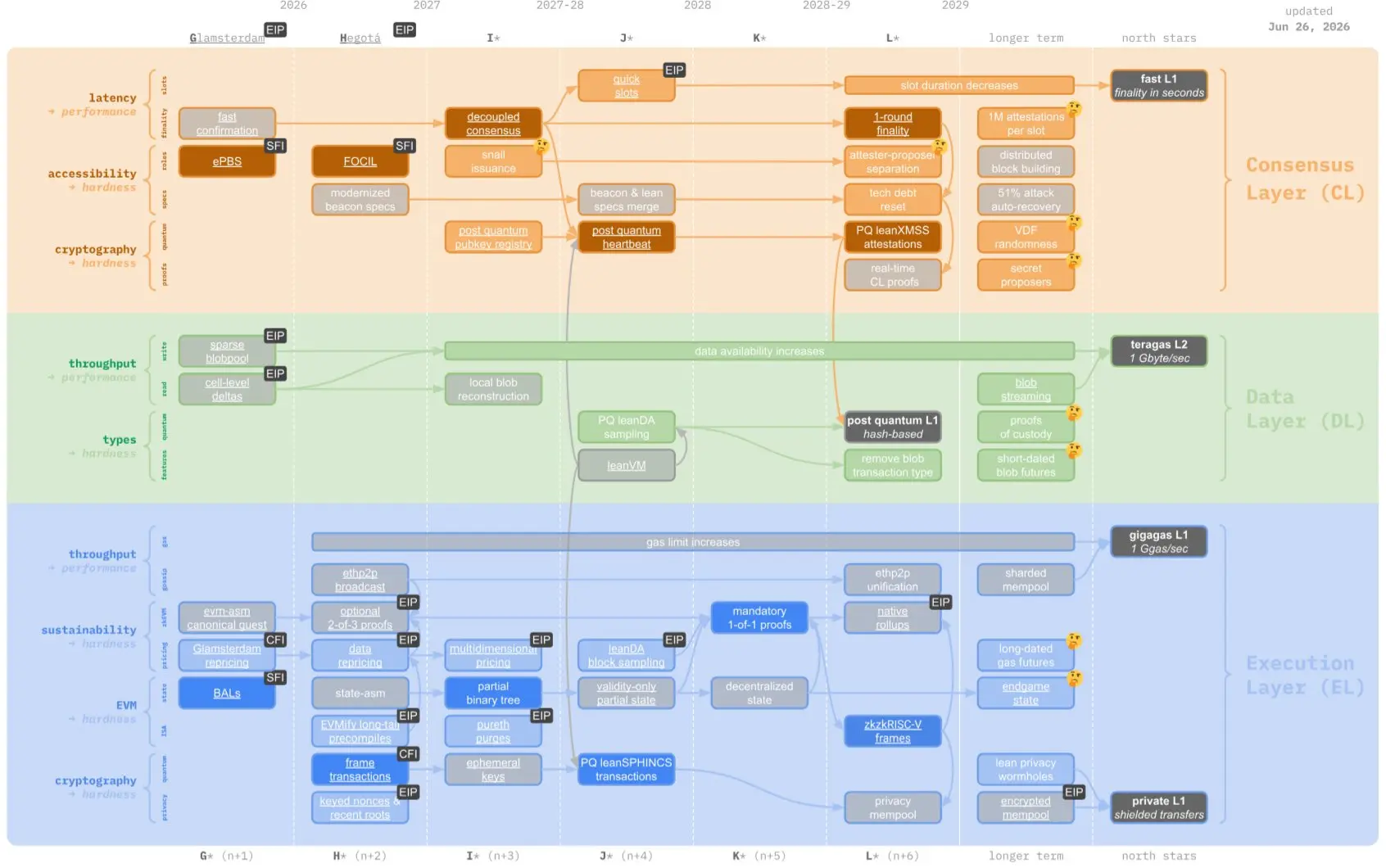
This vision clearly outlines five long-term strategic goals: faster L1 finality, achieving 1 gigagas per second L1 throughput (capable of handling tens of thousands of TPS under peak conditions), L2 scaling with a teragas-level vision for the ecosystem, comprehensively quantum-resistant cryptography, and L1-native private transactions.

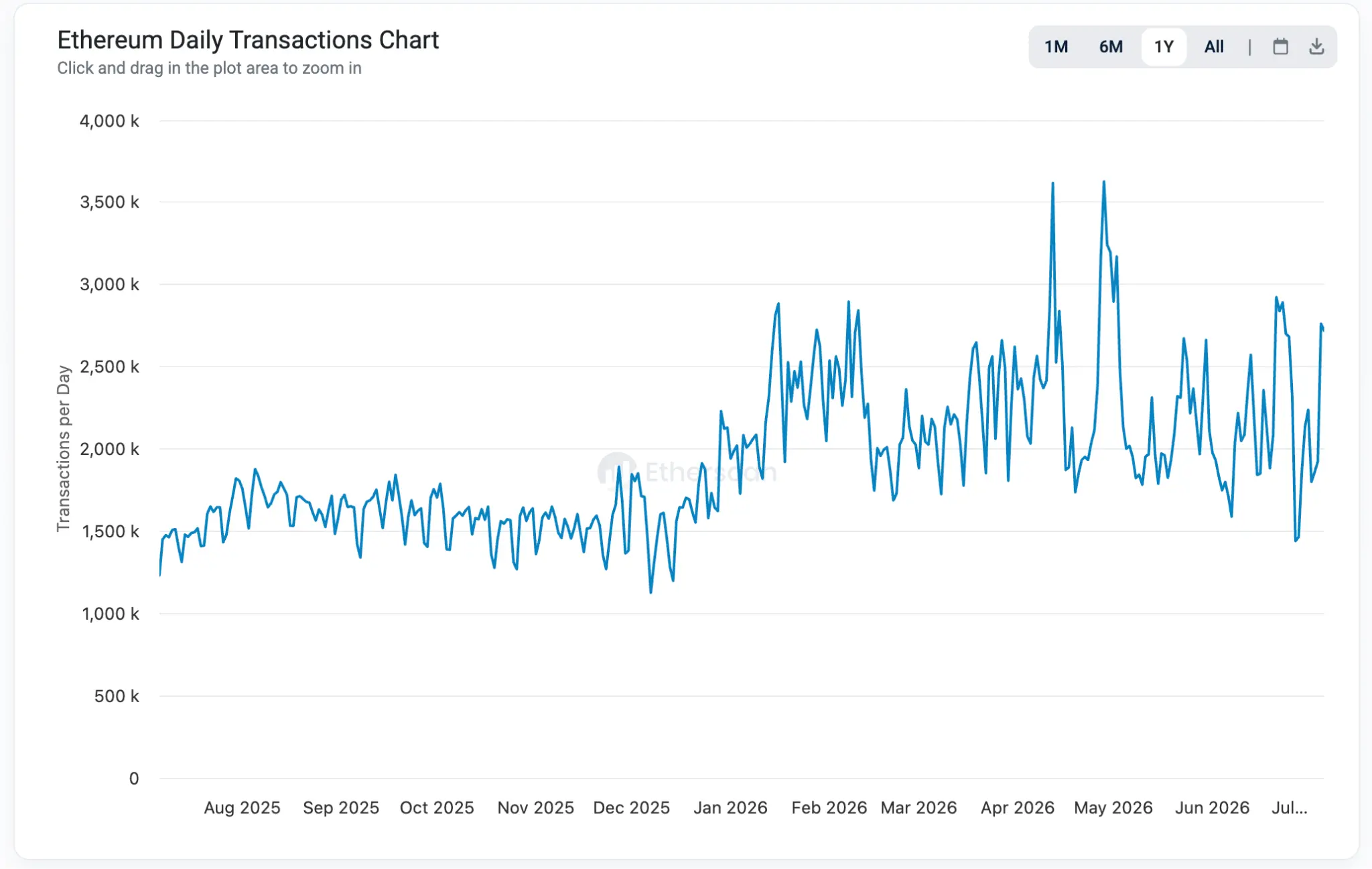
Comparing these with the current state reveals the ambitious nature of these goals. According to Etherscan data, the current Ethereum L1 processes only about 32 transactions per second on average (approximately 2.7 million per day). The 1 gigagas target implies a hundreds-fold explosion in L1's computational capacity. It's worth noting that L1's on-chain demand has actually been on a growth trend over the past year: daily transaction volume has rebounded significantly from 1.4 million in mid-2025 and has remained mostly stable between 2 million and 2.9 million in 2026, even nearing 3.6 million during market peaks in April and May. The release of this roadmap aims to address this resurging on-chain activity demand.
The timeline is also clearly marked: the Hegotá upgrade, currently scheduled as the second upgrade in 2026, is likely to be Ethereum's last "pre-Lean era" hard fork. Every subsequent upgrade, in theory, will be part of this reconstruction. The nearer-term Glamsterdam upgrade is expected to bring a substantial gas limit increase; this upgrade was originally anticipated to launch in the first half of 2026 but has not yet gone live.

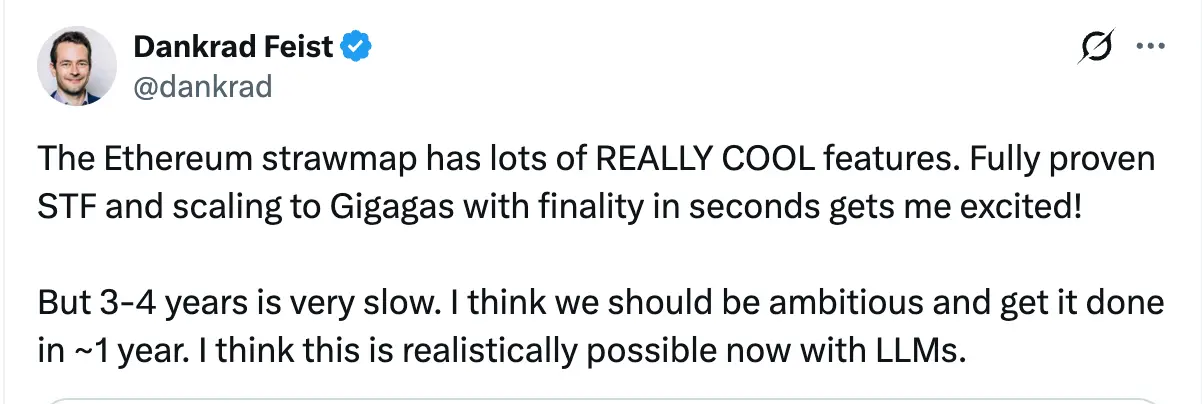
The timeline has also been a focal point of discussion since the roadmap's release. Former Ethereum Foundation core researcher and proposer of the Ethereum Danksharding solution, Dankrad Feist, posted on X, stating that while he affirms the strawmap, a three-to-four-year timeline is far too slow, suggesting that with current large language model technology, this upgrade should be completed within a year.
Major Core Technology Upgrades: Proof Verification and State Restructuring

The technical core of Lean Ethereum is to fundamentally change the verification model. Ethereum's current security model relies on every node re-executing every transaction to confirm state correctness. The new design incorporates recursive STARK proofs as a native core component of the protocol: a single prover handles the heavy computation, while all other nodes only need to verify a concise mathematical proof.

This choice also addresses another issue: STARK uses hash-based cryptography, and currently has no known quantum attack vectors, whereas Ethereum's current signature schemes carry related risks. Vitalik stated that the priority for quantum security has been "significantly raised." The roadmap plans to gradually replace all quantum-vulnerable components with Winternitz signatures, with the most urgent piece being finding a quantum-safe design for the blobs that L2s rely on to reduce fees.

The consensus layer is also within the scope of changes. In today's Ethereum, transactions are included in blocks within seconds, but it takes about fifteen minutes to reach finality. The new design separates the "chain that continuously produces blocks" and "finality" into two distinct processes. The goal is for validators to finalize within one or two voting rounds, compressing fifteen minutes down to near real-time. Additionally, there is multidimensional gas pricing, meaning different resources like computation, storage, and data transmission are priced separately—similar to how water and electricity bills are separate—instead of being lumped into a single fee.

Changes to the state architecture directly involve application developers. The state can be understood as Ethereum's real-time general ledger, recording all account balances and smart contract data. This ledger only grows thicker, and currently, full nodes must maintain a complete copy, leading to persistently high on-chain storage costs.

Vitalik's solution involves a structural layering of the storage architecture: the existing, fully-featured "Dynamic State (core essential zone)" will be strictly limited to a 2 TB hardware threshold, preventing its unlimited expansion. Simultaneously, the protocol will introduce a new, highly scalable "new state storage layer (large warehouse)" with a capacity of up to 100 TB. In Vitalik's vision for 2030, most tokens (ERC-20), NFTs, and regular DeFi applications that are willing to rewrite their contracts and migrate to this large warehouse with the new architecture could see transaction fees drop by over tenfold. The protocol layer won't force or subsidize; it will simply present the significant price differential between the two layers, leaving it to market applications to decide their migration timing.

The role of privacy has also been redefined. Ethereum's past division of labor was: everything on-chain is transparent; users wanting privacy must seek third-party privacy protocols. This time, Vitalik writes, "Privacy is no longer an afterthought, it is a first-class goal," meaning privacy transitions from something "users install themselves" to "part of the building code." In the future, during the design phase of every new protocol component, it will be evaluated for its ability to support low-cost, intermediary-free, and quantum-resistant privacy features. Whether this can be achieved remains to be seen, but the evaluation criteria itself have been written into the roadmap.

EVM Replacement Controversy: L2 Ecosystem Game

For the past decade, Ethereum has run on an engine called the EVM (Ethereum Virtual Machine). Contracts worldwide, development tools, and programming languages are all built around it. Now, Vitalik proposes replacing this engine. The reason relates to the aforementioned STARK proofs: generating mathematical proofs for transactions is expensive with the EVM; switching to an engine more friendly to proofs would be significantly cheaper.

He names two architecture candidates: RISC-V and leanISA. The ideal endgame is for the new engine to become the protocol's native component, with the EVM relegated to a translation layer: old contracts can still run, but they are first translated into instructions the new engine understands before execution. Replacing the engine is relatively more complex, which is why this proposal has been controversial since Vitalik first introduced the RISC-V idea in April 2025.

Offchain Labs, the core development firm behind the L2 Arbitrum, publicly advocated in November last year that another architecture, WebAssembly (WASM), is the better choice. However, WASM was not on the candidate list Vitalik presented this time. Why does this matter? Because Arbitrum is one of Ethereum's largest L2s, and its contract technology, Stylus, is built on WASM.

You can think of it this way: L1 changing its engine is like redefining the "plug standard" for the entire ecosystem. If your equipment happens to use the same plug, it works seamlessly; if not, you have to pay for an adapter. Whom the list favors determines which L2's past investments can seamlessly integrate with the future L1 and which ones will bear the adapter cost.

Ethereum has no voting mechanism to resolve such disagreements. Whether to replace the engine and with what ultimately depends on the rough consensus among developers in the All Core Devs meetings and whether client teams are willing to implement it. As of now, the engine replacement remains a long-term goal mentioned by Vitalik, and developer meetings have not reached any formal conclusion.

Will the Roadmap Affect ETH's Price?

Mapping the technical roadmap to ETH's price involves two temporal layers.

The first layer is the mechanism-driven transmission path. Since EIP-1559, Ethereum burns the base fee of every transaction. The scale of L1 transaction activity thus directly influences ETH's supply dynamics and settlement value. Under this mechanism, if the gigagas target is achieved and L1 transaction volume recovers alongside throughput enhancement, gas consumption and burn rates would amplify in tandem. This is the most direct transmission path between the roadmap and ETH pricing. However, it's crucial to emphasize that this path relies on the premise that "demand follows the capacity increase"—capacity itself does not automatically create demand.

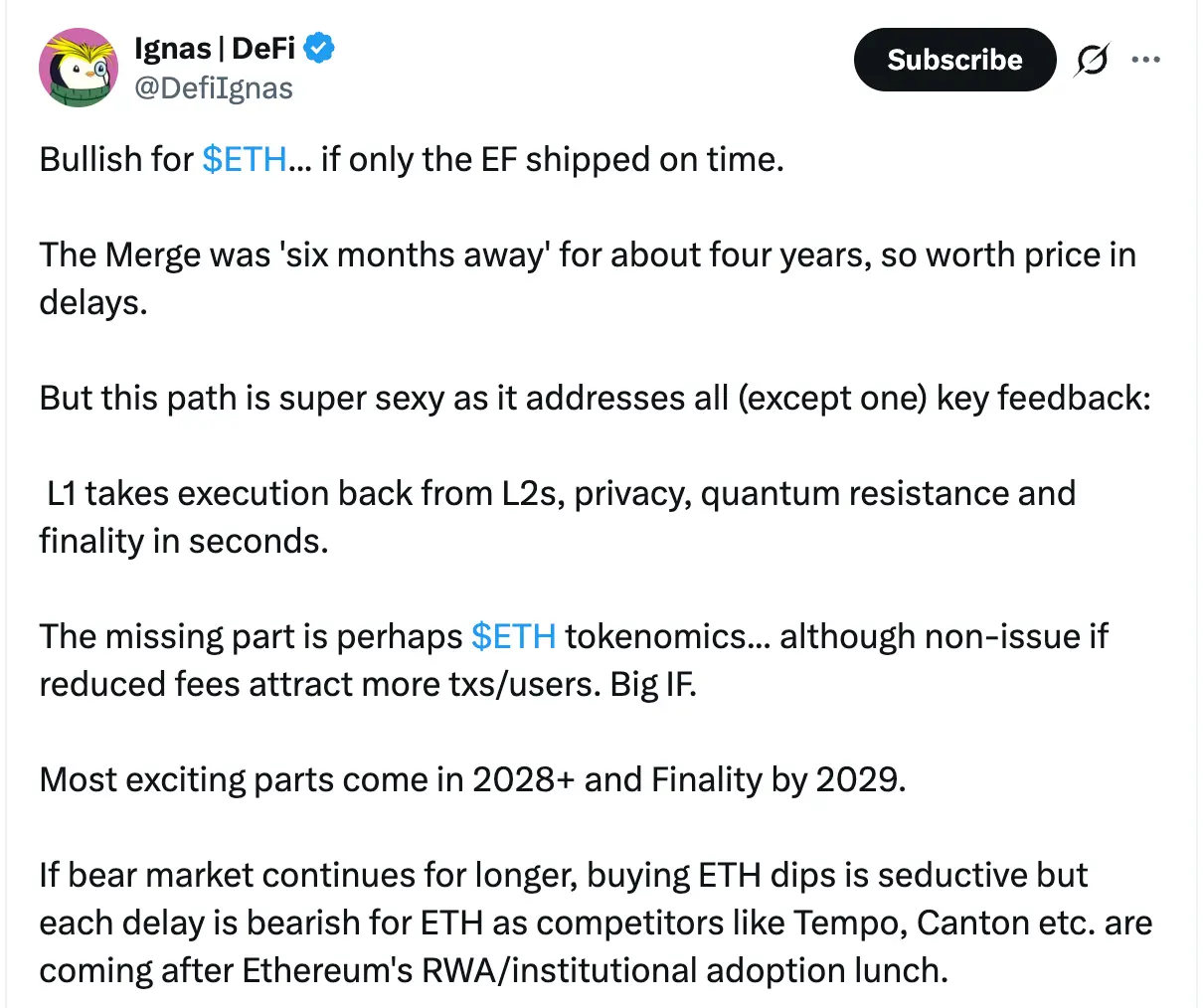
The second layer is the time lag. The roadmap announces a three-to-four-year phased engineering project. Within 2026, this roadmap will not change any aspect of Ethereum's current state. It is a directional commitment, and Ethereum's directional commitments have a history of delays in their timelines—The Merge itself was years later than early estimates. In other words, this roadmap raises Ethereum's long-term capacity ceiling but does not address ETH's medium-term value capture issues. Analyst Ignas's criticism of the roadmap points precisely to this: it does not encompass adjustments to ETH's own token economics.
Watchlist for the Next Decade

Summarizing the preceding content, the final answers all point to the same structure: this strawmap raises Ethereum's long-term ceiling but does not immediately solve ETH's medium-term value capture problem. Now is not the time to FOMO based on the roadmap alone.

Instead of pricing the roadmap itself, a more actionable approach is to track several near-term verifiable nodes:

  • Whether the Glamsterdam upgrade can launch smoothly and complete the gas limit increase.

  • Whether blob demand can continue growing with L2 activity.

  • Whether L1 fee revenue and ETH burn rates can improve.

  • Whether L2 growth can feed back to L1 through blob payments and settlement demand.

  • Whether ETH's relative performance against BTC can recover.

These indicators each correspond to elements of the roadmap and can be verified weekly on public dashboards like Etherscan's charts page and DefiLlama. Changes in any of these will provide the market with pricing signals much earlier than the roadmap document itself. Changes in any of these will tell the market sooner whether this three-to-four-year reconstruction is being delivered or delayed.

Criptos en tendencia

Preguntas relacionadas

QWhat is the Lean Ethereum roadmap, and how is it positioned within Ethereum's development history?

AThe Lean Ethereum roadmap is a comprehensive, long-term upgrade plan announced by Vitalik Buterin, positioned as Ethereum's third major evolution following the Merge. It is not a single upgrade but a series of protocol improvements to be rolled out in phases over the next three to four years. It aims to fundamentally restructure almost every core module of the protocol, including validation methods, cryptography, finality, and state storage.

QWhat are the five long-term strategic goals outlined in the strawmap for Lean Ethereum?

AThe five long-term strategic goals are: achieving faster L1 finality, reaching 1 gigagas per second L1 throughput (capable of handling tens of thousands of TPS in extreme cases), teragas-level scaling for L2 ecosystems, achieving comprehensive quantum cryptographic security, and enabling L1-native private transactions.

QWhat core technological shift is at the heart of Lean Ethereum's approach to transaction verification?

AThe core shift is moving away from every node re-executing every transaction for verification. Instead, Lean Ethereum will incorporate recursive STARK proofs as a native core component of the protocol. A single prover handles the heavy computational work, and all other nodes simply verify a succinct mathematical proof, drastically reducing computational overhead.

QWhat is the primary controversy surrounding the proposed EVM replacement in the Lean Ethereum roadmap, and which L2 project is notably affected?

AThe controversy centers on which new execution engine architecture should replace the EVM. Vitalik proposed candidates like RISC-V and leanISA for their proof-friendliness. However, L2 project Arbitrum, whose Stylus technology is built on WebAssembly (WASM), advocated for WASM. Since Vitalik's candidate list excludes WASM, it could impose additional 'adapter costs' on ecosystems like Arbitrum that have invested in different architectures, creating a strategic divergence.

QAccording to the article, what is the most direct mechanism through which the Lean Ethereum roadmap could potentially impact the price of ETH, and what is its key prerequisite?

AThe most direct mechanism is via the EIP-1559 fee-burn model. If the gigagas throughput target is achieved and leads to a resurgence in L1 transaction volume, the amount of gas consumed and ETH burned would increase, potentially affecting ETH's supply and value. The key prerequisite for this path is that 'demand follows back after the capacity increase,' meaning the increased capacity itself does not automatically create the necessary user demand and transaction activity.

Lecturas Relacionadas

In Just 11 Days, Claude Rewrote Millions of Lines of Code, an Epic AI Engineering Feat Sparks Fury

In just 11 days, Bun's founder Jarred Sumner used Anthropic's Claude AI models to rewrite its million lines of code from Zig to Rust. This move sparked significant controversy, particularly from Zig's creator, Andrew Kelley, who publicly criticized Sumner's engineering practices and the decision to use AI for such a massive rewrite. Bun, a high-performance JavaScript/TypeScript runtime and rival to Node.js, was originally written in Zig. After Anthropic acquired Bun, the team encountered persistent stability and memory safety bugs in the Zig codebase. These issues, combined with Zig's strict policy against LLM-generated code, led to the decision to rewrite in Rust. The rewrite was executed using Claude AI tools at an estimated API cost of $165,000, dramatically reducing the expected time and financial cost. Andrew Kelley's response was scathing. He blamed the original bugs on poor engineering habits, calling Bun's Zig code a collection of "hacks on top of hacks." He expressed relief that Bun was no longer associated with Zig, fearing it would misrepresent the language and attract low-quality, AI-generated contributions. The tech community is divided; some view Kelley's critique as unprofessional, while others see it as a defense of engineering integrity. A major concern about the AI-driven rewrite is the resulting code quality. The translation from Zig left approximately 27,000 lines of unsafe Rust code, raising fears about long-term maintainability and technical debt. The debate centers on whether this project is a milestone in AI-assisted development or a future maintenance nightmare.

marsbitHace 2 hora(s)

In Just 11 Days, Claude Rewrote Millions of Lines of Code, an Epic AI Engineering Feat Sparks Fury

marsbitHace 2 hora(s)

From Auto Finance to Bitcoin to AI Engines: An Analysis of Cango's 'What Not to Do' Strategy

From Auto Finance to Bitcoin and Now AI: Cango's "What Not to Do" Strategy Cango, a Chinese auto finance platform that went public on the NYSE in 2018, is undergoing its third major transformation. After selling its entire auto business in 2024, it pivoted to become a large-scale Bitcoin miner, acquiring 50 exahash of mining rigs from Bitmain. However, its true goal was never Bitcoin, but owning and controlling energy infrastructure. Now, Cango is pivoting again. While most listed Bitcoin miners are leasing power to giant hyperscalers for AI training clusters, Cango is taking the opposite path. It has launched an AI inference subsidiary called EcoHash, focusing not on training but on distributed inference. The company's strategy hinges on the insight that over 70% of mining industry power is controlled by small, independent sites (10-50 MW), which are too small for hyperscalers but ideal for low-latency AI inference. Cango aims to partner with these small operators, providing the AI technology, customers, and financing through its EcoLink software layer, which can distribute workloads across sites for reliability. Cango maintains a hybrid model, running roughly 31.7 EH/s of Bitcoin mining for cash flow while aggressively cleaning its balance sheet—slashing long-term debt by 94.5% to $30.6 million and raising $75 million for its AI venture. Its first AI deployment will be at a 50 MW site in Georgia. The strategy faces skepticism, given the high costs of converting mining sites and the potential for an AI bubble. However, Cango's leadership believes discipline around "what not to do"—avoiding direct competition with hyperscalers in training—positions it to capture the long-tail demand for distributed AI inference power.

Foresight NewsHace 2 hora(s)

From Auto Finance to Bitcoin to AI Engines: An Analysis of Cango's 'What Not to Do' Strategy

Foresight NewsHace 2 hora(s)

Strategy's Bitcoin Sales Cap Far Exceeds $1.25 Billion: A Detail the Market Overlooked

The article discusses how MicroStrategy's potential Bitcoin sales go far beyond the announced $1.25 billion "reserve-building capacity." It clarifies a key distinction in the company's "BTC Monetization Program": selling Bitcoin to *build* a new dollar reserve (the $1.25B cap) versus selling to *replenish* the existing USD Reserve after it's used for expenses like preferred share dividends. The recent $216M BTC sale for dividend payments was a "replenishment," leaving the headline $1.25B building quota untouched. The plan actually outlines three potential funding pools from BTC sales: 1) Building the reserve ($1.25B cap), 2) Covering preferred share/ debt costs (no specified cap), and 3) Funding buyback programs (up to $20B). This means the structured sales potential exceeds $30 billion, not including uncapped replenishment sales. The piece argues this marks MicroStrategy's shift from a passive "buy-and-hold" Bitcoin proxy to an actively managed entity using BTC as a balance-sheet tool to manage its complex capital structure (common stock, preferred shares, debt, reserve). This creates new dynamics and potential conflicts, as actions benefiting one part (e.g., selling BTC to pay dividends) may pressure another (e.g., undermining the "never sell" narrative). Investors must now parse the company's specific terminology ("build" vs. "replenish") to understand the true scope of future BTC sales, which is significantly larger than the market initially perceived.

marsbitHace 2 hora(s)

Strategy's Bitcoin Sales Cap Far Exceeds $1.25 Billion: A Detail the Market Overlooked

marsbitHace 2 hora(s)

Goldman Sachs Report Deconstructs the Competitive Landscape of China's AI Large Models: Who Will Be the Long-Term Winner?

Goldman Sachs analyzes China's AI large language model (LLM) landscape, identifying key players and a strategic shift towards efficiency and global expansion. The report highlights that Chinese open-source/open-weight models are closing the performance gap with top global proprietary models at significantly lower cost, driven by architectural innovations like MoE. This enables a "two-tier" market: a high-end segment (e.g., GLM5.2, Qwen3.7 Max) with pricing at ~$1 per million tokens, and a low-end, price-sensitive global segment. Open-source strategies aid adoption but limit monetization, as deployments via third-party platforms (e.g., AWS Bedrock, Alibaba Cloud) may not generate direct revenue for model creators. The industry is thus moving towards "open-weight + community license" models with revenue-sharing to improve unit economics. Internationally, the focus is shifting from "token maximization" to ROI-driven enterprise adoption, particularly in non-U.S. markets. Major cloud platforms are integrating Chinese models (e.g., DeepSeek, MiniMax). Using a competitive framework based on pricing power, cost advantage, and financial strength, Goldman Sachs identifies **Zhipu AI** and **DeepSeek** as leaders in foundational text models, and **ByteDance** (with Seedance) leading in multimodal/video generation. **MiniMax** and **Kuaishou** are also rated favorably. The firm forecasts China's AI model API/subscription revenue growing from ~RMB 35bn (2026E) to RMB 879bn by 2030.

marsbitHace 2 hora(s)

Goldman Sachs Report Deconstructs the Competitive Landscape of China's AI Large Models: Who Will Be the Long-Term Winner?

marsbitHace 2 hora(s)

Trading

Spot

Artículos destacados

Qué es $S$

Entendiendo SPERO: Una Visión General Completa Introducción a SPERO A medida que el panorama de la innovación continúa evolucionando, la aparición de tecnologías web3 y proyectos de criptomonedas juega un papel fundamental en la configuración del futuro digital. Un proyecto que ha atraído la atención en este campo dinámico es SPERO, denotado como SPERO,$$s$. Este artículo tiene como objetivo reunir y presentar información detallada sobre SPERO, para ayudar a entusiastas e inversores a comprender sus fundamentos, objetivos e innovaciones dentro de los dominios web3 y cripto. ¿Qué es SPERO,$$s$? SPERO,$$s$ es un proyecto único dentro del espacio cripto que busca aprovechar los principios de descentralización y tecnología blockchain para crear un ecosistema que promueva la participación, la utilidad y la inclusión financiera. El proyecto está diseñado para facilitar interacciones de igual a igual de nuevas maneras, proporcionando a los usuarios soluciones y servicios financieros innovadores. En su esencia, SPERO,$$s$ tiene como objetivo empoderar a los individuos al proporcionar herramientas y plataformas que mejoren la experiencia del usuario en el espacio de las criptomonedas. Esto incluye habilitar métodos de transacción más flexibles, fomentar iniciativas impulsadas por la comunidad y crear caminos para oportunidades financieras a través de aplicaciones descentralizadas (dApps). La visión subyacente de SPERO,$$s$ gira en torno a la inclusividad, buscando cerrar brechas dentro de las finanzas tradicionales mientras aprovecha los beneficios de la tecnología blockchain. ¿Quién es el Creador de SPERO,$$s$? La identidad del creador de SPERO,$$s$ sigue siendo algo oscura, ya que hay recursos públicos limitados que proporcionan información de fondo detallada sobre su(s) fundador(es). Esta falta de transparencia puede derivarse del compromiso del proyecto con la descentralización, una ética que muchos proyectos web3 comparten, priorizando las contribuciones colectivas sobre el reconocimiento individual. Al centrar las discusiones en torno a la comunidad y sus objetivos colectivos, SPERO,$$s$ encarna la esencia del empoderamiento sin señalar a individuos específicos. Como tal, comprender la ética y la misión de SPERO sigue siendo más importante que identificar a un creador singular. ¿Quiénes son los Inversores de SPERO,$$s$? SPERO,$$s$ cuenta con el apoyo de una diversa gama de inversores que van desde capitalistas de riesgo hasta inversores ángeles dedicados a fomentar la innovación en el sector cripto. El enfoque de estos inversores generalmente se alinea con la misión de SPERO, priorizando proyectos que prometen avances tecnológicos sociales, inclusión financiera y gobernanza descentralizada. Estas fundaciones de inversores suelen estar interesadas en proyectos que no solo ofrecen productos innovadores, sino que también contribuyen positivamente a la comunidad blockchain y sus ecosistemas. El respaldo de estos inversores refuerza a SPERO,$$s$ como un contendiente notable en el dominio de proyectos cripto que evoluciona rápidamente. ¿Cómo Funciona SPERO,$$s$? SPERO,$$s$ emplea un marco multifacético que lo distingue de los proyectos de criptomonedas convencionales. Aquí hay algunas de las características clave que subrayan su singularidad e innovación: Gobernanza Descentralizada: SPERO,$$s$ integra modelos de gobernanza descentralizada, empoderando a los usuarios para participar activamente en los procesos de toma de decisiones sobre el futuro del proyecto. Este enfoque fomenta un sentido de propiedad y responsabilidad entre los miembros de la comunidad. Utilidad del Token: SPERO,$$s$ utiliza su propio token de criptomoneda, diseñado para servir diversas funciones dentro del ecosistema. Estos tokens permiten transacciones, recompensas y la facilitación de servicios ofrecidos en la plataforma, mejorando la participación y la utilidad general. Arquitectura en Capas: La arquitectura técnica de SPERO,$$s$ apoya la modularidad y escalabilidad, permitiendo la integración fluida de características y aplicaciones adicionales a medida que el proyecto evoluciona. Esta adaptabilidad es fundamental para mantener la relevancia en el cambiante paisaje cripto. Participación de la Comunidad: El proyecto enfatiza iniciativas impulsadas por la comunidad, empleando mecanismos que incentivan la colaboración y la retroalimentación. Al nutrir una comunidad sólida, SPERO,$$s$ puede abordar mejor las necesidades de los usuarios y adaptarse a las tendencias del mercado. Enfoque en la Inclusión: Al ofrecer tarifas de transacción bajas e interfaces amigables para el usuario, SPERO,$$s$ busca atraer a una base de usuarios diversa, incluyendo a individuos que anteriormente pueden no haber participado en el espacio cripto. Este compromiso con la inclusión se alinea con su misión general de empoderamiento a través de la accesibilidad. Cronología de SPERO,$$s$ Entender la historia de un proyecto proporciona información crucial sobre su trayectoria de desarrollo y hitos. A continuación se presenta una cronología sugerida que mapea eventos significativos en la evolución de SPERO,$$s$: Fase de Conceptualización e Ideación: Las ideas iniciales que forman la base de SPERO,$$s$ fueron concebidas, alineándose estrechamente con los principios de descentralización y enfoque comunitario dentro de la industria blockchain. Lanzamiento del Whitepaper del Proyecto: Tras la fase conceptual, se lanzó un whitepaper completo que detalla la visión, los objetivos y la infraestructura tecnológica de SPERO,$$s$ para generar interés y retroalimentación de la comunidad. Construcción de Comunidad y Primeras Interacciones: Se realizaron esfuerzos de divulgación activa para construir una comunidad de primeros adoptantes y posibles inversores, facilitando discusiones en torno a los objetivos del proyecto y obteniendo apoyo. Evento de Generación de Tokens: SPERO,$$s$ llevó a cabo un evento de generación de tokens (TGE) para distribuir sus tokens nativos a los primeros seguidores y establecer liquidez inicial dentro del ecosistema. Lanzamiento de la dApp Inicial: La primera aplicación descentralizada (dApp) asociada con SPERO,$$s$ se puso en marcha, permitiendo a los usuarios interactuar con las funcionalidades centrales de la plataforma. Desarrollo Continuo y Alianzas: Actualizaciones y mejoras continuas a las ofertas del proyecto, incluyendo alianzas estratégicas con otros actores en el espacio blockchain, han moldeado a SPERO,$$s$ en un jugador competitivo y en evolución en el mercado cripto. Conclusión SPERO,$$s$ se erige como un testimonio del potencial de web3 y las criptomonedas para revolucionar los sistemas financieros y empoderar a los individuos. Con un compromiso con la gobernanza descentralizada, la participación comunitaria y funcionalidades diseñadas de manera innovadora, allana el camino hacia un paisaje financiero más inclusivo. Como con cualquier inversión en el espacio cripto que evoluciona rápidamente, se anima a los posibles inversores y usuarios a investigar a fondo y participar de manera reflexiva con los desarrollos en curso dentro de SPERO,$$s$. El proyecto muestra el espíritu innovador de la industria cripto, invitando a una mayor exploración de sus innumerables posibilidades. Mientras el viaje de SPERO,$$s$ aún se desarrolla, sus principios fundamentales pueden, de hecho, influir en el futuro de cómo interactuamos con la tecnología, las finanzas y entre nosotros en ecosistemas digitales interconectados.

120 Vistas totalesPublicado en 2024.12.17Actualizado en 2024.12.17

Qué es $S$

Qué es AGENT S

Agent S: El Futuro de la Interacción Autónoma en Web3 Introducción En el paisaje en constante evolución de Web3 y las criptomonedas, las innovaciones están redefiniendo constantemente cómo los individuos interactúan con las plataformas digitales. Uno de estos proyectos pioneros, Agent S, promete revolucionar la interacción humano-computadora a través de su marco agente abierto. Al allanar el camino para interacciones autónomas, Agent S busca simplificar tareas complejas, ofreciendo aplicaciones transformadoras en inteligencia artificial (IA). Esta exploración detallada profundizará en las complejidades del proyecto, sus características únicas y las implicaciones para el dominio de las criptomonedas. ¿Qué es Agent S? Agent S se presenta como un marco agente abierto innovador, diseñado específicamente para abordar tres desafíos fundamentales en la automatización de tareas informáticas: Adquisición de Conocimiento Específico del Dominio: El marco aprende inteligentemente de diversas fuentes de conocimiento externas y experiencias internas. Este enfoque dual le permite construir un rico repositorio de conocimiento específico del dominio, mejorando su rendimiento en la ejecución de tareas. Planificación a Largo Plazo de Tareas: Agent S emplea planificación jerárquica aumentada por la experiencia, un enfoque estratégico que facilita la descomposición y ejecución eficiente de tareas complejas. Esta característica mejora significativamente su capacidad para gestionar múltiples subtareas de manera eficiente y efectiva. Manejo de Interfaces Dinámicas y No Uniformes: El proyecto introduce la Interfaz Agente-Computadora (ACI), una solución innovadora que mejora la interacción entre agentes y usuarios. Utilizando Modelos de Lenguaje Multimodal de Gran Escala (MLLMs), Agent S puede navegar y manipular diversas interfaces gráficas de usuario sin problemas. A través de estas características pioneras, Agent S proporciona un marco robusto que aborda las complejidades involucradas en la automatización de la interacción humana con las máquinas, preparando el terreno para una multitud de aplicaciones en IA y más allá. ¿Quién es el Creador de Agent S? Si bien el concepto de Agent S es fundamentalmente innovador, la información específica sobre su creador sigue siendo elusiva. El creador es actualmente desconocido, lo que resalta ya sea la etapa incipiente del proyecto o la elección estratégica de mantener a los miembros fundadores en el anonimato. Independientemente de la anonimidad, el enfoque sigue siendo en las capacidades y el potencial del marco. ¿Quiénes son los Inversores de Agent S? Dado que Agent S es relativamente nuevo en el ecosistema criptográfico, la información detallada sobre sus inversores y patrocinadores financieros no está documentada explícitamente. La falta de información disponible públicamente sobre las bases de inversión u organizaciones que apoyan el proyecto plantea preguntas sobre su estructura de financiamiento y hoja de ruta de desarrollo. Comprender el respaldo es crucial para evaluar la sostenibilidad del proyecto y su posible impacto en el mercado. ¿Cómo Funciona Agent S? En el núcleo de Agent S se encuentra una tecnología de vanguardia que le permite funcionar de manera efectiva en diversos entornos. Su modelo operativo se basa en varias características clave: Interacción Humano-Computadora Similar a la Humana: El marco ofrece planificación avanzada de IA, esforzándose por hacer que las interacciones con las computadoras sean más intuitivas. Al imitar el comportamiento humano en la ejecución de tareas, promete elevar las experiencias de los usuarios. Memoria Narrativa: Empleada para aprovechar experiencias de alto nivel, Agent S utiliza memoria narrativa para hacer un seguimiento de las historias de tareas, mejorando así sus procesos de toma de decisiones. Memoria Episódica: Esta característica proporciona a los usuarios una guía paso a paso, permitiendo que el marco ofrezca apoyo contextual a medida que se desarrollan las tareas. Soporte para OpenACI: Con la capacidad de ejecutarse localmente, Agent S permite a los usuarios mantener el control sobre sus interacciones y flujos de trabajo, alineándose con la ética descentralizada de Web3. Fácil Integración con APIs Externas: Su versatilidad y compatibilidad con varias plataformas de IA aseguran que Agent S pueda encajar sin problemas en ecosistemas tecnológicos existentes, convirtiéndolo en una opción atractiva para desarrolladores y organizaciones. Estas funcionalidades contribuyen colectivamente a la posición única de Agent S dentro del espacio cripto, ya que automatiza tareas complejas y de múltiples pasos con una intervención humana mínima. A medida que el proyecto evoluciona, sus posibles aplicaciones en Web3 podrían redefinir cómo se desarrollan las interacciones digitales. Cronología de Agent S El desarrollo y los hitos de Agent S pueden encapsularse en una cronología que resalta sus eventos significativos: 27 de septiembre de 2024: El concepto de Agent S fue lanzado en un documento de investigación integral titulado “Un Marco Agente Abierto que Usa Computadoras Como un Humano”, mostrando las bases del proyecto. 10 de octubre de 2024: El documento de investigación fue puesto a disposición del público en arXiv, ofreciendo una exploración profunda del marco y su evaluación de rendimiento basada en el benchmark OSWorld. 12 de octubre de 2024: Se lanzó una presentación en video, proporcionando una visión visual de las capacidades y características de Agent S, involucrando aún más a posibles usuarios e inversores. Estos marcadores en la cronología no solo ilustran el progreso de Agent S, sino que también indican su compromiso con la transparencia y la participación comunitaria. Puntos Clave Sobre Agent S A medida que el marco Agent S continúa evolucionando, varios atributos clave destacan, subrayando su naturaleza innovadora y potencial: Marco Innovador: Diseñado para proporcionar un uso intuitivo de las computadoras similar a la interacción humana, Agent S aporta un enfoque novedoso a la automatización de tareas. Interacción Autónoma: La capacidad de interactuar de manera autónoma con las computadoras a través de GUI significa un salto hacia soluciones informáticas más inteligentes y eficientes. Automatización de Tareas Complejas: Con su metodología robusta, puede automatizar tareas complejas y de múltiples pasos, haciendo que los procesos sean más rápidos y menos propensos a errores. Mejora Continua: Los mecanismos de aprendizaje permiten a Agent S mejorar a partir de experiencias pasadas, mejorando continuamente su rendimiento y eficacia. Versatilidad: Su adaptabilidad en diferentes entornos operativos como OSWorld y WindowsAgentArena asegura que pueda servir a una amplia gama de aplicaciones. A medida que Agent S se posiciona en el paisaje de Web3 y criptomonedas, su potencial para mejorar las capacidades de interacción y automatizar procesos significa un avance significativo en las tecnologías de IA. A través de su marco innovador, Agent S ejemplifica el futuro de las interacciones digitales, prometiendo una experiencia más fluida y eficiente para los usuarios en diversas industrias. Conclusión Agent S representa un audaz avance en la unión de la IA y Web3, con la capacidad de redefinir cómo interactuamos con la tecnología. Aunque aún se encuentra en sus primeras etapas, las posibilidades para su aplicación son vastas y atractivas. A través de su marco integral que aborda desafíos críticos, Agent S busca llevar las interacciones autónomas al primer plano de la experiencia digital. A medida que nos adentramos más en los reinos de las criptomonedas y la descentralización, proyectos como Agent S sin duda desempeñarán un papel crucial en la configuración del futuro de la tecnología y la colaboración humano-computadora.

524 Vistas totalesPublicado en 2025.01.14Actualizado en 2025.01.14

Qué es AGENT S

Cómo comprar S

¡Bienvenido a HTX.com! Hemos hecho que comprar Sonic (S) sea simple y conveniente. Sigue nuestra guía paso a paso para iniciar tu viaje de criptos.Paso 1: crea tu cuenta HTXUtiliza tu correo electrónico o número de teléfono para registrarte y obtener una cuenta gratuita en HTX. Experimenta un proceso de registro sin complicaciones y desbloquea todas las funciones.Obtener mi cuentaPaso 2: ve a Comprar cripto y elige tu método de pagoTarjeta de crédito/débito: usa tu Visa o Mastercard para comprar Sonic (S) al instante.Saldo: utiliza fondos del saldo de tu cuenta HTX para tradear sin problemas.Terceros: hemos agregado métodos de pago populares como Google Pay y Apple Pay para mejorar la comodidad.P2P: tradear directamente con otros usuarios en HTX.Over-the-Counter (OTC): ofrecemos servicios personalizados y tipos de cambio competitivos para los traders.Paso 3: guarda tu Sonic (S)Después de comprar tu Sonic (S), guárdalo en tu cuenta HTX. Alternativamente, puedes enviarlo a otro lugar mediante transferencia blockchain o utilizarlo para tradear otras criptomonedas.Paso 4: tradear Sonic (S)Tradear fácilmente con Sonic (S) en HTX's mercado spot. Simplemente accede a tu cuenta, selecciona tu par de trading, ejecuta tus trades y monitorea en tiempo real. Ofrecemos una experiencia fácil de usar tanto para principiantes como para traders experimentados.

1.1k Vistas totalesPublicado en 2025.01.15Actualizado en 2026.06.02

Cómo comprar S

Discusiones

Bienvenido a la comunidad de HTX. Aquí puedes mantenerte informado sobre los últimos desarrollos de la plataforma y acceder a análisis profesionales del mercado. A continuación se presentan las opiniones de los usuarios sobre el precio de S (S).

活动图片