In Just 11 Days, Claude Rewrote Millions of Lines of Code, an Epic AI Engineering Feat Sparks Fury

marsbitPublicado a 2026-07-11Actualizado a 2026-07-11

Resumen

In just 11 days, Bun's founder Jarred Sumner used Anthropic's Claude AI models to rewrite its million lines of code from Zig to Rust. This move sparked significant controversy, particularly from Zig's creator, Andrew Kelley, who publicly criticized Sumner's engineering practices and the decision to use AI for such a massive rewrite. Bun, a high-performance JavaScript/TypeScript runtime and rival to Node.js, was originally written in Zig. After Anthropic acquired Bun, the team encountered persistent stability and memory safety bugs in the Zig codebase. These issues, combined with Zig's strict policy against LLM-generated code, led to the decision to rewrite in Rust. The rewrite was executed using Claude AI tools at an estimated API cost of $165,000, dramatically reducing the expected time and financial cost. Andrew Kelley's response was scathing. He blamed the original bugs on poor engineering habits, calling Bun's Zig code a collection of "hacks on top of hacks." He expressed relief that Bun was no longer associated with Zig, fearing it would misrepresent the language and attract low-quality, AI-generated contributions. The tech community is divided; some view Kelley's critique as unprofessional, while others see it as a defense of engineering integrity. A major concern about the AI-driven rewrite is the resulting code quality. The translation from Zig left approximately 27,000 lines of unsafe Rust code, raising fears about long-term maintainability and technical debt. The...

These days, the tech community has been feasting on drama: Zig programming language creator Andrew Kelley is furious.
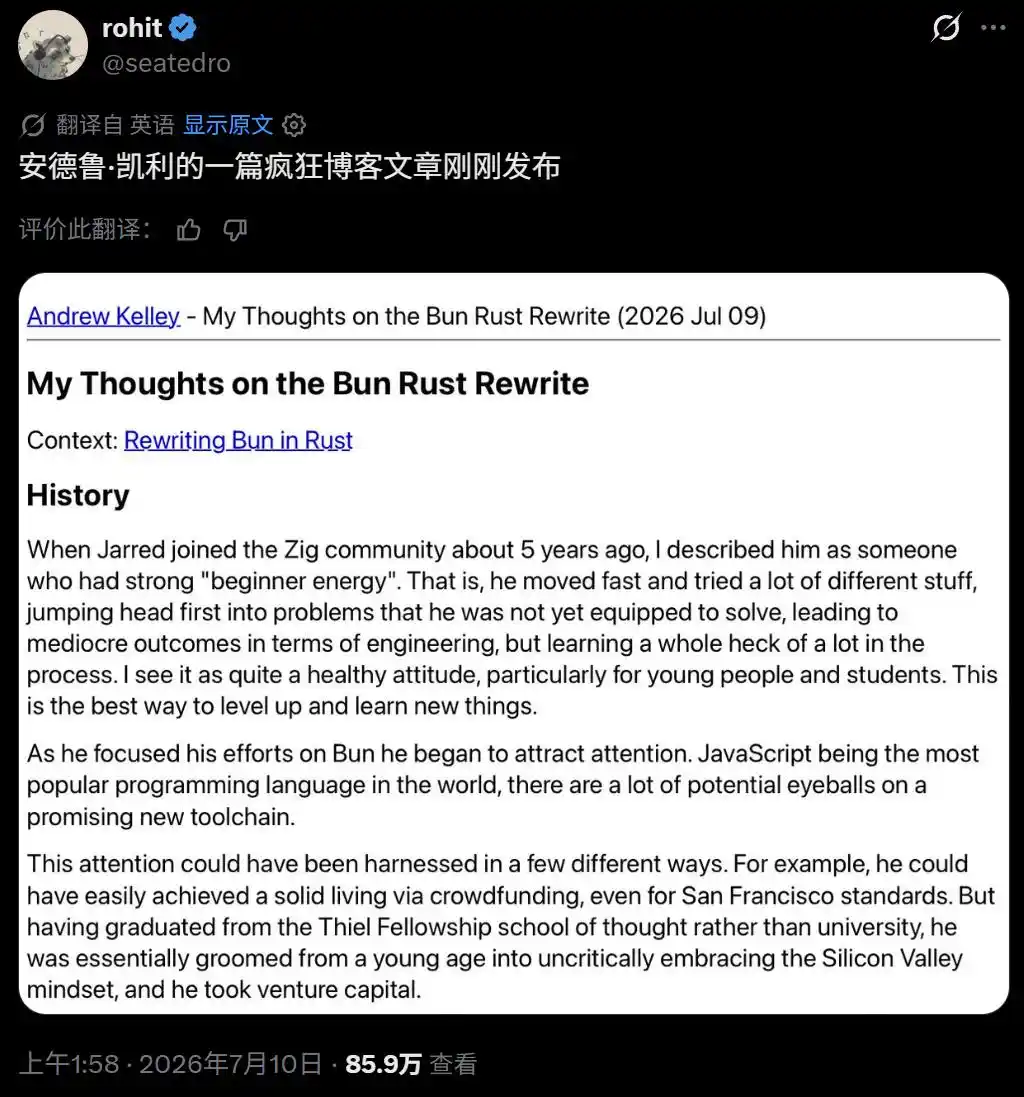
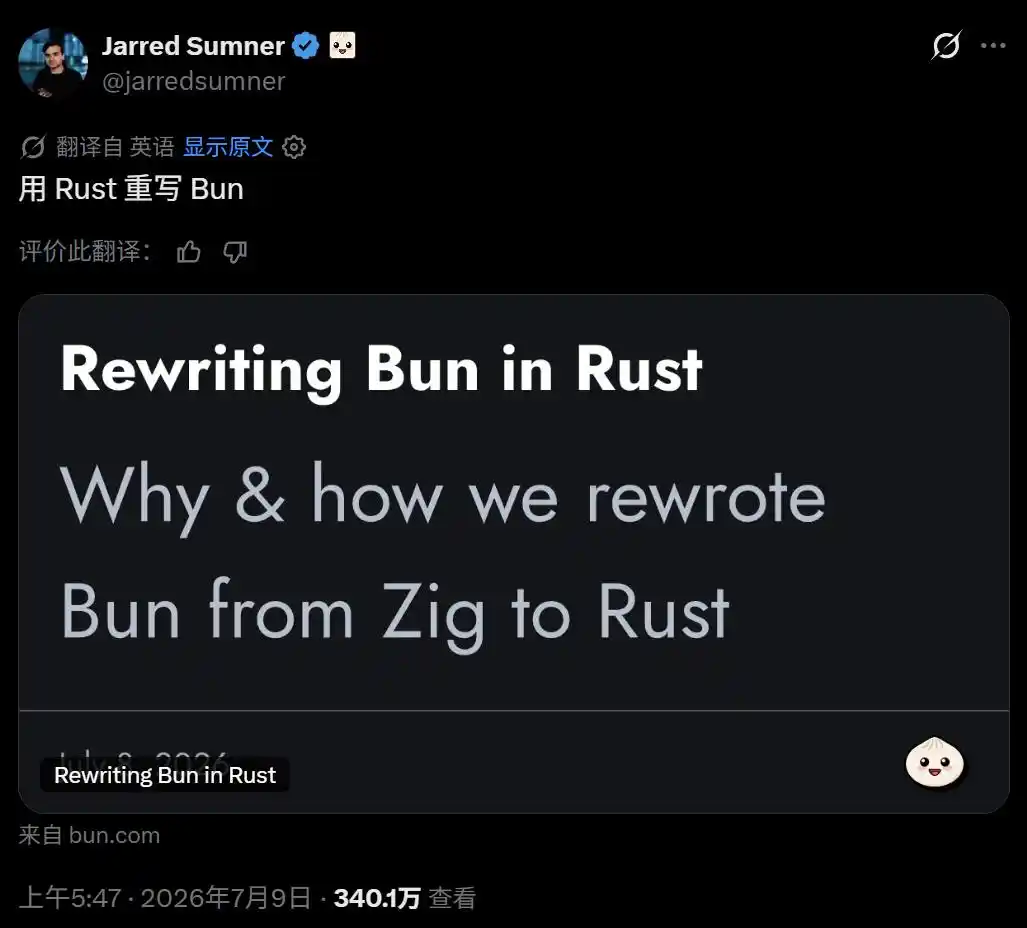
The reason? Bun, which had fully committed to the Zig language, was rewritten in Rust by its founder, Jarred Sumner.
Andrew Kelley didn't mince words, showing his anger without the usual polite discourse surrounding such a phenomenal tech event. He directly targeted Jarred Sumner's personal engineering habits, management abilities, and the business logic behind this move.

Bun is a high-performance JavaScript/TypeScript runtime, designed to be a faster, modern direct replacement for Node.js. In recent years, it has become a heavyweight contender challenging Node.js's dominance in the frontend world.

Bun's core selling point is speed: whether it's startup time, dependency installation, or test execution, it far outpaces its competitors, partly because it was originally written in Zig.

In December last year, Anthropic announced its acquisition of Bun, planning to use it as infrastructure to power its AI coding tools, Claude Code and the Claude Agent SDK. Jarred Sumner and other Bun team members are now working at Anthropic.

After large-scale application, especially as the underlying layer for Claude Code, the Bun team encountered what they deemed to be intractable stability issues.

Specifically, the Zig version of Bun had a significant number of memory safety bugs — use-after-free, double-free, forgetting to free memory on error paths, etc. In Zig, these issues rely on coding conventions for prevention, whereas in Rust, the borrow checker and Drop mechanism turn them directly into compilation errors.

On another front, the upstream Zig community maintains a zero-tolerance policy towards code generated by large language models (LLMs). Even optimization patches unrelated to AI could not be merged upstream. The Bun team heavily relies on AI-assisted development, and continuing with Zig meant having to maintain their own compiler fork long-term, at a high cost.

Thus, in May of this year, we witnessed a major engineering feat in the tech world: Bun's founder Jarred Sumner announced that they had rewritten Bun's million lines of code in Rust within 11 days. They used Anthropic's then-unreleased Claude Fable 5 (a Mythos-level model) and the dynamic workflow capabilities of Claude Code.
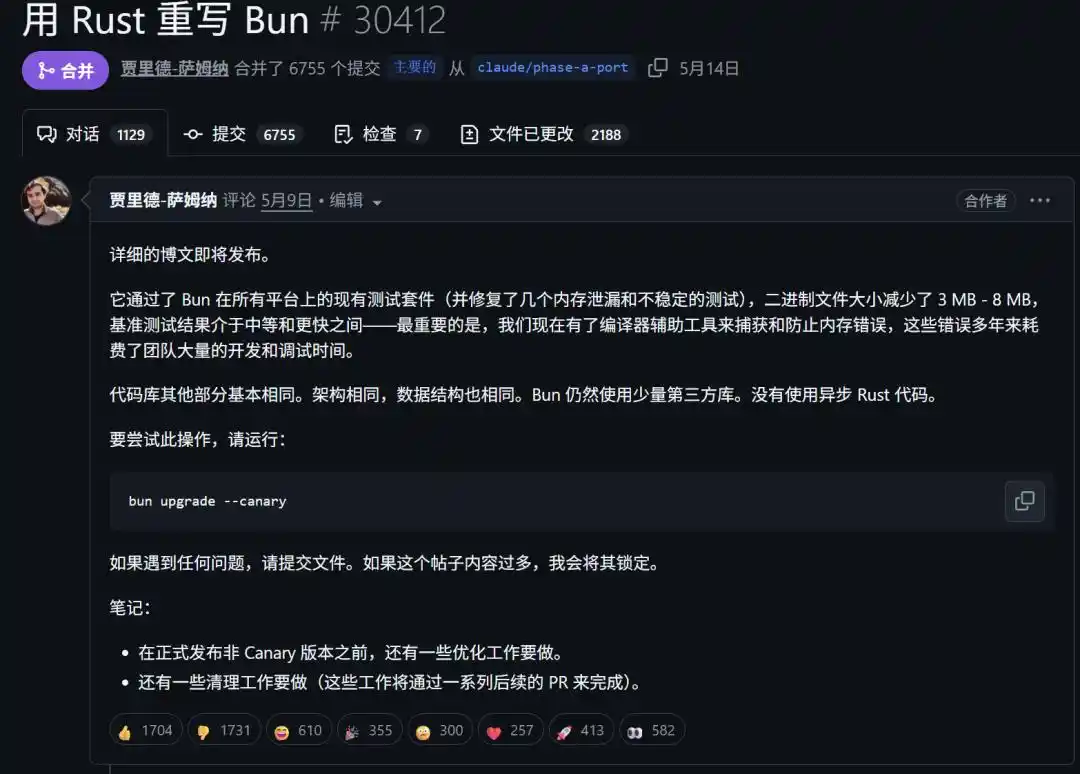
This was an epic large-scale test of Agentic Workflows, later promoted by Anthropic as a benchmark case for Dynamic Workflows, but it also sparked controversy for "betraying the faith."

In a recent blog post, Zig creator Andrew Kelley argued that the root cause of Bun's bugs before the rewrite was Jarred Sumner's poor engineering habits.

First, even before AI became prominent, Jarred was consistently writing poor-quality code. Kelley stated that the Zig team often reviews users' codebases, and Bun's codebase filled them with "extreme fear." It was full of hacky patches stacked on top of more hacks, abused assertions, and in the rush to push new features quickly, they almost never took time to fix bugs or address technical debt.

Then came the million lines of code generated by Claude. Kelley countered: "Bun officially claims that 1 million lines of unvetted Rust (AI-written) code are safe because there are test cases; well, if the test cases were really that comprehensive, why didn't they catch all those pesky bugs in the original Zig-written version?"

Now, Kelley expresses deep disappointment with Jarred's transformation from an open-source developer with "beginner energy" into a "stinky manager."

Kelley bluntly stated that when he learned Bun was abandoning Zig, he wasn't angry about the betrayal but rather relieved. He was afraid that Bun, bearing the Zig name, would create misunderstandings externally and, worse, attract users who only copy-paste AI-generated code. He even sarcastically remarked that he's now enjoying a cup of tea, glad that "this is finally not my problem anymore."

With such direct confrontation, others in the tech community have joined the fray, sharing their views.

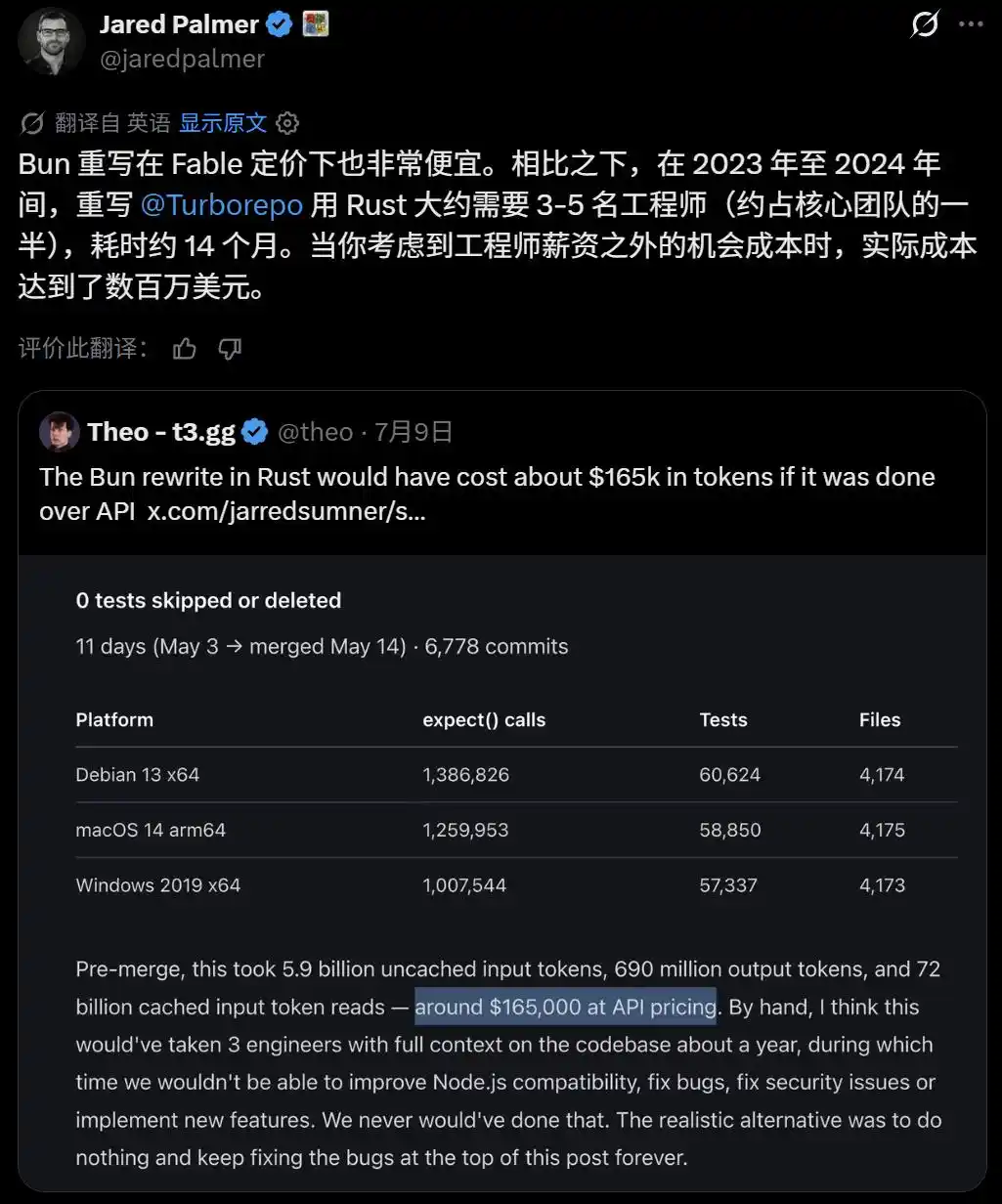
First, some did the math: Claude's tokens are often criticized as expensive, but based on data released by Jarred Sumner and Bun, the Rust rewrite of the Bun project is estimated to have consumed $165,000 in API fees. In the tech and engineering world, this price and timeline are frighteningly cheap.

On paper alone, AI compressed development costs to about one-tenth of the original estimate, and the time was reduced from roughly a year to less than two weeks.
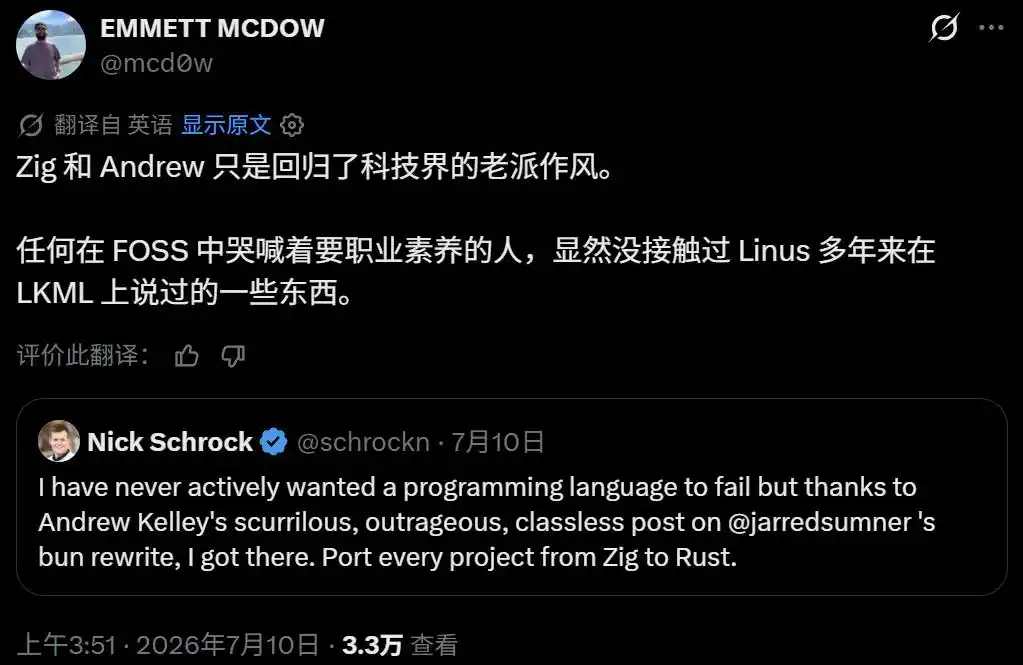
Secondly, there's the debate on the collision of open-source community culture with the AI era. After reading Andrew Kelley's blog post, some felt extremely uncomfortable, believing his public attack on a former major user and sponsor (Bun had long funded Zig) showed a lack of professionalism. Some even radically expressed they had "never before so actively wished for a programming language to fail."

However, veteran programmers also voiced support, arguing that in this era driven by capital and AI hype, Andrew is merely defending pure engineering quality, reminiscent of Linus Torvalds's style back in the day.
Of course, everyone is more concerned about whether the project is still usable after such a drastic overhaul.

The biggest point of contention currently is that, since the 1 million lines of code were mechanically translated from Zig by AI, they lack the architectural refactoring a human engineer would provide. The new codebase retains a staggering 27,000 lines of `unsafe` code blocks. Many worry that the cognitive and debugging costs for human developers maintaining, reading, and modifying this massive "AI-generated blob" in the future might ultimately exceed the upfront development costs saved today.

Will this project, which breaks the established rules of software engineering history, become a milestone where AI reshapes programming paradigms, or will it eventually erupt as an unmaintainable volcano of technical debt? Only time will tell.

References:

https://bun.com/blog/bun-in-rust

https://andrewkelley.me/post/my-thoughts-bun-rust-rewrite.html

This article is from the WeChat public account "Machine Heart" (ID: almosthuman2014), author: Focus on AI.


Criptos en tendencia

Preguntas relacionadas

QWhat is the main reason Bun's founder, Jarred Sumner, decided to rewrite the entire Bun project from Zig to Rust?

AThe main reason was to address persistent stability issues, particularly memory safety bugs (like use-after-free, double-free) that were difficult to eradicate in Zig. Rust's ownership and borrowing model turns these issues into compile-time errors, offering stronger safety guarantees. Additionally, Zig's upstream community had a zero-tolerance policy for LLM-generated code, which conflicted with Bun team's heavy reliance on AI-assisted development, forcing them to maintain their own compiler fork.

QWhat was Zig creator Andrew Kelley's primary criticism regarding the quality of Bun's original Zig codebase?

AAndrew Kelley criticized that the Bun codebase, even before AI was heavily used, was poorly engineered. He described it as being filled with 'hacks on top of hacks,' rampant use of assertions, and a general lack of effort to fix bugs or address technical debt in favor of quickly shipping new features. He attributed the bugs to Jarred Sumner's 'stinky manager' habits and poor engineering practices rather than a flaw in the Zig language itself.

QAccording to the article, how much did the AI-assisted Rust rewrite of Bun cost in API fees, and how long did it take?

AAccording to data released by Jarred Sumner and Bun, the Rust language rewrite of the Bun project was estimated to have consumed approximately $165,000 in API fees. The entire process of rewriting the million lines of code was completed in just 11 days.

QWhat is a major technical concern raised by developers about the new AI-generated Rust code for Bun?

AA major concern is that the AI mechanically translated the code from Zig to Rust without significant architectural refactoring by human engineers. As a result, the new codebase contains a high number of 'unsafe' code blocks—reportedly 27,000 lines. Critics worry that the cognitive load and debugging costs for future human developers maintaining this 'AI-generated artifact' could eventually outweigh the initial development time and cost savings.

QWhat conflicting viewpoints does the article present about the community reaction to Andrew Kelley's public criticism?

AThe article presents two conflicting viewpoints. One side criticizes Andrew Kelley, finding his public attack on a former major user and sponsor (Bun had funded Zig) unprofessional and lacking in grace. Some even expressed a desire for Zig to fail. The other side, including veteran programmers, defends him, viewing his stance as a defense of pure engineering quality and craftsmanship in an era dominated by capital and AI hype, comparing his directness to that of figures like Linus Torvalds.

Lecturas Relacionadas

From Auto Finance to Bitcoin to AI Engines: An Analysis of Cango's 'What Not to Do' Strategy

From Auto Finance to Bitcoin and Now AI: Cango's "What Not to Do" Strategy Cango, a Chinese auto finance platform that went public on the NYSE in 2018, is undergoing its third major transformation. After selling its entire auto business in 2024, it pivoted to become a large-scale Bitcoin miner, acquiring 50 exahash of mining rigs from Bitmain. However, its true goal was never Bitcoin, but owning and controlling energy infrastructure. Now, Cango is pivoting again. While most listed Bitcoin miners are leasing power to giant hyperscalers for AI training clusters, Cango is taking the opposite path. It has launched an AI inference subsidiary called EcoHash, focusing not on training but on distributed inference. The company's strategy hinges on the insight that over 70% of mining industry power is controlled by small, independent sites (10-50 MW), which are too small for hyperscalers but ideal for low-latency AI inference. Cango aims to partner with these small operators, providing the AI technology, customers, and financing through its EcoLink software layer, which can distribute workloads across sites for reliability. Cango maintains a hybrid model, running roughly 31.7 EH/s of Bitcoin mining for cash flow while aggressively cleaning its balance sheet—slashing long-term debt by 94.5% to $30.6 million and raising $75 million for its AI venture. Its first AI deployment will be at a 50 MW site in Georgia. The strategy faces skepticism, given the high costs of converting mining sites and the potential for an AI bubble. However, Cango's leadership believes discipline around "what not to do"—avoiding direct competition with hyperscalers in training—positions it to capture the long-tail demand for distributed AI inference power.

Foresight NewsHace 1 hora(s)

From Auto Finance to Bitcoin to AI Engines: An Analysis of Cango's 'What Not to Do' Strategy

Foresight NewsHace 1 hora(s)

Strategy's Bitcoin Sales Cap Far Exceeds $1.25 Billion: A Detail the Market Overlooked

The article discusses how MicroStrategy's potential Bitcoin sales go far beyond the announced $1.25 billion "reserve-building capacity." It clarifies a key distinction in the company's "BTC Monetization Program": selling Bitcoin to *build* a new dollar reserve (the $1.25B cap) versus selling to *replenish* the existing USD Reserve after it's used for expenses like preferred share dividends. The recent $216M BTC sale for dividend payments was a "replenishment," leaving the headline $1.25B building quota untouched. The plan actually outlines three potential funding pools from BTC sales: 1) Building the reserve ($1.25B cap), 2) Covering preferred share/ debt costs (no specified cap), and 3) Funding buyback programs (up to $20B). This means the structured sales potential exceeds $30 billion, not including uncapped replenishment sales. The piece argues this marks MicroStrategy's shift from a passive "buy-and-hold" Bitcoin proxy to an actively managed entity using BTC as a balance-sheet tool to manage its complex capital structure (common stock, preferred shares, debt, reserve). This creates new dynamics and potential conflicts, as actions benefiting one part (e.g., selling BTC to pay dividends) may pressure another (e.g., undermining the "never sell" narrative). Investors must now parse the company's specific terminology ("build" vs. "replenish") to understand the true scope of future BTC sales, which is significantly larger than the market initially perceived.

marsbitHace 1 hora(s)

Strategy's Bitcoin Sales Cap Far Exceeds $1.25 Billion: A Detail the Market Overlooked

marsbitHace 1 hora(s)

Goldman Sachs Report Deconstructs the Competitive Landscape of China's AI Large Models: Who Will Be the Long-Term Winner?

Goldman Sachs analyzes China's AI large language model (LLM) landscape, identifying key players and a strategic shift towards efficiency and global expansion. The report highlights that Chinese open-source/open-weight models are closing the performance gap with top global proprietary models at significantly lower cost, driven by architectural innovations like MoE. This enables a "two-tier" market: a high-end segment (e.g., GLM5.2, Qwen3.7 Max) with pricing at ~$1 per million tokens, and a low-end, price-sensitive global segment. Open-source strategies aid adoption but limit monetization, as deployments via third-party platforms (e.g., AWS Bedrock, Alibaba Cloud) may not generate direct revenue for model creators. The industry is thus moving towards "open-weight + community license" models with revenue-sharing to improve unit economics. Internationally, the focus is shifting from "token maximization" to ROI-driven enterprise adoption, particularly in non-U.S. markets. Major cloud platforms are integrating Chinese models (e.g., DeepSeek, MiniMax). Using a competitive framework based on pricing power, cost advantage, and financial strength, Goldman Sachs identifies **Zhipu AI** and **DeepSeek** as leaders in foundational text models, and **ByteDance** (with Seedance) leading in multimodal/video generation. **MiniMax** and **Kuaishou** are also rated favorably. The firm forecasts China's AI model API/subscription revenue growing from ~RMB 35bn (2026E) to RMB 879bn by 2030.

marsbitHace 1 hora(s)

Goldman Sachs Report Deconstructs the Competitive Landscape of China's AI Large Models: Who Will Be the Long-Term Winner?

marsbitHace 1 hora(s)

Trading

Spot

Artículos destacados

Cómo comprar EPIC

¡Bienvenido a HTX.com! Hemos hecho que comprar Epic Chain (EPIC) sea simple y conveniente. Sigue nuestra guía paso a paso para iniciar tu viaje de criptos.Paso 1: crea tu cuenta HTXUtiliza tu correo electrónico o número de teléfono para registrarte y obtener una cuenta gratuita en HTX. Experimenta un proceso de registro sin complicaciones y desbloquea todas las funciones.Obtener mi cuentaPaso 2: ve a Comprar cripto y elige tu método de pagoTarjeta de crédito/débito: usa tu Visa o Mastercard para comprar Epic Chain (EPIC) al instante.Saldo: utiliza fondos del saldo de tu cuenta HTX para tradear sin problemas.Terceros: hemos agregado métodos de pago populares como Google Pay y Apple Pay para mejorar la comodidad.P2P: tradear directamente con otros usuarios en HTX.Over-the-Counter (OTC): ofrecemos servicios personalizados y tipos de cambio competitivos para los traders.Paso 3: guarda tu Epic Chain (EPIC)Después de comprar tu Epic Chain (EPIC), guárdalo en tu cuenta HTX. Alternativamente, puedes enviarlo a otro lugar mediante transferencia blockchain o utilizarlo para tradear otras criptomonedas.Paso 4: tradear Epic Chain (EPIC)Tradear fácilmente con Epic Chain (EPIC) en HTX's mercado spot. Simplemente accede a tu cuenta, selecciona tu par de trading, ejecuta tus trades y monitorea en tiempo real. Ofrecemos una experiencia fácil de usar tanto para principiantes como para traders experimentados.

215 Vistas totalesPublicado en 2025.03.17Actualizado en 2026.06.02

Cómo comprar EPIC

Discusiones

Bienvenido a la comunidad de HTX. Aquí puedes mantenerte informado sobre los últimos desarrollos de la plataforma y acceder a análisis profesionales del mercado. A continuación se presentan las opiniones de los usuarios sobre el precio de EPIC (EPIC).

活动图片