SEC Approves Tokenized Securities—DTCC To Establish Blockchain Standards

ccn.comPublicado a 2025-12-12Actualizado a 2025-12-12

Resumen

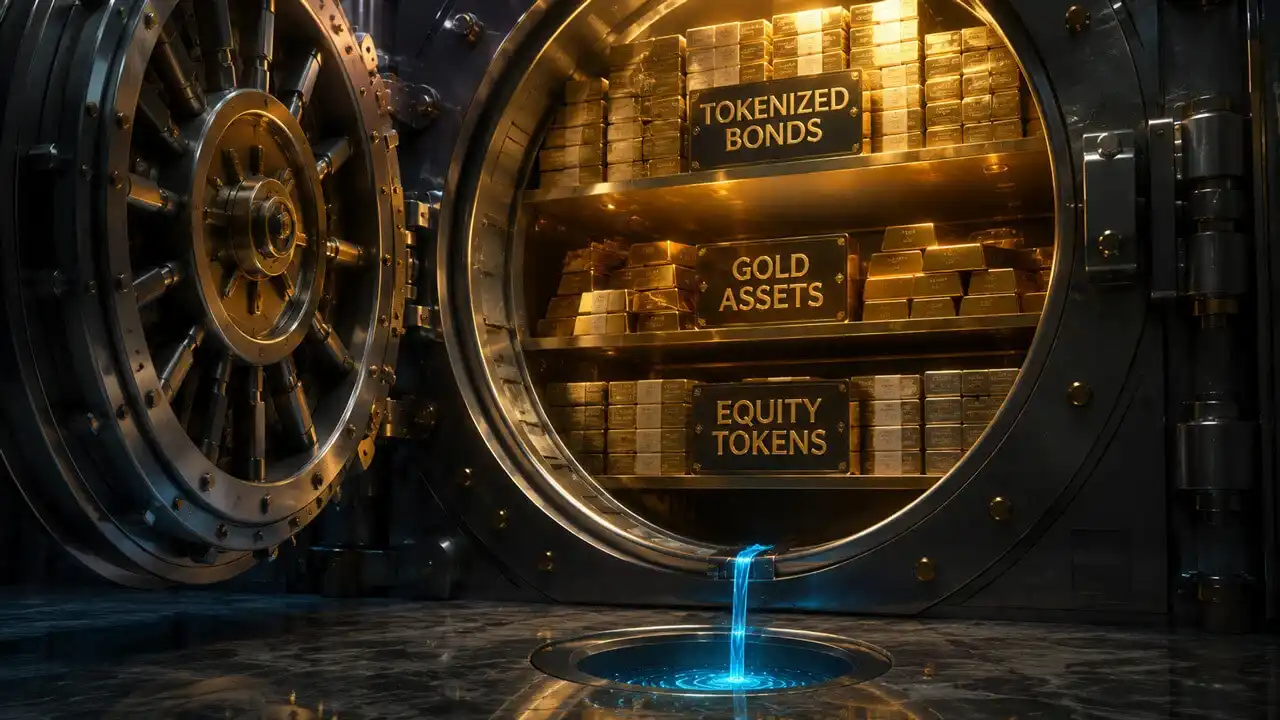
The U.S. Securities and Exchange Commission (SEC) has approved the DTCC to develop a securities tokenization program. Its subsidiary, the Depository Trust Company, will establish standards for recording ownership of stocks, ETFs, and Treasuries on blockchain. This initiative aims to launch a pilot program in the second half of 2026. As the core of U.S. financial infrastructure, the DTCC processes quadrillions in transactions annually and will now define objective technology standards for tokenization. While it won’t mandate a specific blockchain, it will maintain a list of approved networks that meet its criteria. This move is expected to shape the future of tokenized securities globally, including decisions on approved blockchains and token data inscription requirements.

The Securities and Exchange Commission (SEC) has granted the Depositary Trust and Clearing Company (DTCC) approval to develop a securities tokenization program.

The Depository Trust Company, a DTCC subsidiary, is now tasked with developing standards to record the ownership of stocks, ETFs, and Treasuries on the blockchain.

Tokenization at the Heart of U.S. Financial Infrastructure

Some of the first tokenized securities in the U.S. include money market funds like Franklin Templeton’s FOBXX and BlackRock’s BUIDL.

Although these are real, regulated products, they exist outside of DTCC clearing and settlement.

Up until now, blockchain-powered issuance and settlement have existed as parallel rails that remain subordinate to the core financial infrastructure.

With a no-action letter from the SEC, the DTCC will move forward with a pilot tokenization scheme expected to launch in the second half of 2026.

DTCC To Set Blockchain Standards

As the United States’ primary central securities depository, pretty much every transfer of U.S. equities, corporate bonds, or notes runs through the DTCC, which processed transactions worth $3 quadrillion in 2023.

When it sets standards, they have implications for capital markets around the world.

In other words, the future of securities tokenization—questions like which blockchains will be approved and what kind of information tokens must be inscribed with—now rests with the DTC.

Rather than prescribing a particular blockchain, the SEC has tasked the DTC with defining objective technology standards that platforms must meet.

In practice, however, the organization will maintain a list of approved blockchains that meet its criteria.

Participants in the tokenization pilot are expected to receive this list in the coming months.

Lecturas Relacionadas

Making AI Products Is No Longer the Hard Part; Being Seen Is: Developers, Web3, and Chinese AI Opportunities at mu Shanghai

The article discusses the shifting challenges of AI entrepreneurship, based on insights from the mu Shanghai AI WEEK event in May 2026. As AI tools drastically lower the barrier to creating product prototypes, the core difficulty for startups has moved from "how to build" to "who to build for"—finding real users, sustainable business models, and community engagement. The event itself was structured as an extended, immersive developer community space rather than a traditional conference, attracting a global mix of participants (40% AI, 20-30% Web3). This format emphasized deep networking and collaborative creation over one-way presentations. A key observation is that with powerful models and coding assistants becoming ubiquitous, execution is less of a moat. The new scarce resource is judgment—identifying valuable, defensible scenarios where an application won't be quickly rendered obsolete by the next model update. This pushes competition downstream to distribution, user acquisition, and commercialization. Notably, many Web3 practitioners are migrating into AI, bringing with them expertise in community building, global collaboration, and grassroots marketing—skills highly relevant as AI apps fight for visibility. Meanwhile, opportunities in AI hardware, robotics, and embodied intelligence are seen as more durable, leveraging China's robust manufacturing and supply chain ecosystem as a key advantage. The article notes that major Chinese model companies (like MiniMax) are now actively competing for developer mindshare through community programs, hackathons, and improved tooling, recognizing developers as core users. Ultimately, the conclusion is that while AI simplifies building, the harder part of the journey is ensuring a product is truly needed, understood, and retained by its users.

marsbitHace 8 min(s)

Making AI Products Is No Longer the Hard Part; Being Seen Is: Developers, Web3, and Chinese AI Opportunities at mu Shanghai

marsbitHace 8 min(s)

Why is the RWA Boom Failing to Benefit DeFi?

The rapid growth of the tokenized real-world assets (RWA) market, now nearing $30 billion on-chain, has largely bypassed the DeFi ecosystem. Only about $2.47 billion is actively locked in DeFi protocols, indicating a penetration rate of just 9%. A major barrier is the "permissioned" architecture of most RWA products, like BlackRock's BUIDL fund, which are designed for institutional compliance. They require whitelisting, off-chain settlement, and strict investor accreditation, making them incompatible with open, permissionless DeFi applications like Aave or Uniswap. This is evident in categories like bonds/money market funds ($16.6B on-chain, $920M in DeFi) and tokenized equities ($2.7B on-chain, $78M in DeFi). Notable exceptions are private credit protocols (e.g., Maple Finance, Centrifuge) and assets like Ondo's USDY, which were designed from inception for DeFi composability, allowing them to be used freely as collateral. Morpho and Aave Horizon also demonstrate successful RWA lending integrations. However, industry reports (IOSCO, ECB) warn that growth may remain confined within traditional financial systems due to fragmented regulations, lack of unified standards, and inherent conflicts between DeFi's open logic and compliance requirements like minimum investments and fixed redemption windows. The RWA sector is effectively split into two markets: a compliant, permissioned on-chain finance market and a smaller DeFi-native market focused on composability. For DeFi penetration to rise significantly, asset issuers must prioritize designs that enable permissionless circulation from the start, moving away from models centered solely on institutional compliance.

marsbitHace 29 min(s)

Why is the RWA Boom Failing to Benefit DeFi?

marsbitHace 29 min(s)

Clarity Act Outlook: No Yield, No Payment

"Clear Act Outlook: No Yield, No Payment" analyzes the evolving U.S. regulatory landscape for stablecoins, focusing on the interplay between the proposed "Clarity Act" and the existing "Genius Act." The article argues that the Genius Act successfully fostered "payment stablecoins" by permitting tokenized assets like U.S. Treasuries as reserves. This created a structured market where stablecoin issuers (like USDC) must hold these reserves, often purchased as Tokenized Money Market Funds (TMMFs) from giants like BlackRock. These TMMFs are primarily B2B products, ensuring user-facing stablecoins remain non-interest-bearing and used primarily for payments. The upcoming Clarity Act is seen as the next phase, aiming to restrict passive yield on stablecoins. Its goal is to dismantle the arbitrage advantage of offshore stablecoins like USDT by redirecting Treasury demand towards compliant, U.S.-sanctioned TMMFs. For on-chain and compliant offshore dollars, this creates new pressure: they must spur adoption and utility to generate yield, as simple Treasury staking may be restricted. This indirectly promotes dollar circulation and sustained Treasury purchases. Ultimately, the analysis posits that U.S. regulation seeks to create a new dollar distribution model. By separating payment function from yield generation and anchoring both to U.S. debt instruments, it aims to embed the dollar and Treasury demand into the global crypto economy, managing yields through sanctioned intermediaries while leaving room for DeFi and cross-border arbitrage.

marsbitHace 57 min(s)

Clarity Act Outlook: No Yield, No Payment

marsbitHace 57 min(s)

Trading

Spot
Futuros
活动图片