Compiled & Edited: Deep Tide TechFlow
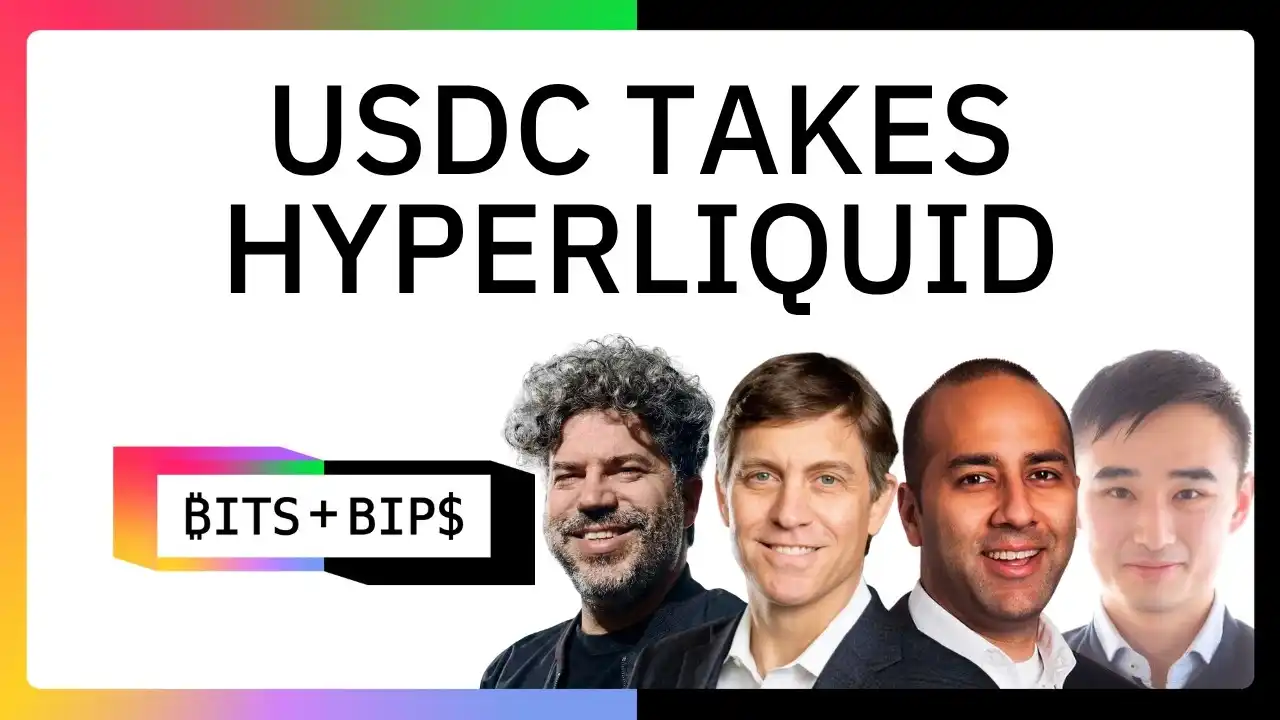
Guests: Gordon Liao (Chief Economist, Circle), Ram Ahluwalia (Co-founder & CEO, Lumida Wealth), Chris Perkins (Managing Partner, CoinFund)
Host: Austin Campbell
Original Title: The Fed, China, and CLARITY + Coinbase Eats USDH
Podcast Source: Unchained
Air Date: May 19, 2026
Editor's Note
In this podcast, Gordon Liao, Chief Economist at Circle, systematically explains for the first time the market structure logic behind USDH being replaced by USDC. USDC balances on the Hyperliquid platform have roughly doubled over the past year. 90% of the reserve earnings are returned to Hyperliquid for HYPE buybacks, with Coinbase acting as the treasury deployer and Circle as the technical deployer, staking 500,000 HYPE tokens.
Gordon also breaks down the long-end U.S. Treasury rates. The current 30-year yield breaking above 5% is primarily driven by the term premium. Meanwhile, stablecoins are quietly becoming marginal buyers of U.S. Treasuries. In Q1 2026 alone, USDC on-chain settlement volume reached $21 trillion. Stablecoins' concentrated purchases of short-term Treasuries effectively lower the overall weighted duration of U.S. government debt, potentially providing support against rising long-end rates.
Additionally, the program discusses key sticking points in the CLARITY Act and differing views on where value will be captured in AI following the OpenAI lawsuit.
Key Quotes
USDH Replaced by USDC
- "This is essentially a liquidity supernova event. As the dominant perpetual contract platform on-chain, the collateral asset it uses radiates throughout the on-chain economy."
- "That governance vote eight or nine months ago chose a different reference asset. But as the platform grows and matures, it also needs to interface with more traditional institutions. Using high-quality, institutional-grade collateral is a key part of that."
- "Anywhere that can lock up TVL—be it an exchange, a prediction market—will figure out how to monetize that floating rate. Why give that money to a third party?"
- "For Coinbase and Circle, this is a strategic move that neutralizes an emerging competitor. Coinbase, as the collateral manager, inserts itself at a key node of this new infrastructure."
Multiple Attributes of Stablecoins
- "Regarding whether stablecoins are a medium of exchange or a store of value, we see they can be multiple things simultaneously. In payment scenarios, they are a medium of exchange. In this scenario, they are a carrier for capital liquidity and collateral liquidity. As the system scales and institutionalizes, the latter becomes increasingly important."
- "An Agent would likely want a money market fund that pays interest while funds are idle. But the moment it initiates a payment, it would want that money wrapped as a stablecoin. The compliance paperwork just for paying with securities is unbearable."
OpenAI Case and AI Value Capture
- "There's almost no value capture at the LLM layer. These AI Labs spend tens of billions providing free services for people like us; it's essentially public service. The value of an LLM lies in the model weights—that's IP."
- "Whoever owns the end-user delivers the most value. Value primarily resides at the application layer, and with cloud businesses and AI implementation service providers, companies like Accenture will do quite well."
- "I think it's a barbell structure. Besides the distribution end, the other end is energy. Whoever gets almost free energy and cheap compute wins. Elon has an advantage there."
On the CLARITY Act
- "The compromise by Thom Tillis and Angela Alsobrooks essentially separates the store of value, settlement, and unit of account functions of money."
- "We are approaching Hillary's Step (the final challenging ascent on Everest). There's still the committee seat issue and the ethics issue. The ethics hurdle will be very difficult to pass."
- "I've felt from the start that the banking industry's fight on this was quixotic. What exactly do you want to get out of it? Are you just stabbing each other, or handing a big gift to asset management companies?"
Long-Term Treasuries and Rates
- "Most of the upward movement in the 30-year yield comes from the term premium, now around 80 bps, which is quite high compared to being negative two years ago. This means the market reflects supply-demand dynamics, not expectations of future short-term rates."
- "The narrative that stablecoins are marginal buyers of U.S. Treasuries has more substance than people credit. Their duration is very short, concentrated in short-term bills and reverse repos. This actually frees up space for the Treasury to issue more debt on the short end. On a dollar-duration weighted basis, it reduces the supply of long-term Treasuries in the market."
- "Investors are saying: I need more compensation to hedge against greater inflation risk. That's all. They know the Fed isn't inclined to cut rates."
Coinbase and Circle Take Down USDH
Austin Campbell (Host): Welcome to Bits + Bips, where we explore how crypto and macro collide in basis points. I'm host Austin Campbell. Today's guests are Ram Ahluwalia, Co-founder & CEO of Lumida Wealth; Chris Perkins, Managing Partner at CoinFund; and Gordon Liao, Chief Economist at Circle. Lots of topics in rates and news today, I'm especially looking forward to Gordon's perspective.
Let's start with Circle. Coinbase and Circle essentially ate USDH. USDC will be crowned as the quote asset aligned with Hyperliquid (an on-chain perpetual DEX). Native Markets, which won the governance contest eight months ago, was acquired by Coinbase. USDH holders will redeem for USDC during a migration period. Coinbase will become the official reserve asset management/deployment partner for USDC on Hyperliquid. Circle will handle USDC's technical integration and operational infrastructure on Hyperliquid and stake 500,000 HYPE tokens for a validator seat. 90% of reserve earnings will flow back to Hyperliquid, likely for HYPE buybacks via a grant fund.
Rough calculation: Currently about $5 billion USDC on Hyperliquid. At ~4% yield, that's nearly $200 million annualized. Most of this flows to Hyperliquid, Coinbase takes a cut, and Circle gains a new deployment venue for USDC, continuing to catch up with Tether's size.
The bull case: deeper order books, less slippage, faster on/off-ramps, better market maker support. HYPE is tied to platform fees, staking, and builder activity. Bitwise is also applying for a spot HYPE ETF. The bear case, e.g., from ZachXBT, worries that if Hyperliquid's core collateral, quote asset, and liquidity become increasingly dependent on USDC, the system hands part of its lifeline to Circle/Coinbase/regulatory orders. Plus governance issues with Native Markets. Chris, as an investor in this space, what's your take?
Chris Perkins: I think this is one of a series of moves we'll see. The keyword is "net interest income." Step back and look at the traditional exchange model: you earn ticket fees, a small cut per trade; clearing usually isn't profitable, though in our space it's become a new line, sometimes making a bit from data. But the real money is in net interest income.
How it works in TradFi: clients give you dollars as collateral, you give them to the clearinghouse, which invests them, keeps a big chunk, and returns a small piece to you. That's your net spread. It's a fundamental part of any exchange's business model. Many dApps overlooked this, giving away this nice income. Now they realize they need to bring it back.
I can tell you, anywhere that can lock up TVL—exchanges, apps, prediction markets—will figure out how to monetize that floating rate. Why give it to a third party?
From the exchange's perspective, that's the bull case—Hyperliquid rallied on the news because this circle is now closed (pun on Circle). You solved net interest income, returning it to token holders. From the Circle/Coinbase side, you also win—details matter, like lock-up period, rate renegotiation frequency, not sure if Gordon can share. But you get distribution for your stablecoin. USDC is fungible; the more it circulates, the more likely end-users accept it as payment.
So USDC wins too. Maybe economic terms get adjusted later. Hyperliquid wins big, securing net interest income; Circle gets greater distribution, larger scale, broader utility, and hopefully incremental use cases. I think it's a win-win.
Austin Campbell: Gordon, passing the ball to you. I'm also familiar with Circle. USDC has many facets in the current market. From a market structure perspective, Americans are used to viewing money as layered—the money you buy coffee with isn't the same as what you settle derivatives with. But now we're seeing USDC used for many things simultaneously; fungibility is increasing. What's your view from Circle's perspective? How does it look from your economics background and market structure lens?
Gordon Liao: A few observations. First, we're witnessing the overall maturation of infrastructure. Hyperliquid is the dominant on-chain perp platform today, scaling significantly. USDC balances on the platform have roughly doubled year-over-year.
That governance vote eight or nine months ago did choose a different reference asset. But as the platform grows and matures, it needs to interface with more traditional institutions. Using high-quality, institutional-grade collateral is a key part of that. Choosing USDC is recognition of its underlying safety and the 1:1 reserve commitment.
As Chris said, this is a win-win and a liquidity supernova event. As the dominant on-chain perp platform, the collateral asset it uses radiates throughout the on-chain economy. So it's a significant liquidity event that will encourage the use of USDC and associated infrastructure.
We deployed USDC to Hyperliquid last September, along with CCTP. So it's been there for a while, but this is a great "reaffirmation" event.
Regarding whether stablecoins are a medium of exchange or a store of value, we see they can be multiple things simultaneously. In some scenarios, they are a medium of exchange for payments. In others, they are carriers for capital liquidity and collateral liquidity. As the system scales and institutionalizes, the latter becomes increasingly important.
A similar trend is visible in settlement volume. Our recent earnings showed Q1 USDC on-chain settlement volume was $21 trillion. This reflects expanding infrastructure and improving liquidity on major platforms—both centralized and decentralized.
Austin Campbell: Following that line, USDC circulation is highly tied to Coinbase. Coinbase has many products built on USDC, like debit/credit card payments, enterprise payments. Now we're also using it as a core asset for exchanges like Hyperliquid. Ram, from a market perspective, does this make you more bullish or bearish on Coinbase and Circle stock?
Ram Ahluwalia: It's positive for everyone, especially for Hyperliquid. For Coinbase and Circle, they successfully neutralized an emerging competitor. Coinbase, as collateral manager, inserts itself at a key node of the new infrastructure—a very strategic move.
For Hyperliquid, keeping 90% of the revenue is a reward for its achievements over the past few years. We discussed Hyperliquid three or four weeks ago; it's one of the assets you want to hold this cycle. Coinbase acted very proactively because Hyperliquid is becoming core to decentralized trading venues. Circle gets a significant recurring net interest income stream. So it's a win for all, especially beneficial for Hyperliquid.
This ties back to another topic we've discussed: distribution will ultimately drive most of the returns in this system. Gordon, you also said Hyperliquid is an emerging perp DEX in crypto. All these parties coming together essentially recognize the position of distribution and users. This theme will recur when judging winners and losers.
OpenAI Lawsuit
Austin Campbell: Speaking of users and winners, today Elon Musk lost, Sam Altman won, at least round one. An Oakland federal jury unanimously rejected all of Musk's claims in under two hours. The core was the three-year statute of limitations. The jury found Musk knew about OpenAI's shift to for-profit in 2021; he didn't sue until February 2024.
He originally sought $134 billion in "unjust enrichment" and removal of Altman and Brockman from leadership, citing the 2025 for-profit reorganization. But substantive issues—breach of charitable trust, unjust enrichment—were not adjudicated. Musk's team indicated an appeal. Wired commented that both sides painted the other as self-serving; neither Musk nor Altman came out looking good. The takeaway is that OpenAI can likely proceed to IPO, at least in the interim.
A few interesting reactions on X. Structural skeptics say it's a major legal win for OpenAI, but bigger political/institutional questions remain—what does it mean for an organization built with a "non-profit, human-first" mission for public legitimacy to become one of the world's most valuable commercial platforms? News24 says a non-profit machine created to benefit humanity was forcibly turned into a closed, for-profit machine backed by Microsoft. The trial did reveal broken promises on openness and safety. Chris, your thoughts?
Chris Perkins: Seems the statute of limitations lapsed; that's clean. Not sure how Musk's lawyers appeal, but they're smart; they'll figure something out.
At this point, Ram usually has something negative to say about OpenAI—he'll call it much ado about nothing. Before he does, the bigger issue for crypto is that due to regulatory pressure over the past four years, many foundations were structured as non-profits alongside Labs. I wish there was clear precedent to sort out the relationship between foundations and Labs. In many protocols, who's responsible for what, who is who, gets confusing.
Not saying foundations are useless—they absolutely have non-profit ideals to advance, like cryptographic research for Ethereum. But many foundations were motivated by seeking protection against a very aggressive regulator. So this case will have far-reaching implications for crypto. Sam is also getting more involved in the space now.
Ram Ahluwalia: Chris, you literally handed me the ball. I didn't expect this case to amount to much, so indeed, nothing happened—much ado about nothing.
The tech world has produced heroes and villains. I put many in the hero bucket, some in the villain bucket, but that doesn't mean they haven't created value. Sam's issue is a history of signing contracts and then violating them. He even played this game with Microsoft—signing with Amazon before renegotiating with Microsoft. Microsoft, in turn, got very favorable terms, and OpenAI got needed capital. Of course, Microsoft also wanted to deliver their 10x return by funding OpenAI.
To me, Sam is clearly a villain. He was fired by a board he appointed, inadvertently seeding his main competitor during that period, and had an employee die under suspicious circumstances during his tenure.
Chris Perkins: That's a bit extreme.
Ram Ahluwalia: No no, it's factual. "Had an employee die under suspicious circumstances during his tenure" is an accurate statement; those circumstances were indeed suspicious.
Anyway, there are heroes and villains in this space; I put him in the villain bucket.
Austin Campbell: Gordon, any thoughts?
Gordon Liao: Looking more broadly, AI is fiercely competitive at every layer; this courtroom drama is one facet. But for our audience interested in both blockchain and AI, where are the opportunities? I think it's about building the rails for tomorrow—for Agents, for AI. This is what we at Circle have been doing, releasing our agent tech stack and what we call ARC, the "Agentic Runtime for Commerce." I believe these will have lasting network effects, as strong as USDC's. So even with intense competition at the base model layer, there are many opportunities elsewhere from a business perspective.
Chris Perkins: Competition is good; we need more. No one is perfect; I'm not. It's a brutal race. Hope they keep innovating, keep creating value, and hope the free market prevails.
Austin Campbell: Let me push along this line: We're fighting over OpenAI in court today because the private market sees it as one of the most valuable foundational model companies. But let me stress-test this: long-term, could this trial be remembered as much ado about nothing? The rationale being, if distribution is where value ultimately accrues, will value reside with companies like OpenAI, Anthropic, or with platforms that deliver models to users and collect tolls?
Ram Ahluwalia: Definitely the latter. There's almost no value capture at the LLM layer. These AI Labs spend tens of billions providing free services for us; it's essentially public service. But Microsoft owns OpenAI's IP—after six years they can dispose of shares, but the IP is permanent. They can do anything with the IP, even put it on the internet—not saying they will, but LLM value lies in model weights; that's IP. It goes to a direct competitor.
So I support AI Labs raising more money to invest in humanity's future, but there's no value capture in their business model. Meta brought in the 'A-team' (Ram references 80s TV shows), their new models are strong, they're spending big on NVIDIA GPUs. So this race is still early.
Anthropic is leading, revenue growing fast. Today I also saw Michael Dell from Dell reveal they signed 1,000 new enterprise customers. We're moving from a world of only hyperscale data centers and AI Labs burning GPUs to real commercial deployment, and it's still early.
Whoever owns the end-user delivers the most value—primarily at the application layer, cloud business, and AI implementation service providers like Accenture.
Chris Perkins: I agree with the distribution-end logic, but I think it's a barbell. The other end is energy. Whoever gets almost free energy and cheap compute wins. Elon has an advantage there. The science of getting almost free energy from space isn't easy, but if anyone can, it's the person who can put things in space globally. That's Elon's unfair advantage at the stack's very bottom. But the front end remains distribution king.
Ram Ahluwalia: We also haven't seen Apple truly unveil its play. How many times has Apple descended late in the race and then dominated? There's been internal churn lately; this company is worth watching.
Austin Campbell: Apple is an interesting story here. While its "Mag 7" peers are spending on model training CapEx, Apple seems to be saying: We're a vertically integrated hardware company from front to back—iPhone, MacBook to servers, Mac Studio. We'll be the endpoint for your model distribution; we'll collect tolls. Look at what they do with the App Store, look at ecosystem bundling.
Incidentally, Chris, this ties back to your pet topic of identity—Apple is one of the few big tech companies that does a "passable" job on privacy, easier to trust on these issues. So one bifurcation I'm watching: Do you build your own AI, or deploy others' AI and tax them? The latter are distributors.
Gordon, you're at a company making "money" and have seen many cases of Agentic Commerce and AI entwined with finance. How do you see this relating to modernizing the U.S. financial system and adoption of new products? Reminder for U.S. listeners: Asia had 24/7 real-time gross settlement systems from the late 90s/early 2000s. We're two decades behind. Could this accelerate the refresh of the entire financial economy, not just the AI sector?
Gordon Liao: Absolutely. Currently, most transactions are human-intermediated, but many forecasts predict machine-to-machine, machine-initiated payments will dominate. Today's large LLM companies are big and important, but models change very fast; even open-source models aren't far behind. So value will increasingly flow to commodities, hardware, and the rails where Agentic Commerce happens.
For example, micropayments—we recently released a micropayment protocol, essentially a market where agents can browse, find each other, use the best tools, and run machine-to-machine commerce even when no one is present. All this will be built on blockchain rails. We've seen huge growth areas with ARC, tightly integrated with finance. We'll touch on this again with CLARITY, which contrasts with balance-sheet-based intermediation and aligns well with activity-based finance.
Austin Campbell: Let me offer a counterpoint. I often hear agent payments will go on-chain, but I also think they'll use traditional rails—an Agent getting a credit card is easy. I think the winners here will be those who can facilitate flow across different systems. That's why I watch combos like Coinbase + Circle, or companies like Fidelity launching products—they already have money market funds, cash management products, and are now launching a stablecoin.
Agents seem to have less "loyalty" than human consumers, but they excel at optimizing across different flows. Not all flows use the same framework—sometimes you need on-chain payment, sometimes card swipe, sometimes bank account. I suspect winners in Agentic Commerce will be those who seamlessly integrate across these. In theory, pure on-chain or pure off-chain entities might lose to those bridging both.
CLARITY Act: At 'Hillary's Step'
Austin Campbell: The Senate Banking Committee voted 15-9, bipartisan, to send the Digital Asset Market Clarity Act to the full Senate. It needs 60 votes to proceed to formal consideration on the floor. Another pending issue: whether more amendments will be added once it reaches the floor.
The bill's core includes: decentralization test, SEC-CFTC jurisdictional split, which tokens fall under which agency. Everyone agrees it's imperfect but workable.
Let me highlight two points. First, the stablecoin yield controversy—consumers, retail, and the crypto industry call it "functioning as designed," banking lobbyists still call it a "loophole." Senators Tillis and Alsobrooks reached a compromise: strictly passive yield is prohibited, but "activity-based rewards" are allowed. The American Bankers Association (ABA) is unhappy, other parties are somewhat satisfied, and Senators say "no more renegotiation." Let's discuss assuming Tillis and Alsobrooks are correct—no renegotiation. If the bill passes as is, what are your thoughts?
Gordon Liao: I'll start. Money itself has multiple attributes: a settlement tool and a store of value. In a sense, it separates the store of value, settlement, and unit of account functions.
It also echoes a larger trend in financial intermediation. Traditional intermediation is heavily balance-sheet-dependent, hence banking rules centered on stress-testing bank balance sheets. In that world, growing the balance sheet is key, with corresponding regulation. But looking at the evolution of on-chain finance, a significant portion is activity-based—not about balance sheet size, but a set of activities intermediated by smart contracts.
This compromise nicely captures the boundary between old and new—from a traditional, balance-sheet-heavy intermediated world to a new, smart-contract and agent-led intermediated world. Players focused on activity-based rewards, activity-based services, and new intermediation forms have a big opportunity.
Chris Perkins: First, kudos to Senator Tim Scott, Senator Loomis, Republican leadership did a great job. Special mention to Senator Gallego and Senator Alsobrooks. Gallego is a Marine; I was in Ramadi, he fought in Haditha. This guy has courage; he gave the bill bipartisan color in committee, excellent.
We are now approaching Hillary's Step (the final challenging ascent on Everest). The committee seat issue remains, the ethics issue remains. The ethics hurdle will be very difficult to pass. Then there's banking dissatisfaction. The banking lobby is pulling the national security card today, perhaps because they're unhappy with other provisions. So getting to the finish line will be tough.
But I still believe the bill ultimately passes. I'd like to hear your views, as we've diverged on this at times.
Ram Ahluwalia: I think it squeaks through. What did Trump do? He tweeted about the CLARITY Act, saying he'd put chips on the table. With midterms approaching, there's little benefit in letting it fail. I still think it squeaks through.
Austin Campbell: I'm a bit more skeptical than both of you. Reaching the floor is a very positive signal; whatever the prior probability estimate was, it should be raised. But Chris, no one has given me a truly credible solution for the "ethics issue." I see two possible paths here: one appears good short-term but very bad long-term—CLARITY passes along pure partisan lines in House and Senate. That's possible in the current framework. But if passed by Republicans only, it would likely be like the Affordable Care Act—the other side starts dismantling it once in power. Forcing transformative legislation through on a purely partisan basis hasn't ended well in U.S. legislative history.
The other path is the bill crashes directly on the ethics rock. If it dies, it dies there. Every other issue, including the banking yield debate, has solutions. Many arguments are essentially industry special pleading, unfavorable to the average consumer, the U.S. economy, and national security agencies increasingly interested in and positive about digital assets. The ethics part is where I still have doubts after talking to people on both sides. So I'm pumping the brakes.
Ram Ahluwalia: Austin, what's the specific sticking point on ethics?
Austin Campbell: The core is: Will Democrats vote for a bill that doesn't force the Trump family to divest from World Liberty Financial, meme coins, etc.? Will Republicans send a bill to the President's desk that forces the President to do that? That's the breakpoint. I don't see an elegant solution. But Chris is right, it gets weird now that it's on the floor. It has a non-zero chance of moving forward. Maybe some compromise unrelated to crypto, like trading other chips.
Ram Ahluwalia: Differentiating between yield and "activity" is very clever design; I like it in principle. The question is, how many edge cases can activity-based regulation accommodate?
Chris Perkins: We now live in a "post-Chevron deference" era (referring to the Supreme Court overturning Chevron, meaning courts no longer default to deferring to agency interpretations). Before, it was "when rules aren't clear, regulators decide," agencies could fill in blanks in ambiguous text. Now legislation must be more rigid, more prescriptive, resulting in worse drafting. Then any dispute goes to court. In a way, we needed Chevron to go, but it had its benefits. Not saying bring it back, just noting increased complexity.
Austin Campbell: Let me add another angle: This issue is essentially a Gordian knot, rooted in structural problems of U.S. financial regulation overall. To prevent money market funds from paying yield, you'd need to rewrite the 1940 Investment Company Act—they are legally required to pay earnings to clients, can't keep money compounding in the vehicle. As long as we have tokenized securities on one side, stablecoins on the other, and reserves resembling tokenized securities, this door cannot be closed. The issue is form, not substance. Otherwise, you'd need to rewrite the Banking Act and the 1940 Act. I don't think Congress has the appetite.
They almost couldn't confirm Warsh, which is just putting a person in a chair for a specific job. We expect them to rewrite the fundamental structure of U.S. securities regulation? No way. So from the start, I felt the banking industry's fight was quixotic—what exactly do you want to get? Isn't this just stabbing each other and handing a big gift to asset management companies?
Chris Perkins: Senator Gillibrand is now one of the key people to watch. She's pro-crypto, deeply involved from the earliest legislative formation, but she's very firm on ethics. If someone can cut a deal with her, it would be impactful.
Bond Vigilantes vs. New Fed Chair Warsh
Austin Campbell: Warsh is the most narrowly confirmed Fed Chair in modern history. The first FOMC meeting is mid-June, but hours after his confirmation, a $25 billion 30-year Treasury auction broke 5%. The 30-year yield hit 5.12% intraday, the first "5-handle" since the 2008 financial crisis. The 10-year is at 4.59%, the 2-year at 4.08%. CME FedWatch shows a 50% probability of a hike later this year, completely reversing the prior rate cut narrative. Of course, how to read this data is debatable; it's not a straight line to hikes.
Ed Yardeni, who coined "bond vigilante," says they are now setting policy; the Fed may be forced to hike in July. Vincent Ahn from WisdomTree says Warsh wanted to keep the option of a day-one cut, but the bond market just took that option off the table. Morgan Stanley says rate cuts are delayed until 2027. Ryan Swift from BCA says if Warsh goes dovish amid this bloodbath, inflation expectations could de-anchor, and the Fed loses control of the long end.
Some think it's good. Phil Blacanto from Reuters Breakingviews says evaporating rate cut expectations could constrain an overly interventionist Fed, possibly a good thing. But rates are a complex space, often misread even in traditional markets. Gordon, as an economist, market observer, with Fed background, what do you think the market is saying now?
Gordon Liao: I'll answer from a background perspective. I used to work at the Federal Reserve Board in Washington. In such a role, when you see rate moves, the first question is: Is it the term premium moving, or expected short-term rates?
Using a classic ACM model breakdown, most of the upward move in the 30-year yield is driven by the term premium. The term premium is currently around 80 bps, quite high relative to being negative two years ago. The term premium largely reflects supply-demand, while expected short rates reflect market expectations of whether the Fed will hike.
The yield increase primarily from term premium means the market is reflecting several supply-demand factors. On the demand side: first, ongoing fiscal issues, fiscal expansion; second, possibly reduced confidence in the Fed's ability to control inflation long-term; third, potentially weaker foreign demand—there have been significant changes in international flows over the past year.
The supply side is also interesting. Incoming Chair Warsh supports shrinking the Fed's balance sheet, implying reverse QE. This coincides with the long-end yield pressure you see.
Another narrative is stablecoins as marginal buyers of U.S. Treasuries. I think this narrative has more substance than credited. Not just because stablecoin supply is growing, but because of the duration structure. Stablecoin holdings have very short duration, which frees up space for the Treasury to issue more debt at the short end.
If you do a duration-weighted calculation, this actually implies a significant shift in dollar duration, reducing the supply of long-duration dollars in the market, potentially alleviating current upward rate pressure. So these are connected. Don't view rates as a single number; break them into term premium and expected short rates, then consider balance sheet aspects—expected changes to the Fed's balance sheet and private sector demand.
Austin Campbell: An important point you made, often overlooked: It's not just who is buying Treasuries, but more granularly, who is buying which maturity. Constrained by the GENIUS Act, stablecoins prefer short-term Treasuries. Even without that preference, they use reverse repos, can collateralize with Treasuries, but longer-duration Treasuries have larger haircuts, so there's a maturity preference.
Meanwhile, the biggest buyers of the 30-year long end are insurance companies and sovereign funds. Their preferences are shifting: sovereign funds reducing long-term Treasury holdings, perhaps with geopolitical considerations; insurance companies tied to the demographic curve of the countries they serve. As the baby boomers phase out, the next major cohort is millennials, the insurance curve distorts, demand for 30-year may decline.
So I'm watching the term premium. Gordon, you said 80 bps is relatively high recently, but historically it's actually low—historically it could reach 150 bps or higher. The term premium curve itself is distorting, a neglected part of this story. Ram, from an investment perspective, what's your view on long-end bonds?
Ram Ahluwalia: First, I agree it's supply-demand driven. Investors are saying: I need more compensation to hedge against greater inflation risk. That's all. They know the Fed isn't inclined to cut rates, so someone has to give, and the way to give is rates going up.
You can see inflation's resurgence in oil prices' impact on memory prices, gasoline, etc. I find it somewhat ironic Warsh's confirmation vote was so lopsided. Elizabeth Warren's litmus test was: Will you cut rates? This guy wants to cut, so the vote was more a political signal.
Overall, I expect rates are peaking. If so, rate-sensitive sectors that have been beaten down, like insurance, will bounce. Insurance is a balance sheet business, similar to banks. When rates rise, the value of bonds they hold falls, and the discounted asset value of future liabilities also falls. So they've been suppressed.
But the most interesting shift in the last couple of days: long-duration, high free-cash-flow assets started bouncing. The major indices were down over a point the last two days, but long-duration high free-cash-flow assets were up. The equity market is telling you: they believe long-end rates will come down. It's a bit funny—usually we view bonds as part of the equity market, but maybe the stock market is right this time. Warsh's confirmation is a sort of capitulation event. We're still missing a viral Ray Dalio "End of Times" video; that hasn't dropped yet.
Chris Perkins: Let me chime in. Long-term, there are some very deflationary pressures hitting the economy—first AI, then energy prices; investment in cheap energy is staggering. Elon will put it in space, and compute coming from there will be unprecedented. These are long-term deflationary. Warsh himself has talked about this, especially regarding AI.
The problem is the short term. Sovereign funds are selling Treasuries—some because they want decoupling, some because they need cash. High oil prices have their reasons. This administration is different from any post-war one: first, it's re-evaluating how inflation itself is measured; second, the collaboration between Treasury, led by Bessent, and the Fed is unprecedented. I think this collaboration leads to a more holistic policy response. Doesn't mean Warsh isn't independent—you can be both independent and collaborative, and I think that's how it should be. So I'm optimistic here.
Finally, geopolitics can turn bad quickly or good quickly. I think it turns good—midterms approaching, Americans don't like the current state. It's tough, but I'd guess Trump leans towards de-escalation rather than escalation.
Austin Campbell: That's time. Thanks so much for joining today; the timing was perfect. Hope listeners benefited from your perspectives.