Goldman Sachs Research Report Analysis: Circle and USDC Are Moving Beyond the Crypto World, Cross-Border Payments and AI Agents Become New Battlegrounds

marsbitPublicado a 2026-07-07Actualizado a 2026-07-07

Resumen

Goldman Sachs published a summary of its meeting with Circle Internet Group (issuer of USDC) on July 5th. The core takeaway is that stablecoins, led by USDC, are evolving from a crypto-native tool into foundational infrastructure for traditional finance and the AI economy. USDC's use cases are rapidly expanding beyond crypto trading into cross-border payments, e-commerce, capital market settlements, and notably, payments for AI agents. Circle's management emphasized that stablecoin growth is now decoupled from crypto market cycles, driven by this diversification. They outlined five key application layers and highlighted USDC's network effects, global liquidity depth, and regulatory compliance as competitive moats. Circle distinguishes USDC from bank-issued tokenized deposits, arguing the former is an open, internet-native system without bank credit risk. Strategically, Circle is building a broader fintech platform with its Arc Layer 1 blockchain, the Circle Payments Network for cross-border transfers, and an "Agentic Stack" to serve AI agent economies, where USDC already dominates. Regarding regulation, Circle views potential U.S. legislation like the CLARITY Act as a catalyst for growth rather than a constraint, expecting it to encourage broader institutional adoption and active usage. Goldman Sachs maintains a Neutral rating on Circle with a $96 price target, noting the company's shift from a pure stablecoin issuer to a financial infrastructure provider. Key risks inclu...

Written by: Rita

Tidal Guide Introduction

Goldman Sachs released the management meeting notes for Circle Internet Group (CRCL.US) on July 5th. Circle is the issuer of USDC. The core message of this meeting is: Stablecoins are transitioning from being peripheral tools in the crypto world to becoming infrastructure for traditional finance and the AI economy. USDC's use cases are rapidly expanding, extending from crypto trading to cross-border payments, consumer e-commerce, capital market settlements, and even AI agent payments. Goldman Sachs rates Circle as Neutral with a target price of $96. The current stock price is $64.62, implying an upside potential of approximately 48.6%.

Stablecoin Growth Has Decoupled from the Crypto Market Cycle

Circle management repeatedly emphasized a key judgment during the meeting: stablecoin growth has decoupled from the fluctuations of the crypto market. Over the past few quarters, while crypto market trading volume and prices have trended downwards, the market capitalization and transaction volume of stablecoins have continued to rise.

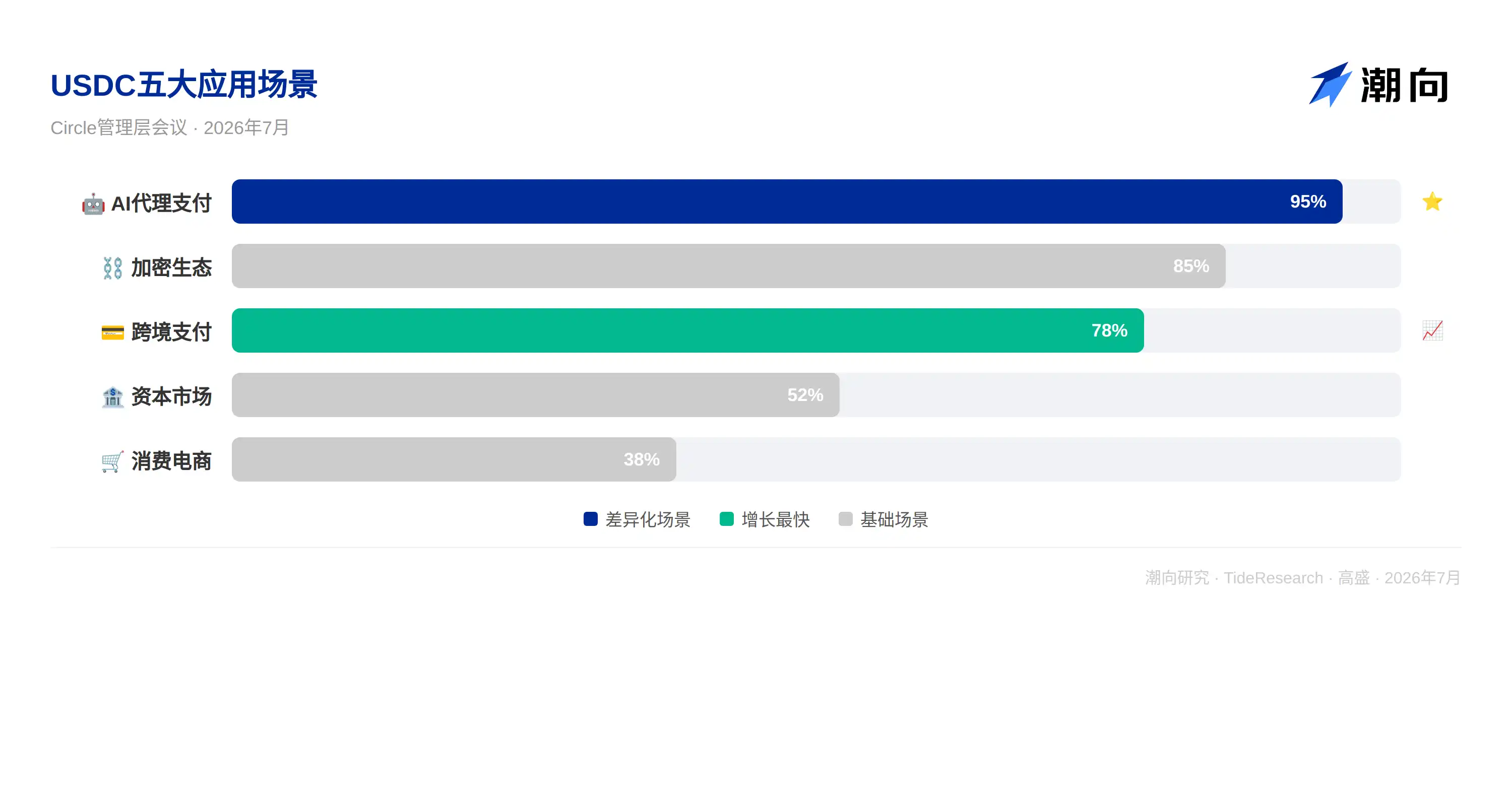
The reason lies in the diversification of use cases. Circle categorizes USDC's application scenarios into five tiers, covering the full spectrum from the crypto ecosystem to AI agent payments.

The crypto ecosystem is USDC's foundation, with continuous expansion of liquidity through partnerships with rapidly growing platforms like Hyperliquid.

Cross-border payments and treasury management are currently the fastest-growing segments. USDC's instant settlement and extremely low transaction costs are transforming traditional bilateral cross-border payment processes. Circle noted that demand for USD stablecoins is particularly strong in emerging markets, representing a trend of "digital dollarization," where people use USDC as a substitute for local currency or unreliable banking systems.

Consumer and e-commerce use cases are also taking shape. Major e-commerce platforms like Stripe and Shopify have begun supporting USDC payments, allowing users to directly choose USDC at checkout. Stablecoin-linked credit cards are also emerging, enabling users to hold and spend stablecoins.

Breakthroughs in capital markets are even more critical. Circle sees the potential for USDC as collateral for derivatives and a settlement currency. The recent CFTC approval allowing Futures Commission Merchants to treat specific stablecoins as readily marketable collateral is a significant institutional catalyst. The tokenization of real-world assets is also expanding USDC's application scenarios, as stablecoins are the natural cash settlement tool for on-chain transactions.

The most emphasized differentiated scenario by Circle is AI agent payments. AI agents are autonomously executing economic activities. x402 is currently a leading agent payment protocol, with USDC accounting for approximately 99% of all transactions on that protocol. AI agents require atomic settlement and extremely low transaction costs, making stablecoins the most suitable payment tool.
USDC's Competitive Moat is Network Effects

Management believes that stablecoins are a classic network effects business. The USDC network is a public, internet-native financial infrastructure that anyone can access—individuals, businesses, and developers alike.

Circle outlined three major competitive advantages for USDC.
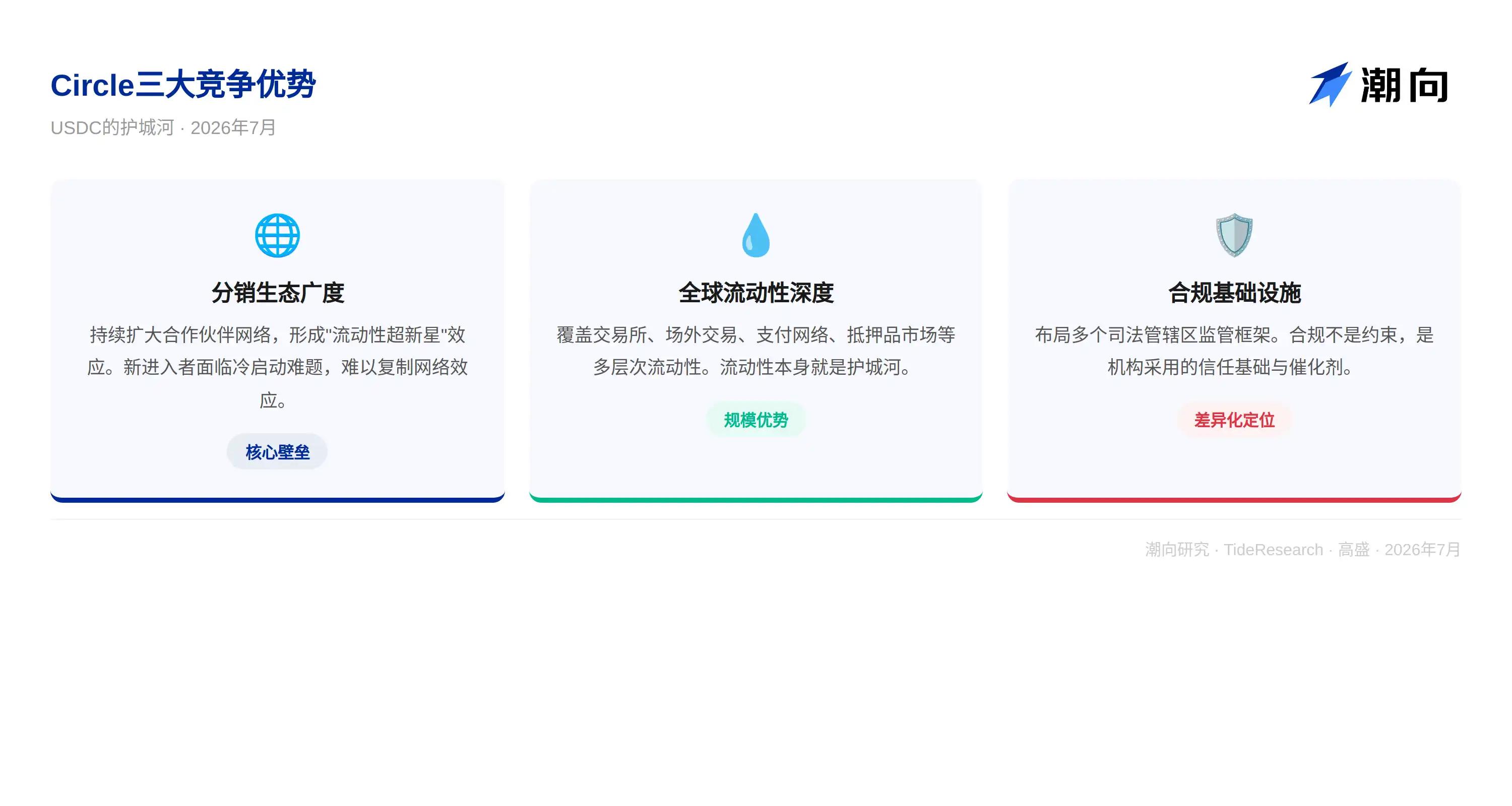
First, the breadth of distribution and platform ecosystems. USDC strengthens liquidity by continuously adding partners, creating a "liquidity supernova" effect. New stablecoin entrants find it difficult to replicate this network effect due to the cold start problem: no liquidity without users, and no users without liquidity.

Second, global liquidity depth. USDC has deep liquidity across exchanges, over-the-counter markets, payment networks, and collateral markets. This depth itself is a moat.

Third, compliance infrastructure. USDC has regulatory arrangements across multiple jurisdictions. Management views this as a key driver for institutional adoption, not a constraint.

Regarding competition, Circle distinguishes between two types of opponents. One is tokenized deposits, which are digital deposit certificates issued by banks. Circle argues that stablecoins have advantages over tokenized deposits because they are open, interoperable, carry no bank credit risk, and are fully reserved. The other is new stablecoin competitors. Circle expects more new stablecoins to emerge, but they lack the network effects Circle has accumulated over more than a decade.

The Difference Between Tokenized Deposits and Stablecoins is Structural

Circle believes the difference between stablecoins and tokenized deposits is structural, not merely a matter of who arrived first.

Stablecoins constitute an open, public, internet-native financial system accessible to anyone, with liquidity flowing freely across platforms. Tokenized deposits are more like an extension of the banking system, likely confined within a single bank or consortium ecosystem. These are two completely different architectures: stablecoins are internet-native, while tokenized deposits represent a digital upgrade of the banking system.

Another key difference is credit risk. Stablecoins are fully reserved, digital cash with no credit risk. Tokenized deposits are essentially liabilities of a bank, carrying bank credit risk. In Circle's view, this difference is fundamental.

Circle's Three Strategic Products Aim to Turn Stablecoins into an Operating System

Circle is not just a stablecoin issuer; it is positioning itself as an internet-native financial platform. Management emphasized three strategic products during the meeting.

Arc is Circle's in-house developed Layer 1 public blockchain, positioned as a comprehensive financial operating system aimed at enhancing liquidity and interoperability, particularly for attracting traditional financial institutions.

Circle Payments Network (CPN) is the cross-border payment product, enabling faster and more efficient cross-border payments through blockchain settlement. Institutional adoption is growing.

Agentic Stack is the product line for AI agents, with the goal of maintaining USDC's dominant share in AI-related economic activities. Given that USDC already accounts for roughly 99% of transaction volume on the x402 protocol, the first-mover advantage in this space is evident.

Regulation is a Catalyst, Not a Constraint

The market has long been concerned that stablecoin regulation might constrain Circle's business model, but Circle management offered a completely opposite interpretation. They believe that if market structure legislation like the CLARITY Act passes, it will serve as a catalyst for USDC growth, not a business constraint. The reasons are threefold: The bill allows issuers to continue incentivizing distribution through revenue sharing, enabling Circle to keep expanding its partner network; The bill could unlock institution-grade crypto adoption, leading to greater stablecoin usage; The bill encourages usage-based reward mechanisms over passive holding, which would promote active use of USDC and reduce idle accumulation.

Tidal Guide Perspective

Goldman Sachs rates Circle as Neutral, but the notes themselves reveal a lot. Circle is successfully expanding USDC from a crypto trading tool into internet-native financial infrastructure, which is the right direction.

It's worth questioning how deep Circle's moat really is. Network effects do exist, but USDC's biggest competitor, USDT, still leads in stablecoin market capitalization. The compliance advantage Circle relies on is seen as a weakness by crypto purists: transparency means being subject to regulation, and regulation means the potential for freezing assets. Circle's institutional positioning is a double-edged sword.

Another point worth noting is Goldman Sachs' valuation framework. The $96 target price corresponds to a 35x P/E ratio, but Circle's current profitability heavily depends on interest income from reserve assets. If interest rates decline, Circle's profits would be directly pressured. This risk is only briefly mentioned in the notes, but its actual impact on valuation could be greater than that of regulation.
Disclaimer

This article is Tidal Guide Research's compilation and interpretation of a third-party securities firm research report. The ratings, target prices, profit forecasts, and related judgments cited herein are the views of that firm's analysts, representing only the stance of their affiliated institution. They do not represent the views of Tidal Guide Research and do not constitute any investment advice.

The market carries risks, and decisions should be made independently. This article should not serve as the basis for buying or selling any securities.

Criptos en tendencia

Preguntas relacionadas

QAccording to Goldman Sachs' research note, what is the core message from the Circle management meeting?

AThe core message is that stablecoins, specifically USDC, are transitioning from a peripheral tool in the crypto world to becoming infrastructure for traditional finance and the AI economy. Its use cases are rapidly expanding beyond crypto trading into areas like cross-border payments, e-commerce, capital market settlements, and AI agent payments.

QWhat are the five key application layers or use cases for USDC as outlined by Circle's management?

AThe five layers are: 1) The crypto ecosystem (as its fundamental base), 2) Cross-border payments and treasury management, 3) Consumer e-commerce payments, 4) Capital markets (as collateral and settlement currency), and 5) AI agent payments, which is emphasized as a key differentiating scenario.

QWhat does Circle identify as the primary competitive moat for USDC in the stablecoin market?

ACircle identifies network effects as the primary competitive moat. This is built upon the breadth of its distribution and platform ecosystem (liquidity), the depth of its global liquidity, and its established compliance infrastructure across multiple jurisdictions.

QHow does Circle's view of regulation, such as the potential CLARITY Act, differ from typical market concerns?

ACircle views regulation as a potential catalyst for growth, not a constraint. They argue that legislation like the CLARITY Act would allow them to continue incentivizing distribution partners, could unlock institutional crypto adoption (increasing stablecoin usage), and would encourage reward mechanisms based on active use rather than passive holding.

QWhat is the 'tidal direction perspective' or key risk flagged in the article regarding Circle's business model and valuation?

AA key risk noted is that Circle's current profitability is highly dependent on interest income from its reserve assets. If interest rates decline, the company's profits could be directly pressured, which poses a significant risk to its valuation that may be larger than regulatory concerns.

Lecturas Relacionadas

Blood Loss of $55 Million Selling 3,588 BTC, Strategy Becomes a Literal Scumbag

On July 6th, Strategy (formerly MicroStrategy) disclosed in an SEC filing that it sold 3,588 Bitcoin (BTC) between June 29th and July 5th for approximately $216 million, at an average price of ~$60,200. This marked the company's largest net sale since initiating its Bitcoin strategy in 2020 and its first institutionalized reduction of its core holding. The sale resulted in a realized loss of about $54.8 million, as the selling price was below its average cost basis of ~$75,476 per BTC. The proceeds were used to pay preferred stock dividends and replenish USD reserves. This move follows a new "Digital Credit Capital Framework" approved on June 29th, authorizing the sale of up to $1.25 billion in Bitcoin. The sale consumes roughly 17% of this authorized amount in its first week. Strategy's foundational narrative, built by founder Michael Saylor, was a commitment to "never sell" Bitcoin. The recent institutionalized selling framework and these substantial sales represent a significant shift from that original promise. While the amount sold is only 0.4% of Strategy's total holdings of 843,775 BTC, the action challenges the premium at which its stock (MSTR) trades relative to its Bitcoin holdings. Investors had priced in the "never sell" narrative. The company now faces a contradiction: it sells Bitcoin at a loss to pay dividends on the preferred stock it issued to fund Bitcoin purchases. Saylor has framed selling as a tool for future strategic purchases, but each sale erodes the credibility of the original commitment, potentially threatening the premium valuation of MSTR shares.

Foresight NewsHace 34 min(s)

Blood Loss of $55 Million Selling 3,588 BTC, Strategy Becomes a Literal Scumbag

Foresight NewsHace 34 min(s)

JP Morgan Tokenized Fund Surges 250% in TVL in One Month, Institutional Funds Are Treating Ethereum as the Default Underlying Layer

JPMorgan's tokenized money market fund, JLTXX, has seen its on-chain total value locked (TVL) surge approximately 250% in a month, reaching nearly $700 million from an initial $200 million since its launch seven weeks ago. The fund, which invests in short-term U.S. Treasuries and repos, operates exclusively on the public Ethereum mainnet, signaling growing institutional acceptance of Ethereum as a foundational layer for compliant financial products. A key driver of this growth is its inclusion as reserve assets for stablecoins like USDG, meeting requirements under U.S. stablecoin legislation. Simultaneously, despite a significant price decline—ETH has fallen over 50% from its 2025 high—institutional accumulation continues. BitMine Immersion Technologies, led by Tom Lee, purchased an additional $73 million worth of ETH last week, bringing its holdings to roughly 4.8% of Ethereum's circulating supply. The article highlights a divergence: while the tokenization of real-world assets and stablecoin reserves is driving long-term institutional adoption of Ethereum's infrastructure, short-term price action remains pressured by market sentiment and ETF outflows. This suggests that institutional on-chain activity, though a positive fundamental development, may not serve as a reliable signal for near-term price bottoms.

marsbitHace 38 min(s)

JP Morgan Tokenized Fund Surges 250% in TVL in One Month, Institutional Funds Are Treating Ethereum as the Default Underlying Layer

marsbitHace 38 min(s)

Dialogue with Yihui Capital, SoundAI Technology, Ling Universe, and Zhongbo Jili: Opportunities and Challenges in the AI Smart Hardware Track

On June 28, 2026, an event titled "New Opportunities in AI Hardware: The Battle for Interactive Entry Points Begins" was held in Beijing. It featured a report from ITJuzi and discussions with experts from SoundAI, Ling Universe, One Reed Capital, and Zhongbo Juli on the opportunities and challenges in China's AI hardware sector. Key report findings highlight the sector's intense activity: 327 out of 431 startups founded post-2023 have secured funding, with 179 investments in H1 2026 alone. The landscape is dominated by embodied intelligent robots, while wearable tech like smart rings and AI glasses shows rapid growth. Geographically, Shenzhen leads, leveraging its superior hardware supply chain, followed by Beijing and Shanghai. The overarching trend is for companies to focus on micro-innovations within specific scenarios rather than reinventing foundational technology. Industry leaders shared several critical insights: 1. **Balancing Innovation & Market Readiness**: Entrepreneurs face the "hammer looking for a nail" dilemma. Success requires balancing technical capability with user acceptance, cost control, and incremental design improvements rather than chasing disruptive innovation. 2. **Competitive Landscape**: The future interactive entry point may not be a single super-device but a mix of universal terminals and specialized, scenario-specific hardware. While large companies have ecosystem advantages, startups can win by deeply targeting vertical markets and specific user groups. 3. **Core Challenges & Business Models**: Key hurdles include deep understanding of AI models and navigating non-transparent hardware supply chains. Viable business models may involve selling hardware at cost and generating revenue through software subscriptions, but this requires tight control over both hardware BOM and model inference costs. 4. **The Road to Commercialization**: The ultimate test is market validation—achieving sales growth and sustainable cash flow. Companies must find the right application scenario, use edge computing effectively, and close the loop from technology to commercial success. 5. **The Future of Interaction**: Proactive, context-aware interaction is the next frontier, though it's currently limited by issues like model hallucinations and environmental perception. The near-term focus should be on identifying target users and creating a coherent experience in specific domains, such as health wearables. In summary, to succeed in the competitive AI hardware arena, companies must strategically choose their niche, build a team with the right geographical advantages (e.g., leveraging Shenzhen's supply chain), and most importantly, execute a flawless commercialization strategy that translates technology into market-accepted products and sustainable business growth.

marsbitHace 1 hora(s)

Dialogue with Yihui Capital, SoundAI Technology, Ling Universe, and Zhongbo Jili: Opportunities and Challenges in the AI Smart Hardware Track

marsbitHace 1 hora(s)

Trading

Spot

Artículos destacados

Qué es USDC(WORMHOLE)

USD Coin (Wormhole): Un Resumen Completo Introducción En el mundo en rápida evolución de las criptomonedas, USD Coin (Wormhole), conocido como $USDC(Wormhole), se destaca como una solución pionera dentro del paisaje de las finanzas descentralizadas (DeFi). Operando en varias plataformas blockchain, incluido Solana, USD Coin (Wormhole) es más que solo una representación digital del dólar estadounidense. Encapsula el espíritu innovador de las finanzas modernas, habilitando transacciones cruzadas sin problemas y mejorando la interoperabilidad entre diversos ecosistemas blockchain a través del avanzado protocolo Wormhole. ¿Qué es USD Coin (Wormhole)? USD Coin (Wormhole) es una versión tokenizada del dólar estadounidense diseñada para facilitar transacciones sin fricciones a través de diferentes redes blockchain. Su objetivo principal es aumentar la liquidez y mejorar la funcionalidad del ecosistema DeFi. Al aprovechar el protocolo Wormhole, que establece una robusta red de comunicación entre cadenas, los usuarios pueden transferir tokens USDC sin esfuerzo a través de varias plataformas. Esta capacidad entre cadenas marca un avance significativo en el uso de criptomonedas, promoviendo un ecosistema más interconectado y eficiente donde los activos pueden fluir libremente entre diferentes blockchains. La propuesta de valor de USD Coin (Wormhole) radica no solo en su estabilidad, al estar vinculado al dólar estadounidense, sino también en su capacidad para conectar ambientes blockchain dispares. Este enfoque innovador fomenta un mayor nivel de participación entre usuarios y desarrolladores, allanando el camino para nuevas y emocionantes aplicaciones dentro de las finanzas descentralizadas. ¿Quién es el creador de USD Coin (Wormhole)? Los orígenes de USD Coin (Wormhole) están intrínsecamente ligados a la red Wormhole, que fue desarrollada por Jump Crypto. Si bien no se documentan de manera prominente creadores individuales específicos, Jump Crypto es notable por su participación en el avance de la tecnología blockchain y en el apoyo de sus aplicaciones en finanzas. Al crear la red Wormhole, Jump Crypto ha desempeñado un papel vital en la promoción de transferencias de activos inter cadenas, mejorando la eficiencia y diversidad en el uso de criptomonedas. ¿Quiénes son los inversores de USD Coin (Wormhole)? El éxito de USD Coin (Wormhole) cuenta con el apoyo de inversiones de varios fondos y organizaciones notables dentro del ámbito de las criptomonedas. Los inversores clave incluyen: Coinbase Ventures: Un prominente brazo de capital de riesgo respaldado por uno de los intercambios de criptomonedas líderes en la industria, Coinbase Ventures proporciona capital esencial y apoyo estratégico a proyectos blockchain prometedores. Arrington XRP Capital: Especializándose en activos digitales, Arrington XRP Capital reconoce el potencial de proyectos innovadores como USD Coin (Wormhole) y ha invertido en consecuencia para respaldar su desarrollo. Jump Trading: Como la organización matriz de Jump Crypto, Jump Trading aporta no solo inversión, sino también una gran experiencia en tecnología de trading y dinámicas de mercado para fortalecer el proyecto Wormhole. ¿Cómo funciona USD Coin (Wormhole)? El marco operativo de USD Coin (Wormhole) está intrincadamente diseñado para facilitar transacciones efectivas entre cadenas, maximizando la seguridad y eficiencia. Aquí hay un resumen simplificado de cómo funciona: Bloqueo de Activos: Cuando un usuario desea transferir USDC de una blockchain a otra, primero bloquea sus tokens en la blockchain de origen. Este proceso asegura que los activos estén seguros y se preparen para ser quemados o movidos más tarde. Acabado de Tokens: Después de que los tokens se bloquean, se acuña una cantidad equivalente de USDC en la blockchain de destino. Esto proporciona al usuario acceso a sus fondos en una nueva plataforma, reflejando la flexibilidad que permite el protocolo Wormhole. Transferencia entre Cadenas: El protocolo Wormhole facilita eficientemente todo el proceso de transferencia. Asegura que, una vez que se acuñan los USDC en la cadena de destino, los tokens equivalentes se quemen en la cadena de origen. El resultado es una transferencia fluida de valor entre dos entornos blockchain distintos. Esta metodología entre cadenas asegura que las transacciones permanezcan seguras y transparentes, mejorando significativamente la liquidez dentro de los diferentes ecosistemas DeFi. Línea de Tiempo de USD Coin (Wormhole) Comprender la evolución de USD Coin (Wormhole) proporciona un contexto vital para su importancia en el ámbito de las criptomonedas. Aquí hay una línea de tiempo que destaca hitos importantes en la historia del proyecto: 2021: Se lanza el proyecto Wormhole, estableciendo un marco para las transferencias de activos entre cadenas y sentando las bases para el desarrollo de USD Coin (Wormhole). 2022: La red Wormhole experimenta un desafío significativo con una violación de seguridad que resulta en un robo de $325 millones. Sin embargo, el incidente es posteriormente abordado y reembolsado por Jump Crypto, mostrando el compromiso del proyecto con la seguridad y la transparencia. 2023: USD Coin (Wormhole) se integra con el Protocolo de Transferencia entre Cadenas de Circle (CCTP), mejorando sus capacidades para transferencias entre cadenas y solidificando aún más su lugar dentro del ecosistema DeFi. 2024: El desarrollo y expansión continuos de la red Wormhole prosiguen, con el objetivo de aumentar la utilidad y el alcance de USD Coin (Wormhole) así como mejorar su marco operativo. Características Clave El éxito de USD Coin (Wormhole) se puede atribuir a varias características clave que lo diferencian de otras ofertas de criptomonedas: Interoperabilidad entre Cadenas En el núcleo de USD Coin (Wormhole) está su capacidad para facilitar transferencias sin problemas a través de múltiples redes blockchain. Esta interoperabilidad sirve como una piedra angular para las finanzas descentralizadas, permitiendo que varias plataformas interactúen entre sí, acelerando así la evolución de los servicios financieros. Seguridad Wormhole emplea una Red de Guardianes bien diseñada compuesta por validadores de nodos que aseguran transacciones seguras entre cadenas. Esta supervisión colectiva minimiza el riesgo de fraude y proporciona a los usuarios la confianza de que sus activos están protegidos durante las transferencias entre cadenas. Mejora de Liquidez Al permitir que el USDC circule libremente a través de diferentes blockchains, USD Coin (Wormhole) mejora la liquidez en el ecosistema DeFi. Esta mayor liquidez puede fomentar un comercio más eficiente, contribuir a mejores estrategias de precios y mejorar la dinámica del mercado general que abarca varios activos digitales. Conclusión USD Coin (Wormhole) es una innovación pivotal en el espacio blockchain, reforzando las capacidades de las finanzas descentralizadas (DeFi) y estableciendo un ecosistema financiero más conectado. Con su robusto marco para transacciones entre cadenas, características de seguridad y fuerte respaldo de inversores reputados, USD Coin (Wormhole) está posicionado para desempeñar un papel clave en el futuro de las criptomonedas. Conforme el panorama de las finanzas digitales continúa evolucionando, USD Coin (Wormhole) no solo abraza el futuro de la interconectividad entre redes blockchain, sino que también reafirma el poder de la tokenización y la tecnología blockchain en transformar cómo percibimos y utilizamos el valor en un mundo digital. Al navegar las complejidades de la funcionalidad entre cadenas, demuestra un enfoque sofisticado para habilitar la inclusividad financiera y la innovación en el mundo de las criptomonedas.

180 Vistas totalesPublicado en 2024.04.03Actualizado en 2024.12.03

Qué es USDC(WORMHOLE)

Qué es $USDC

Classic USDC: Una Visión General Completa Introducción a Classic USDC En el panorama en rápida evolución del mercado de criptomonedas, las stablecoins han emergido como componentes críticos, particularmente en la provisión de estabilidad en medio de la volatilidad que caracteriza a los activos digitales. Un proyecto de este tipo es Classic USDC, una iniciativa de moneda digital que busca ofrecer un medio de intercambio estable y confiable. Al mantener un valor ajustado 1:1 con el dólar estadounidense, Classic USDC se esfuerza por ofrecer a los usuarios un activo digital confiable, equipado para varias aplicaciones dentro de los ecosistemas web3 y de criptomonedas. ¿Qué es Classic USDC? Classic USDC es fundamentalmente una stablecoin, que es un tipo de criptomoneda diseñada para minimizar la volatilidad del precio típicamente observada en el mercado de activos digitales. Específicamente, Classic USDC aspira a representar estrechamente el valor del dólar estadounidense, asegurando que los usuarios puedan aprovechar esta moneda digital para transacciones, ahorros y otras actividades financieras sin el temor de fluctuaciones de precios repentinas que podrían afectar a muchas criptomonedas. El objetivo principal de Classic USDC es proporcionar un equivalente digital confiable y digno de confianza del dólar estadounidense, diseñado para una integración fluida en una amplia gama de aplicaciones web3, plataformas de finanzas descentralizadas (DeFi) y otros sistemas financieros relacionados con criptomonedas. Al ofrecer una moneda digital estable, Classic USDC busca facilitar el comercio diario, hacer que la tecnología blockchain sea más accesible y fomentar la adopción de criptomonedas para su uso generalizado. Creador de Classic USDC La identidad del creador o del equipo de desarrollo detrás de Classic USDC sigue siendo en gran parte desconocida, y la falta de transparencia ha llevado a un grado de incertidumbre sobre los orígenes del proyecto. Mientras que muchas iniciativas de criptomonedas muestran de manera prominente a sus fundadores y equipos de desarrollo, Classic USDC no proporciona información clara sobre sus creadores, lo que plantea desafíos para los posibles usuarios o inversores que evalúan la credibilidad y fiabilidad del proyecto. Inversores de Classic USDC Junto con la ambigüedad que rodea a sus creadores, Classic USDC también carece de especificidad en relación con sus inversores. El respaldo financiero de un proyecto puede otorgarle credibilidad y estabilizar sus operaciones; sin embargo, la ausencia de fundamentos de inversión documentados o de organizaciones que apoyen a Classic USDC plantea preguntas sobre su estructura de financiamiento. Esta falta de claridad podría, potencialmente, obstaculizar la confianza de los interesados en el proyecto. ¿Cómo Funciona Classic USDC? La mecánica operativa de Classic USDC depende en gran medida de su sistema de reservas, que es fundamental para los cimientos de cualquier stablecoin. Classic USDC se compromete a mantener una reserva de activos que corresponden directamente al valor de la moneda digital en circulación. Específicamente, por cada token de Classic USDC emitido, se retiene una cantidad equivalente de activos en reserva, ya sea en efectivo o equivalentes de efectivo. Esta estrategia está diseñada para mantener el valor de Classic USDC, ofreciendo tranquilidad a los usuarios de que canjear sus tokens por dólares estadounidenses es factible en cualquier momento. Esta estructura de reserva busca mejorar la estabilidad y fiabilidad de Classic USDC, posicionándolo como una alternativa segura en el mercado de criptomonedas. Al asegurar que el valor de Classic USDC esté correlacionado de manera consistente con el dólar estadounidense, el proyecto aspira a generar confianza entre los usuarios que pueden ser cautelosos respecto a las dinámicas del mercado en general. Cronología de Classic USDC La historia de Classic USDC está marcada por varios hitos clave que reflejan su trayectoria y evolución dentro del ecosistema de criptomonedas: 2021: Se destaca la creación de Classic USDC, introduciendo una nueva opción de moneda digital diseñada para la estabilidad. Durante este año, surgieron los primeros registros de la actividad del token y se establecieron sus niveles de precios iniciales. 2024: Classic USDC comienza a experimentar fluctuaciones de precios notables, mientras el mercado de criptomonedas en general lidia con varias tendencias y el sentimiento de los usuarios. Surgen predicciones sobre su potencial futuro, indicando un fuerte interés de parte de observadores y analistas del mercado que prevén oportunidades de crecimiento. Proyecciones Futuras Los expertos especulan que Classic USDC puede alcanzar niveles más altos de adopción y estabilidad en los próximos años, con posibles desarrollos adicionales anticipados alrededor de 2025 y 2026. Sin embargo, estas proyecciones deben ser abordadas con optimismo cauteloso, ya que el mercado de criptomonedas es inherentemente impredecible y varios factores externos pueden influir en la trayectoria de Classic USDC. Puntos Clave Sobre Classic USDC Estabilidad: La propuesta central de Classic USDC gira en torno a proporcionar una moneda digital que esté en paralelo con el valor del dólar estadounidense, asegurando así estabilidad en un mercado a menudo volátil. Sistema de Reserva: El compromiso del proyecto de mantener una reserva de activos para respaldar su valor subraya su fiabilidad y solidez operativa. Integración Web3 y Cripto: Classic USDC está diseñado para facilitar una integración sencilla dentro de diversas aplicaciones, con el objetivo de mejorar la experiencia del usuario y ampliar la aceptación de criptomonedas en transacciones cotidianas. Potencial de Crecimiento Futuro: Aunque aún está en fase emergente, Classic USDC posee avenidas prospectivas para el crecimiento a medida que aumenta la conciencia y utilización de las stablecoins en los contextos de web3 y criptografía. Conclusión Classic USDC se presenta como una notable iniciativa de stablecoin dentro de la esfera de las criptomonedas, esforzándose por proporcionar a los usuarios una moneda digital confiable que encarne la estabilidad del dólar estadounidense. A pesar de las incertidumbres respecto a sus creadores y respaldo financiero, los principios subyacentes de Classic USDC—centrados en las garantías respaldadas por reservas—se esfuerzan por posicionarlo como una opción digna de confianza para individuos y empresas que navegan por la economía digital. Con la vista puesta en el futuro, los analistas del mercado están atentos a cómo Classic USDC evoluciona en respuesta a las dinámicas cambiantes del paisaje de criptomonedas, estableciéndose potencialmente como un jugador significativo en el ámbito de las stablecoins.

70 Vistas totalesPublicado en 2024.05.01Actualizado en 2024.12.03

Qué es $USDC

Cómo comprar USDC

¡Bienvenido a HTX.com! Hemos hecho que comprar USD Coin (USDC) sea simple y conveniente. Sigue nuestra guía paso a paso para iniciar tu viaje de criptos.Paso 1: crea tu cuenta HTXUtiliza tu correo electrónico o número de teléfono para registrarte y obtener una cuenta gratuita en HTX. Experimenta un proceso de registro sin complicaciones y desbloquea todas las funciones.Obtener mi cuentaPaso 2: ve a Comprar cripto y elige tu método de pagoTarjeta de crédito/débito: usa tu Visa o Mastercard para comprar USD Coin (USDC) al instante.Saldo: utiliza fondos del saldo de tu cuenta HTX para tradear sin problemas.Terceros: hemos agregado métodos de pago populares como Google Pay y Apple Pay para mejorar la comodidad.P2P: tradear directamente con otros usuarios en HTX.Over-the-Counter (OTC): ofrecemos servicios personalizados y tipos de cambio competitivos para los traders.Paso 3: guarda tu USD Coin (USDC)Después de comprar tu USD Coin (USDC), guárdalo en tu cuenta HTX. Alternativamente, puedes enviarlo a otro lugar mediante transferencia blockchain o utilizarlo para tradear otras criptomonedas.Paso 4: tradear USD Coin (USDC)Tradear fácilmente con USD Coin (USDC) en HTX's mercado spot. Simplemente accede a tu cuenta, selecciona tu par de trading, ejecuta tus trades y monitorea en tiempo real. Ofrecemos una experiencia fácil de usar tanto para principiantes como para traders experimentados.

269 Vistas totalesPublicado en 2024.12.11Actualizado en 2026.06.02

Cómo comprar USDC

Discusiones

Bienvenido a la comunidad de HTX. Aquí puedes mantenerte informado sobre los últimos desarrollos de la plataforma y acceder a análisis profesionales del mercado. A continuación se presentan las opiniones de los usuarios sobre el precio de USDC (USDC).

活动图片