Blood Loss of $55 Million Selling 3,588 BTC, Strategy Becomes a Literal Scumbag

Foresight NewsPublicado a 2026-07-07Actualizado a 2026-07-07

Resumen

On July 6th, Strategy (formerly MicroStrategy) disclosed in an SEC filing that it sold 3,588 Bitcoin (BTC) between June 29th and July 5th for approximately $216 million, at an average price of ~$60,200. This marked the company's largest net sale since initiating its Bitcoin strategy in 2020 and its first institutionalized reduction of its core holding. The sale resulted in a realized loss of about $54.8 million, as the selling price was below its average cost basis of ~$75,476 per BTC. The proceeds were used to pay preferred stock dividends and replenish USD reserves. This move follows a new "Digital Credit Capital Framework" approved on June 29th, authorizing the sale of up to $1.25 billion in Bitcoin. The sale consumes roughly 17% of this authorized amount in its first week. Strategy's foundational narrative, built by founder Michael Saylor, was a commitment to "never sell" Bitcoin. The recent institutionalized selling framework and these substantial sales represent a significant shift from that original promise. While the amount sold is only 0.4% of Strategy's total holdings of 843,775 BTC, the action challenges the premium at which its stock (MSTR) trades relative to its Bitcoin holdings. Investors had priced in the "never sell" narrative. The company now faces a contradiction: it sells Bitcoin at a loss to pay dividends on the preferred stock it issued to fund Bitcoin purchases. Saylor has framed selling as a tool for future strategic purchases, but each sale erodes th...


Written by: ChandlerZ, Foresight News


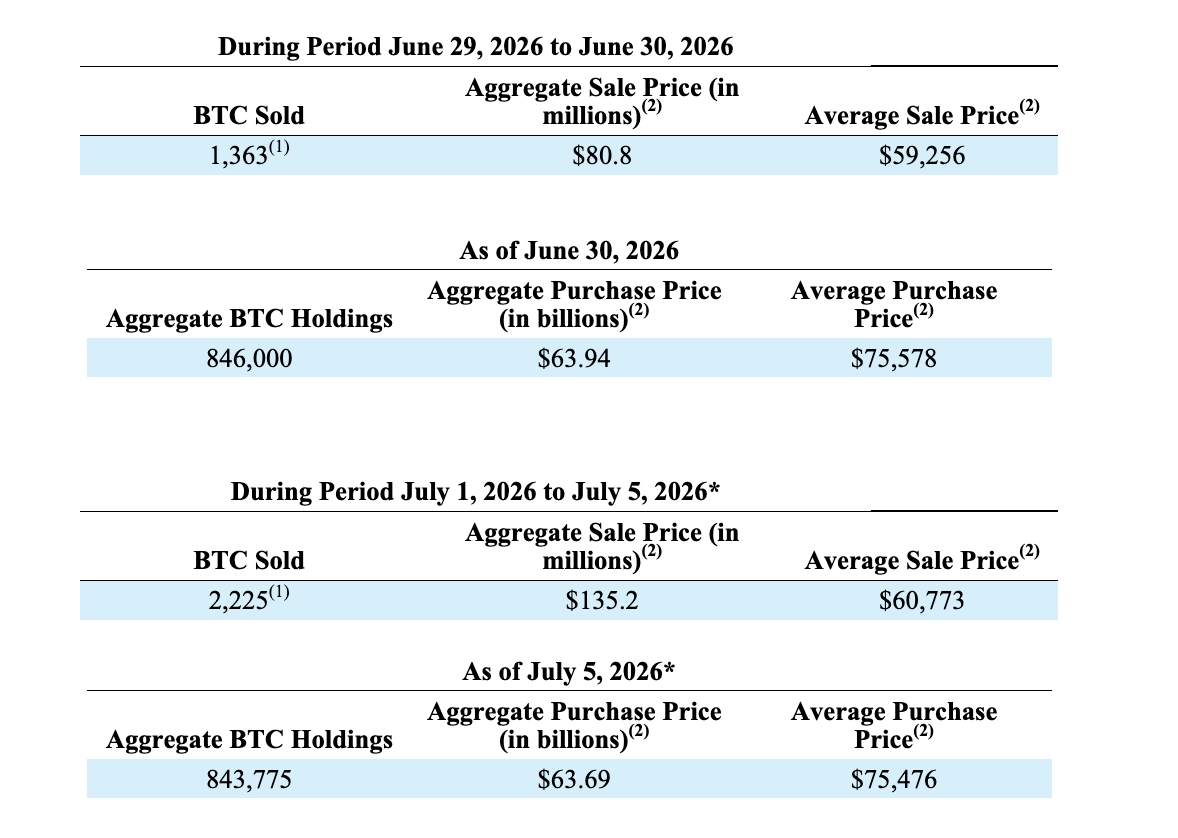
On July 6, Strategy (formerly MicroStrategy) disclosed in an SEC 8-K filing that the company sold 1,363 Bitcoin from June 29 to 30 at an average price of approximately $59,256, totaling about $80.8 million; and sold 2,225 Bitcoin from July 1 to 5 at an average price of approximately $60,773, totaling about $135.2 million. The proceeds were used to pay preferred stock dividends and supplement US dollar reserves.


This is the largest net sale by Strategy since initiating its Bitcoin strategy in 2020, and the company's first institutionalized reduction of core assets in six years. The average selling price was approximately $60,200, below the company's average cost basis of about $75,476 per Bitcoin, resulting in a loss of approximately $15,276 per coin, totaling $54.81 million.


As of July 5, Strategy cumulatively holds 843,775 Bitcoin, with a total acquisition cost of approximately $63.69 billion. It remains the publicly traded company with the largest Bitcoin holdings globally.


According to official statements, as of July 5, Strategy's US dollar reserve balance was $2.55 billion, unchanged from the previous week. In the second quarter of 2026, the company reported a digital asset loss of approximately $8.32 billion, including approximately $8.31 billion in unrealized losses and about $900,000 in realized losses. As of June 30, the book value of its Bitcoin holdings decreased to $49.67 billion, falling below the acquisition cost. Strategy will record a full valuation allowance for the related deferred tax assets.


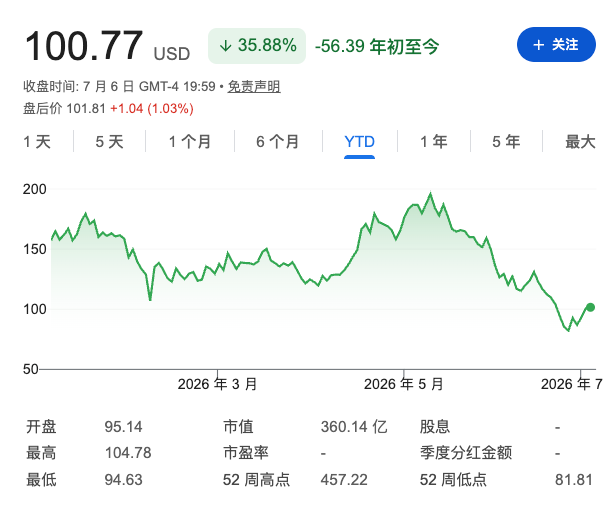
After the disclosure, Bitcoin quickly dipped below $61,500, then reversed after the US stock market opened, with buying interest pushing it back up to around $64,500. MSTR's stock price corrected by about 2% following a 21% gain the previous week but is still down over 35% year-to-date.


From 32 to 3,588, a 100-Fold Increase in Six Weeks


Selling Bitcoin was once a taboo for Strategy. In September 2020, after completing his first $425 million Bitcoin purchase, founder Michael Saylor told CoinDesk in an interview, "I didn't buy it to sell it. Ever." For the next five years, Strategy only bought and never sold, positioning itself as a permanent holder of Bitcoin using its corporate balance sheet.


December 2022 was the only exception. Strategy announced the sale of 704 Bitcoin at an average price of about $16,776, but repurchased 810 Bitcoin two days later, resulting in a net increase in holdings. The SEC filing characterized this move as tax-loss harvesting, using capital losses to offset previous capital gains for tax benefits.


On May 5, 2026, during its Q1 earnings call, Strategy first signaled a potential sale. Michael Saylor stated, "We might sell some Bitcoin to pay dividends, to get the market accustomed to it."


He later told Fortune in an interview that the purpose of those remarks was "to create panic and squeeze shorts and haters." However, an SEC filing three weeks later revealed that Strategy sold 32 Bitcoin between May 26 and 31, raising approximately $2.5 million.


Six weeks later, that number grew from 32 to 3,588.


$1.25 Billion Sales Authorization, 17% Burned in a Week


The sale of 3,588 coins was not a temporary decision. On the same day as the first Bitcoin sale (June 29), Strategy released a new capital framework titled "Digital Credit Capital Framework," formally institutionalizing Bitcoin sales into company policy.
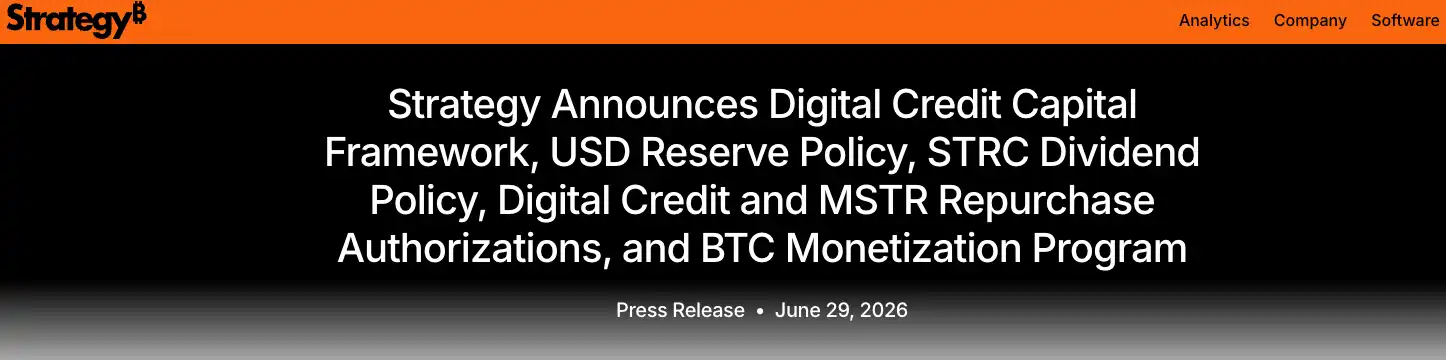


The framework's core provisions include a US Dollar Reserve Policy, adjustments to the STRC Dividend Policy, a Preferred Stock Repurchase Plan, a Common Stock Repurchase Plan, and a BTC Liquidation Plan. Key points authorize management to sell up to $1.25 billion worth of Bitcoin (approximately 20,800 coins at current prices, representing 2.5% of total holdings) when necessary; establish a US dollar reserve system with a minimum level equal to the sum of preferred stock dividends and interest expenses for the next 12 months; increase the STRC preferred stock's annual dividend rate from 11.5% to 12%, effective July 1; and authorize up to $1 billion in preferred stock repurchases and $1 billion in common stock repurchases.


As of June 28, Strategy's US dollar reserves stood at $2.55 billion. When releasing the framework, Strategy aimed to signal that selling Bitcoin was merely one option in its overall capital management toolbox and that the company had sufficient cash reserves to meet dividend obligations. However, the speed of the sales clearly exceeded market expectations. 3,588 coins, $216 million, meant that 17% of the $1.25 billion sales authorization was consumed in its first week of effectiveness.


From 2020 to 2025, Strategy's Bitcoin acquisition strategy was built on an aggressive financing engineering model—issuing convertible bonds, offering common stock, issuing preferred stock, and using all raised funds to purchase Bitcoin. This model worked perfectly during Bitcoin bull runs, as asset appreciation covered financing costs, creating a positive feedback loop between the company's stock price and Bitcoin.


Strategy currently has four series of preferred stock trading in the market: STRC (12% annual dividend), STRK (8%), STRF (10%), and STRD (10%), with combined annual dividend obligations of approximately $1 billion. Preferred stock dividends are rigid expenses that must be paid on time regardless of Bitcoin's price movement. The company's software business (formerly MicroStrategy's BI products) generates less than $500 million in annual revenue, far from enough to cover the dividends.


This creates a significant contradiction: Strategy raises funds by issuing preferred stock to buy Bitcoin, but the dividend obligations of those preferred stocks then force the company to sell Bitcoin to pay the dividends. This contradiction was masked when Bitcoin's price was above the acquisition cost.


Bitcoin has fallen significantly from its October 2025 all-time high. Strategy's comprehensive average cost is approximately $75,476, while this batch was sold at an average price of only about $60,200, incurring a loss of over $15,000 per coin. The Q1 financials recorded a $12.5 billion digital asset impairment loss, and Q2 recorded another $8.32 billion. The company is now selling Bitcoin below cost to pay dividends on securities issued to buy Bitcoin in the first place.


Premium Collateral


3,588 coins represent 0.4% of the total 840,000-coin holdings, having a limited direct impact on Bitcoin's market price. The $1.25 billion sales authorization ceiling represents 2.5% of total holdings; even if fully utilized, it's far from a liquidation. From a balance sheet perspective, Strategy faces no solvency crisis.


But MSTR's stock price has never been priced based solely on its balance sheet. This stock has long traded at a premium of 1.5 to 3 times its Bitcoin Net Asset Value (NAV). The premium investors pay is not for the 840,000 Bitcoin themselves (directly buying BTC or an ETF is cheaper). Instead, it's for a narrative product provided by Michael Saylor: a Bitcoin absorption machine that only buys and never sells, with holdings perpetually growing, never appearing on the sell side. This promise was the collateral for MSTR's entire premium.


As of June 28, Strategy had $2.55 billion in US dollar reserves and annual preferred stock dividend obligations of about $1 billion. The cash was sufficient to cover over two years of payments. Financially, Michael Saylor did not need to sell Bitcoin now. Yet, he still initiated the institutionalized sales framework, raised the STRC dividend rate, and executed $216 million in sales within a week. The four series of preferred stocks generate monthly cash outflow obligations, while the promise of "never selling" precluded using core assets for repayment.


When these two realities coexist on the same balance sheet, one must give way. Michael Saylor chose to give way on the latter.


Following the first coin sale this year, Michael Saylor's new narrative is that if the interest/dividends on issued bonds or preferred stocks can be serviced at a low financial cost, Strategy can use leverage to buy and lock in more Bitcoin at lower prices. Since overall asset appreciation during a bull market far outweighs interest costs, theoretically, through instruments like convertible notes, the company could buy 20 Bitcoin for every one it sells.


But each time Saylor sells Bitcoin, he must explain why it doesn't constitute breaking his promise, and the explanations themselves consume the credibility he has built over six years.


MSTR's premium over its BTC NAV has never been because this company holds Bitcoin more efficiently than an ETF. It was largely because Saylor turned "never selling" into a corporate governance-level religious ritual. Once the ritual is interrupted, MSTR becomes just a leveraged Bitcoin holding vehicle, and the market already has plenty of cheaper alternatives.


Strategy's balance sheet can withstand the paper volatility of 840,000 Bitcoin, but it may not withstand a story that is fading.


Criptos en tendencia

Preguntas relacionadas

QAccording to the article, why did Strategy (formerly MicroStrategy) sell 3,588 Bitcoin in late June and early July 2026?

AStrategy sold the Bitcoin to raise funds for paying dividends on its preferred shares and to supplement its dollar reserves.

QHow much was the realized loss on this specific sale of 3,588 BTC, and what was the approximate cost basis per Bitcoin for the company at that time?

AThe company realized a loss of approximately $54.81 million on the sale. The average selling price was around $60,200 per Bitcoin, which was below the company's approximate cost basis of $75,476 per Bitcoin, resulting in a loss of about $15,276 per coin.

QWhat major shift in company policy did Strategy announce alongside the Bitcoin sales, and what is the authorized limit for future sales under this new framework?

AStrategy announced a new 'Digital Credit Capital Framework' which institutionalized the sale of Bitcoin as a capital management tool. It authorized management to sell up to $1.25 billion worth of Bitcoin (approximately 20,800 BTC at the time) if necessary.

QThe premium was based on Michael Saylor's narrative and commitment that Strategy would be a 'permanent holder' that only buys and never sells Bitcoin, making it a unique 'absorption machine.' This commitment was the 'collateral' for the stock's premium. The recent institutionalized selling breaks this core promise, risking the erosion of this narrative-based premium as the company becomes seen as just another leveraged Bitcoin holding tool with cheaper alternatives available.

AThe article suggests MSTR stock historically traded at a significant premium to its Bitcoin holdings. What was the implied reason for this premium, and why is it now considered at risk?

QWhat financial obligation is creating pressure for Strategy to sell Bitcoin, even at a loss, according to the analysis in the article?

AThe company has annual dividend obligations of approximately $1 billion from its four series of outstanding preferred shares. Its core software business generates less than $500 million in annual revenue, which is insufficient to cover these mandatory dividend payments, forcing the company to use other assets like Bitcoin.

Lecturas Relacionadas

With Mining Profits Depressed, What Kind of Mining Companies Can Survive a Bear Market?

Mining Profitability Slumps: Which Miners Can Survive the Bear Market? A comprehensive Bitcoin miner stress indicator has recently hit a historically low "extreme stress" zone, aligning with the typical market cycle pattern where industry bottoms coincide with severe miner pressure. The current situation presents a direct survival test: if hashprice (daily USD revenue per PH/s of computing power) remains weak, only the most robust mining firms will endure. Hashprice, which incorporates block rewards, transaction fees, network difficulty, and BTC price, is the core metric for mining profitability. Despite Bitcoin's price holding above previous lows, profitability is shrinking due to rising difficulty and low fees. Recent data shows hashprice around $32-33/PH/s/day, with a significant divide: newer, energy-efficient rigs (<19 J/TH) generate ~$81 per megawatt, while older, inefficient models (25-38 J/TH) make only ~$43/MW. This gap is forcing inefficient operators to shut down. The industry has a self-correcting mechanism. As high-cost miners power down, the network's total computing power (hashrate) drops. This eventually triggers a downward adjustment in mining difficulty, increasing the rewards for remaining miners. Data from Q2 2026 shows the hashrate has already fallen by 5.8%, with an estimated 252 EH/s of inefficient mining capacity idled. Firms at risk of淘汰 (elimination) are those reliant on old hardware, high electricity costs, and significant debt. Survivors will likely be miners with newer equipment, low-cost power contracts, strong cash reserves, and flexible operations. A key trend is diversification into AI and high-performance computing (HPC) hosting, though this path is only viable for miners with the necessary infrastructure, capital, and clients. The miner stress indicator serves as a warning, not a precise timing tool for a market bottom. Key signals to watch are whether hashprice stabilizes above ~$30, difficulty continues to adjust downward, hashrate finds a floor, and miner Bitcoin selling subsides. The duration of this low-profitability period will act as a solvency test, determining which miners are positioned to survive and eventually benefit from the next cycle.

Foresight NewsHace 12 min(s)

With Mining Profits Depressed, What Kind of Mining Companies Can Survive a Bear Market?

Foresight NewsHace 12 min(s)

JP Morgan Tokenized Fund Surges 250% in TVL in One Month, Institutional Funds Are Treating Ethereum as the Default Underlying Layer

JPMorgan's tokenized money market fund, JLTXX, has seen its on-chain total value locked (TVL) surge approximately 250% in a month, reaching nearly $700 million from an initial $200 million since its launch seven weeks ago. The fund, which invests in short-term U.S. Treasuries and repos, operates exclusively on the public Ethereum mainnet, signaling growing institutional acceptance of Ethereum as a foundational layer for compliant financial products. A key driver of this growth is its inclusion as reserve assets for stablecoins like USDG, meeting requirements under U.S. stablecoin legislation. Simultaneously, despite a significant price decline—ETH has fallen over 50% from its 2025 high—institutional accumulation continues. BitMine Immersion Technologies, led by Tom Lee, purchased an additional $73 million worth of ETH last week, bringing its holdings to roughly 4.8% of Ethereum's circulating supply. The article highlights a divergence: while the tokenization of real-world assets and stablecoin reserves is driving long-term institutional adoption of Ethereum's infrastructure, short-term price action remains pressured by market sentiment and ETF outflows. This suggests that institutional on-chain activity, though a positive fundamental development, may not serve as a reliable signal for near-term price bottoms.

marsbitHace 1 hora(s)

JP Morgan Tokenized Fund Surges 250% in TVL in One Month, Institutional Funds Are Treating Ethereum as the Default Underlying Layer

marsbitHace 1 hora(s)

Dialogue with Yihui Capital, SoundAI Technology, Ling Universe, and Zhongbo Jili: Opportunities and Challenges in the AI Smart Hardware Track

On June 28, 2026, an event titled "New Opportunities in AI Hardware: The Battle for Interactive Entry Points Begins" was held in Beijing. It featured a report from ITJuzi and discussions with experts from SoundAI, Ling Universe, One Reed Capital, and Zhongbo Juli on the opportunities and challenges in China's AI hardware sector. Key report findings highlight the sector's intense activity: 327 out of 431 startups founded post-2023 have secured funding, with 179 investments in H1 2026 alone. The landscape is dominated by embodied intelligent robots, while wearable tech like smart rings and AI glasses shows rapid growth. Geographically, Shenzhen leads, leveraging its superior hardware supply chain, followed by Beijing and Shanghai. The overarching trend is for companies to focus on micro-innovations within specific scenarios rather than reinventing foundational technology. Industry leaders shared several critical insights: 1. **Balancing Innovation & Market Readiness**: Entrepreneurs face the "hammer looking for a nail" dilemma. Success requires balancing technical capability with user acceptance, cost control, and incremental design improvements rather than chasing disruptive innovation. 2. **Competitive Landscape**: The future interactive entry point may not be a single super-device but a mix of universal terminals and specialized, scenario-specific hardware. While large companies have ecosystem advantages, startups can win by deeply targeting vertical markets and specific user groups. 3. **Core Challenges & Business Models**: Key hurdles include deep understanding of AI models and navigating non-transparent hardware supply chains. Viable business models may involve selling hardware at cost and generating revenue through software subscriptions, but this requires tight control over both hardware BOM and model inference costs. 4. **The Road to Commercialization**: The ultimate test is market validation—achieving sales growth and sustainable cash flow. Companies must find the right application scenario, use edge computing effectively, and close the loop from technology to commercial success. 5. **The Future of Interaction**: Proactive, context-aware interaction is the next frontier, though it's currently limited by issues like model hallucinations and environmental perception. The near-term focus should be on identifying target users and creating a coherent experience in specific domains, such as health wearables. In summary, to succeed in the competitive AI hardware arena, companies must strategically choose their niche, build a team with the right geographical advantages (e.g., leveraging Shenzhen's supply chain), and most importantly, execute a flawless commercialization strategy that translates technology into market-accepted products and sustainable business growth.

marsbitHace 2 hora(s)

Dialogue with Yihui Capital, SoundAI Technology, Ling Universe, and Zhongbo Jili: Opportunities and Challenges in the AI Smart Hardware Track

marsbitHace 2 hora(s)

Trading

Spot

Artículos destacados

Qué es BITCOIN

Entendiendo HarryPotterObamaSonic10Inu (ERC-20) y Su Posición en el Espacio Cripto En los últimos años, el mercado de criptomonedas ha sido testigo de un aumento en la popularidad de las monedas meme, capturando el interés no solo de los comerciantes, sino también de aquellos que buscan compromiso comunitario y valor de entretenimiento. Entre estos tokens únicos se encuentra HarryPotterObamaSonic10Inu (ERC-20), un proyecto intrigante que mezcla referencias culturales en el tejido de las criptomonedas. Este artículo profundiza en los aspectos clave de HarryPotterObamaSonic10Inu, explorando sus mecanismos, ethos impulsado por la comunidad y su relación con el paisaje cripto más amplio. ¿Qué es HarryPotterObamaSonic10Inu (ERC-20)? Como su nombre sugiere, HarryPotterObamaSonic10Inu es una moneda meme construida sobre la blockchain de Ethereum, clasificada bajo el estándar ERC-20. A diferencia de las criptomonedas tradicionales que pueden enfatizar la utilidad práctica o el potencial de inversión, este token prospera en el valor de entretenimiento y la fuerza de su comunidad. El proyecto tiene como objetivo fomentar un entorno donde los usuarios comprometidos puedan reunirse, compartir ideas y participar en actividades inspiradas por diversos fenómenos culturales. Una característica notable de HarryPotterObamaSonic10Inu es su cero impuestos en las transacciones. Este atractivo elemento tiene como objetivo incentivar el comercio y la participación comunitaria, sin cargos adicionales que puedan disuadir a los comerciantes de pequeña escala. El suministro total de la moneda está establecido en mil millones de tokens, una cifra que marca su intención de mantener una circulación sustancial dentro de la comunidad. Creador de HarryPotterObamaSonic10Inu (ERC-20) Los orígenes de HarryPotterObamaSonic10Inu están algo envueltos en misterio; los detalles sobre el creador siguen siendo desconocidos. El desarrollo de este token carece de un equipo identificable o de un plan explícito, lo cual no es inusual dentro del sector de monedas meme. En cambio, el proyecto ha surgido de manera orgánica, con su progreso muy dependiente del entusiasmo y la participación de su comunidad. Inversores de HarryPotterObamaSonic10Inu (ERC-20) En cuanto a inversiones externas y respaldo, HarryPotterObamaSonic10Inu también sigue siendo ambiguo. El token no lista ninguna fundación de inversión conocida o apoyo organizacional significativo. En cambio, la savia del proyecto es su comunidad de base, que informa su crecimiento y sostenibilidad a través de la acción colectiva y el compromiso en el espacio cripto. ¿Cómo Funciona HarryPotterObamaSonic10Inu (ERC-20)? Como una moneda meme, HarryPotterObamaSonic10Inu opera principalmente fuera de los marcos tradicionales que a menudo rigen el valor de los activos. Hay varios aspectos distintivos que definen cómo funciona el proyecto: Transacciones Sin Impuestos: Sin tarifas impositivas en las transacciones, los usuarios pueden comprar y vender el token libremente sin preocuparse por costos ocultos. Compromiso Comunitario: El proyecto prospera en la interacción comunitaria, aprovechando plataformas de redes sociales para crear entusiasmo y facilitar la participación. Las discusiones, el intercambio de contenido y el compromiso son elementos cruciales que ayudan a expandir su alcance y fomentar la lealtad entre los seguidores. Sin Utilidad Práctica: Cabe señalar que HarryPotterObamaSonic10Inu no ofrece utilidad concreta dentro del ecosistema financiero. Más bien, se clasifica como un token principalmente para actividades de entretenimiento y comunitarias. Referencia Cultural: El token incorpora astutamente elementos de la cultura popular para atraer interés, conectando con entusiastas de los memes y seguidores de las criptomonedas por igual. HarryPotterObamaSonic10Inu ejemplifica cómo las monedas meme operan de manera diferente a los proyectos de criptomonedas más tradicionales, ingresando al mercado como construcciones sociales innovadoras en lugar de activos utilitarios. Cronología de HarryPotterObamaSonic10Inu (ERC-20) La historia de HarryPotterObamaSonic10Inu está marcada por varios hitos notables: Creación: El token surgió de un meme viral, capturando la imaginación de muchos entusiastas de las criptomonedas. Las fechas específicas de creación no están disponibles, subrayando su ascenso orgánico. Listado en Exchanges: HarryPotterObamaSonic10Inu ha llegado a varios exchanges, permitiendo un acceso y comercio más fácil por parte de la comunidad. Iniciativas de Compromiso Comunitario: Actividades continuas destinadas a mejorar la interacción comunitaria, incluyendo concursos, campañas en redes sociales y generación de contenido por parte de fanáticos y defensores. Planes de Expansión Futuros: La hoja de ruta del proyecto incluye el lanzamiento de una colección de NFT, mercancía y un sitio de comercio electrónico relacionado con sus temas culturales, involucrando aún más a la comunidad e intentando añadir más dimensiones a su ecosistema. Puntos Clave Sobre HarryPotterObamaSonic10Inu (ERC-20) Naturaleza Impulsada por la Comunidad: El proyecto prioriza la participación colectiva y la creatividad, asegurando que la involucración de los usuarios esté a la vanguardia de su desarrollo. Clasificación como Moneda Meme: Representa la epítome de las criptomonedas basadas en el entretenimiento, diferenciándose de los vehículos de inversión tradicionales. Sin Afiliación Directa con Bitcoin: A pesar de la similitud en el nombre del ticker, HarryPotterObamaSonic10Inu es distinto y no tiene relación con Bitcoin u otras criptomonedas establecidas. Enfoque en la Colaboración: HarryPotterObamaSonic10Inu está diseñado para crear un espacio para la colaboración y el intercambio de historias entre sus poseedores, proporcionando una vía para la creatividad y el vínculo comunitario. Perspectivas Futuras: La ambición de expandirse más allá de su premisa inicial hacia NFTs y mercancías describe un camino para que el proyecto potencialmente ingrese a avenidas más tradicionales dentro de la cultura digital. A medida que las monedas meme continúan capturando la imaginación de la comunidad de criptomonedas, HarryPotterObamaSonic10Inu (ERC-20) se destaca debido a sus lazos culturales y su enfoque centrado en la comunidad. Si bien puede no encajar en el molde típico de un token impulsado por la utilidad, su esencia radica en la alegría y la camaradería fomentadas entre sus seguidores, destacando la naturaleza en evolución de las criptomonedas en una era cada vez más digital. A medida que el proyecto continúa desarrollándose, será importante observar cómo las dinámicas comunitarias influyen en su trayectoria en el cambiante paisaje de la tecnología blockchain.

1.9k Vistas totalesPublicado en 2024.04.01Actualizado en 2024.12.03

Qué es BITCOIN

Cómo comprar BTC

¡Bienvenido a HTX.com! Hemos hecho que comprar Bitcoin (BTC) sea simple y conveniente. Sigue nuestra guía paso a paso para iniciar tu viaje de criptos.Paso 1: crea tu cuenta HTXUtiliza tu correo electrónico o número de teléfono para registrarte y obtener una cuenta gratuita en HTX. Experimenta un proceso de registro sin complicaciones y desbloquea todas las funciones.Obtener mi cuentaPaso 2: ve a Comprar cripto y elige tu método de pagoTarjeta de crédito/débito: usa tu Visa o Mastercard para comprar Bitcoin (BTC) al instante.Saldo: utiliza fondos del saldo de tu cuenta HTX para tradear sin problemas.Terceros: hemos agregado métodos de pago populares como Google Pay y Apple Pay para mejorar la comodidad.P2P: tradear directamente con otros usuarios en HTX.Over-the-Counter (OTC): ofrecemos servicios personalizados y tipos de cambio competitivos para los traders.Paso 3: guarda tu Bitcoin (BTC)Después de comprar tu Bitcoin (BTC), guárdalo en tu cuenta HTX. Alternativamente, puedes enviarlo a otro lugar mediante transferencia blockchain o utilizarlo para tradear otras criptomonedas.Paso 4: tradear Bitcoin (BTC)Tradear fácilmente con Bitcoin (BTC) en HTX's mercado spot. Simplemente accede a tu cuenta, selecciona tu par de trading, ejecuta tus trades y monitorea en tiempo real. Ofrecemos una experiencia fácil de usar tanto para principiantes como para traders experimentados.

5.3k Vistas totalesPublicado en 2024.12.12Actualizado en 2026.06.02

Cómo comprar BTC

Qué es $BITCOIN

ORO DIGITAL ($BITCOIN): Un Análisis Integral Introducción al ORO DIGITAL ($BITCOIN) ORO DIGITAL ($BITCOIN) es un proyecto basado en blockchain que opera en la red Solana, cuyo objetivo es combinar las características de los metales preciosos tradicionales con la innovación de las tecnologías descentralizadas. Aunque comparte un nombre con Bitcoin, a menudo referido como “oro digital” debido a su percepción como un refugio de valor, ORO DIGITAL es un token separado diseñado para crear un ecosistema único dentro del paisaje Web3. Su meta es posicionarse como un activo digital alternativo viable, aunque los detalles sobre sus aplicaciones y funcionalidades aún están en desarrollo. ¿Qué es ORO DIGITAL ($BITCOIN)? ORO DIGITAL ($BITCOIN) es un token de criptomoneda diseñado explícitamente para su uso en la blockchain de Solana. A diferencia de Bitcoin, que proporciona un papel de almacenamiento de valor ampliamente reconocido, este token parece centrarse en aplicaciones y características más amplias. Aspectos notables incluyen: Infraestructura Blockchain: El token está construido sobre la blockchain de Solana, conocida por su capacidad para manejar transacciones de alta velocidad y bajo costo. Dinámicas de Suministro: ORO DIGITAL tiene un suministro máximo limitado a 100 cuatrillones de tokens (100P $BITCOIN), aunque los detalles sobre su suministro circulante no se han divulgado actualmente. Utilidad: Si bien las funcionalidades precisas no están delineadas explícitamente, hay indicios de que el token podría ser utilizado para diversas aplicaciones, potencialmente involucrando aplicaciones descentralizadas (dApps) o estrategias de tokenización de activos. ¿Quién es el Creador de ORO DIGITAL ($BITCOIN)? En la actualidad, la identidad de los creadores y el equipo de desarrollo detrás de ORO DIGITAL ($BITCOIN) sigue siendo desconocida. Esta situación es típica entre muchos proyectos innovadores dentro del espacio blockchain, particularmente aquellos alineados con las finanzas descentralizadas y fenómenos de monedas meme. Si bien tal anonimato puede fomentar una cultura impulsada por la comunidad, intensifica las preocupaciones sobre la gobernanza y la responsabilidad. ¿Quiénes son los Inversores de ORO DIGITAL ($BITCOIN)? La información disponible indica que ORO DIGITAL ($BITCOIN) no tiene patrocinadores institucionales conocidos ni inversiones destacadas de capital de riesgo. El proyecto parece operar en un modelo de peer-to-peer centrado en el apoyo y la adopción de la comunidad en lugar de rutas de financiamiento tradicionales. Su actividad y liquidez se sitúan principalmente en intercambios descentralizados (DEX), como PumpSwap, en lugar de plataformas de trading centralizadas establecidas, lo que resalta aún más su enfoque de base. Cómo Funciona ORO DIGITAL ($BITCOIN) Los mecanismos operativos de ORO DIGITAL ($BITCOIN) pueden elaborarse en función de su diseño blockchain y atributos de red: Mecanismo de Consenso: Al aprovechar el único proof-of-history (PoH) de Solana combinado con un modelo de proof-of-stake (PoS), el proyecto asegura una validación de transacciones eficiente que contribuye al alto rendimiento de la red. Tokenómica: Si bien los mecanismos deflacionarios específicos no se han detallado extensamente, el vasto suministro máximo de tokens implica que podría atender microtransacciones o casos de uso nicho que aún están por definirse. Interoperabilidad: Existe el potencial de integración con el ecosistema más amplio de Solana, incluyendo varias plataformas de finanzas descentralizadas (DeFi). Sin embargo, los detalles sobre integraciones específicas permanecen no especificados. Cronología de Eventos Clave Aquí hay una cronología que destaca hitos significativos relacionados con ORO DIGITAL ($BITCOIN): 2023: El despliegue inicial del token ocurre en la blockchain de Solana, marcado por su dirección de contrato. 2024: ORO DIGITAL gana visibilidad al estar disponible para trading en intercambios descentralizados como PumpSwap, permitiendo a los usuarios comerciar contra SOL. 2025: El proyecto presencia actividad de trading esporádica y potencial interés en compromisos liderados por la comunidad, aunque no se han documentado asociaciones notables o avances técnicos hasta el momento. Análisis Crítico Fortalezas Escalabilidad: La infraestructura subyacente de Solana soporta altos volúmenes de transacciones, lo que podría mejorar la utilidad de $BITCOIN en varios escenarios de transacción. Accesibilidad: El potencial bajo precio de trading por token podría atraer a inversores minoristas, facilitando una participación más amplia debido a oportunidades de propiedad fraccionada. Riesgos Falta de Transparencia: La ausencia de patrocinadores, desarrolladores o un proceso de auditoría conocidos públicamente puede generar escepticismo sobre la sostenibilidad y confiabilidad del proyecto. Volatilidad del Mercado: La actividad de trading depende en gran medida del comportamiento especulativo, lo que puede resultar en una volatilidad de precios significativa y en incertidumbre para los inversores. Conclusión ORO DIGITAL ($BITCOIN) surge como un proyecto intrigante pero ambiguo dentro del ecosistema de Solana en rápida evolución. Si bien intenta aprovechar la narrativa del “oro digital”, su alejamiento del papel establecido de Bitcoin como refugio de valor subraya la necesidad de una diferenciación más clara de su utilidad y estructura de gobernanza previstas. La aceptación y adopción futura dependerán probablemente de abordar la actual opacidad y de definir sus estrategias operativas y económicas de manera más explícita. Nota: Este informe abarca información sintetizada disponible hasta octubre de 2023, y pueden haber ocurrido desarrollos más allá del período de investigación.

110 Vistas totalesPublicado en 2025.05.13Actualizado en 2025.05.13

Qué es $BITCOIN

Discusiones

Bienvenido a la comunidad de HTX. Aquí puedes mantenerte informado sobre los últimos desarrollos de la plataforma y acceder a análisis profesionales del mercado. A continuación se presentan las opiniones de los usuarios sobre el precio de BTC (BTC).

活动图片