JP Morgan Tokenized Fund Surges 250% in TVL in One Month, Institutional Funds Are Treating Ethereum as the Default Underlying Layer

marsbitPublicado a 2026-07-07Actualizado a 2026-07-07

Resumen

JPMorgan's tokenized money market fund, JLTXX, has seen its on-chain total value locked (TVL) surge approximately 250% in a month, reaching nearly $700 million from an initial $200 million since its launch seven weeks ago. The fund, which invests in short-term U.S. Treasuries and repos, operates exclusively on the public Ethereum mainnet, signaling growing institutional acceptance of Ethereum as a foundational layer for compliant financial products. A key driver of this growth is its inclusion as reserve assets for stablecoins like USDG, meeting requirements under U.S. stablecoin legislation. Simultaneously, despite a significant price decline—ETH has fallen over 50% from its 2025 high—institutional accumulation continues. BitMine Immersion Technologies, led by Tom Lee, purchased an additional $73 million worth of ETH last week, bringing its holdings to roughly 4.8% of Ethereum's circulating supply. The article highlights a divergence: while the tokenization of real-world assets and stablecoin reserves is driving long-term institutional adoption of Ethereum's infrastructure, short-term price action remains pressured by market sentiment and ETF outflows. This suggests that institutional on-chain activity, though a positive fundamental development, may not serve as a reliable signal for near-term price bottoms.

Author: Claude, Deep Tide TechFlow

Deep Tide Introduction: If you're still holding Ethereum, with its price more than halved this year, you might be wondering who's buying at these levels.

The answer is the most conservative money on Wall Street. JP Morgan's tokenized money market fund, JLTXX, has seen its on-chain size surge from $200 million to nearly $700 million in seven weeks, growing about 250% in one month, and it runs exclusively on Ethereum. In the same week, BitMine, led by Tom Lee, purchased another $73 million worth of ETH, bringing its total holdings to about 4.8% of Ethereum's circulating supply. The ETH price is falling, but institutions are accumulating; these two things are happening simultaneously.
JP Morgan has quietly turned a tokenized fund into one of the fastest-growing products in recent years.

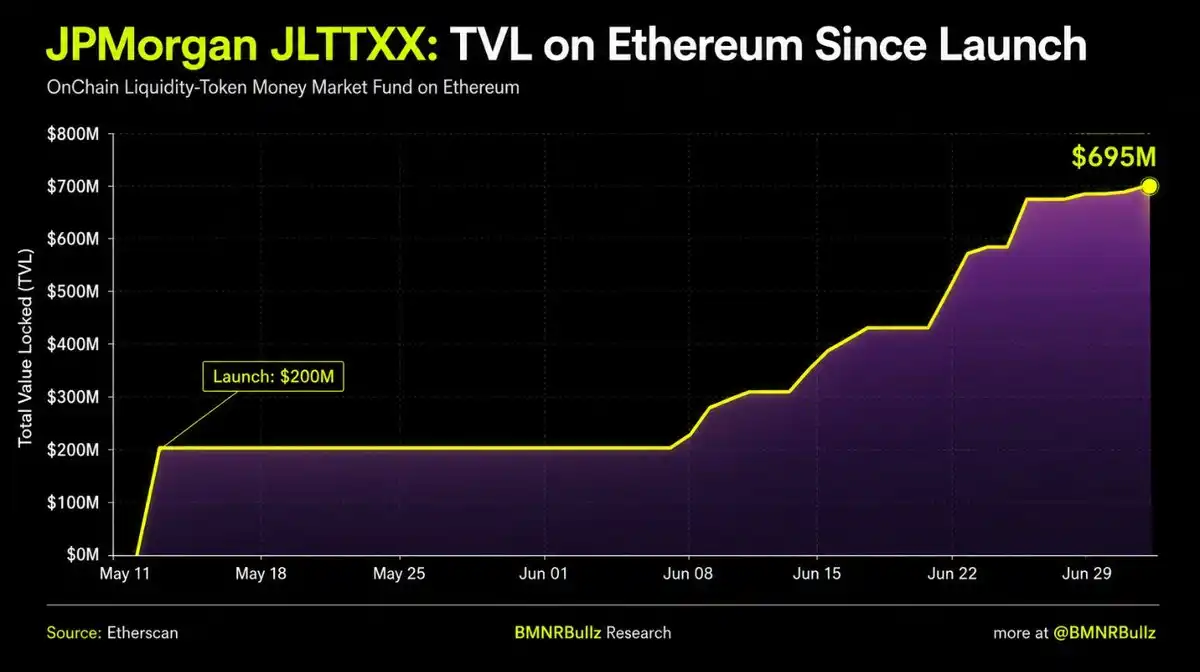
According to The Defiant, the on-chain management scale of JP Morgan's OnChain Liquidity Token Money Market Fund (ticker: JLTXX) grew by approximately 250% over the past month, based on data from blockchain analytics platform Token Terminal. This fund operates only on Ethereum.

From $200M to Nearly $700M in Seven Weeks, JP Morgan Seeded with Its Own Capital

JLTXX launched on May 13th. JP Morgan initially seeded it with $100 million of its own capital, and custodian Anchorage Digital also participated in the initial subscription. The on-chain total value locked (TVL) on the first day was about $200 million. According to a post by ethereuminsti on X, this number reached $695 million seven weeks later, a 248% increase, closely matching Token Terminal's ~250% figure.

The fund's investments are anything but aggressive, consisting entirely of short-term U.S. Treasury bills and overnight repurchase agreements fully collateralized by Treasuries or cash, identical to the safest assets in traditional money market funds. What's truly different is where it runs. JP Morgan has its own private settlement network called Kinexys, but JLTXX, like the bank's first tokenized fund MONY launched last December, chose the public Ethereum mainnet over its own chain. The fact that a bank with its own blockchain infrastructure places its product on a public chain is a signal in itself.

For ETH holders, the implication here is: Ethereum is gradually transforming from a speculative asset into an underlying ledger for compliant financial products in the eyes of institutions. This type of demand has little relation to short-term price fluctuations but will solidify into long-term network usage.

Stablecoin Reserve Needs Behind the Growth

The rapid growth of JLTXX is partly because it's being used as a reserve for stablecoins.

According to disclosures by a Dune analysis account, this fund has been added to the reserve asset pool for the USDG stablecoin, alongside BlackRock's BUIDL and Superstate's STBXX. This points to a growing demand: stablecoin issuers need on-chain Treasury exposure that complies with the rules of the GENIUS Act. The GENIUS Act, U.S. stablecoin legislation passed in 2025, specifies the conditions that stablecoin reserve assets must meet, and tokenized Treasury money market funds fit perfectly into this niche.

JP Morgan designed JLTXX to accept subscriptions both in cash and stablecoins, effectively positioning the fund at the intersection of regulated finance and crypto-native infrastructure. It's not alone in this race. BlackRock has filed documents with the SEC for two tokenized money market products, one of which involves tokenizing a share class of its existing $6.1 billion BlackRock US Treasury Fund on Ethereum. BlackRock's BUIDL is currently the world's largest tokenized fund, with assets under management surpassing $2.8 billion in early 2026 and spanning eight blockchains.

Observers can discern the direction from this: stablecoin reserves are a cake that is definitely growing, and institutions are almost unanimously choosing Ethereum as the foundational layer for that cake.

BitMine Buys Another $73M in a Week, Holdings Approach 5% of Circulating Supply

While traditional finance approaches Ethereum from the asset side, accumulation on-chain hasn't stopped.

According to a holdings update released on Monday by BitMine Immersion Technologies (NYSE: BMNR), the Ethereum treasury company chaired by Fundstrat's Tom Lee purchased 42,197 ETH over the past week, valued at approximately $73 million at the time. This purchase brings BitMine's total ETH holdings to 5,742,237, accounting for about 4.8% of Ethereum's circulating supply. BitMine's own accounts list its crypto and other asset total value at $11.1 billion, including its ETH position valued at $1,800 per ETH, 206 BTC, a $180 million stake in Beast Industries, a $71 million stake in Eightco Holdings, and $527 million in cash and marketable securities.
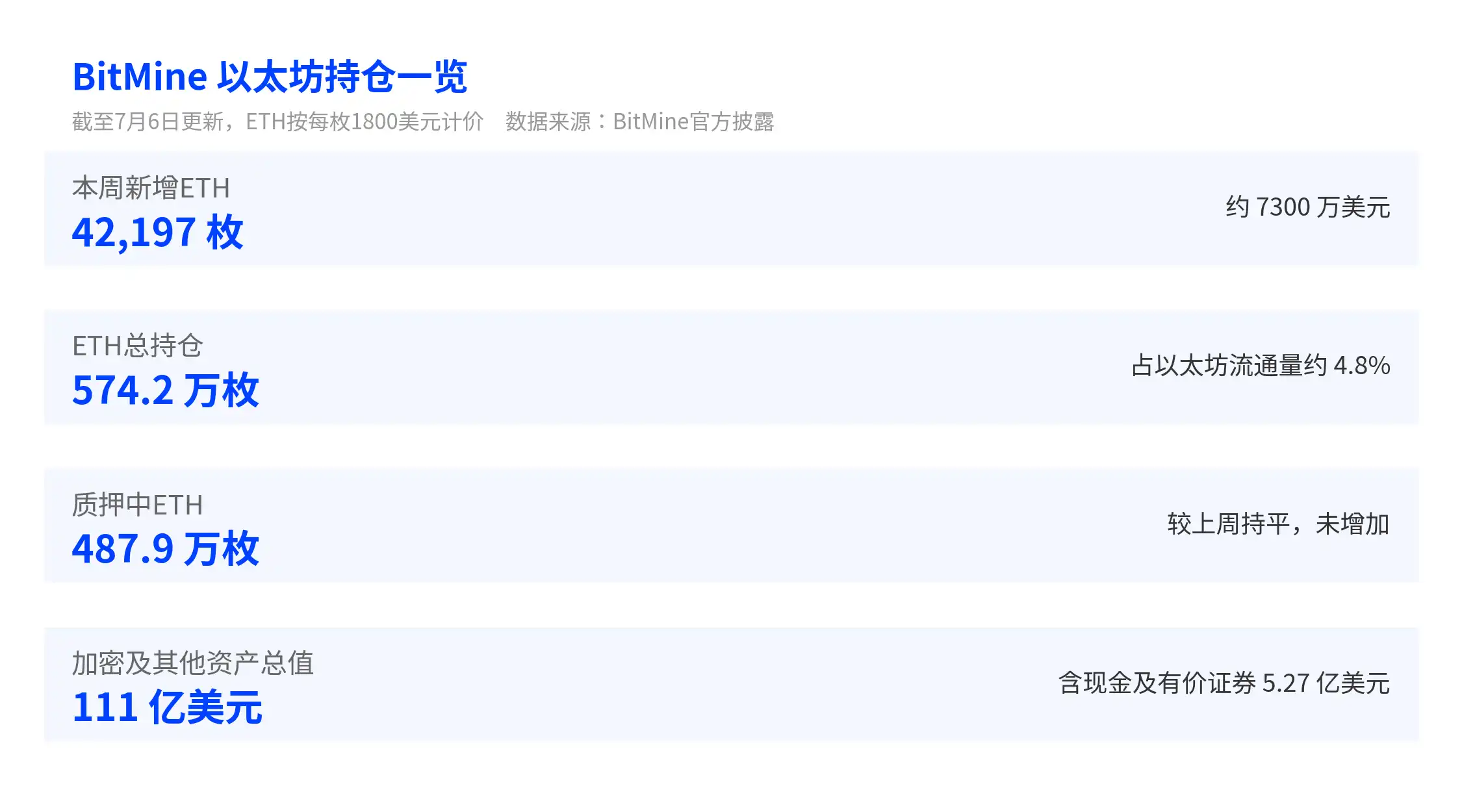
One detail worth noting for holders: BitMine's staked ETH amount remained flat at 4,879,157, meaning the newly acquired coins this week were not staked. The company's publicly stated goal is to control 5% of Ethereum's total supply, and its weekly accumulation is approaching that threshold.

A risk note is warranted here: BitMine's holding value is highly dependent on the coin price. Its accounts value ETH at $1,800, while as of July 6th, the spot ETH price was around $1,747, already below its valuation benchmark. In June this year, insiders also warned that the company faced a cash shortfall of about $30 million, which Tom Lee publicly denied as a financing crisis. For those following such treasury companies to go long on ETH, the double leverage of the company's stock price and the coin price is a double-edged sword.

Price Falls, Institutions Buy: How to Read This Divergence

Putting the two threads together paints a contradictory picture: institutions are accelerating their entry while the coin price is moving down.

Ethereum has had a tough year. According to multiple market data sources, ETH has fallen over 50% from its all-time high of around $4,900 in August 2025. It closed the first three quarters of 2026 with three consecutive quarterly declines, the first recorded three-quarter losing streak. Spot Ethereum ETFs also recorded net outflows in June. On-chain activity is declining too. According to Glassnode data, the 14-day moving average of active addresses dropped from about 795,000 in early February to about 420,000 in June, a decline of about 46%.

Therefore, the growth in JP Morgan's fund size and BitMine's holdings tells a different story from the secondary market price action. Institutions are buying into Ethereum's long-term position as a settlement layer and compliant asset infrastructure, betting on the stablecoin reserve and tokenized asset trend. The secondary market is selling based on short-term liquidity, sentiment, and ETF fund flows. These two narratives can diverge for a long time, and there's no certainty about which will materialize first.

For holders or potential entrants, the operational implication here is: institutional accumulation and the tokenization narrative are real, fundamental changes, but they do not constitute a short-term price floor. Historically, concentrated buying by large holders hasn't always been a clean buy signal; a local top followed the whale accumulation in February. It's valid to consider institutional entry as a long-term logic, but caution is advised when using it as a basis for timing a market bottom.


Criptos en tendencia

Preguntas relacionadas

QWhat is the growth rate of JPMorgan Chase's tokenized fund JLTXX in terms of on-chain TVL over the past month, and on which blockchain does it operate?

AJPMorgan Chase's tokenized money market fund JLTXX has seen its on-chain Total Value Locked (TVL) increase by approximately 250% over the past month. It operates exclusively on the Ethereum blockchain.

QAccording to the article, what is the primary traditional asset composition of the JLTXX fund, and what new demand is driving its growth?

AThe JLTXX fund is invested in conservative, traditional assets such as short-term U.S. Treasury bills and overnight repurchase agreements fully collateralized by Treasuries or cash. Its growth is partly driven by its inclusion as a reserve asset for stablecoins, meeting the requirements of U.S. regulations like the GENIUS Act for on-chain Treasury exposure.

QHow much ETH did BitMine Immersion Technologies purchase in the week prior to the article's publication, and what is the company's stated long-term goal regarding Ethereum's supply?

ABitMine Immersion Technologies purchased 42,197 ETH (worth approximately $73 million at the time) in the week before the article's publication. The company's publicly stated goal is to control 5% of Ethereum's total supply.

QWhat contradictory market trends regarding Ethereum does the article highlight between institutional activity and price action?

AThe article highlights a contradiction where institutional activity is increasing (e.g., JPMorgan's growing tokenized fund and BitMine's accumulating ETH holdings), while Ethereum's price is declining significantly, having fallen over 50% from its 2025 highs. This suggests institutions are betting on Ethereum's long-term utility as a settlement layer, while short-term market prices are driven by different factors like sentiment and ETF flows.

QName one other major financial institution mentioned in the article that is also active in the tokenized fund space, and what is the name of its flagship product?

ABlackRock is another major financial institution active in the tokenized fund space mentioned in the article. Its flagship tokenized fund is called BUIDL, which was the world's largest tokenized fund with over $2.8 billion in assets under management as of early 2026.

Lecturas Relacionadas

With Mining Profits Depressed, What Kind of Mining Companies Can Survive a Bear Market?

Mining Profitability Slumps: Which Miners Can Survive the Bear Market? A comprehensive Bitcoin miner stress indicator has recently hit a historically low "extreme stress" zone, aligning with the typical market cycle pattern where industry bottoms coincide with severe miner pressure. The current situation presents a direct survival test: if hashprice (daily USD revenue per PH/s of computing power) remains weak, only the most robust mining firms will endure. Hashprice, which incorporates block rewards, transaction fees, network difficulty, and BTC price, is the core metric for mining profitability. Despite Bitcoin's price holding above previous lows, profitability is shrinking due to rising difficulty and low fees. Recent data shows hashprice around $32-33/PH/s/day, with a significant divide: newer, energy-efficient rigs (<19 J/TH) generate ~$81 per megawatt, while older, inefficient models (25-38 J/TH) make only ~$43/MW. This gap is forcing inefficient operators to shut down. The industry has a self-correcting mechanism. As high-cost miners power down, the network's total computing power (hashrate) drops. This eventually triggers a downward adjustment in mining difficulty, increasing the rewards for remaining miners. Data from Q2 2026 shows the hashrate has already fallen by 5.8%, with an estimated 252 EH/s of inefficient mining capacity idled. Firms at risk of淘汰 (elimination) are those reliant on old hardware, high electricity costs, and significant debt. Survivors will likely be miners with newer equipment, low-cost power contracts, strong cash reserves, and flexible operations. A key trend is diversification into AI and high-performance computing (HPC) hosting, though this path is only viable for miners with the necessary infrastructure, capital, and clients. The miner stress indicator serves as a warning, not a precise timing tool for a market bottom. Key signals to watch are whether hashprice stabilizes above ~$30, difficulty continues to adjust downward, hashrate finds a floor, and miner Bitcoin selling subsides. The duration of this low-profitability period will act as a solvency test, determining which miners are positioned to survive and eventually benefit from the next cycle.

Foresight NewsHace 12 min(s)

With Mining Profits Depressed, What Kind of Mining Companies Can Survive a Bear Market?

Foresight NewsHace 12 min(s)

Blood Loss of $55 Million Selling 3,588 BTC, Strategy Becomes a Literal Scumbag

On July 6th, Strategy (formerly MicroStrategy) disclosed in an SEC filing that it sold 3,588 Bitcoin (BTC) between June 29th and July 5th for approximately $216 million, at an average price of ~$60,200. This marked the company's largest net sale since initiating its Bitcoin strategy in 2020 and its first institutionalized reduction of its core holding. The sale resulted in a realized loss of about $54.8 million, as the selling price was below its average cost basis of ~$75,476 per BTC. The proceeds were used to pay preferred stock dividends and replenish USD reserves. This move follows a new "Digital Credit Capital Framework" approved on June 29th, authorizing the sale of up to $1.25 billion in Bitcoin. The sale consumes roughly 17% of this authorized amount in its first week. Strategy's foundational narrative, built by founder Michael Saylor, was a commitment to "never sell" Bitcoin. The recent institutionalized selling framework and these substantial sales represent a significant shift from that original promise. While the amount sold is only 0.4% of Strategy's total holdings of 843,775 BTC, the action challenges the premium at which its stock (MSTR) trades relative to its Bitcoin holdings. Investors had priced in the "never sell" narrative. The company now faces a contradiction: it sells Bitcoin at a loss to pay dividends on the preferred stock it issued to fund Bitcoin purchases. Saylor has framed selling as a tool for future strategic purchases, but each sale erodes the credibility of the original commitment, potentially threatening the premium valuation of MSTR shares.

Foresight NewsHace 1 hora(s)

Blood Loss of $55 Million Selling 3,588 BTC, Strategy Becomes a Literal Scumbag

Foresight NewsHace 1 hora(s)

Dialogue with Yihui Capital, SoundAI Technology, Ling Universe, and Zhongbo Jili: Opportunities and Challenges in the AI Smart Hardware Track

On June 28, 2026, an event titled "New Opportunities in AI Hardware: The Battle for Interactive Entry Points Begins" was held in Beijing. It featured a report from ITJuzi and discussions with experts from SoundAI, Ling Universe, One Reed Capital, and Zhongbo Juli on the opportunities and challenges in China's AI hardware sector. Key report findings highlight the sector's intense activity: 327 out of 431 startups founded post-2023 have secured funding, with 179 investments in H1 2026 alone. The landscape is dominated by embodied intelligent robots, while wearable tech like smart rings and AI glasses shows rapid growth. Geographically, Shenzhen leads, leveraging its superior hardware supply chain, followed by Beijing and Shanghai. The overarching trend is for companies to focus on micro-innovations within specific scenarios rather than reinventing foundational technology. Industry leaders shared several critical insights: 1. **Balancing Innovation & Market Readiness**: Entrepreneurs face the "hammer looking for a nail" dilemma. Success requires balancing technical capability with user acceptance, cost control, and incremental design improvements rather than chasing disruptive innovation. 2. **Competitive Landscape**: The future interactive entry point may not be a single super-device but a mix of universal terminals and specialized, scenario-specific hardware. While large companies have ecosystem advantages, startups can win by deeply targeting vertical markets and specific user groups. 3. **Core Challenges & Business Models**: Key hurdles include deep understanding of AI models and navigating non-transparent hardware supply chains. Viable business models may involve selling hardware at cost and generating revenue through software subscriptions, but this requires tight control over both hardware BOM and model inference costs. 4. **The Road to Commercialization**: The ultimate test is market validation—achieving sales growth and sustainable cash flow. Companies must find the right application scenario, use edge computing effectively, and close the loop from technology to commercial success. 5. **The Future of Interaction**: Proactive, context-aware interaction is the next frontier, though it's currently limited by issues like model hallucinations and environmental perception. The near-term focus should be on identifying target users and creating a coherent experience in specific domains, such as health wearables. In summary, to succeed in the competitive AI hardware arena, companies must strategically choose their niche, build a team with the right geographical advantages (e.g., leveraging Shenzhen's supply chain), and most importantly, execute a flawless commercialization strategy that translates technology into market-accepted products and sustainable business growth.

marsbitHace 2 hora(s)

Dialogue with Yihui Capital, SoundAI Technology, Ling Universe, and Zhongbo Jili: Opportunities and Challenges in the AI Smart Hardware Track

marsbitHace 2 hora(s)

Trading

Spot

Artículos destacados

Cómo comprar LAYER

¡Bienvenido a HTX.com! Hemos hecho que comprar Solayer (LAYER) sea simple y conveniente. Sigue nuestra guía paso a paso para iniciar tu viaje de criptos.Paso 1: crea tu cuenta HTXUtiliza tu correo electrónico o número de teléfono para registrarte y obtener una cuenta gratuita en HTX. Experimenta un proceso de registro sin complicaciones y desbloquea todas las funciones.Obtener mi cuentaPaso 2: ve a Comprar cripto y elige tu método de pagoTarjeta de crédito/débito: usa tu Visa o Mastercard para comprar Solayer (LAYER) al instante.Saldo: utiliza fondos del saldo de tu cuenta HTX para tradear sin problemas.Terceros: hemos agregado métodos de pago populares como Google Pay y Apple Pay para mejorar la comodidad.P2P: tradear directamente con otros usuarios en HTX.Over-the-Counter (OTC): ofrecemos servicios personalizados y tipos de cambio competitivos para los traders.Paso 3: guarda tu Solayer (LAYER)Después de comprar tu Solayer (LAYER), guárdalo en tu cuenta HTX. Alternativamente, puedes enviarlo a otro lugar mediante transferencia blockchain o utilizarlo para tradear otras criptomonedas.Paso 4: tradear Solayer (LAYER)Tradear fácilmente con Solayer (LAYER) en HTX's mercado spot. Simplemente accede a tu cuenta, selecciona tu par de trading, ejecuta tus trades y monitorea en tiempo real. Ofrecemos una experiencia fácil de usar tanto para principiantes como para traders experimentados.

303 Vistas totalesPublicado en 2025.02.11Actualizado en 2026.06.02

Cómo comprar LAYER

Discusiones

Bienvenido a la comunidad de HTX. Aquí puedes mantenerte informado sobre los últimos desarrollos de la plataforma y acceder a análisis profesionales del mercado. A continuación se presentan las opiniones de los usuarios sobre el precio de LAYER (LAYER).

活动图片