Will the Continued Shutdown of the Strait of Hormuz Trigger an Oil and Gas Supply Crisis?

marsbitPublicado a 2026-05-08Actualizado a 2026-05-08

Resumen

The prolonged closure of the Strait of Hormuz, a critical global energy chokepoint, is evolving from a military conflict into a severe stress test for worldwide energy trade. Despite a ceasefire, transit remains minimal due to persistent threats from Iran, which uses drones, small boats, mines, and a new transit permit/fee system to effectively control the strait. Daily vessel traffic has plummeted from about 135 to under 10 ships, trapping over 1500 commercial vessels. The U.S. has initiated "Project Freedom" to escort ships, but Iran condemns it as a violation. The crisis is forcing a fundamental re-pricing of risk and cost for using this route, which normally carries about one-fifth of global oil and LNG supplies. Even if a political deal is reached, restoring full, trusted transit will be slow due to mine clearance needs, security concerns, and eroded market confidence. Major oil producers like Saudi Arabia are using alternative pipelines, but capacities are limited and routes are also vulnerable. Iran has signaled its intent to institutionalize control over the strait post-conflict, leveraging it as a geopolitical tool. The standoff underscores how Iran can paralyze this vital passage without a traditional navy, creating a lasting impact on global energy security and trade logistics.

Editor's Note: The crisis in the Strait of Hormuz is evolving from a military conflict into a stress test for global energy trade.

The key recent shift is that the ceasefire has not led to a genuine resumption of navigation. In early May, the United States announced the launch of "Project Freedom," attempting to guide stranded vessels away from the Persian Gulf; Iran, in turn, warned external warships not to enter the strait. Subsequently, the U.S. and Iran engaged in another round of clashes near the Strait of Hormuz, with the U.S. claiming it intercepted an Iranian attack on three U.S. naval vessels, and Iran accusing the U.S. of violating the ceasefire and attacking vessels and coastal areas. While former President Trump stated the ceasefire remained in effect, the market has already begun repricing the risks, with Brent crude prices briefly rising to around $101 per barrel.

Iran has demonstrated that, even without a traditionally strong navy, it can bring the world's most important energy artery to a near-standstill through the use of drones, small boats, the threat of mines, and mechanisms for passage permits and fees. For shipowners, insurers, and oil-producing nations, the question is no longer just "can we pass through," but "how much risk do we bear for each passage."

This means the cost of using the Strait of Hormuz is being repriced. Once considered an implicitly available piece of global energy infrastructure, it is now turning into a geopolitical bargaining chip in Iran's hands. Even if a future agreement is reached between the U.S. and Iran, a full restoration of shipping to pre-conflict levels is unlikely to happen immediately, because what has truly been damaged is not the waterway itself, but the market's trust in its safety.

Below is the original article:

No region in the world produces more oil and natural gas than the countries spanning the coast of the Persian Gulf. Most of that energy is exported by tankers navigating through the Strait of Hormuz—and that waterway has effectively been blocked for more than two months.

Since being attacked by the U.S. and Israel in late February, Iran has been restricting vessel transit through the strait. Iran refuses to reopen this vital shipping lane unless the U.S. lifts its maritime blockade on Iranian ports. Tensions escalated again in early May, nearly threatening the maintenance of the ceasefire agreement. Prior to this, former U.S. President Donald Trump announced that the U.S. would launch an operation called "Project Freedom" to guide stranded ships away from the Persian Gulf.

The economic impact of the Strait of Hormuz obstruction is accumulating worldwide. As prices for oil, natural gas, and other commodities rise, supplies are also tightening. Even if the U.S. and Iran eventually break the deadlock in peace talks and reach an agreement to lift the strait blockade, free navigation may not fully resume. Iran has already signaled its intent to use its de facto control over the Strait of Hormuz as a weapon it can wield against adversaries in the future.
How Did the War Affect the Strait of Hormuz?

How did the Iran war affect shipping in the Strait of Hormuz?

Following the outbreak of war on February 28, Iran intermittently attacked ships in and around the Persian Gulf, leading most shipowners to be unwilling to risk casualties, cargo loss, and vessel destruction by attempting to cross the Strait of Hormuz. The average number of vessels passing through the strait daily dropped from around 135 during peacetime to fewer than 10.

Meanwhile, Iran has continued to transport its own oil through the strait. It has also allowed some other vessels to pass, often via a corridor hugging the Iranian coastline; sometimes, Iran has demanded fees of up to $2 million from these vessels.
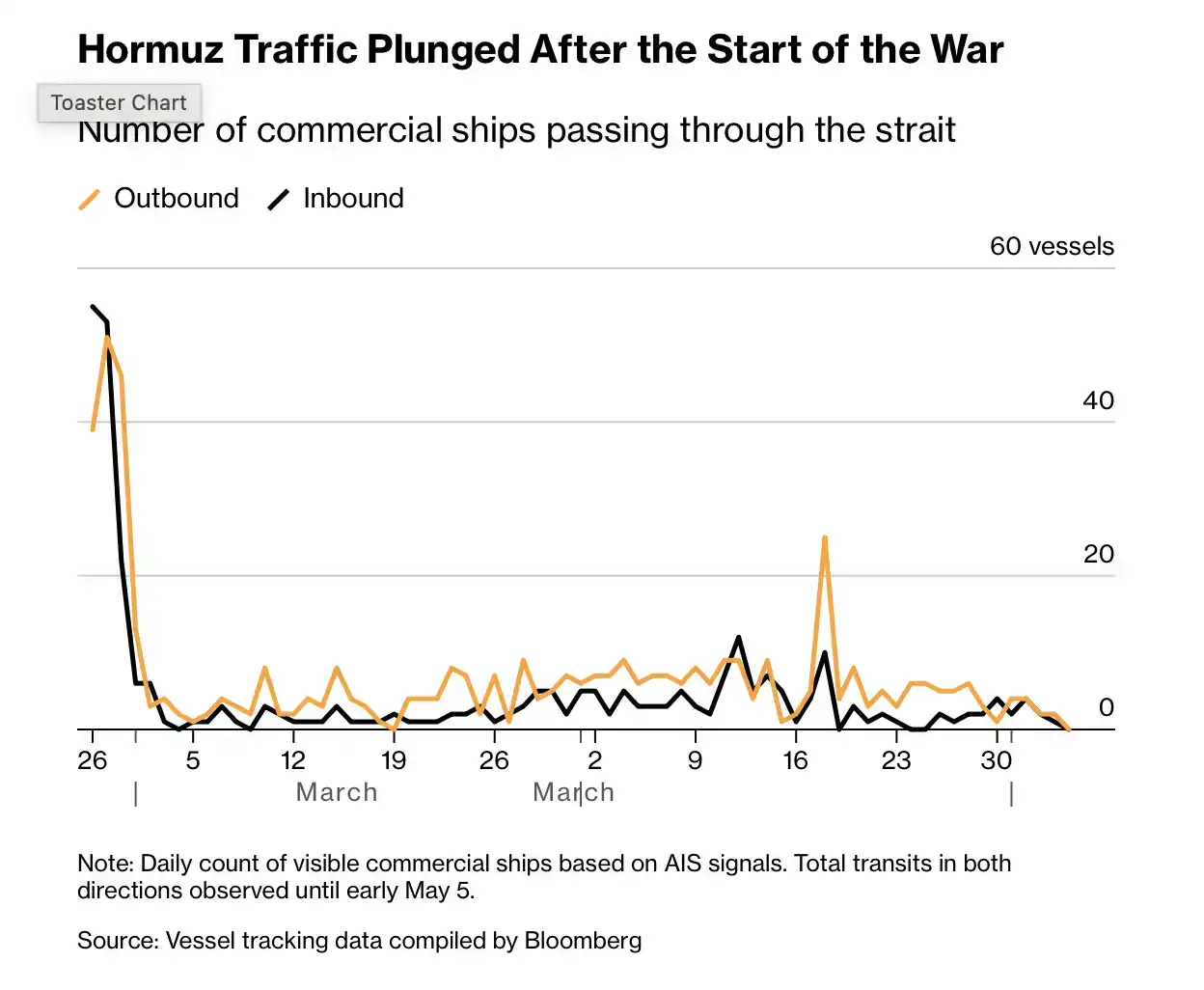
Even after the warring parties agreed to a ceasefire in early April, strait traffic remained nearly stagnant. Starting April 13, the U.S. began imposing a blockade on vessels that had called at Iranian ports or were bound for them, aiming to pressure Iranian oil exports and force the Iranian regime to restore the Strait of Hormuz to a "toll-free zone."

So far, Iran has successfully resisted the blockade pressure. According to Iran's semi-official Tasnim news agency, in early May, Iran even expanded the area over which it claims control in the Strait of Hormuz. As the stalemate persists, the U.S. military states that over 1,500 merchant vessels are now trapped in the Persian Gulf. With crude storage space exhausted, oil producers in the region have been forced to suspend most of their production.

What is needed to reopen the Strait of Hormuz?

Even if a peace agreement is reached, it is unlikely to immediately restore normal navigation through the Strait of Hormuz. Shipowners need assurance that the reopening is lasting and that passage is safe. One issue is the potential threat of mines. Iran has stated it has laid mines along the most commonly used routes within this narrow strait. Sweeping and clearing these explosives could take weeks.

Some vessel operators may be reluctant to sail through the Strait of Hormuz without military escorts. The U.S. Navy does not have enough ships to protect the more than 100 vessels that typically pass through the waterway daily, and the Trump administration has struggled to convince allies to immediately deploy their naval forces. The UK and France are leading consultations to form a multinational coalition to help restore shipping in the Strait of Hormuz once the conflict ceasefire holds.

Even if escort arrangements are finalized, clearing the backlog of vessels on both sides of the strait could take weeks. The narrowness of the Strait of Hormuz limits the number of ships that can be escorted at once and also makes convoyed vessels more vulnerable to attack.

Trump announced that, starting May 4, the U.S. would launch "Project Freedom" to guide neutral vessels out of the Persian Gulf. He did not elaborate on the operation's details, though U.S. Central Command stated it would provide military support, including deploying missile destroyers, aircraft, and drones. Iran labeled this move "Project Deadlock" and accused it of violating the ceasefire.

What does the Iran war mean for the long-term future of the Strait of Hormuz?

Shipowners, insurers, and clients have seen that for Iran, with minimal traditional naval power, rapidly bringing Strait of Hormuz transit to a halt was not difficult; restoring normal operations, however, is proving much harder.

If a U.S.-Iran peace agreement fails to eliminate the threat Iran poses to Hormuz shipping, the economic logic of this critical trade artery could change for years. The most cautious vessel operators may decide that transiting the strait under any circumstance is not worth the risk. Higher insurance premiums could also weaken the competitiveness of Gulf trade compared to other regions.

Iran has signaled its intent to continue exerting control over Strait of Hormuz transit and monetize its influence over this waterway, even after the war ends. Iran's parliament is advancing a bill to enshrine its sovereignty over the strait in domestic law and formally establish a fee system for vessel passage.
Energy Artery Being Repriced

Why is the Strait of Hormuz so important?

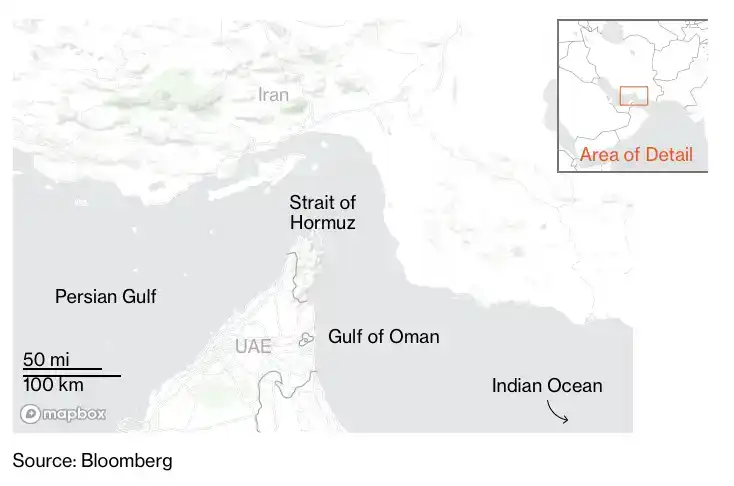
The Strait of Hormuz borders Iran to the north and the UAE and Oman to the south, connecting the Persian Gulf with the Indian Ocean. It stretches about 100 miles (161 km) long and is about 24 miles wide at its narrowest point. The two-way shipping lanes are each just 2 miles wide.

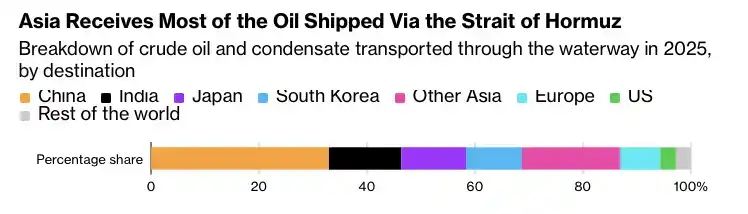
For energy markets, this strait is a vital artery, carrying about one-fifth of the world's oil and liquefied natural gas supply. Under normal circumstances, Saudi Arabia, Iraq, Iran, Kuwait, Bahrain, Qatar, and the UAE all export crude oil via the Strait of Hormuz, with the majority of cargoes destined for Asia.
Gulf countries also have numerous refineries producing significant volumes of diesel, jet fuel, naphtha—used in making plastics and gasoline—and other petroleum products, which are exported via the strait to global markets.

Beyond energy, the Strait of Hormuz is also a chokepoint for transporting products like aluminum, fertilizers, and even helium, which is used in semiconductor manufacturing.

Can oil-producing nations bypass the Strait of Hormuz?

Kuwait, Qatar, and Bahrain have no alternative maritime export routes.

Saudi Arabia, the largest shipper of oil through the Strait of Hormuz, has already diverted some crude via a pipeline extending west to the Red Sea port of Yanbu. Saudi Aramco plans to utilize the pipeline's full capacity of 7 million barrels per day, though only about 5 million barrels per day is available for export, with the remainder for domestic use.

But the Red Sea route is not without risk. Iran has already attacked a refinery in Yanbu and struck a pumping station on the East-West Pipeline; furthermore, the Iran-backed Houthi rebels in Yemen have threatened to resume attacks on vessels in the Red Sea.

The UAE can also bypass the Strait of Hormuz to some extent. However, its alternative capacity is limited, and the port of Fujairah has also been attacked by Iran. This port lies at the end of a pipeline linking UAE oilfields with the Gulf of Oman. Additionally, while Iraq is attempting to resume exports via Jordanian and Syrian ports, the transport volumes under consideration represent only a small fraction of its typical exports via the Strait of Hormuz.

Does Iran have the right to control the Strait of Hormuz?

Under the United Nations Convention on the Law of the Sea (UNCLOS), coastal states can exercise sovereignty over waters extending 12 nautical miles (about 14 miles) from their coastline, an area known as the territorial sea.

The Strait of Hormuz passes through the territorial seas of Iran and Oman. However, states must allow foreign vessels "innocent passage" within their territorial seas and must not hamper "innocent passage" or "transit passage" of foreign vessels through straits used for international navigation. The convention also stipulates that states may not levy charges on foreign vessels merely for passing through their territorial seas.

Although the Iranian government signed UNCLOS in 1982, the Iranian parliament has never ratified the treaty.


Preguntas relacionadas

QWhat is the core change in the geopolitical situation regarding the Strait of Hormuz, according to the article?

AThe core change is that the Strait of Hormuz is being re-priced from a piece of default, usable global infrastructure into a geopolitical lever under Iran's de facto control. It's no longer just a question of physical passage, but of risk and cost.

QAccording to the article, why would normal traffic not resume immediately even after a peace deal between the US and Iran?

ANormal traffic wouldn't resume immediately because the main issue is not just the physical blockade but the shattered market trust in the safety of the passage. Ship operators need assurances of lasting safety, and concerns like uncleared mines, lack of military escort, and high insurance costs would persist.

QHow did the daily traffic through the Strait of Hormuz change after the outbreak of war and during the ceasefire?

AAfter the war outbreak, daily traffic dropped from an average of about 135 vessels in peacetime to less than 10. During the subsequent ceasefire, maritime traffic remained almost at a standstill, with over 1,500 commercial ships reportedly trapped.

QWhat alternative route does Saudi Arabia primarily use to bypass the Strait of Hormuz, and what are its limitations?

ASaudi Arabia primarily reroutes oil through the Petroline pipeline to the Red Sea port of Yanbu. Its limitations include the pipeline's total capacity of 7 million barrels per day, with only about 5 million barrels available for export, and the route's exposure to risks from Iran and Houthi attacks.

QWhat is the legal basis, according to the article, that challenges Iran's right to control or charge fees for passage through the Strait of Hormuz?

AAccording to the United Nations Convention on the Law of the Sea (UNCLOS), which Iran signed in 1982 but never ratified, coastal states must allow 'innocent passage' or 'transit passage' in straits used for international navigation. The convention also states that countries cannot levy charges solely for the passage of foreign ships through their territorial waters.

Lecturas Relacionadas

I've Been a Divorce Lawyer for 26 Years: How Has Cryptocurrency Become a New Tool for the Wealthy to Hide Assets?

Natalie Brunell reports on insights from divorce lawyer James Sexton, who has 26 years of experience. He argues that money itself is not the root of marital breakdown; rather, emotional disconnection is the core issue. While financial hardship increases divorce risk, excessive wealth can also make divorce easier by reducing the incentive to work on the relationship. Sexton discusses financial management in marriages, advocating for transparency and a "yours, mine, and ours" system that balances shared finances with individual autonomy and privacy. He notes the growing normalization of prenuptial agreements, especially among younger generations. A significant portion focuses on cryptocurrency's role in divorce. Sexton explains that crypto became a new tool for hiding assets due to its early anonymity and complexity. He highlights that many lawyers and spouses lack understanding, allowing knowledgeable parties to gain advantages. He cites a New York legal form that only added a specific crypto disclosure field in 2026. On saving relationships, Sexton emphasizes small, consistent acts of reconnection, affirmation, and expressing appreciation, which he finds more effective than criticism. He concludes that fostering warmth and kindness is a simple yet powerful way to strengthen bonds and, in his words, "put divorce lawyers out of business."

marsbitHace 34 min(s)

I've Been a Divorce Lawyer for 26 Years: How Has Cryptocurrency Become a New Tool for the Wealthy to Hide Assets?

marsbitHace 34 min(s)

Turing Award Laureate Sutton's New Work: Using a Formula from 1967 to Solve a Major Flaw in Streaming Reinforcement Learning

New research titled "Intentional Updates for Streaming Reinforcement Learning" (arXiv:2604.19033v1), involving Turing Award laureate Richard Sutton, addresses a core challenge in deep reinforcement learning (RL): the "stream barrier." Current deep RL methods typically rely on replay buffers and batch training for stability, failing catastrophically when learning online from single data points (streaming). The authors propose a fundamental shift: instead of prescribing how far to move parameters (a fixed step size), their "Intentional Updates" method specifies the desired change in the function's output (e.g., a 5% reduction in value prediction error). It then calculates the step size needed to achieve that intent. This idea is inspired by the Normalized Least Mean Squares (NLMS) algorithm from 1967. Applied to value and policy learning, this yields algorithms like Intentional TD(λ) and Intentional AC. The method inherently stabilizes learning by adapting the step size based on the local gradient landscape, preventing overshooting/undershooting. In experiments on MuJoCo continuous control and Atari discrete tasks, Intentional AC achieved performance rivaling batch-based algorithms like SAC in a streaming setting (batch size=1, no replay buffer), while being ~140x more computationally efficient per update. The work demonstrates significant robustness, reducing reliance on numerous stabilization tricks. A remaining challenge is bias in policy updates due to action-dependent step sizes. Overall, this approach advances efficient, online, "learn-as-you-go" RL, enabling adaptive systems without massive data buffers or compute clusters.

marsbitHace 42 min(s)

Turing Award Laureate Sutton's New Work: Using a Formula from 1967 to Solve a Major Flaw in Streaming Reinforcement Learning

marsbitHace 42 min(s)

From KYC to KYA, Is It Time to Give AI Agents Their Own 'ID Cards'?

Titled "From KYC to KYA: Is It Time to Issue 'Identity Cards' for AI Agents?", this article discusses the emerging concept of Know Your Agent (KYA) as AI agents become increasingly autonomous. In Agent-to-Agent (A2A) scenarios, where agents execute contracts, payments, and trades without human intervention, the lack of a shared identity standard creates risks like unauthorized transactions, fraud, and accountability gaps. KYA acts as a trust layer to verify an agent's origin, authority, and accountability. The need for KYA is most critical outside centralized platforms (like Google or Coinbase), such as in decentralized exchanges (DEX), A2A payments, and merchant payments. Several key players are building KYA infrastructure: - **ERC-8004**: A proposed Ethereum standard that issues a unique AgentID as an NFT, building on-chain identity, reputation, and validation systems. - **Visa TAP**: Visa's solution issues agent identity credentials, with transactions verified via triple signatures (legitimacy, delegator, payment method). - **Trulioo**: Extends its KYC/KYB compliance infrastructure using a Digital Passport for Agents (DAP), issued after verifying both the developer and user, and refreshed per transaction. - **Sumsub**: Focuses on post-issuance real-time verification, detecting agent anomalies during transactions using its existing compliance systems. Regulatory bodies are also acting. The EU AI Act mandates operator identification in logs for high-risk AI systems, the US NIST prioritizes agent identity management standards, and Singapore has released a national AI governance framework. Similar to how the 2019 FATF Travel Rule impacted crypto exchanges, possessing KYA infrastructure may determine market entry in the AI agent era. The market is expected to segment rather than produce a single winner, with success depending on integrations with merchants, payment networks, and KYC client bases.

marsbitHace 1 hora(s)

From KYC to KYA, Is It Time to Give AI Agents Their Own 'ID Cards'?

marsbitHace 1 hora(s)

The Next Generation of Payments Lies Not in the Payment Layer

The Next-Generation of Payment is Not in the Payment Layer This is the second piece in a series analyzing Stripe's AI strategy. The series stems from Stripe's vision of becoming the economic infrastructure for the AI Agent era, announced at Stripe Sessions 2026. A key debate centers on whether Know Your Agent (KYA) is merely an upgrade to existing payment systems. The author argues the opposite: payment will become a subsystem of KYA, not the other way around. Historically, major payment innovations (online banking, mobile wallets, QR codes) emerged from new transaction scenarios that broke the underlying assumptions of old systems, not from optimization within the payment layer itself. Agent economy is that new scenario, and KYA is the foundational infrastructure growing to support it. KYA's proposed five layers—Agent Identity, Authorization Scope, Intent Signing, Liability Chain Auditing, and Credit Rating—extend far beyond payments. Only authorization and auditing directly touch the payment链路. Identity, intent, and credit layers serve broader needs like cross-platform calls, AI alignment, and permission management. Stripe's strategic moves validate this view. Its focus on "economic infrastructure for AI," investments in protocols like Agentic Commerce Protocol (an identity/session protocol), Shared Payment Tokens, stablecoin infrastructure, embedded wallets, and its own Tempo blockchain for settlement, all point to building the KYA layer, not just optimizing payments. Data shows the core challenge in AI commerce has shifted upstream: determining "who this is, what they intend to do, and if they deserve resources" happens long before checkout. This is why Stripe is moving its Radar fraud prevention from the transaction moment to the entire user lifecycle—a KYA-layer concern. Legally, ultimate responsibility will still fall on a human, as laws like AB 316 dictate. However, in a distributed,网状 liability chain involving users, Agent platforms, model providers, and payment protocols, KYA's role is to use cryptography to make every entity's actions and roles verifiable and traceable. This enables accountability where it was previously impossible to pinpoint evidence, fundamentally changing责任追溯, not just payment efficiency. The next-generation payment形态 will not be designed within the payment layer. It will emerge from the Agent economy scenario after the KYA infrastructure is established.

marsbitHace 3 hora(s)

The Next Generation of Payments Lies Not in the Payment Layer

marsbitHace 3 hora(s)

Trading

Spot
Futuros

Artículos destacados

Cómo comprar GAS

¡Bienvenido a HTX.com! Hemos hecho que comprar GAS (GAS) sea simple y conveniente. Sigue nuestra guía paso a paso para iniciar tu viaje de criptos.Paso 1: crea tu cuenta HTXUtiliza tu correo electrónico o número de teléfono para registrarte y obtener una cuenta gratuita en HTX. Experimenta un proceso de registro sin complicaciones y desbloquea todas las funciones.Obtener mi cuentaPaso 2: ve a Comprar cripto y elige tu método de pagoTarjeta de crédito/débito: usa tu Visa o Mastercard para comprar GAS (GAS) al instante.Saldo: utiliza fondos del saldo de tu cuenta HTX para tradear sin problemas.Terceros: hemos agregado métodos de pago populares como Google Pay y Apple Pay para mejorar la comodidad.P2P: tradear directamente con otros usuarios en HTX.Over-the-Counter (OTC): ofrecemos servicios personalizados y tipos de cambio competitivos para los traders.Paso 3: guarda tu GAS (GAS)Después de comprar tu GAS (GAS), guárdalo en tu cuenta HTX. Alternativamente, puedes enviarlo a otro lugar mediante transferencia blockchain o utilizarlo para tradear otras criptomonedas.Paso 4: tradear GAS (GAS)Tradear fácilmente con GAS (GAS) en HTX's mercado spot. Simplemente accede a tu cuenta, selecciona tu par de trading, ejecuta tus trades y monitorea en tiempo real. Ofrecemos una experiencia fácil de usar tanto para principiantes como para traders experimentados.

293 Vistas totalesPublicado en 2024.12.12Actualizado en 2025.03.21

Cómo comprar GAS

Discusiones

Bienvenido a la comunidad de HTX. Aquí puedes mantenerte informado sobre los últimos desarrollos de la plataforma y acceder a análisis profesionales del mercado. A continuación se presentan las opiniones de los usuarios sobre el precio de GAS (GAS).

活动图片