Has the Cryptocurrency Market Hit Bottom? Here's What Institutions Think

Foresight NewsPublicado a 2026-06-16Actualizado a 2026-06-16

Resumen

"Has the crypto market bottomed out? Major institutions are divided on the outlook, according to a recent analysis by Matt Hougan, Chief Investment Officer of Bitwise. Three prominent research firms published in-depth reports on the topic with differing conclusions. Galaxy Digital argues Bitcoin has not yet found its bottom, pointing to only 4 out of 13 historical bottoming indicators being met. Their analysis suggests a potential bottom range of $30,000 to $54,000. NYDIG adopts a more cautious stance, noting that while metrics are close to historical bear market lows, a classic panic-selling capitulation event is missing. They acknowledge the possibility of a bottom but consider it unlikely, citing structural changes from institutional adoption. In contrast, Standard Chartered Bank asserts the bottom is already in at around $59,000. Their revised bullish view, predicting a year-end target of $100,000, hinges on anticipated reductions in ETF selling pressure linked to events like a potential SpaceX IPO. Despite the surface-level disagreement on the exact price floor, the reports share significant common ground crucial for long-term investors. All three institutions agree that a market bottom will likely form within the current year, that current prices are closer to the bottom than to previous cycle highs, and that Bitcoin is poised for another major bull cycle in the future. The core takeaway is that while the precise bottom level remains debated, the long-term value prop...


Authored by: Matt Hougan, Chief Investment Officer, Bitwise

Compiled by: Chopper, Foresight News


Over the past two weeks, three cryptocurrency research firms I have long followed—other than Bitwise—have published in-depth reports addressing the same issue: Has the cryptocurrency market reached its bottom?


  • Galaxy Digital: Bitcoin has not bottomed yet; data points to a potential bottoming zone.
  • NYDIG: What factors are currently suppressing Bitcoin's price performance?
  • Standard Chartered: The market bottom has already occurred.


The three reports are detailed, containing a wealth of data and complete logical reasoning, and are worth reading in full. However, if you're looking for a simple, unified answer, you might be disappointed: the judgments given by these three authoritative institutions are completely different.


Has the Market Bottomed?


  • Galaxy Digital: No
  • NYDIG: Possibly, but not very likely
  • Standard Chartered: Yes


Below, we break down the core logic of each institution one by one.


Three Institutions, Three Views


Galaxy Digital


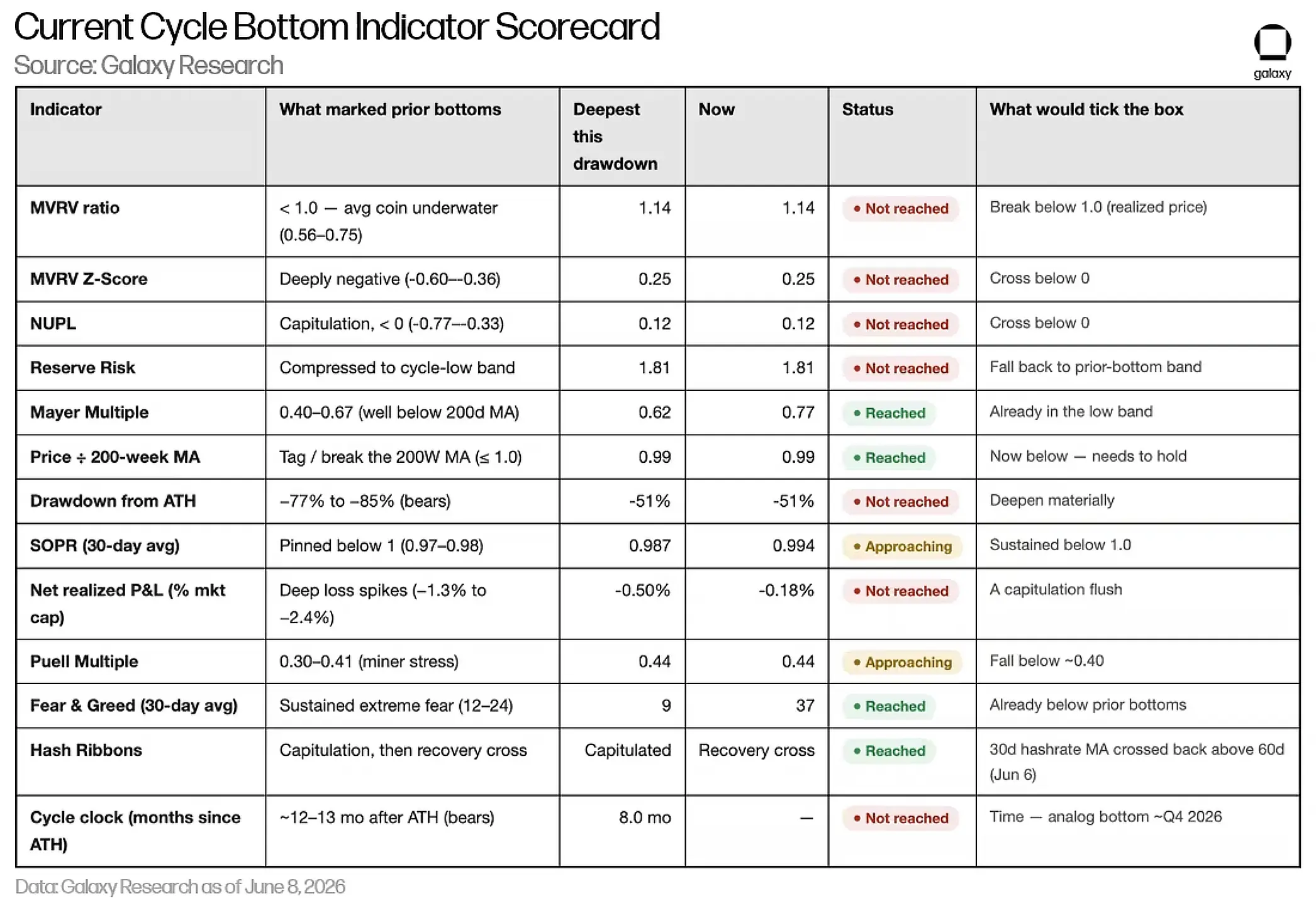
Galaxy Digital reviewed Bitcoin's full 17-year price history and summarized 13 indicators that typically appear simultaneously when the market truly bottoms out. These cover six dimensions: valuation, profit-taking, miner pressure, price trends, bull/bear cycles, and market sentiment. Long-term Bitcoin investors are familiar with these indicators, including the 200-week moving average, Fear & Greed Index, Mayer Multiple, etc.


Galaxy found that currently only 4 indicators fully meet the criteria, 2 are partially met, and the remaining 7 have not triggered a bottom signal. The report concludes that the bottom range for this Bitcoin cycle is between $30,000 and $54,000, with a neutral baseline bottom of $40,000 to $46,000.


NYDIG


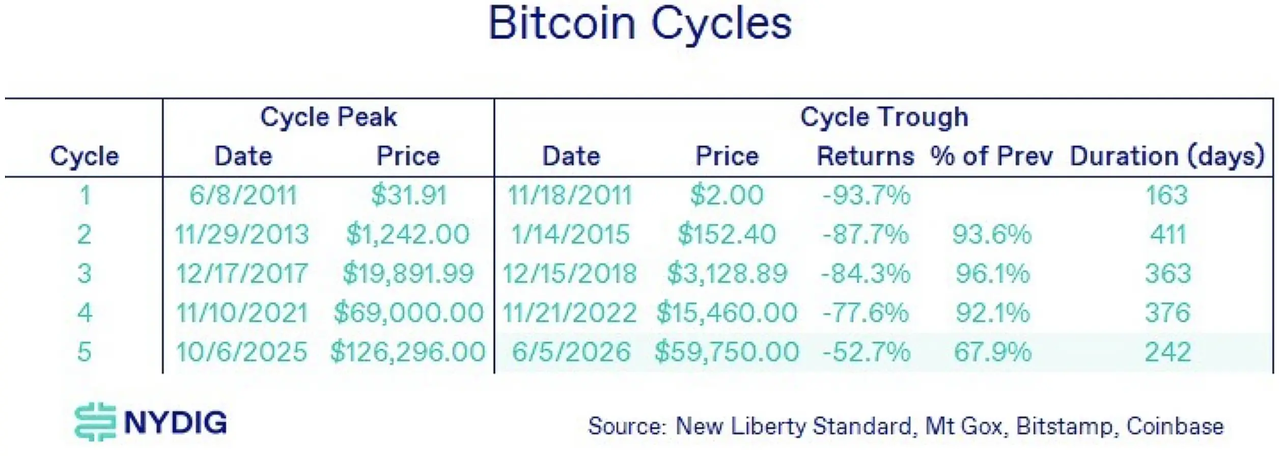
NYDIG also adopts a multi-indicator comprehensive analysis framework, comparing the current market with historical cycles, assessing the market status from dimensions such as the duration of maximum drawdown and holder profit/loss (what Bitcoin users call 'MVRV,' or the market value to realized value ratio).


NYDIG believes that current indicators are very close to the extreme ranges of historical major bottoms, but the hallmark widespread panic selling seen in past major bear markets has not yet occurred. However, the report introduces a variable: the entry of institutional funds has fundamentally changed Bitcoin's cycle logic. The magnitude of this correction might be smaller than in historical bear markets. From this perspective, the bottom might also have already appeared.


Standard Chartered


Standard Chartered is not unwaveringly bullish on Bitcoin. Back in February when Bitcoin was at $67,000, the bank lowered its full-year price forecast, warning that the price could fall to $50,000, citing a weaker macroeconomic environment and sustained selling pressure from Bitcoin ETFs.


But last Friday, Standard Chartered updated its view, identifying $59,000 as the bottom of this cycle. The two main logics supporting this view are: a potential diplomatic agreement between the US and Iran, and the highly anticipated upcoming SpaceX IPO. Standard Chartered believes that the substantial selling by ETF holders was to raise funds for participating in the SpaceX listing, and this selling pressure will gradually subside. Standard Chartered's latest forecast is that Bitcoin will challenge $100,000 within the year.


Consensus Far Outweighs Differences in the Three Reports


You might wonder, what useful information can be extracted from three reports with seemingly opposing views? In fact, the underlying consensus in these three reports far outweighs the surface differences. For long-term investors, the conclusions they agree on are far more valuable than their disagreements:


  • All three judge that the market bottom for this cycle will occur within this year.
  • All three believe the current price is closer to the bottom than to the previous high.
  • All three unanimously remain bullish, expecting Bitcoin to usher in a new bull market in the future.


At the time of writing this article, Bitcoin is trading around $67,000. One report claims the bottom at $59,000 has already occurred, one sees a potential drop to $50,000, and another a neutral baseline bottom of $43,000. But the core conclusion is highly unified: a bottom will definitely be reached within the year.


This is the key point long-term investors should focus on. Whether the bottom is at $40,000, $50,000, or $60,000, the difference is actually limited. What truly matters is whether Bitcoin can subsequently surge to $100,000, $200,000, or even $1 million. As long as it reaches those levels, entering and holding long-term at the current price offers considerable upside potential.


A rather ironic phenomenon in the current market is that everyone is obsessing over whether the market has bottomed, while overlooking a more important question—has the top already appeared? In my view, as long as the peak has not arrived, Bitcoin retains its long-term allocation value.


The core logic supporting Bitcoin's long-term value has not only persisted but continues to strengthen: government debt continues to accumulate worldwide with no effective resolution in sight; inflation constantly erodes the real purchasing power of wealth; public trust in centralized institutions like governments and banks continues to decline; the global digitalization process keeps accelerating; Bitcoin's trading and investment channels are constantly improving; and the early crypto-native demographic is aging, with their assets and industry influence growing simultaneously.


Of course, potential risks remain in the market, including threats from quantum computing and tightening global regulation. However, on balance, the current situation looks better than in any previous crypto winter.


Preguntas relacionadas

QWhat are the three major research institutions mentioned in the article and their respective views on whether the crypto market has bottomed?

AThe three institutions are Galaxy Digital, NYDIG, and Standard Chartered. Their views are: Galaxy Digital believes the market has not bottomed yet. NYDIG considers it possible but unlikely that the bottom has been reached. Standard Chartered asserts that the bottom has already appeared at $59,000.

QAccording to Galaxy Digital, how many out of its 13 identified bottoming indicators are currently signaling a market bottom?

AAccording to Galaxy Digital's analysis, only 4 of the 13 indicators are fully met, 2 are partially met, and 7 have not yet signaled a bottom.

QWhat is the core consensus shared by the three research reports despite their differing views on the exact bottom price?

AThe core consensus is threefold: 1) The market bottom will occur within this year. 2) The current price is closer to the bottom than to the previous all-time high. 3) All three institutions are optimistic that Bitcoin will experience a new bull market in the future.

QWhat two specific reasons did Standard Chartered give for revising its view and declaring that the market bottomed at $59,000?

AStandard Chartered based its revised view on two primary reasons: 1) A potential diplomatic agreement between the US and Iran. 2) The upcoming, highly anticipated SpaceX IPO, which they believe led to ETF selling pressure as investors raised funds to participate, and this pressure is expected to subside.

QWhat does Matt Hougan, the author and Bitwise CIO, suggest is a more important question for long-term investors than whether the market has bottomed?

AMatt Hougan suggests that a more important question for long-term investors is whether the market top has already appeared. He argues that as long as the peak has not been reached, Bitcoin retains its value as a long-term investment.

Lecturas Relacionadas

Standard Chartered Bank Places a 40x 'Bet', Calls for UNI to Rise to $100

Standard Chartered Bank’s digital asset research head, Geoff Kendrick, initiated coverage on Uniswap with a highly bullish long-term price target of $100 for its UNI token by 2030—a roughly 40-fold increase from its ~$2.60 trading price at the time of the report. The bank’s thesis hinges on the exponential growth of tokenized real-world assets (RWA), projected to surge from ~$340 billion to $4 trillion by 2028. It expects the share of these assets deployed in DeFi to rise from 3.5% to 30%, driving total DeFi TVL to around $2.7 trillion. As the leading decentralized exchange (DEX), Uniswap is positioned to capture a significant portion of this liquidity influx. A key catalyst is Uniswap’s “fee switch,” activated in late 2024, which directs a portion of protocol fees to UNI token buybacks and burns. This transforms UNI from a pure governance token into a yield-generating, deflationary asset, narrowing its valuation gap with centralized exchanges like Coinbase. The report draws an analogy: Coinbase operates like Netflix (centralized, high-cost), while Uniswap functions like YouTube (open, user-generated, network-effect driven). Despite its dominant market share and recent institutional adoption—such as BlackRock’s BUIDL fund and Fidelity’s stablecoin using Uniswap for liquidity—the path faces challenges. Competition from Solana-based DEXs and aggregators threatens user mindshare, while regulatory delays or setbacks in RWA adoption could slow the projected growth. Furthermore, UNI remains down over 92% from its 2021 peak, reflecting persistent market skepticism. Ultimately, Standard Chartered’s report signals a shift in traditional finance’s perception of DeFi, valuing network effects and cash flow potential. However, realizing the $100 target depends on Uniswap successfully navigating intense competition, regulatory hurdles, and the multi-year timeline for massive tokenized asset adoption.

marsbitHace 8 min(s)

Standard Chartered Bank Places a 40x 'Bet', Calls for UNI to Rise to $100

marsbitHace 8 min(s)

For Those Still Obsessed with Altcoins, Just Go All-in on HOOD

Title: "For Those Still Fixated on Altcoins, Just Bet on HOOD" The article argues that Robinhood (HOOD) stock is a compelling alternative for investors still holding onto hopes for altcoin rallies. It highlights HOOD's recent strong performance, briefly touching $100, and expresses continued optimism. The bullish thesis is multi-faceted: HOOD's operational data for May showed record highs in key metrics like total assets and funded customers, though crypto volume was weaker. Positive catalysts include Robinhood launching its own prediction market (Rothera) to capture more revenue, gaining approval to act as an IPO underwriter for major upcoming listings, and being selected to manage the new "Trump Account" government savings program for millions of future US newborns. Insider and institutional buying, along with raised price targets, provide further confidence. The core argument is that HOOD is successfully decoupling from the crypto market's fortunes. While crypto-related revenue was once a major contributor, its share of total revenue has been declining, hitting 13% in Q1 2026. Although HOOD's price historically moved with Bitcoin, a recent divergence is noted. The author posits that Robinhood's growing equity trading, prediction markets, and IPO-related businesses can drive growth independently of a crypto bull market. Thus, HOOD offers asymmetric exposure: it stands to benefit if the crypto market recovers but is no longer wholly dependent on it. For those disillusioned with altcoins' risks, HOOD presents a potentially safer way to maintain exposure to the fintech and speculative trading space.

marsbitHace 17 min(s)

For Those Still Obsessed with Altcoins, Just Go All-in on HOOD

marsbitHace 17 min(s)

For Those Still Obsessed with Altcoins, Just Buy HOOD

The author expresses bullish sentiment on Robinhood (HOOD) stock, citing multiple positive catalysts. Recent monthly operational data shows record highs in key metrics like total assets, funded customers, and margin balances. On the news front, Robinhood launched its own prediction market (Rothera), received approval to act as an IPO underwriter, and was selected to manage the new "Trump Accounts" for U.S. newborns, ensuring a long-term user base. Insiders and institutions are also buying or raising price targets. The core investment thesis, however, focuses on HOOD's evolving valuation narrative. Historically viewed as a "crypto proxy," its stock price was highly correlated with Bitcoin and its revenue heavily dependent on cryptocurrency trading fees. Recent data indicates this dependence is waning: crypto-related revenue hit a multi-quarter low of 13% of total revenue in Q1 2026, and the stock price has recently decoupled from BTC's trend. The author argues HOOD is transforming into a more diversified platform. Its growth is now driven by equities, options, prediction markets, and IPO-related services. This reduces its cyclical vulnerability to crypto bear markets. Crucially, if the crypto market recovers, HOOD would still benefit from increased trading activity. Therefore, for investors still hoping for gains from altcoins but concerned about their risks and liquidity, the author suggests HOOD offers a compelling alternative with higher safety margins—it can rise with a crypto bull run but isn't reliant on one.

Odaily星球日报Hace 21 min(s)

For Those Still Obsessed with Altcoins, Just Buy HOOD

Odaily星球日报Hace 21 min(s)

Cryptocurrency & Stock Market Indicator丨SpaceX Discloses Holding 18,712 Bitcoins Worth $1.18 Billion; Strategy Spends $100 Million Two Weeks in a Row to Scoop Up BTC at Low Levels (June 16)

"Coin-Stock Barometer: SpaceX discloses holding 18,712 Bitcoin worth $1.18B; Strategy spends another $100M accumulating BTC (June 16) SpaceX has officially disclosed holding 18,712 Bitcoin in its S-1 filing, valued at ~$1.18B, becoming the 8th largest public company Bitcoin holder. Its average cost is ~$35,000 per BTC. In weekly BTC treasury news, Strategy (formerly MicroStrategy) purchased another 1,587 BTC (~$100M) last week, increasing its total to 846,842 BTC. Mara Holdings added 1,000 BTC. However, Metaplanet and others made no purchases. Nakamoto sold ~600 BTC to repay ~$45M in debt. Global public companies (excluding miners) now hold 1,121,341 BTC. In other crypto treasury developments: - Metaplanet acquired Siiibo Securities to build a Bitcoin-focused financial ecosystem in Japan. - Bitmine increased its ETH holdings by 76,881 last week. - SharpLink's cumulative ETH staking rewards surpassed 21,119 ETH. - Forward Industries' acquisition offers for two SOL treasury companies, including Brera Holdings (holding 2.1M SOL), were rejected. - Tron Inc.'s TRX holdings surpassed 700 million. - Avalanche Treasury Co. (AVAT) begins trading on Nasdaq. - AIFC detailed plans to use WLFI tokens for collateral/loans. Market perspectives on U.S. stocks vary. 'White-Haired Stock God' Serenity sees the current cycle as retail-to-institution transfers, where negative reports may signal institutional accumulation. Morgan Stanley suggests a rotation from tech to cyclical stocks could occur. Citrini believes the U.S. stock market hasn't peaked but expects frequent 10-15% pullbacks in the coming months."

marsbitHace 27 min(s)

Cryptocurrency & Stock Market Indicator丨SpaceX Discloses Holding 18,712 Bitcoins Worth $1.18 Billion; Strategy Spends $100 Million Two Weeks in a Row to Scoop Up BTC at Low Levels (June 16)

marsbitHace 27 min(s)

Trading

Spot
Futuros
活动图片